
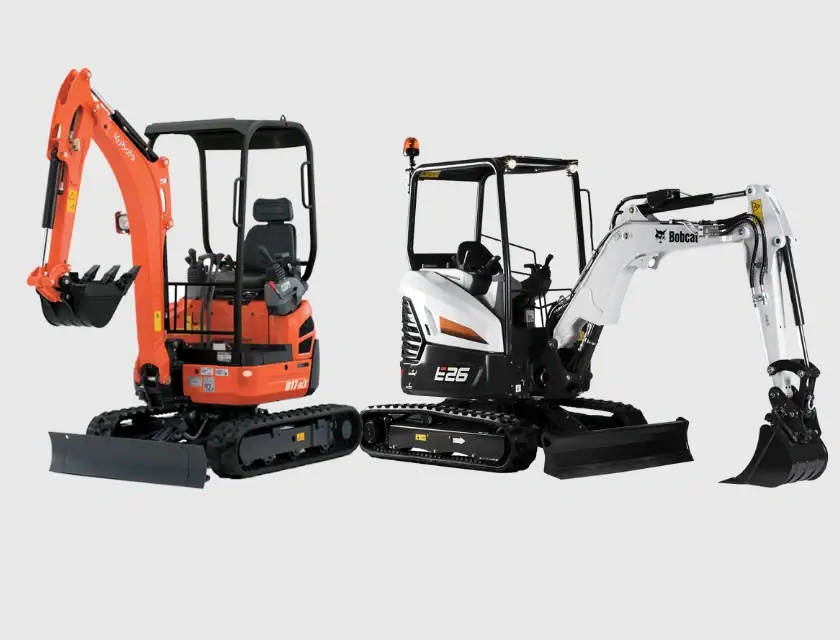

Bobcat vs Kubota vs John Deere Compact Excavators: The Complete Comparison (Canada)
Introduction
For a Saskatchewan farmer running tile drainage, an Alberta acreage owner digging footings, or a prairie contractor working tight residential lots, three names dominate the compact excavator decision: Bobcat, Kubota, and John Deere. All three build capable, reliable machines across the full 1-to-8-tonne range, all three have strong prairie dealer networks, and all three will do the work. So the real question isn’t which brand is “best” — none is universally better — but which is the right fit for your specific ground, your loads, and how you like to work.
This guide compares the three brands honestly, the way an experienced operator who’s run all of them would. We’ll start with each brand’s design philosophy — because they genuinely differ in how they approach tail swing, engines, and hydraulics — then work through head-to-head comparisons at each size class, matching real competing models. We’ll cover the specification traps that make naive comparisons misleading, and finish with clear recommendations by use case and full comparison tables. Throughout, we link to detailed specs and reviews for every model so you can dig deeper.
The short version: Kubota leads on sales and its own reliable engines; Bobcat counters with an in-track swing frame and no-DPF engines across the line; John Deere builds reduced or zero tail swing into nearly every machine and offers no-DPF engines on most. But the details matter, and they differ by size class. Let’s work through them.
The Most Important Concept: Tail Swing (and How Each Brand Approaches It)
Before comparing models, understand tail swing — it’s the single most important design choice on any compact excavator, and the three brands approach it differently.
Tail swing describes how far the rear of the machine — the counterweight and engine housing — extends past the tracks when the upper structure rotates. Less overhang means you can work flush against walls, fences, and buildings; more overhang means better lifting stability but more caution near obstacles. The categories run from zero tail swing (rear stays within the tracks) through reduced and minimal (small overhang) to conventional (counterweight swings well past the tracks).
Here’s how each brand approaches it — and this is central to choosing:
Kubota splits its lineup into two series by tail swing. The U-Series uses zero, tight, or reduced tail swing for confined work; the KX-Series uses conventional tail swing for open work with maximum stability and value. Kubota makes you choose — which is powerful if you know your work: a zero-tail-swing U35-4 for tight quarters, or a conventional KX033-4 for open-field stability and lower cost.
John Deere makes the choice for you. Nearly every John Deere compact machine is built with reduced or zero tail swing by design — the 17 and 26 use reduced tail swing, and the 35 and up are zero tail swing. Even the flagship 60keeps a reduced tail swing rather than going conventional. If you want simplicity and close-quarters capability by default, Deere delivers it.
Bobcat offers a range and adds a unique frame feature. Bobcat spans zero, reduced, minimal, and conventional across its lineup — but its standout is the in-track swing frame on many models, where the swing castings and cylinders stay within the tracks even when digging in an offset position. On a zero-tail-swing Bobcat like the E35, this means you can turn right up against a wall without any part of the machine bumping it — an edge many competitors can’t match even at the same tail-swing rating.
The takeaway: if you value tight-quarters access, all three serve you, but Deere makes it standard, Kubota’s U-Series is purpose-built for it, and Bobcat’s in-track frame does it best. If you want maximum open-field lifting stability at lower cost, Kubota’s KX-Series is the clearest choice; Bobcat offers conventional models too, while Deere stays reduced/zero throughout.
Specification Traps That Make Comparisons Misleading
Before the head-to-heads, three traps that trip up naive brand comparisons — knowing these lets you compare honestly.
Model numbers aren’t standardized the same way. All three roughly use “number ≈ operating weight,” but the details differ: Kubota’s number is tonnes × 10 (a U35 ≈ 3.5 t), John Deere’s is similar (a 35 ≈ 3.6 t), and Bobcat’s E-numbers roughly track too (an E35 ≈ 3.5 t) — but a Bobcat E35, Kubota U35-4, and John Deere 35 aren’t identical in weight or spec, just the same class. Always compare actual operating weights and dig depths, not just the numbers.
Naming changes create used-market confusion. Bobcat renamed models in 2023 (the E42 became the E48, the E50 became the E55). John Deere is transitioning from “G-Series” to “P-Tier” (a 35G is now the 35 P-Tier — same machine). Kubota uses generation suffixes (-4, -5). A used “35G,” “E42,” or older-suffix Kubota is the same machine under a current name — don’t let it confuse your comparison.
Tail swing terminology varies by brand. “Zero,” “reduced,” “minimal,” “tight,” and “conventional” aren’t used identically across brands. Kubota’s “tight tail” (U48-5) and Bobcat’s “minimal” (E55) describe similar small overhangs; always look at the actual design and, where available, the tail-swing radius, rather than the marketing label alone.
Head-to-Head by Size Class
Now the comparisons that matter — matching real competing models at each size. We’ll focus on the classes where all three brands compete directly.
Sub-2 Tonne (Micro): Tight Access
At the smallest end, all three offer retractable-undercarriage machines for doorway and gate access. Bobcat’s E17 (zero tail swing) and E20 (zero, with strong next-gen digging force), Kubota’s U17-5 (zero tail swing, new for 2025, factory thumb-ready) and conventional KX018-4, and John Deere’s 17 P-Tier (reduced tail swing, retractable) all compete here. For the tightest work, the zero-tail-swing options (E17, E20, U17-5) edge the reduced Deere; the Kubota U17-5’s factory thumb bracket makes it the most attachment-ready out of the box. Below these, Bobcat’s E08 and E10 and Kubota’s K008-5 serve the sub-1-tonne ultra-compact niche.
2.5 to 3 Tonne: Versatile Light Work
Bobcat’s E26 (minimal tail swing, no-DPF) and E32 (conventional), Kubota’s top-selling U27-4 (tight tail swing, class-leading cab), and John Deere’s 26 P-Tier and 30 P-Tier (reduced tail swing) compete here. Kubota’s U27-4 is a perennial best-seller for good reason — strong digging with the largest, most comfortable cab in the class. Bobcat’s E26 offers no-DPF simplicity; the Deere 30 fills the 3-tonne gap nicely with more force than the 26. For tight-quarters versatility, the U27-4 and Deere machines lead; for the E32’s conventional stability, you trade some tight-access capability.
3.5 Tonne: The Big One — E35 vs U35-4 vs 35 P-Tier
This is the most-searched, most-important comparison in the compact excavator world — the 3.5-tonne, zero-tail-swing class where all three brands field their most popular machines. Get this one right and you understand the whole brand comparison.
All three — the Bobcat E35, Kubota U35-4, and John Deere 35 P-Tier — are zero-tail-swing machines around 3.5-3.6 tonnes with roughly 10 feet of dig depth. They’re genuinely close competitors, and the choice comes down to specifics:
- Bobcat E35 — its standout is the clamp-ready extendable arm (the only one in the class), pushing dig depth to nearly 13 feet on demand, plus the in-track swing frame for the tightest work and a no-DPF engine. Best for buyers who want maximum reach flexibility and tight-quarters capability.
- Kubota U35-4 — Kubota’s sales-leading reliability, its own engine, a deluxe cab, and an optional angle blade. Best for buyers prioritizing proven reliability and cab comfort. (Note Kubota also offers the conventional KX033-4 in this class — the open-work, better-value alternative to the zero-tail-swing U35-4.)
- John Deere 35 P-Tier — Deere’s no-DPF Yanmar engine, strong dealer network and support, in-base connectivity, and a 2-year/2,000-hour warranty. Best for buyers who value Deere’s support and simplicity. (One note: the 35’s open-center hydraulics can stall under heavy multi-function attachment work — see the hydraulics section below.)
There’s no wrong answer here — all three are excellent. The decision genuinely comes down to dealer support in your area, whether you want the Bobcat’s extendable arm, and price. This is the class where cross-shopping pays off most.
4 Tonne: More Muscle
Bobcat’s E40 (reduced tail swing, 40 hp, best-in-class lift) and E48 (conventional), Kubota’s benchmark KX040-5(conventional, the most popular 4-tonne machine in the class, 6-in-1 blade) and U48-5 (tight tail with conventional power), compete here. The Kubota KX040-5 is a class benchmark — powerful, towable by a one-ton truck, with a versatile 6-in-1 blade. Bobcat’s E40 counters with reduced tail swing and best-in-class lift; the U48-5 uniquely offers conventional-class power in a tight-tail body. John Deere bridges this range between the 35 and 50.
5 Tonne: Serious Digging
Bobcat’s E55 (minimal tail swing, in-track frame) and E60 (conventional, 55 hp), Kubota’s U55-5 (reduced tail swing, most powerful U-Series) and KX057-5 (conventional, load-sensing hydraulics), and John Deere’s 50 P-Tier (zero tail swing, closed-center hydraulics) compete here. This is where hydraulics diverge meaningfully: the Deere 50 and Kubota KX057-5 use closed-center/load-sensing systems for smooth multi-function attachment work, a real advantage over open-center machines. The Deere 50’s zero tail swing is the tightest-working option at this size; the Kubota KX057-5 offers the deepest dig (12’9″). All are a big step up from the 3.5-tonne class in stability and breakout.
6 to 8 Tonne: The Flagships
At the top, Bobcat’s E88 (8-tonne, conventional + in-track frame, class-leading 10,020 lb lift), Kubota’s KX080-5 (8.4-tonne, tight tail design, 66.6 hp), and John Deere’s 60 P-Tier (6.1-tonne, reduced tail swing, 53 hp) top their lineups. Note the size difference: Bobcat and Kubota field true 8-tonne flagships, while Deere’s largest compact is 6.1 tonnes — if you need maximum compact capability, the E88 and KX080-5 are bigger machines. The Bobcat E88 leads on lift capacity; the Kubota KX080-5 on horsepower and a surprisingly tight tail for its size; the Deere 60 on reduced-tail-swing maneuverability in a slightly smaller package. All three use DPF engines at this size (unlike the smaller no-DPF machines).
The Engine & Emissions Comparison: A Real Differentiator
Engines are where the brands genuinely differ, and it affects maintenance and uptime.
Bobcat meets Tier 4 emissions without a diesel particulate filter (DPF) on most models — its ultra-low particulate combustion (ULPC) design avoids the regeneration cycles and DPF maintenance that interrupt work. This is a consistent Bobcat advantage across the compact line (the largest machines aside).
John Deere similarly uses naturally aspirated Yanmar engines with no aftertreatment (no DPF) on most models — the 17 through 50 avoid a DPF, with only the flagship 60 using one. Deere and Bobcat are closely matched on this no-DPF advantage.
Kubota builds its own engines — a genuine reliability point and part of why it leads compact excavator sales for 20 years running. Most meet Tier 4 / Stage V; the flagship KX080-5 uses a DPF. Kubota’s engine reputation is a real draw, though several models do use emissions aftertreatment where Bobcat and Deere avoid it.
The practical takeaway: if avoiding a DPF and its regeneration downtime matters most, Bobcat and John Deere have the edge on most models. If you value a manufacturer building its own proven engines, Kubota is the draw. All three are reliable; the difference is in the emissions approach and who makes the engine.
The Hydraulics Comparison: Open vs Closed Center
A subtler but important difference, especially for attachment-heavy work.
Smaller machines across all brands typically use open-center hydraulics, where functions can compete for oil flow. The John Deere 35, for example, can stall when running a demanding attachment while moving the arm. This is fine for straightforward bucket digging but limiting for multi-function attachment work.
Larger machines increasingly use closed-center or load-sensing hydraulics — the John Deere 50 and 60, the Kubota KX057-5 and KX080-5, and Bobcat’s larger machines — delivering oil on demand for smooth multi-function performance. If mulching, brush cutting, or running a thumb constantly is central to your work, prioritize a machine with closed-center/load-sensing hydraulics, which often means stepping up to the 5-tonne class regardless of brand.
Recommendations by Use Case
Cutting through the details, here’s where each brand fits best:
- Maximum reach flexibility in the popular 3.5-tonne class: Bobcat E35, for its unique clamp-ready extendable arm.
- Proven reliability and cab comfort, mid-size: Kubota U35-4 or the top-selling U27-4.
- Best open-field value in the 4-tonne class: Kubota KX040-5, a class benchmark.
- Simplicity and no-DPF operation with strong dealer support: John Deere 35 P-Tier or Bobcat E35.
- Tightest-working machine at 5 tonnes: John Deere 50 P-Tier, zero tail swing with closed-center hydraulics.
- Maximum compact capability (biggest flagships): Bobcat E88 (best lift) or Kubota KX080-5 (most power).
- No-DPF advantage across the line: Bobcat or John Deere.
- Attachment-heavy multi-function work: any brand’s 5-tonne class with closed-center hydraulics.
Comparison Chart: Flagship Models by Brand
| Spec | Bobcat E88 | Kubota KX080-5 | John Deere 60 P-Tier |
|---|---|---|---|
| Weight class | 8 tonne | 8.4 tonne | 6.1 tonne |
| Tail swing | Conventional + in-track | Tight | Reduced |
| Horsepower | ~65 hp | 66.6 hp | 53 hp |
| Dig depth | ~15.2 ft | ~15.1 ft | ~12.4 ft |
| Lift capacity | ~10,020 lb (class-leading) | High | ~8,550 lb |
| Engine | DPF | DPF | DPF |
Comparison Chart: The 3.5-Tonne Class (Most Popular)
| Spec | Bobcat E35 | Kubota U35-4 | John Deere 35 P-Tier |
|---|---|---|---|
| Weight class | 3.5 tonne | 3.5 tonne | 3.6 tonne |
| Tail swing | Zero + in-track | Zero | Zero |
| Dig depth | ~10.3 ft (12.9 extendable) | ~9.9 ft | ~10.0 ft |
| Standout | Extendable arm, in-track frame | Reliability, deluxe cab | No-DPF, dealer support, warranty |
| Engine | No DPF | Kubota-built | No DPF |
Frequently Asked Questions
Which is better: Bobcat, Kubota, or John Deere compact excavators?
None is universally better — all three build capable, reliable machines across the full size range. Kubota leads on sales and builds its own engines; Bobcat offers an in-track swing frame and no-DPF engines across the line; John Deere builds reduced or zero tail swing into nearly every machine with no-DPF engines on most. The right choice depends on your size class, tail-swing needs, dealer support, and price. For the popular 3.5-tonne class, the Bobcat E35, Kubota U35-4, and John Deere 35 P-Tier are all excellent.
How do I compare a Bobcat E35, Kubota U35-4, and John Deere 35G?
All three are zero-tail-swing machines around 3.5 tonnes with about 10 feet of dig depth — genuinely close competitors. The Bobcat E35 offers a unique clamp-ready extendable arm (reaching nearly 13 feet) and in-track swing frame; the Kubota U35-4 offers sales-leading reliability and a deluxe cab; the John Deere 35 P-Tier (formerly 35G) offers a no-DPF engine, strong dealer support, and a 2-year/2,000-hour warranty. The decision comes down to dealer support, whether you want the extendable arm, and price.
Which brand has the biggest compact excavator?
Kubota’s KX080-5 (8.4 tonne, 66.6 hp) and Bobcat’s E88 (8 tonne, class-leading 10,020 lb lift) are the largest, both true 8-tonne flagships. John Deere’s largest compact excavator, the 60 P-Tier, is smaller at 6.1 tonnes — so for maximum compact capability, Bobcat and Kubota field bigger machines.
Which compact excavator brand avoids a DPF?
Bobcat and John Deere both avoid a diesel particulate filter on most of their compact excavators (only their largest flagships use one), which eliminates regeneration downtime and reduces maintenance. Kubota builds its own engines with a strong reliability reputation, but several models use emissions aftertreatment where Bobcat and Deere avoid it. If no-DPF operation is a priority, Bobcat and John Deere have the edge.
What’s the difference between Kubota’s U-Series and KX-Series?
Tail swing. The U-Series (U27-4, U35-4, etc.) uses zero, tight, or reduced tail swing for confined work; the KX-Series (KX033-4, KX040-5, etc.) uses conventional tail swing for open work with more stability and value. This is unique to Kubota — Bobcat offers a range of tail swings across its lineup, while John Deere builds reduced/zero tail swing into nearly every machine.
Are John Deere excavators still called G-Series?
John Deere is transitioning from “G-Series” to “P-Tier” naming. For each size, the two refer to essentially the same machine — a 35G is the same as a 35 P-Tier. Dealers currently sell both, and used “G” machines are the same as their P-Tier equivalents.
Which brand is best for tight-quarters work?
All three serve tight-quarters work well, but differently. John Deere makes reduced/zero tail swing standard across nearly its whole line. Kubota’s U-Series is purpose-built for it with zero/tight tail swing. Bobcat’s in-track swing frame arguably does it best — on a zero-tail-swing Bobcat like the E35, the swing castings stay within the tracks even when digging offset, letting you work tighter than many competitors at the same tail-swing rating.
Which brand should I buy for drainage and footings on the prairies?
For tile drainage, water lines, and footings, the 3.5-to-5-tonne machines from any of the three brands work well — the choice is about dealer support and specifics more than capability. The Bobcat E35, Kubota U35-4, and John Deere 35 P-Tier each handle most prairie drainage work; step up to the 5-tonne class (Bobcat E60, Kubota KX057-5, John Deere 50 P-Tier) for deeper or tougher work. Local dealer support and parts availability should weigh heavily in your decision.
Dig Deeper: Brand-Specific Guides
For a full breakdown of each brand’s lineup, model by model, see our dedicated buyer’s guides: the Bobcat compact excavator buyer’s guide, the Kubota excavator buyer’s guide, and the John Deere excavator buyer’s guide. To browse and compare every compact excavator across all brands, visit the Compact & Mini Excavators hub on Aglist.
Note: We try our best to keep specs and information accurate, but some details can be missing or different depending on the source. Before you buy, service, or repair equipment, please double-check key specs with the manufacturer, the owner’s manual, or your dealer.
About reviews: Reviews on Aglist are written by real users. We moderate them for spam and abuse, but opinions and claims are still personal—so use them as guidance, not as a guarantee.
