Overview & Specs
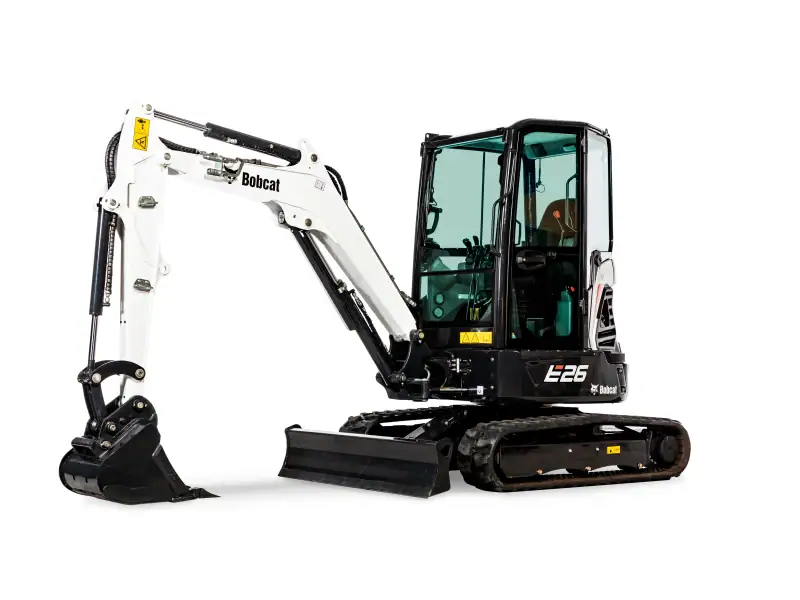
Bobcat E26 Compact Excavator
On This Page
ToggleIntroduction
The Bobcat E26 steps up from the sub-2-tonne micro machines into genuine compact excavator territory — a 2.6-tonne machine with the dig depth, lifting capacity, and hydraulic power to handle real digging work, while staying small enough to transport easily and maneuver in tight spaces. With a 24.8-horsepower engine, robust hydraulics, and Bobcat’s in-track swing frame, the E26 is a practical, capable choice for prairie acreage owners, landscapers, and contractors whose work has outgrown a micro machine but doesn’t need a full mid-size excavator.
On Aglist, the value is in understanding where the E26 fits in the compact excavator market, with real owner and operator feedback beside the spec sheet. The numbers tell you what it digs and lifts; the reviews tell you how it performs in different soil, how the controls feel over a long day, and how it holds up in service.
The E26 uses a minimal tail swing design — a middle ground between conventional and zero tail swing — which shapes how and where it can work. We explain that below, because tail swing is the most important design choice on any compact excavator.
Configurations & Pricing Context
The E26 is part of Bobcat’s R2-Series compact excavator lineup, available in standard and long-arm configurations. The long-arm version adds reach and dig depth for jobs that need to work farther from the machine. It’s offered with a canopy or optional enclosed cab — and for Canadian year-round work, the enclosed cab with heat and optional A/C is the sensible choice.
The E26 runs trenching and grading buckets, augers, hydraulic breakers, plate compactors, and more within its size class, with multiple coupler options including Bobcat’s X-Change system for faster attachment changes. For prairie drainage, utility, and landscaping work, it’s a versatile machine.
Pricing varies by configuration, attachments, and dealer. Because Dmytro has direct knowledge of Saskatchewan dealer and used pricing, we defer to local market figures over manufacturer-advertised numbers.
Key Specifications
| Specification | Bobcat E26 |
|---|---|
| Machine class | Compact excavator |
| Operating weight | 5,763 lb (2,614 kg) standard / 6,190 lb (2,808 kg) long arm |
| Weight class | 2.6–2.8 tonne |
| Tail swing | Minimal |
| Horsepower | 24.8 hp |
| Emissions | Tier 4 (ULPC, no DPF) |
| Maximum dig depth | ~9 ft 6 in (2.9 m) |
| Lift capacity (standard arm) | ~2,359 lb (1,070 kg) |
| Bucket digging force | ~5,652 lbf |
| Hydraulic flow | ~54 L/min (14.3 gpm) |
| Fuel capacity | ~9.1 gal (34.4 L) |
| Configurations | Standard / long arm |
| Travel | Two-speed with auto-shift |
Specifications are verified against Bobcat specification data and independent spec databases. Confirm exact figures for the specific machine, year, and option package with your dealer.
Understanding Tail Swing (Read This Before You Compare)
Tail swing is the most important design concept on any compact excavator, and the E26 takes a middle-ground approach with its minimal tail swing.
Tail swing describes how far the rear of the machine — the counterweight and engine housing — extends past the tracks when the upper structure rotates. A minimal-tail-swing machine like the E26 has only a small rear overhang — more than a true zero-tail-swing machine, but far less than a conventional one. This balances two goals: enough rear counterweight for solid lifting stability, while keeping the overhang small enough to work reasonably close to walls and obstacles with care.
The E26 also uses Bobcat’s in-track swing frame: when digging in an offset position, the swing castings and cylinders stay within the tracks, letting you work tight against an obstacle even though the rear has a small overhang. For prairie operators, minimal tail swing is a sensible compromise — you get better lifting performance than a zero-tail-swing machine while retaining good capability near structures. Just be aware the small rear overhang means you still watch the back when working flush against a wall, unlike a true zero-tail-swing machine.
Build & Engineering Detail
The E26 runs a 24.8-horsepower Tier 4 diesel that meets emissions without a diesel particulate filter, using Bobcat’s ultra-low particulate combustion (ULPC) design. For owners, the no-DPF approach is a real advantage: no regeneration cycle to wait through and no DPF maintenance cost — meaningful on a machine that works hard and may sit between jobs.
The hydraulics and cylinders are built for strong breakout force, and the in-track swing frame lets the machine dig flush in offset positions. A dual-flange track roller system enhances over-the-side digging and improves ride quality — a practical benefit when working across uneven ground or lifting to the side. The standard and long-arm configurations let buyers match the machine to their work: standard arm for maximum breakout force, long arm for reach and depth.
Bobcat routes steel hydraulic lines through protected channels in the boom rather than exposed rubber hoses, and groups daily maintenance points for easy access through the tailgate and side panels. A greaseless boom swing cylinder pin joint with a sealed bushing removes one daily maintenance task. The Bobcat depth check system, available with the display, helps achieve accurate dig depth without leaving the cab.
Best Applications
The E26 is a strong fit for:
- Drainage and utility trenching — the ~9.5-foot dig depth and solid lifting handle tile drainage, water lines, and pipe-setting on acreages and small farms.
- Landscaping and grading — material moving, backfilling, and grading with minimal ground disturbance.
- Work near structures, with care — minimal tail swing and the in-track swing frame allow digging reasonably close to walls and obstacles.
- Buyers stepping up from a micro machine — the E26 offers meaningfully more dig depth, lifting, and power while staying transportable.
For the tightest work flush against walls, a true zero-tail-swing machine like the E20 has an edge; for deeper or heavier work, the E32 and larger machines step up. But the E26 hits a practical sweet spot of capability and transportability.
How the E26 Fits the Bobcat Lineup
The E26 sits at the entry to Bobcat’s mid-size compact excavator range, above the sub-2-tonne micro machines (E17, E19, E20) and below the larger E32 and up. With minimal tail swing, it balances the lifting stability of a conventional machine against the tight-access capability of a zero-tail-swing one. Within the lineup, it’s the natural choice for buyers who need real compact excavator capability — drainage, utilities, landscaping — in a still-transportable package.
Bobcat E26 Reviews & Ratings
On Aglist, open the Reviews & Ratings section on this page to see how the E26 performs where it matters: digging force and depth in different soils, lifting stability, the smoothness and reliability of the hydraulics, control feel and operator comfort, and serviceability. If you own an E26, your review helps the next prairie buyer judge this versatile compact machine.
Frequently Asked Questions
What is the operating weight of the Bobcat E26? About 5,763 lb (2,614 kg) in standard configuration, or 6,190 lb (2,808 kg) as the long-arm version — placing it in the 2.6-to-2.8-tonne class. It’s transportable on a standard trailer while offering real digging capability.
Does the Bobcat E26 have zero tail swing? No — the E26 uses minimal tail swing, a middle ground with a small rear overhang. This gives it better lifting stability than a zero-tail-swing machine while still allowing work reasonably close to obstacles. For true zero tail swing, look at the E20.
Does the Bobcat E26 have a DPF? No. The E26’s 24.8-horsepower Tier 4 engine meets emissions without a diesel particulate filter, using Bobcat’s ultra-low particulate combustion (ULPC) design. That means no regeneration cycle and no DPF maintenance cost.
How deep can the Bobcat E26 dig? Maximum dig depth is roughly 9 feet 6 inches (about 2.9 m), with the long-arm version reaching deeper. That suits tile drainage, water lines, and utility trenching on acreages and small farms.
What’s the difference between the standard and long-arm E26? The standard arm gives maximum breakout force and lifting ability; the long arm trades some force for greater reach and dig depth. Choose based on whether digging power or reach matters more for your work.
What attachments does the Bobcat E26 use? It runs trenching and grading buckets, augers, hydraulic breakers, plate compactors, and more, with multiple coupler options including Bobcat’s X-Change system for faster changes.
What’s the lift capacity of the Bobcat E26? Lift capacity is highest with the standard arm at about 2,359 lb, with bucket digging force around 5,652 lbf. Actual lifting varies with reach and angle, so check the lift chart for the positions you’ll use.
Is the Bobcat E26 good for cold-weather work? With the optional enclosed cab, heat, and A/C, yes — it’s well suited to year-round prairie work. For winter use, the enclosed cab is worth specifying.
How does the E26 compare to the E32? The E32 is larger (3.2-tonne class) with more dig depth (about 10 feet 3 inches) and uses conventional tail swing. If the E26’s capacity meets your needs it’s the more transportable choice; if you need more depth and power, the E32 is the step up.
Related Models
- Compact & Mini Excavators — browse and compare excavators across all brands on Aglist.
- Bobcat E20 — the smaller zero-tail-swing machine, for tighter access.
- Bobcat brand hub — explore the full Bobcat equipment lineup.
Share your experience
Help other Canadian buyers — leave a quick review for the
Bobcat E26
There are no reviews yet. Be the first one to write one.