Overview & Specs
Bobcat E20 Mini Excavator
On This Page
ToggleIntroduction
The Bobcat E20 is a 2-tonne mini excavator that packs surprising digging force and reach into a machine small enough to fit through a standard gate. As the next-generation replacement for Bobcat’s earlier 324 model, the current E20 delivers 24% more arm digging force and 26% more lifting capacity over the blade than its predecessor — meaningful gains that make it a genuinely capable machine for tight-space work, not just a maneuverable one. For prairie acreage owners, landscapers, and contractors who need real excavator performance where access is restricted, the E20 hits a strong balance.
On Aglist, the value is in understanding where the E20 fits in the compact excavator market, with real owner and operator feedback beside the spec sheet. The numbers tell you what it digs; the reviews tell you how it performs in confined quarters, how the upgraded hydraulics feel, and whether the retractable undercarriage holds up.
The E20’s defining feature — and the reason it works so well in tight spaces — is its zero tail swing. With just 0.35 inches of rear overhang, the machine rotates with virtually no tail swing, letting you work right next to walls, fences, and obstacles without repositioning. We explain why that matters below.
Configurations & Pricing Context
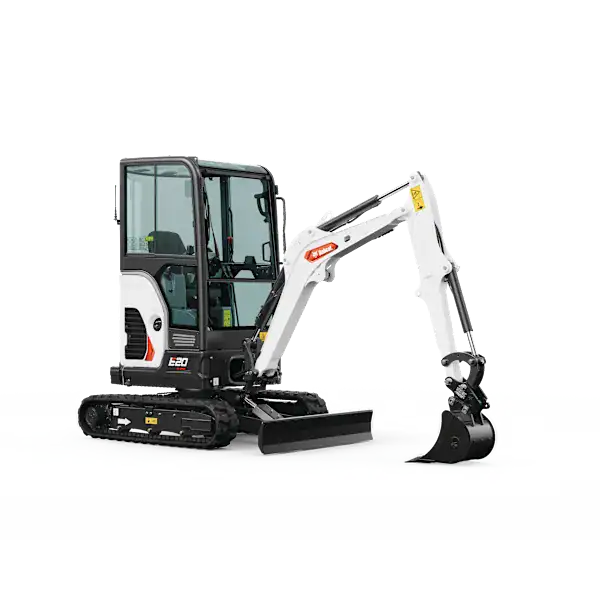
The E20 is part of Bobcat’s current compact excavator lineup, recently redesigned as a next-generation machine. It comes standard with a long arm for greater reach and dig depth, and a long dozer blade for improved grading and backfilling. It’s offered with a canopy or optional enclosed cab — and for Canadian year-round work, the enclosed cab with heat is the sensible choice.
The E20 uses a pin-on attachment system (with optional coupler) and runs trenching and grading buckets, augers, hydraulic and nitrogen breakers, and a hydraulic clamp within its size class. For prairie utility, drainage, and landscaping work, it’s a versatile small machine.
Pricing varies by configuration, attachments, and dealer. Because Dmytro has direct knowledge of Saskatchewan dealer and used pricing, we defer to local market figures over manufacturer-advertised numbers.
Key Specifications
| Specification | Bobcat E20 |
|---|---|
| Machine class | Mini excavator |
| Operating weight | ~2,019 kg (4,450 lb) with cab |
| Weight class | 1.9–2 tonne |
| Tail swing | Zero tail swing (0.35 in / ~9 mm overhang) |
| Undercarriage width (retracted) | ~38.6 in (980 mm) |
| Undercarriage width (extended) | ~53.5 in (1,360 mm) |
| Maximum dig depth | 8 ft 6 in (2.6 m) |
| Maximum reach | 14 ft (4.3 m) |
| Dump height | 8 ft 8 in (2.6 m) |
| Rated lift capacity | ~1,098 lb (498 kg) |
| Bucket digging force | ~4,684 lb-ft |
| Engine | ~15 hp, Tier 4 diesel |
| Arm | Long arm (standard) |
Specifications are verified against Bobcat specification data and independent spec databases. The E20 was recently updated to a next-generation design; confirm exact figures for the specific machine, year, and option package with your dealer.
Understanding Tail Swing (Read This Before You Compare)
Tail swing is the most important design concept on any compact excavator, and the E20 is one of the best examples of zero tail swing in its class.
Tail swing describes how far the rear of the machine — the counterweight and engine housing — extends past the tracks when the upper structure rotates. The E20 has just 0.35 inches of rear overhang, meaning the back of the machine stays essentially within the track width through full rotation. In practical terms, you can dig flush against a wall, in a trench beside a building, or along a fence line and rotate the machine freely without the rear striking anything.
The E20 pairs this with Bobcat’s in-track swing frame: when you dig in an offset position, the swing castings and cylinders also stay within the tracks, protecting the components and letting you work right up against an obstacle. For confined prairie work — digging beside a shop, between buildings, along fences — this combination is exactly what you want. The trade-off versus a conventional machine like the E19 is typically slightly less lifting stability, but the E20’s next-generation hydraulics and added counterweight options narrow that gap considerably.
Build & Engineering Detail
The E20’s headline story is its next-generation upgrade over the 324 it replaces. A new closed-center hydraulic system with a load-sensing pump delivers exactly the flow the work needs, improving multi-function operation — you can swing the boom while running an attachment with smooth, precise control. Larger boom and blade cylinders produce the 24% gain in arm digging force and 26% gain in lifting over the blade. The result is a small machine that digs and lifts more like a bigger one.
The retractable undercarriage hydraulically narrows to about 38.6 inches to pass through gates and doorways, then extends to about 53.5 inches for a stable, capable digging stance — and the dozer blade folds to match the narrow width. The standard long arm adds reach and dig depth over a standard arm, reaching 8 feet 6 inches deep and 14 feet out. An integrated automatic slew brake means the operator doesn’t need to manually engage it when transporting the machine.
Bobcat routes steel hydraulic lines through protected channels in the boom rather than exposed rubber hoses, and an under-boom light aids visibility in the trench. Daily maintenance points are accessible through the swing-open tailgate and side panels.
Best Applications
The E20 is a strong fit for:
- Tight-access digging with real performance — trenching, drainage, and utility work through gates and between buildings, where the upgraded digging force matters.
- Work flush against structures — the 0.35-inch tail swing lets you dig beside foundations, shops, and walls without repositioning.
- Landscaping and acreage projects — grading, backfilling, planting, and material handling with minimal ground disturbance.
- Buyers upgrading from an older micro machine — the next-generation performance gains are substantial over the previous generation.
It is a light-duty machine by class, and for deeper digging or heavier lifting you’ll want a 2.5-to-4-tonne machine like the E26 or E32. But within the 2-tonne zero-tail-swing class, the E20 is a strong performer.
How the E20 Fits the Bobcat Lineup
The E20 sits in Bobcat’s sub-2-tonne compact excavator range as the higher-performance zero-tail-swing option, above the smaller E17 and alongside the conventional-tail-swing E19. Stepping up, the E26 (minimal tail swing) and E32 move into mid-size compact excavator capability. The E20’s role is to deliver maximum tight-access capability with genuinely useful digging force — the machine for confined work that still demands real performance.
Bobcat E20 Reviews & Ratings
On Aglist, open the Reviews & Ratings section on this page to see how the E20 performs where it matters: digging force and reach in tight quarters, the smoothness of the upgraded hydraulics, control feel and operator comfort, and the durability of the retractable undercarriage. If you own an E20, your review helps the next prairie buyer judge this next-generation micro machine.
Frequently Asked Questions
What is the operating weight of the Bobcat E20? About 2,019 kg (roughly 4,450 lb) with a cab, placing it in the 2-tonne class. It’s small enough to trailer easily while delivering real digging performance.
Does the Bobcat E20 have zero tail swing? Yes — with just 0.35 inches of rear overhang, the E20 rotates with virtually no tail swing, so the rear stays within the track width. Paired with Bobcat’s in-track swing frame, this lets you dig flush against walls and obstacles without repositioning.
How deep can the Bobcat E20 dig? Maximum dig depth is 8 feet 6 inches (2.6 m), with 14 feet of maximum reach and an 8-foot-8-inch dump height — strong figures for a 2-tonne machine, helped by the standard long arm.
What did the new Bobcat E20 improve over the old model? The current E20 replaced the 324 model with a next-generation design: 24% more arm digging force and 26% more lifting capacity over the blade, thanks to a new closed-center load-sensing hydraulic system and larger cylinders. It comes standard with a long arm and long blade.
How narrow can the Bobcat E20 get? Its retractable undercarriage narrows to about 38.6 inches to pass through gates and doorways, then extends to about 53.5 inches for a stable digging stance. The dozer blade folds to match the narrow width.
What attachments does the Bobcat E20 use? It runs trenching and grading buckets, augers, hydraulic and nitrogen breakers, and a hydraulic clamp, using a pin-on system with an optional coupler.
What’s the lift capacity of the Bobcat E20? Rated lift capacity is about 1,098 lb, with the next-generation design adding 26% more lifting over the blade than the previous model. An optional add-on counterweight further boosts lifting performance.
Is the Bobcat E20 good for cold-weather work? With the optional enclosed cab and heat, yes — it’s usable through prairie winters. For year-round comfort, the enclosed cab is worth specifying.
How does the E20 compare to the E17? Both are zero-tail-swing machines with retractable undercarriages, but the E20 is larger (2-tonne vs 1.7-tonne) with more dig depth, reach, and digging force. The E17 is the most compact and transportable; the E20 adds performance while keeping tight-access capability.
Related Models
- Compact & Mini Excavators — browse and compare excavators across all brands on Aglist.
- Bobcat E17 — the smaller zero-tail-swing machine, for maximum transportability.
- Bobcat brand hub — explore the full Bobcat equipment lineup.
Share your experience
Help other Canadian buyers — leave a quick review for the
Bobcat E20
There are no reviews yet. Be the first one to write one.