Overview & Specs
John Deere 60 P-Tier (60G) Compact Excavator
On This Page
ToggleIntroduction
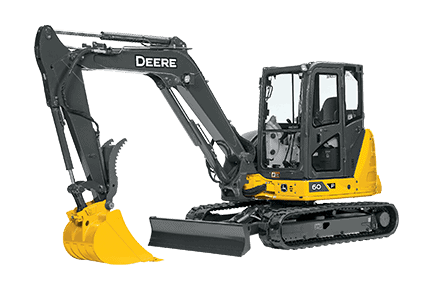
The John Deere 60 P-Tier is the biggest and most powerful compact excavator John Deere builds — a 6.1-tonne machine that brings serious digging force, lift capacity, and reach to the top of Deere’s compact line. Formerly the 60G (and still widely called that), it delivers 50% more bucket breakout force and dramatically more lifting capacity than the popular 35, while keeping the reduced-tail-swing maneuverability that lets it work in surprisingly tight spaces. Powerful enough for demolition of barns and garages, deep foundation work, and heavy material handling, yet still transportable, it’s the choice for prairie contractors and larger operations needing maximum compact-excavator capability from a brand with deep excavator experience.
On Aglist, the value is in understanding where the 60 P-Tier fits in the compact excavator market — and whether you need this much machine — with real owner and operator feedback beside the spec sheet. The numbers tell you what it digs; the reviews tell you how it performs on the biggest jobs, how the cab feels over a long day, and how it holds up. It competes directly with the Bobcat E60 and Kubota KX057-5 / U55-5.
The 60 P-Tier uses a reduced-tail-swing design — the John Deere hallmark, even at flagship size. We explain why that matters below, since tail swing is the most important design feature on any compact excavator.
Configurations & Pricing Context
The 60 P-Tier is the largest model in John Deere’s compact excavator lineup, in the 6.1-tonne class — the current P-Tier designation for what was the 60G (both names refer to essentially the same machine, sold side by side as John Deere transitions to P-Tier naming). It comes in enclosed cab (heat and A/C standard) or optional canopy configurations, with standard and long-arm options, mechanical quick-coupler, auxiliary hydraulics with selector valve, a backfill blade, and power/economy modes.
The 60 P-Tier runs buckets, augers, hydraulic hammers, thumbs, compactors, and more, with rubber, steel, or rubber-pad track options. Its attachments are shared across John Deere compact machines, and — like the 50 — it works with engcon tiltrotators. Rent1USA and other rental companies have added multiple units to fleets, reflecting its popularity for demolition, landscaping, and excavation.
Pricing varies by configuration, attachments, and dealer; this is a premium machine at the top of the compact range. Because Dmytro has direct knowledge of Saskatchewan dealer and used pricing, we defer to local market figures over manufacturer-advertised numbers.
Key Specifications
| Specification | John Deere 60 P-Tier (60G) |
|---|---|
| Machine class | Compact excavator (flagship) |
| Also known as | John Deere 60G |
| Operating weight | ~13,620 lb (6,180 kg) |
| Weight class | 6.1 tonne |
| Tail swing | Reduced (4 ft 3 in tail swing radius) |
| Net rated power | ~53 hp at 2,000 rpm |
| Engine | Yanmar 4TNV98C-WHB (with DPF) |
| Maximum dig depth | ~12 ft 4 in (3.77 m) — 13 ft 6 in long arm |
| Maximum reach | ~20 ft 5 in — 21 ft 6 in long arm |
| Maximum dumping height | ~13 ft 8 in |
| Bucket breakout force | ~9,240 lb |
| Arm digging force | ~6,990 lb |
| Lift capacity (over front, ground level) | ~8,550 lb |
| Hydraulics | Closed-center load-sensing (1 variable pump) |
| Ground pressure (rubber) | ~5.1 psi |
Specifications are verified against John Deere specification data and independent spec databases. The 60G and 60 P-Tier share essentially the same machine; confirm exact figures for the specific machine, year, and configuration with your dealer.
Understanding Tail Swing (Read This Before You Compare)
Tail swing is the most important design concept on any compact excavator, and the 60 P-Tier keeps John Deere’s reduced-tail-swing approach even at flagship size.
Tail swing describes how far the rear of the machine — the counterweight and engine housing — extends past the tracks when the upper structure rotates. The 60 P-Tier has a reduced-tail-swing design with a 4-foot-3-inch tail swing radius: even though it’s the biggest machine in the G-Series/P-Tier line, the rear overhang is kept modest, so it stays maneuverable and productive in tight spaces — perfect for “dig-and-go” projects and work within close lot lines.
This is notable because most competitors’ 6-tonne machines are either full conventional tail swing (more overhang) or a distinct tight-tail model. John Deere instead carries its reduced-tail-swing philosophy up through the flagship. A useful comparison: the reduced-tail-swing 60 P-Tier versus the conventional-tail-swing Bobcat E60 and Kubota KX057-5 (both conventional at this size). The Deere’s reduced tail swing is an advantage for working closer to structures at 6-tonne capability, while all three deliver the stability and power the class is known for. If you need maximum compact capability but still work in semi-confined conditions, the 60 P-Tier’s reduced tail swing is a real differentiator.
Build & Engineering Detail
The 60 P-Tier runs a 53-horsepower Yanmar 4TNV98C-WHB diesel — a bigger engine than the smaller machines, and the source of its substantial power advantage. Compared to the 35, the 60 delivers 50% more bucket breakout force and 250% more over-the-front lifting capacity. Note that, unlike the naturally aspirated smaller machines, the flagship 60 uses a diesel particulate filter (DPF) with an upward-pointing exhaust — so you won’t see the soot that a non-DPF machine can emit, though it adds the DPF to the maintenance picture.
Critically, the 60 uses a closed-center load-sensing hydraulic system with a variable-displacement pump — a major advantage over the smaller machines’ open-center systems. Open-center systems (like the 35’s) can stall or lose performance when running multiple hydraulic functions at once, because oil flows through all valves in series. The 60’s closed-center load-sensing design delivers oil where it’s needed, giving smooth, consistent multi-function performance — a real benefit when running demanding attachments while operating the arm.
The redesigned cab offers wider, taller front glass and a single-hinge door for unsurpassed visibility, air conditioning and heating standard, a suspension seat, and rubber cab mounts for reduced vibration and noise. The operator station tilts forward 50 degrees for easy access to the swing motor, control valve, and engine components, and a hinged door opens to the side-by-side cooler and radiator for easy cleaning. Two-speed auto-shifting propel motors adjust to load automatically. Track options (rubber, steel, rubber-pad) let buyers match the machine to their ground.
Best Applications
The 60 P-Tier is a strong fit for:
- Demolition work — enough power and reach to take down barns, garages, and structures.
- Deep foundation and excavation — 12+ feet of dig depth (13’6″ with long arm) for basements, deep footings, and major excavation.
- Heavy lifting and material handling — the 8,550 lb lift capacity and 9,240 lb breakout handle heavy loads in commercial and residential work.
- Land clearing and tough digging — the big engine, closed-center hydraulics, and stability suit demanding land management.
It is the most capable — and largest — compact excavator John Deere makes, and more machine than most farm or acreage work requires. For operations needing near-full-size capability with reduced-tail-swing access, though, it’s the top of the line. For lighter or more transport-friendly work, the 50 and 35 fit better.
How the 60 P-Tier Fits the John Deere Lineup
The 60 P-Tier sits at the very top of John Deere’s compact excavator range — the 6.1-tonne flagship above the 50, 35, 30, 26, and 17. It brings maximum digging force, lift capacity, and reach to a still-transportable machine, with a closed-center load-sensing hydraulic system that sets it apart from the smaller machines. Its reduced-tail-swing design — unusual for a 6-tonne machine — gives it more confined-space capability than typical flagship compacts. Its cross-brand rivals are the Bobcat E60 and Kubota KX057-5, both conventional-tail-swing 5-to-6-tonne machines.
John Deere 60 P-Tier Reviews & Ratings
On Aglist, open the Reviews & Ratings section on this page to see how the 60 P-Tier (60G) performs where it matters: deep digging power and breakout on the biggest jobs, lift capacity and stability, closed-center hydraulic smoothness with attachments, reduced-tail-swing maneuverability, cab comfort, reliability, and serviceability. If you own a 60G or 60 P-Tier, your review helps the next prairie buyer judge John Deere’s flagship compact excavator.
Frequently Asked Questions
Is the John Deere 60 P-Tier the same as the 60G? Essentially yes. John Deere is transitioning its lineup to “P-Tier” naming, and the 60 P-Tier is the current designation for what was the 60G. They refer to essentially the same 6.1-tonne machine, sold side by side; 60G is common on used machines.
Is the John Deere 60 P-Tier the biggest John Deere compact excavator? Yes. At about 13,620 lb operating weight in the 6.1-tonne class, it’s the largest and most powerful compact excavator John Deere builds, with the highest dig depth, reach, breakout, and lift in the compact line.
How much more powerful is the 60 than the 35? Substantially: the 60 delivers 50% more bucket breakout force and 250% more over-the-front lifting capacity than the 35, thanks to a bigger engine and frame. It’s a major step up for heavy work.
Does the John Deere 60 P-Tier have zero tail swing? No — it has a reduced-tail-swing design (4-foot-3-inch tail swing radius). Even at flagship size, John Deere keeps the overhang modest for maneuverability in tight spaces, which is unusual for a 6-tonne machine — competitors’ machines this size are often full conventional tail swing.
How deep can the John Deere 60 P-Tier dig? Maximum dig depth is about 12 feet 4 inches (13 feet 6 inches with the optional long arm), with over 20 feet of reach and a 9,240 lb bucket breakout force — near-full-size capability in a compact machine.
Does the John Deere 60 P-Tier have a DPF? Yes — unlike the smaller naturally aspirated John Deere compact excavators (like the 35, which has no aftertreatment), the flagship 60 uses a diesel particulate filter with an upward-pointing exhaust. Confirm the emissions setup and maintenance requirements with your dealer.
What hydraulic system does the John Deere 60 P-Tier use? A closed-center load-sensing system with a variable-displacement pump — a major advantage over the smaller machines’ open-center systems. It delivers smooth, consistent performance when running multiple hydraulic functions at once, unlike open-center systems that can stall under multi-function loads.
How does the 60 P-Tier compare to the Bobcat E60 and Kubota KX057-5? All three are capable 5-to-6-tonne machines. The Deere’s reduced tail swing is an edge for working closer to structures, while the Bobcat E60 and Kubota KX057-5 use conventional tail swing for maximum open-work stability. The decision often comes down to dealer support, hydraulics, and price.
Related Models
- Compact & Mini Excavators — browse and compare excavators across all brands on Aglist.
- John Deere 50 P-Tier — the 5-tonne machine one step down, more transportable.
- Bobcat E60 — a comparable 6-tonne machine from Bobcat, for cross-shopping.
Share your experience
Help other Canadian buyers — leave a quick review for the
John Deere 60 P-Tier (60G)
There are no reviews yet. Be the first one to write one.