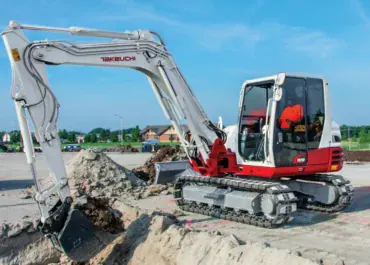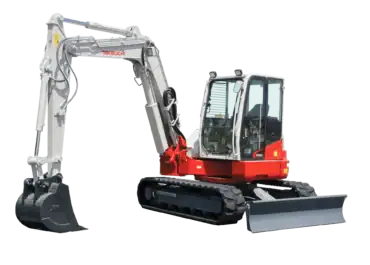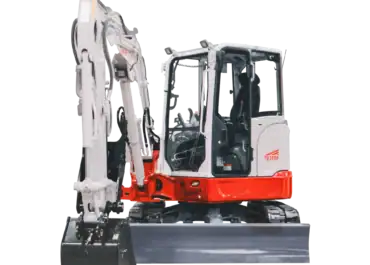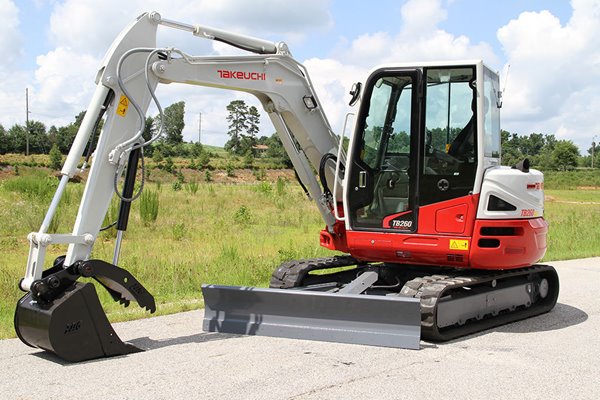
Overview & Specs
The Takeuchi TB260 is worth considering when a compact excavator must alternate between ordinary digging and more than one hydraulic function at the attachment. Its documented primary and secondary auxiliary circuits make the installation details especially important. The right question is not simply how much flow the machine advertises, but which circuit supplies each function and whether the complete tool package suits the work.
For Canadian farms and contractors, this can be a practical middle ground between a smaller property machine and a substantially heavier excavator. That position still needs to be earned on the actual site: the conventional rear requires space, transport must accommodate the equipped machine, and attachment capability must be verified rather than inferred from hose count.
On This Page
ToggleTB260 specifications and source boundaries
The reference package is Takeuchi’s North American TB260 page and its linked October 2019 brochure. The brochure identifies serial ranges for its configuration. Match the offered machine to the correct documentation rather than applying an older sheet indiscriminately.
| Item | Brochure reference | Why it matters |
|---|---|---|
| Engine output | 47.6 hp at 2,400 rpm | Separate from hydraulic-tool performance |
| Operating mass, canopy / cab | 5,500 / 5,735 kg | Starting configuration, not a haul approval |
| Primary / secondary auxiliary flow | 102.2 / 43.9 L/min | Different supplying circuits |
| Maximum depth / ground-level reach | 3,895 / 6,132 mm | Different points in the work envelope |
| Undercarriage width / tail radius | 2,000 / 1,300 mm | Entry and rear-clearance checks |
The current web presentation and the dated brochure do not agree on every imperial weight and force entry. The table deliberately retains the brochure’s metric basis. Disputed breakout values are omitted instead of selecting a number that makes the machine look stronger. Confirm any purchase-critical figure against the actual configuration.
Two circuits do not form one larger attachment supply
The primary and secondary flow entries describe separate circuits. They should not be added together to advertise a larger single-tool supply. A tool with two hydraulic functions needs a defined connection and control arrangement for each, not merely a total that looks sufficient on paper.
Write down the attachment’s jobs first. One function may drive the main tool while another positions it. Their required flow, pressure and control behaviour may differ considerably. Obtain those requirements for the exact attachment, including return and case-drain provisions where applicable, then compare them with the offered carrier installation.
A useful purchase sheet has a row for every required function, with the supplying circuit, connection, control and accepted settings. Missing information remains unresolved. This is more reliable than counting visible couplers, because two apparently similar outlets can serve different purposes.
The brochure describes adjustable auxiliary flow and attachment presets. Their benefit is repeatable setup of a properly matched tool. They do not authorize an unsuitable attachment, and a stored setting left by another owner should not be treated as a verified configuration for newly purchased equipment.
Test the work sequence that justifies the plumbing
An attachment demonstration should reproduce the reason the tool is being bought. A brief unloaded movement proves little about sustained work, controllability or the transition between functions. Define a representative task and use a properly approved setup with a competent operator.
For example, if a farm needs both excavation and controlled handling during a cleanup project, the acceptance brief should include the actual bucket, coupler and relevant companion tool. Observe whether the changes between tasks are practical. Do not assume a smooth digging demonstration has also verified the attachment system.
For a contractor, record setup time, useful output and interruptions. If the specialised function is used for only a small part of the day, its potential saving should be applied to that part of the schedule. Multiplying an attachment advantage across every engine hour overstates its value.
The thumb selection guide is relevant where handling drives the purchase. Contact, mounting and stowed clearance still need to match the bucket and coupler. Hydraulic availability alone does not establish a useful or permitted handling arrangement.
Conventional rear geometry: plan the working area
The TB260 should be compared as a conventional-tail machine. The two-metre undercarriage dimension helps screen the entrance, while the rear radius addresses a different problem at the working position. Both matter, but neither describes the entire operating envelope.
Use a site sketch showing the excavation, suitable standing positions, spoil and receiving equipment. Include the rear’s path through the required rotation and the space occupied by the tool. A location that looks adequate with the machine facing one direction may be unsuitable for the complete cycle.
Where there is room, a conventional layout may fit the work well. Where rear clearance repeatedly dictates awkward positioning, compare another arrangement. The Aglist tail-swing guide helps organize that comparison without treating one design as universally superior.
Do not confuse a compact-machine category with narrow access. Check the blade and attachment as well as the tracks, then assess turns and overhead restrictions along the route. Access preparation and restoration can be real project costs even when the machine eventually reaches the excavation.
Digging range and material destination
The cited working-range drawing describes a shaped envelope. Maximum depth and ground-level reach are not simultaneously available at one point. For a useful evaluation, identify several positions the bucket must reach and the movement between them.
On a property drainage project, the important sequence might include reaching the required profile, extracting material cleanly and placing it where it will not need to be moved twice. If material removal is poorly arranged, more digging capability can simply create a larger stockpile sooner.
Use the actual arm, bucket and coupler in the assessment. A bucket that reaches the bottom may not have a useful filling and extraction path there. Likewise, a maximum dump-height figure does not establish that the tool can place material effectively in the chosen receiving vehicle.
The depth and reach guide explains the measurement labels. Keep the machine’s standing elevation explicit and let the site plan establish appropriate positions before testing whether the excavator reaches from them.
Blade choice and the last part of the project
The brochure lists a blade with float and an optional power angle blade. The relevant distinction is what the machine needs to do after digging. Loose-material placement, backfilling and finishing can occupy enough time to influence the preferred package.
If another machine consistently handles those stages, the extra blade function may offer little benefit. If the TB260 is expected to complete small projects alone, demonstrate the finishing sequence with the proposed blade. Compare the resulting surface and remaining correction work, not just how quickly the first pass is made.
Neither float nor angling replaces grade measurement or a specified compaction process. Treat the blade as one part of the work method. For a used machine, inspect the actual mechanism and wear components before including an option’s value in the offer comparison.
Engine, enclosure and seasonal readiness
The documented engine is a turbocharged Yanmar with DOC and DPF after-treatment. This requires using its own operating and maintenance information. Do not transfer a no-aftertreatment claim from a smaller model in the same brand, or infer a repair history merely from the presence of those components.
For a used purchase, review service records and have warnings or unexplained behaviour investigated by a qualified technician. The outcome should be a defined condition assessment and repair scope, not an improvised diagnosis based on an advertisement.
The brochure’s cab and canopy versions have different equipment and weight references. Choose the enclosure around the real Canadian work calendar, then test the offered climate and visibility equipment. Shoulder-season work may make a cab valuable, but the right choice depends on hours, conditions and the operator’s needs.
Cold weather also affects preparation and material conditions. Follow the specified fuel, fluids, starting and warm-up requirements. A comfortable cab does not make frozen ground suitable for every ordinary bucket task or guarantee the same production as a summer demonstration.
Cost the complete attachment installation
The cheapest attachment quote may omit installation work that another supplier includes. Compare a delivered package with the correct mounting, hoses, controls, setup and documentation. Put essential missing components on the same cost sheet as the excavator itself.
Consider an illustrative additional installation cost of C$3,600 that eliminates 20 minutes of repeated setup on 60 relevant jobs a year. The assumed time saving is 20 hours annually. At an assumed internal time value of C$90 per hour, that equals C$1,800 before maintenance, financing and other costs, giving a simple two-year recovery calculation.
Those figures are invented planning inputs, not market prices or TB260 performance. If the saved time cannot reduce a cost or support useful additional work, its cash value may be smaller. If the specialised tool is used on only ten jobs, the same calculation changes sharply. Measure the recurring delay before building the business case around it.
For infrequent farm projects, compare hiring the complete suitable machine-and-tool combination. Ownership can provide availability and scheduling control, but those benefits should be described honestly rather than presented as guaranteed revenue.
Transport can outweigh a small site advantage
The reference operating mass is not the entire transported load. Identify what it includes, establish the actual equipped machine weight and account for separately carried tools. A thumb, coupler and several buckets should not disappear from the calculation because the advertisement gives one convenient headline weight.
Assess the complete hauling arrangement using actual ratings, dimensions and applicable requirements. Loading, securement and axle loading matter alongside total mass. A trailer that physically accommodates the excavator is not automatically suitable for the full package.
For a contractor moving frequently, count loading and delivery time in the machine comparison. For a farm keeping the excavator on one property, compare contracted delivery with maintaining transport equipment. The same excavator can have a very different ownership case under those two patterns.
Used TB260 inspection priorities
First verify serial identity and configuration, including tracks, arm, blade, enclosure and auxiliary equipment. Then have a competent inspector evaluate undercarriage wear, linkage play, structural repairs, hydraulics and engine condition. These are general purchase checks, not allegations of a model-specific defect.
Give the auxiliary installation its own inspection scope. Check identification, routing, protection, condition and documented suitability of modifications. A machine used mainly for bucket work and one extensively modified for specialised tools may need different questions even if their hour readings are similar.
Identify every included attachment and assess whether it actually fits the intended work. An unknown coupler or heavily modified bucket can represent an unresolved expense rather than added value. Obtain repair and completion estimates before comparing the used package with a more complete alternative.
Alternatives and final buying questions
The TB250-2 is a useful comparison when a somewhat smaller carrier might handle the recurring tasks. Compare exact equipment, transport and the required attachment functions instead of assuming that the next model number is automatically the better choice.
Can primary and secondary flow be combined in the comparison?
Do not add their ratings into one assumed tool supply. Identify the actual circuit serving each function and verify the complete installation.
Does having the right flow make an attachment compatible?
No. Pressure, return, controls, mounting, mass and carrier suitability remain separate checks.
Is a conventional rear unsuitable for property work?
Not necessarily. It depends on the route and working layout. Use measured constraints rather than treating tail categories as quality rankings.
What should the demonstration prove?
That the configured machine completes the recurring excavation and attachment sequence to the required standard, with practical transitions and material placement.
What is the strongest reason to buy this model?
A verified fit between its documented circuits, working envelope and the tasks performed regularly. The TB260 makes sense when that capability is useful often enough to justify its complete ownership and transport package.
Share your experience
Help other Canadian buyers — leave a quick review for the
Takeuchi TB260
There are no reviews yet. Be the first one to write one.