Overview & Specs
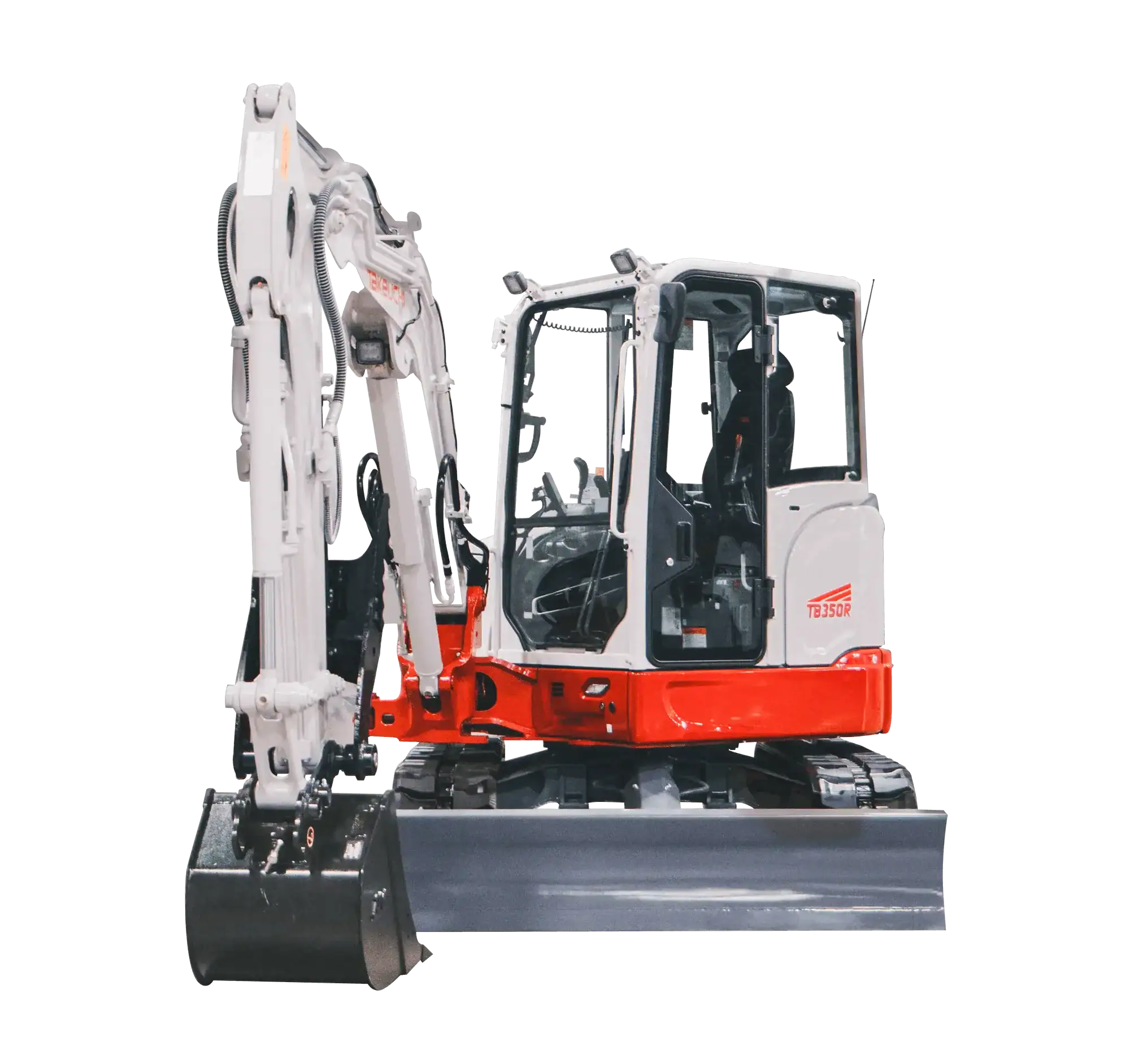
The Takeuchi TB350R suits a shortlist where an excavator needs a compact rear, a meaningful hydraulic-tool package and a useful finishing role. It is not simply a larger version of a narrow-access mini. The documented undercarriage is two metres wide, so the site must accommodate that width even when short tail swing makes the working position easier to arrange.
For Canadian contractors and farms, the buying question is whether the configured machine can take a project from excavation through material placement and restoration with fewer unnecessary transitions. That depends on the actual cab or canopy equipment, blade and attachments. Comparing only horsepower misses much of what makes this model worth investigating.
On This Page
ToggleThe documented North American package
Sources are the Takeuchi product page and the linked February 2023 TB350R brochure. The references below describe that brochure’s configuration. Confirm the equipment and serial-specific information for a new quotation or used example.
| Item | Brochure reference | Practical comparison |
|---|---|---|
| Engine output | 41.7 hp at 2,000 rpm | Not attachment output |
| Canopy / cab operating mass | 4,980 / 5,095 kg | Different starting weight references |
| Undercarriage width / rear radius | 2,000 / 1,075 mm | Access and rotation are separate |
| Maximum depth / ground-level reach | 3,575 / 5,925 mm | Assess the complete digging path |
| Primary auxiliary flow | 93.2 L/min | Match the supplying circuit to the tool |
Published web and brochure breakout-force values differ. The brochure also has a unit-label error in its auxiliary-pressure row. Those disputed entries are not used here as definitive specifications. A purchase that depends on pressure or force needs the applicable confirmed data rather than a silent correction or the most favourable number.
Where short tail can change the job
The rear layout is most valuable when it opens a useful machine position that a conventional rear would repeatedly compromise. Think about an established yard with a limited corridor between the excavation and another structure. The question is not whether the machine looks compact, but whether it can dig and discharge from the planned position throughout the required cycle.
Prepare a plan with the machine’s access route, working footprint and material destination. Include front-tool movement and the space needed by other equipment. A rear radius alone does not describe the entire rotating envelope, and a small gap on a drawing is not a clearance allowance.
If the main delay is a truck arriving late or spoil being placed where it must be moved again, a different rear design may contribute little. Record the actual cause of interruptions before choosing the machine around one feature. The tail-swing comparison helps distinguish layout from access width.
Why the blade deserves a place in the quotation
The cited brochure lists a backfill blade with float and an optional power angle blade with float. Establish which one is supplied. An angle blade can direct material differently during an appropriate finishing task, but its value depends on the direction the material needs to move and the room available for the machine.
For a contractor, divide a normal project into excavation, material removal, backfill placement and final restoration. Identify the stages the excavator actually performs. If a loader already handles all loose material efficiently, an additional blade function may have limited use. If the excavator completes small jobs alone, the same function may matter much more.
Do not confuse spreading with compaction or assume that a blade produces the required finished grade without measurement. The purchase demonstration should end at the same quality standard for each candidate. A fast initial pass that leaves extra correction work is not an established time saving.
On a used TB350R, inspect the blade mechanism and cutting components as part of the machine, not as a free accessory. Worn pivots, damaged hoses or missing parts can change the value of an option. Determine the repair scope before counting the feature as productive equipment.
Hydraulic attachments: compare a system, not a flow headline
The 93.2 L/min primary auxiliary reference is useful when screening a tool intended for that circuit. It does not establish compatibility by itself. The attachment needs the appropriate flow range, pressure, return path, controls, mounting and carrier approval.
A tool demanding less flow should not automatically be operated at the carrier’s maximum setting. Conversely, a tool whose required performance exceeds the available installation cannot be rescued by quoting total pump flow. Obtain the requirements for the exact attachment and have the complete package set up accordingly.
The brochure distinguishes cab equipment, including a secondary auxiliary circuit and a dedicated coupler circuit described in its introduction. That makes cab-versus-canopy comparison more than a comfort choice. Check what the offered machine actually includes and what would be needed to support the intended attachment changes.
A useful quote names the tool, coupler, hoses, controls and commissioning. It also states which buckets must work with the coupler and any thumb. Without those details, two apparently similar attachment packages can leave very different amounts of work for the buyer after delivery.
The Aglist coupler guide explains why changing systems affects more than convenience. For this machine, make the acceptance test include the approved change procedure and the actual tools that will be used repeatedly.
Useful range with the intended bucket installed
A maximum-depth comparison can be misleading when most work happens above that point but at substantial horizontal reach. Map several required positions rather than one deepest measurement. The excavator must fill and extract the bucket, then discharge without creating an awkward return movement.
For loading, establish the receiving vehicle’s height and position relative to the excavator. A bucket clearing the near edge does not show that material can be distributed effectively. The standing elevations and the actual bucket profile matter alongside the boom and arm drawing.
The working-range guide separates maximum reach, ground reach and depth. Use it to prepare the demonstration brief. The TB350R’s published dimensions should screen the job, while the configured machine and site arrangement resolve the practical fit.
Do not use digging force to infer lifting capacity. If handling loads is part of the intended work, consult the applicable chart with the correct direction, radius, height, blade condition and attachment assumptions. That requirement remains separate from whether the bucket can reach the position.
Cab equipment and the Canadian season
The brochure specifies a 7-inch touchscreen and jog-dial arrangement for the cab, versus a 4.3-inch display for the canopy. It also lists cab heating, air conditioning and defrost. A buyer should test those functions rather than treating an enclosed station as a complete description of operator accommodation.
For work that continues into cold or wet periods, visibility and a comfortable control position can influence how practical the machine is to use for a full shift. Assess the regular operator’s sightlines to the blade, tool and receiving equipment. An attractive display cannot compensate for a poor view of the task.
The documented engine arrangement includes DOC and DPF after-treatment. Follow the applicable operating and service instructions, and investigate warning indications on used equipment before purchase. This is a configuration fact, not evidence of a particular repair frequency or a reason to invent a regeneration procedure.
Winter work needs a separate task assessment. Cold-weather preparation does not establish that a normal digging tool is appropriate for frozen material. Likewise, a heater does not solve access problems caused by site conditions. Build the ownership plan around the actual season and work rather than assuming summer productivity all year.
A complete-job comparison with a conventional alternative
The TB250-2 provides a useful conventional-layout comparison. Match enclosure, attachments and the required job before comparing offers. Similar operating classes do not guarantee identical geometry, control equipment or delivered capability.
Consider a hypothetical project where digging takes 150 minutes, material handling 50 minutes and finishing 40 minutes. The total is 240 minutes. Removing ten minutes from digging and fifteen from finishing would reduce the job to 215 minutes, provided no other stage changes. Those are planning assumptions, not measured TB350R performance.
Now suppose a different transport arrangement adds twenty minutes per visit. Most of the site saving disappears. This is why a useful demonstration includes setup and cleanup, while the ownership comparison includes delivery. A quicker isolated bucket cycle is not enough to establish a better business result.
For farm ownership, the same reasoning can be expressed as project availability instead of income. A machine kept ready on the property may offer scheduling convenience, but that benefit should be distinguished from cash earned. Compare occasional rental or contracted work when the attachment-heavy jobs are rare.
Transport and attachment logistics
The brochure’s roughly five-tonne operating references do not settle the hauling calculation. Determine the actual machine configuration, what its stated weight includes, and the additional tools travelling with it. Avoid both missing equipment and counting components twice.
A practical transport package must accommodate the load, dimensions, loading arrangement and applicable requirements for the complete vehicle-and-trailer combination. Do not choose it from trailer length or a casual description of the truck. Obtain the appropriate assessment using actual ratings and weights.
Storage matters too. If a hydraulic tool stays at the yard because it cannot conveniently travel with the excavator, the machine’s theoretical versatility contributes little on site. Plan where tools are stored, how they are identified and how the needed equipment reaches the job.
For an owner who rarely moves the excavator, contracted delivery may be more sensible than maintaining dedicated hauling equipment. For daily contracting, transport time and reliability can dominate small differences in excavation speed. Use the actual move frequency in the comparison.
Inspecting a used TB350R
Begin by reconciling the serial identity and installed equipment with the offer. Record the blade, tracks, arm, coupler, thumb, enclosure and auxiliary circuits. “Fully equipped” is not a specification and should not substitute for an itemized list.
Have a competent evaluator inspect the structure, linkage, undercarriage, hydraulic installation and engine systems. Include the controls used by the intended attachments. A machine that performs ordinary digging smoothly has not thereby demonstrated every secondary function or coupler arrangement.
Check service records and investigate modifications. A previous owner’s custom plumbing may be useful, unsuitable or simply undocumented. Treat that uncertainty as something to resolve before assigning value, rather than assuming that more hoses mean more capability.
Price the actual corrections and missing equipment alongside purchase and initial service. Keep those costs separate from optional upgrades. This prevents a cheap but incomplete machine from appearing directly comparable with a documented, commissioned package.
Frequently asked questions
Is the angle blade standard?
The February 2023 brochure identifies it as optional. Confirm the fitted blade and functions in the quotation rather than relying on a photograph or a general model description.
Does 93.2 L/min mean every high-flow attachment will work?
No. The supplying circuit, pressure, return arrangement, controls, mounting and carrier suitability all need to match the exact tool. A marketing category is not an installation approval.
Is the cab just weather protection?
No. The cited source distinguishes display and hydraulic equipment by enclosure. Compare the complete cab and canopy packages before interpreting their price difference.
Can a short-tail excavator replace a smaller narrow-access machine?
Only where the full route and work area accommodate it. Rear geometry does not reduce the documented two-metre undercarriage width or establish clearance for the fitted blade and tool.
What should decide the purchase?
The ability of the exact package to complete recurring jobs to the required standard, with practical access, tooling and transport. The TB350R is most persuasive when its short rear and equipment options solve measured constraints rather than simply adding features to a specification sheet.
Share your experience
Help other Canadian buyers — leave a quick review for the
Takeuchi TB350R
There are no reviews yet. Be the first one to write one.