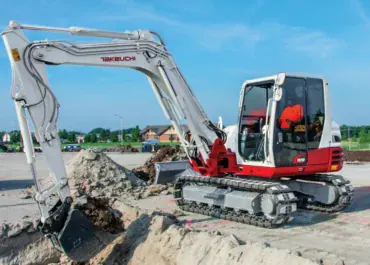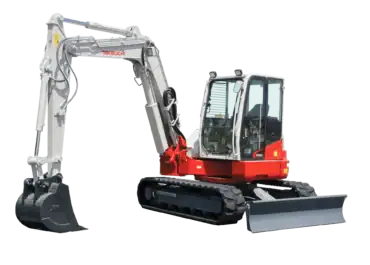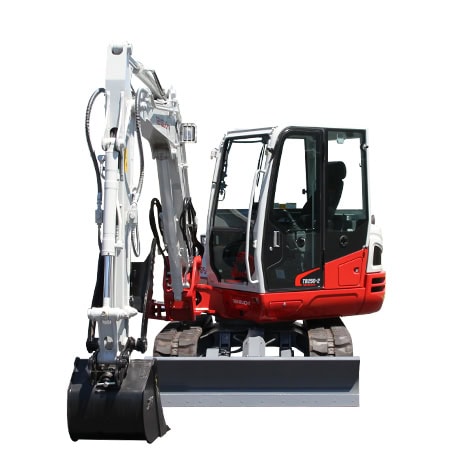
Overview & Specs
The Takeuchi TB250-2 belongs on a shortlist when a compact excavator must do more than ordinary bucket work. Its published primary auxiliary flow makes attachment matching a central part of the buying decision, while its conventional rear layout and roughly five-tonne reference mass require a realistic access and delivery plan. For a Canadian contractor or farm owner, the machine makes most sense when those capabilities serve recurring work rather than an occasional ambitious project.
The important comparison is the complete carrier and attachment system. A tool that connects to the machine can still have unsuitable flow, return plumbing, controls or working geometry. Likewise, an excavator with impressive specifications can be a poor purchase if moving it between the required jobs consumes too much time or excludes important access routes.
On This Page
ToggleKeep TB250-2 separate from the earlier TB250
This guide covers the TB250-2 identified on the North American product page. Its source package includes the October 2019 brochure linked by Takeuchi. Do not substitute a specification sheet for the earlier TB250 simply because a used advertisement omits the suffix.
| Reference | Brochure value | Comparison purpose |
|---|---|---|
| Engine output | 39 hp at 2,400 rpm | Separate from hydraulic attachment output |
| Operating mass, canopy / cab | 4,970 / 5,120 kg | Identify the offered enclosure and equipment |
| Arm length | 1,760 mm | Use the matching range information |
| Maximum depth / ground-level reach | 3,780 / 5,985 mm | Different points in the working envelope |
| Primary auxiliary flow | 91.7 L/min / 24.2 US gpm | Initial hydraulic tool matching |
| Total hydraulic flow | 155.3 L/min | Not flow promised at the attachment |
The current page uses a slightly different canopy mass reference, 4,975 kg. Published web versions also disagree on bucket breakout force. This guide therefore retains the dated brochure basis where stated and does not present the disputed force figure as a definitive comparison. Establish the serial-specific specification before a purchase depends on that value.
Start attachment selection with the tool’s job
Describe what the attachment must accomplish, not simply which accessory you would like to own. Breaking material, drilling holes and sorting objects place different demands on the carrier and installation. A single impressive hydraulic-flow figure does not make every tool suitable.
Obtain the attachment manufacturer’s accepted flow range, pressure limits, return requirements and control needs. Include mounting dimensions, mass and carrier compatibility. Then compare those requirements with the circuit and equipment actually installed on the TB250-2 being offered.
The brochure describes adjustable flow, presets and proportional control for the primary auxiliary system. Those provisions can support repeatable use of approved attachments. They do not eliminate the need for correct commissioning or prove that a previous owner’s settings suit your equipment.
For a tool that drives the business case, request a representative demonstration of the complete approved arrangement. Observe sustained task completion, control and transitions back to ordinary digging. A short unloaded movement is a weak test of an attachment intended to work for substantial periods.
Why 155.3 L/min is not the attachment rating
The total system flow and primary auxiliary flow are separate entries. Selecting a tool as though all combined pump flow is delivered to its connections can produce an incorrect match. Use the relevant circuit information and confirm what happens when the required machine functions are used together.
Pressure matters too, but unrelated peak flow and pressure numbers should not be multiplied into a guaranteed continuous output. Return restrictions, operating conditions and the actual installation affect performance. Keep the comparison tied to the manufacturer’s approved requirements rather than a homemade power claim.
Write the quote around a delivered result. Identify the attachment, coupler, plumbing, controls, commissioning and required documentation. This avoids comparing an inexpensive attachment-only offer with a complete installed system that includes work the first quotation leaves unresolved.
Reach that serves the recurring work
The documented long-arm arrangement gives a substantial working envelope for a compact machine, but maximum depth is only a screening measurement. Identify where the bucket must cut, curl, emerge and discharge relative to suitable standing positions.
Ground-level reach cannot be combined with maximum depth as though both are available at the same point. The range drawing describes a shaped envelope. Couplers and specialist tools can alter the relevant geometry, so include the intended equipment in the assessment.
The Aglist range guide explains the measurement labels. A task near the outer limit deserves a specific demonstration or another equipment solution. Do not treat merely reaching a point as evidence of comfortable repeated production.
If loading is important, measure the receiving vehicle and useful discharge position. Clearing the side is not the same as distributing material effectively. Vehicle positioning and waiting time can outweigh a modest difference in active excavation speed.
Conventional rear geometry and site access
The cited dimensional table lists 1,839 mm undercarriage width and a 1,360 mm tail radius. Preserve those source values rather than rounding the machine into an assumed gate size. Measure the complete route and the widest fitted component, including carried equipment.
The rear must have room to move at the destination. Front equipment, hoses and loads occupy additional space. A conventional layout can work well where the site provides the required arrangement, but it should not be chosen on an assumption that every compact excavator can rotate close to a wall.
Prepare a sketch that includes excavation, spoil, receiving vehicles and other equipment. If the job repeatedly stops because the rear restricts a useful position, compare an alternative layout. If material removal is the bottleneck, a different tail design may leave the main delay unchanged.
Bucket and coupler mass belong in the decision
Choose buckets from the finished tasks and material, then verify their compatibility. A large bucket is beneficial only when the carrier can use it appropriately and the resulting cut suits the project. More volume can also mean more unwanted material handling or a poorer match to difficult material.
The coupler and thumb are part of the complete front-end package. They add mass and can alter geometry. Record the actual components instead of treating “three buckets and a thumb” as a sufficient description of a used offer.
For handling tasks, the thumb selection guide explains why contact, movement and stowed clearance must be checked together. A tool’s ability to hold an object does not establish the machine’s permitted lifting capacity.
Use the applicable lifting chart for the actual configuration, radius, height, direction and stated conditions. Do not substitute breakout force, engine power or operating mass. Attachment assumptions must match the chart rather than an improvised subtraction from a headline rating.
Does a higher-capability carrier pay for itself?
The financial case should identify which recurring delay or limitation the package removes. It might reduce repeated rental, permit an appropriate attachment task or shorten setup. It should not begin with an unsupported claim that more flow always means more profit.
For illustration, suppose a suitable owned attachment package avoids 30 minutes of preparation on 50 jobs annually. That is 25 hours. At an assumed internal time value of C$90 per hour, the theoretical annual benefit is C$2,250 before additional equipment, maintenance, financing and delivery costs. These are hypothetical planning inputs, not market prices or TB250-2 performance results.
If the saved time does not create usable capacity or reduce an actual cost, its cash value may be smaller. Personal convenience can still be worthwhile, but it should not be labelled additional revenue. Test the critical time assumption on comparable work before relying on the calculation.
For infrequent specialty work, compare hiring a complete suitable machine-and-tool package. Ownership is not automatically superior merely because the excavator can be equipped for the task. Frequency, support and the cost of keeping seldom-used equipment ready all matter.
Engine and seasonal ownership
The brochure specifies DOC and DPF exhaust after-treatment. Use the actual engine documentation for operating and service requirements. Do not apply a no-DPF statement from another Takeuchi model to this machine.
On a used example, review relevant service history and have warning indications or unexplained behaviour assessed by a qualified technician. This guide does not prescribe regeneration procedures or identify a universal failure pattern. The presence of a component alone cannot predict a repair bill.
For Canadian weather, choose the operator enclosure around the actual schedule and inspect the installed climate and visibility equipment. Cold starting, fuel and fluids must follow the applicable manual. Frozen material may require reassessing the task and tool rather than assuming ordinary summer output.
Establish how maintenance will be supported at the working location. Access to parts, a workshop or field service can affect downtime. Use actual arrangements and quotations; no particular Canadian stock level or lead time is assumed here.
Transport can decide between otherwise suitable machines
A reference mass near five tonnes is only a starting point. Determine what the specific weight entry includes and establish the actual loaded machine and separately carried attachments. Avoid omissions and double counting when building the equipment list.
The hauling vehicle, trailer, hitch, axles, tyres, loading arrangement and securement provisions need to suit the complete package and applicable requirements. A trailer that is long enough is not necessarily adequately rated, and a truck’s informal size category is not an approval.
A contractor moving daily should count the preparation and delivery time in the machine comparison. An owner keeping the excavator on one farm may instead compare contracted delivery with maintaining transport equipment. Both decisions should use the actual work pattern.
Attachment storage deserves attention as well. A tool package is less useful when the required attachment cannot travel with the machine or be brought conveniently to the working area. Include that supporting arrangement in the quote and demonstration.
Used TB250-2 inspection
Verify the suffix, serial identity, arm, enclosure, tracks, blade, coupler and hydraulic circuits. Match those items to the documents used for the purchase. A machine advertised under a shortened name should not be assigned specifications until its identity is established.
Have a competent inspector assess undercarriage wear, linkage, structure, hydraulic condition and repairs. Include the auxiliary installation if attachments are central to the plan. A smooth digging demonstration does not verify every hydraulic tool function.
Price identified deficiencies and missing components before comparing offers. Several accessories of uncertain fit can represent future work rather than useful value. Service records and a demonstrated complete package often provide more decision-relevant evidence than an hour reading alone.
Alternatives and final questions
The Bobcat E50 and Kubota U55-5 guides offer comparison starting points. Verify exact generations and configurations, then compare the same tool task, access route and delivery requirements.
Is the older TB250 interchangeable with TB250-2?
Do not assume so. Confirm identity and use the matching documents for specifications, attachments and service.
Can the total hydraulic flow be used to choose a breaker?
Use the supplying auxiliary circuit and all the attachment requirements. Combined system flow does not establish flow at the tool.
Why are some published values left unresolved here?
The current web versions and dated brochure disagree on certain entries. A purchase should use the applicable confirmed specification rather than silently selecting the most favourable number.
What must an attachment demonstration include?
The approved installation performing representative work, with suitable controls and transitions. Include the conditions that matter to the actual task.
What is the strongest reason to choose the TB250-2?
A documented fit between its configured carrier capability, the recurring attachment work and a practical access and transport package. That is more useful than buying from horsepower or flow alone.
Share your experience
Help other Canadian buyers — leave a quick review for the
Takeuchi TB250-2
There are no reviews yet. Be the first one to write one.