Overview & Specs
Bobcat E50 Compact Excavator
On This Page
ToggleIntroduction
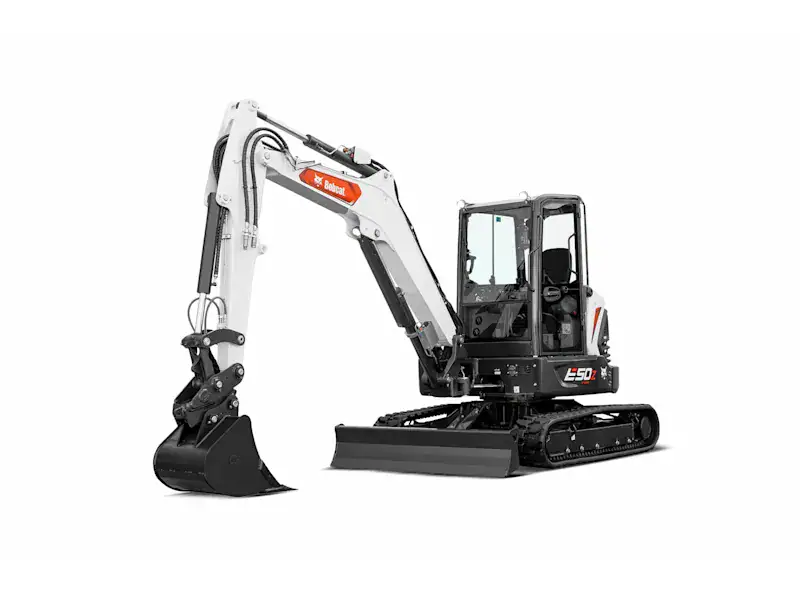
The Bobcat E50 is a five-ton class compact excavator in Bobcat’s R2-Series, built around a minimal tail swing design that lets it work in tight spaces where a conventional machine cannot. At 49.7 horsepower with an operating weight in the 11,357 to 11,894 lb range, it steps up from the four-ton class in power, weight, and lift, while keeping the maneuverability that makes compact excavators so useful close to buildings, fences, and obstacles. For a prairie owner or contractor who works in confined yards and around structures but still needs real digging capacity, the E50 combines reach and tight-quarters access in one machine.
What defines the E50 is that minimal tail swing, less than one inch of overhang, paired with a redesigned Bobcat engine, low-effort joysticks, and a hydraulic control valve tuned for finer grading. It can be configured with a long arm for extra dig depth, and optioned up with a 7-inch touch display, an enclosed cab with heat and air conditioning, a rearview camera, and an angle blade.
On Aglist, the focus is on where the E50 fits against the E42 and the rest of the Bobcat lineup, what the minimal tail swing really gives you, and what it offers a Canadian owner through prairie work.
Key Specifications
| Specification | Bobcat E50 |
|---|---|
| Class | Compact excavator (5-ton class) |
| Series | R2-Series |
| Horsepower | 49.7 hp |
| Engine | Kubota V2403-M diesel |
| Operating weight | 11,357 to 11,894 lb (by configuration) |
| Maximum dig depth | 11.4 ft standard, up to 12.7 ft with long arm |
| Arm digging force | ~6,987 lbf standard, ~5,962 lbf long arm |
| Bucket digging force | ~9,511 lbf |
| Rated lift capacity | ~6,746 lb standard, ~6,534 lb long arm |
| Tail swing | Minimal (less than 1 in overhang) |
| Fuel tank | 19 gal |
| Arm options | Standard, long arm |
| Blade | Standard, optional angle blade |
Specifications are drawn from Bobcat and dealer sources and vary by configuration. Confirm exact specs, arm and blade options, and current pricing with your dealer.
Minimal Tail Swing and What It Gives You
The E50’s defining feature is its minimal tail swing, and it is the main reason to choose it over a conventional machine.
Minimal tail swing means less than one inch of overhang as the machine slews, though the rear of the house still protrudes as much as 6 inches beyond the width of the tracks, which is worth knowing rather than assuming zero. Against a conventional tail swing machine, this gives you far more maneuverability in tight spaces: you can slew and deposit soil, reposition less, and work close to walls, fences, and buildings with much less worry about the counterweight contacting something behind you. For work along a building, between structures, near a property line, or in a confined yard, that access is the whole point of the machine, and it is what a conventional machine cannot offer.
The trade-off, as always, is that a minimal tail swing design balances the machine differently than a conventional one. Bobcat pairs it here with a five-ton class weight and strong digging forces, so the E50 keeps real capacity. If your work is mostly in open areas where tail swing is not a concern, the E42 with its conventional, balanced tail swing may give you slightly better lift for less machine. The honest way to choose between them is by where you work: tight spaces point to the E50, open areas to the E42.
Arm, Blade, and Cab Options
The E50 is configurable, and the options shape it to your work and comfort.
The standard arm digs to 11.4 ft, and the long arm increases that to as much as 12.7 ft while adding reach, at a small cost to digging force and lift, which is the usual trade for extra depth. For deep trenching and footings, the long arm reduces how often you reposition the machine.
On comfort and technology, the E50 can be optioned well beyond a basic machine. A 7-inch touch display adds higher sensitivity, durability, and phone connectivity, an enclosed cab with automatic heat and air conditioning makes long days and cold prairie mornings far more comfortable, and a rearview camera helps with visibility. The angle blade, which pivots for grading and backfill, has an upgraded, more durable upper edge in the R2-Series. A depth check system lets you monitor digging depth to a target and bench off a laser signal with optional laser receivers, which speeds up grading to a set depth. Matching these options to your work and climate is how you get the right E50.
How It Performs
The E50 pairs tight-quarters access with genuine digging capacity, and the R2-Series improvements sharpen it in daily use. The Kubota V2403-M engine, redesigned for the R2-Series, improves performance and simplifies maintenance with single-side serviceability, and the improved cooling system keeps it working and cools it quickly after shutdown. Low-effort joysticks reduce fatigue, and the hydraulic control valve gives finer metering and control for level grading, so the machine can do precise finish work as well as heavy digging.
Auto-shift travel transitions the travel motors between ranges automatically for better tractive effort without manual downshifting, and tie-down points and slew brakes that hold in any position make transport easier and safer. For a prairie owner, the E50’s strength is that it brings five-ton class digging and lift into spaces a larger or conventional machine cannot reach, which makes it a strong choice for yards, building sites, and confined work that still demands real capacity.
Best Applications
The E50 is a strong fit for:
- Work in confined spaces, close to buildings, fences, and property lines
- Trenching and footings where minimal tail swing avoids contacting obstacles
- Owners who want five-ton class digging and lift in a maneuverable machine
- Deeper digging with the long arm, and grading with the angle blade
- Operators who want cab comfort with heat and air conditioning for prairie seasons
For open-area work where tail swing is not a concern, the E42 may give better lift for less machine. The E50’s place is capable digging with the maneuverability that tight spaces demand.
Bobcat E50 Reviews & Ratings
On Aglist, open the Reviews & Ratings section on this page to see how the E50 performs in real Canadian conditions: how the minimal tail swing works out in tight spaces, how it digs and lifts for its class, how the cab and display options hold up through prairie seasons, and how the R2-Series engine and hydraulics perform over time. If you run an E50, your review helps the next prairie owner or contractor choose.
Frequently Asked Questions
How much does the Bobcat E50 weigh? Its operating weight ranges from about 11,357 to 11,894 lb depending on configuration, placing it in the five-ton compact excavator class, a step up from the four-ton E42.
How deep can the Bobcat E50 dig? The standard arm digs to 11.4 ft. With the long arm, dig depth increases to as much as 12.7 ft, adding reach at a small cost to digging force and lift capacity.
Does the Bobcat E50 have zero tail swing? It has minimal tail swing, less than one inch of overhang, though the rear still protrudes up to 6 inches beyond the tracks. This gives far more maneuverability in tight spaces than a conventional machine, while not being a true zero tail swing design.
What is the difference between the Bobcat E42 and E50? The E50 is larger, at 49.7 horsepower and five-ton class weight against the E42’s 42.6 horsepower and four-ton class, and it uses minimal tail swing for tight spaces. The E42 has a conventional, balanced tail swing that favors lift and stability in open work. Choose the E50 for confined spaces and more capacity, the E42 for open-area work and balanced lift.
What engine is in the Bobcat E50? The E50 uses a Kubota V2403-M naturally aspirated diesel, redesigned for the R2-Series, with features like single-side serviceability that simplify maintenance.
What options are available on the E50? Options include a long arm for more depth, an angle blade for grading and backfill, a 7-inch touch display with phone connectivity, an enclosed cab with heat and air conditioning, a rearview camera, and a depth check system that works with optional laser receivers.
Related
- Bobcat excavator buyer’s guide: how the Bobcat excavator range compares.
- Bobcat vs Kubota vs John Deere excavators: cross-brand comparison in the compact class.
Note: We try our best to keep specs and information accurate, but some details can be missing or different depending on the source. Before you buy, service, or repair equipment, please double-check key specs with the manufacturer, the owner’s manual, or your dealer.
About reviews: Reviews on Aglist are written by real users. We moderate them for spam and abuse, but opinions and claims are still personal, so use them as guidance, not as a guarantee.
Share your experience
Help other Canadian buyers — leave a quick review for the
Bobcat E50
There are no reviews yet. Be the first one to write one.