Overview & Specs
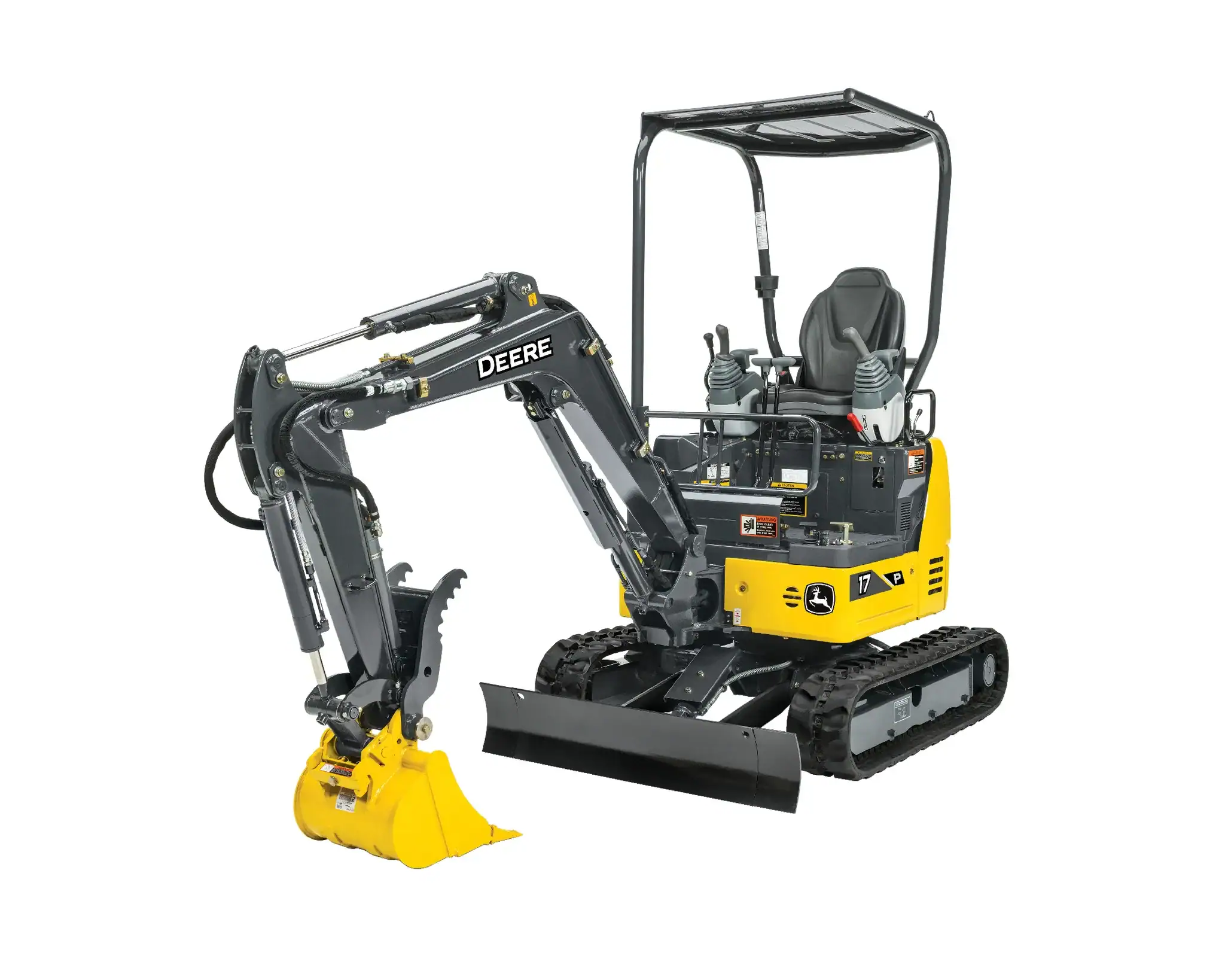
John Deere 17 P-Tier (17G) Mini Excavator
On This Page
ToggleIntroduction
The John Deere 17 P-Tier is the smallest compact excavator John Deere builds — a 1.7-tonne mini machine with a hydraulically retractable undercarriage that squeezes through narrow openings, then expands for stability when it’s time to dig. Formerly sold as the 17G (and still widely referred to that way), it’s the machine for tight-access work: landscaping in fenced yards, trenching between buildings, and light utility jobs where a full-size excavator simply can’t reach. Backed by John Deere’s 40-plus years of excavator manufacturing and its dealer-network strength, it’s a capable, transportable micro digger for prairie landscapers, rental fleets, and acreage owners.
On Aglist, the value is in understanding where the 17 P-Tier fits in the compact excavator market, with real owner and operator feedback beside the spec sheet. The numbers tell you what it digs; the reviews tell you how it handles in tight quarters, how the controls feel, and how it holds up. It competes directly with the Bobcat E17 and Kubota U17-5.
The 17 P-Tier uses a reduced-tail-swing design with a variable-width undercarriage — the combination that defines it. We explain why that matters below, since tail swing is the most important design feature on any compact excavator.
Configurations & Pricing Context
The 17 P-Tier is the entry point of John Deere’s compact excavator lineup, in the 1.7-tonne class. It’s the current P-Tier designation for what was the 17G — John Deere is transitioning its lineup to “P-Tier” naming across the board, and the two names refer to essentially the same machine (you’ll see both on the market). It comes as a ROPS/canopy machine with an optional four-season cab, mechanical quick-coupler, auxiliary hydraulics, and a foldable dozer blade that narrows with the undercarriage.
The 17 P-Tier runs buckets, augers, and hydraulic hammers scaled to its size, with a wedge-style coupler for fast changes. Its compact size and retractable tracks make it a strong rental and light-construction machine.
Pricing varies by configuration and dealer. Because Dmytro has direct knowledge of Saskatchewan dealer and used pricing, we defer to local market figures over manufacturer-advertised numbers.
Key Specifications
| Specification | John Deere 17 P-Tier (17G) |
|---|---|
| Machine class | Mini excavator |
| Also known as | John Deere 17G |
| Operating weight | ~3,790 lb (1,720 kg) |
| Weight class | 1.7 tonne |
| Tail swing | Reduced + variable-width undercarriage |
| Net power | ~14.5 hp |
| Engine | Yanmar Tier 4 Final (no aftertreatment) |
| Maximum dig depth | ~7 ft 2 in (2.19 m) — up to 7 ft 10 in (P-Tier) |
| Maximum lift capacity | ~1,032 lb |
| Undercarriage | Hydraulically retractable (variable width) |
| Dozer blade | Foldable (narrows with tracks) |
| Travel | Two-speed |
Specifications are verified against John Deere specification data and independent spec databases. The 17G and 17 P-Tier share essentially the same machine; confirm exact figures for the specific machine, year, and configuration with your dealer.
Understanding Tail Swing (Read This Before You Compare)
Tail swing is the most important design concept on any compact excavator, and John Deere’s compact line is built around minimizing it.
Tail swing describes how far the rear of the machine — the counterweight and engine housing — extends past the tracks when the upper structure rotates. The 17 P-Tier has a reduced-tail-swing design: the rear overhang is minimal, so the machine can rotate and work in tight quarters with far less risk of the tail striking walls, fences, or obstacles than a conventional machine. Combined with an independent swing boom (which lets the boom offset to dig parallel to a wall) and 360-degree rotation, it slips into close quarters and works around obstacles with ease.
This reflects John Deere’s whole compact-excavator philosophy: rather than splitting the lineup into tight-tail and conventional series, Deere designs its compact machines with reduced (or, on larger models, zero) tail swing by default — they’re built for close-quarters work. The 17 P-Tier adds a variable-width undercarriage on top: retract it to pass through narrow gates and doorways, then expand it for a stable digging stance. That combination of reduced tail swing plus retractable tracks makes it genuinely versatile in the tightest spaces.
Build & Engineering Detail
The 17 P-Tier runs a Yanmar Tier 4 Final diesel of about 14.5 horsepower — and importantly, it meets emissions without aftertreatment devices (no diesel particulate filter), which reduces maintenance and cost. For a small machine that works intermittently, avoiding regeneration cycles is a real uptime advantage.
The variable-width undercarriage is the machine’s core feature: it retracts hydraulically to fit through narrow paths, then repositions for stability without manual labour. The X-frame undercarriage resembles that of larger excavators, designed to shed dirt and debris from the track frames, and the rubber tracks have unique steel cores that resist cracking. Pilot-control levers give smooth control over boom, bucket, arm, and swing, and the control-pattern selector valve (under the seat, with a sight glass) switches between backhoe and excavator control styles with a twist.
Serviceability is practical: oil-impregnated bushings extend grease intervals (500 hours for the arm-boom joint), spin-on filters speed fluid changes, and a simple grease gun and wrench handle track tension. The optional four-season cab with glass front makes it usable year-round.
Best Applications
The 17 P-Tier is a strong fit for:
- Tight-access digging — the retractable undercarriage fits through narrow gates and paths where larger machines can’t go.
- Landscaping and light utility — trenching, grading, planting, and material handling in confined yards.
- Rental and light commercial use — compact, reliable, and easy to transport for “dig-and-go” jobs.
- Work near obstacles — reduced tail swing and swing boom allow digging close to walls and structures.
For deeper digging or heavier work, step up to a 26 or 30. On the prairies, it’s a capable light-duty and confined-space machine rather than a primary heavy digger.
How the 17 P-Tier Fits the John Deere Lineup
The 17 P-Tier is the smallest and lightest machine in John Deere’s compact excavator range, below the 26, 30, 35, 50, and 60. As the entry point, it’s built for maximum access and transportability — the machine for work where fitting in is the priority. It shares the reduced-tail-swing philosophy of the whole G-Series/P-Tier line, with the added retractable undercarriage that only the smallest machines offer.
John Deere 17 P-Tier Reviews & Ratings
On Aglist, open the Reviews & Ratings section on this page to see how the 17 P-Tier (17G) performs where it matters for a micro machine: access and maneuverability in tight quarters, digging performance at its size, control feel, reliability, and ease of transport. If you own a 17G or 17 P-Tier, your review helps the next prairie buyer judge this micro machine.
Frequently Asked Questions
Is the John Deere 17 P-Tier the same as the 17G? Essentially yes. John Deere is transitioning its lineup to “P-Tier” naming, and the 17 P-Tier is the current designation for what was the 17G. They refer to essentially the same 1.7-tonne machine; you’ll see both names on the market, with 17G common on used machines.
What is the operating weight of the John Deere 17 P-Tier? About 3,790 lb (1,720 kg), placing it in the 1.7-tonne class. It’s light enough to trailer easily and a strong rental option.
Can the John Deere 17 P-Tier fit through a gate? Yes — its hydraulically retractable (variable-width) undercarriage narrows to pass through narrow paths and gates, then expands for a stable digging stance. The foldable dozer blade narrows with the tracks.
How deep can the John Deere 17 P-Tier dig? Maximum dig depth is about 7 feet 2 inches (up to about 7 feet 10 inches on the P-Tier configuration), suiting landscaping, light utility, and trenching in tight spaces.
Does the John Deere 17 P-Tier have a DPF? No — its Yanmar Tier 4 Final engine meets emissions without aftertreatment devices (no diesel particulate filter), which reduces maintenance and avoids regeneration downtime.
How much can the John Deere 17 P-Tier lift? Maximum lift capacity is about 1,032 lb, though actual lifting varies with reach and angle. Check the lift chart for the positions you’ll use.
What attachments does the John Deere 17 P-Tier use? It runs buckets, augers, and hydraulic hammers scaled to its size, using a wedge-style mechanical quick-coupler for fast changes.
How does the 17 P-Tier compare to the Bobcat E17 and Kubota U17-5? All three are sub-2-tonne machines with retractable undercarriages for tight access. The Deere and Bobcat E17 both emphasize reduced/zero tail swing; the Kubota U17-5 is zero tail swing. The decision often comes down to dealer support, cab preference, and price. See the Bobcat E17 and Kubota U17-5 pages for comparison.
Related Models
- Compact & Mini Excavators — browse and compare excavators across all brands on Aglist.
- Bobcat E17 — a comparable sub-2-tonne machine from Bobcat, for cross-shopping.
- Kubota U17-5 — a comparable zero-tail-swing machine from Kubota, for cross-shopping.
Share your experience
Help other Canadian buyers — leave a quick review for the
John Deere 17 P-Tier (17G)
There are no reviews yet. Be the first one to write one.