
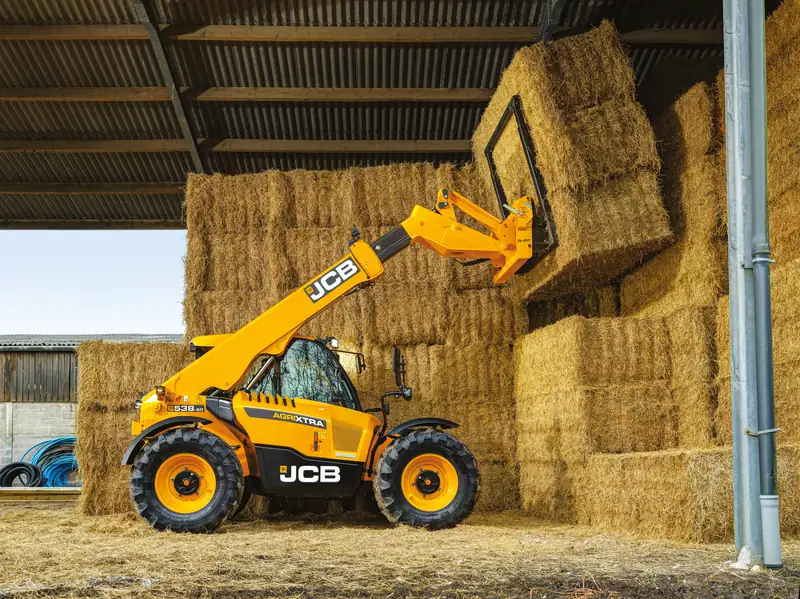

Introduction
JCB invented the telescopic handler in 1977, and nearly fifty years later the Loadall range spans fourteen agricultural models — from a 1.4-tonne machine that fits through a six-foot gap to a 6-tonne heavy-lift champion, and from a 4-metre compact to a 9.5-metre high-lift specialist. That range is a strength, but it makes choosing harder. For a Saskatchewan grain farm loading trucks, an Alberta livestock operation working low sheds, or a Manitoba mixed farm stacking bales, the right Loadall depends on questions most spec sheets don’t answer clearly.
This guide works through those questions in the order that actually narrows the field: how to read a load chart (the single most misunderstood thing about telehandlers), how to decode JCB’s model numbers, whether you need a compact or full-size machine, what the AGRI trim levels really mean, and how the specialist machines differ. We’ll point you to every JCB Loadall model along the way and finish with a full comparison table.
The most important thing you’ll take from this guide: maximum capacity and maximum lift height never happen at the same time. Understanding that one fact — and matching the load chart to your actual work — matters more than any headline number on any brochure. Let’s start there.
First, Understand the Load Chart (This Is the Whole Game)
If you read nothing else in this guide, read this section. It’s the difference between a machine that does your job and one that frustrates you daily.
Every telehandler has two headline numbers: maximum lift capacity and maximum lift height. These two numbers do not occur simultaneously. As the boom extends up and out, the load moves farther from the machine’s center of gravity, and safe lifting capacity drops — often dramatically. The full capacity is available only at low height and close reach.
The load chart is the diagram showing how much a machine can safely lift at every combination of height and forward reach. It’s the machine’s real capability, and it’s what you should be comparing.
JCB’s own figures make this concrete. On the compact 525-60, the machine lifts about 5,500 lb with the boom retracted, about 3,000 lb at full height, and about 1,650 lb at 10 feet 10 inches of forward reach. Same machine, three very different numbers. On the flagship 542-70, the full 4.2-tonne capacity is available low and close — but about 2.7 tonnes at the full 7-metre height.
So the buying question is never “how much does it lift?” It’s “how much does it lift at the height and reach where I actually work?” Measure your real tasks — the height you stack bales, the reach over a truck side, the weight of your heaviest load — and check the load chart at those points. A machine with a lower headline number that lifts more in yourworking envelope is the better machine for you.
This single insight is why the specialist machines exist, and why buying by headline number leads people wrong. We’ll return to it throughout.
Decoding JCB Model Numbers
JCB’s naming is logical once you know the code, and it tells you the two things that matter most.
The format is [capacity][height]. The first digits are lift capacity in hundreds of kilograms; the last two are maximum lift height in metres.
- 514-40 = 1.4 tonnes capacity, 4 metre lift height
- 525-60 = 2.5 tonnes, 6 metres
- 532-70 = 3.2 tonnes, 7 metres
- 542-70 = 4.2 tonnes, 7 metres
- 536-95 = 3.6 tonnes, 9.5 metres
- 560-80 = 6.0 tonnes, 8 metres
Once you know your required capacity and height, the model numbers point you straight to the candidates. Remember: the capacity figure is the maximum (low and close), not what you get at full height.
Question 1: Compact or Full-Size?
This is the first real fork, and it’s decided by your buildings and your yard — not by how much you want to lift.
Compact Loadalls (Access First)
JCB’s compact range prioritizes getting into places bigger machines can’t. The 514-40 is the smallest telehandler JCB builds — under 6 feet wide and about 6 feet tall, it fits through a standard 6-foot gap, down narrow livestock aisles, and under low ceilings. The 516-40 and 520-40 add capacity (1.6 and 2.0 tonnes) at the same 4-metre height, with the 520-40 topping the 4-metre compact group.
The 525-60 (sold as the 525-60 Hi-Viz) is the compact range’s all-rounder — it adds a genuine 6-metre lift height and a full-size cab with industry-leading visibility, plus 74 horsepower and three steering modes, while staying about 6 feet wide. For many prairie operations, it’s the sweet spot: real stacking height with compact access.
The 530-60 (AGRI Super) is a special case — a livestock specialist. It brings 130 horsepower and 3-tonne capacity into a machine just 2.0 metres tall on 20-inch tyres, purpose-built to work beneath raised feeders and drinkers in pig, poultry, and dairy sheds, with the traction to bulldoze litter.
Choose compact if: you work in low or narrow buildings, your yard is tight, your gates are small, or livestock sheds are central to your operation. Access is the constraint compact machines solve.
Full-Size Loadalls (Capability First)
The full-size Series III AGRI range steps up to serious everyday capability — bigger chassis, the CommandPlus cab (best-in-class space, 69 dBA noise, improved visibility), and far more lifting muscle. The 532-60 is the smallest and most maneuverable full-size machine (3.2 tonnes, 6.2 metres) — the natural first step up from a compact or a tractor loader.
Choose full-size if: your buildings and yard accommodate a bigger machine, and you need real capacity, reach, and cab comfort for long working days. Most working grain and mixed farms land here.
Question 2: How High Do You Need to Lift?
Within full-size, height is the next fork — and it’s a genuine trade-off, not a free upgrade.
6-Metre Machines (Capacity-Focused)
The 532-60 (3.2 t) and 538-60 (3.8 t) work at about 6 metres. The 538-60 is the capacity-focused choice: more lift at a similar height, for operations that handle heavy loads more often than they reach high. If your stacking and loading happen below 6 metres, these machines give you more capacity for your money than a taller boom would.
7-Metre Machines (The Core Range)
Seven metres (23 feet) is where most working prairie farms land, and JCB fields the most choice here:
- 532-70 (3.2 t) — reach-focused, the lighter, more affordable 7-metre machine
- 538-70 (3.8 t) — the balanced do-it-all: high capacity and tall reach, avoiding the compromise
- 542-70 (4.2 t) — the long-standing flagship, and in AGRI Pro form JCB’s most powerful and fastest Loadall ever (173 hp, 690 Nm, 50 km/h, DualTech VT)
- 546-70 (4.6 t) — new for 2025: 8.7% more capacity than the 542-70 with no increase in machine size, plus greater tear-out force. JCB positions it as the sensible all-rounder for mixed, livestock, and dairy farms
- 555-70 (5.5 t) — new for 2025: an all-new N-shaped boom and uprated axles deliver nearly 24% more lift than the 542-70, for bulk handling that once demanded a wheel loader
If you’re buying new in this class, the 546-70 and 555-70 deserve a hard look — they deliver more capability in the same agile footprint as the machines they replace.
Question 3: Do You Need a Specialist Machine?
Two Loadalls sit outside the general-purpose range, and they represent opposite answers to the same question. Understanding the difference will save you from an expensive mistake.
The 536-95: Buy It for Height, Not Weight
The 536-95 reaches 9.49 metres (31 feet) — far beyond any standard machine. It’s a long-standing favourite for bale handling, because when storage capacity depends on stack height, reach is everything.
But here’s the honest caveat, and it matters: its 3.6-tonne headline capacity drops sharply at full extension. At 9 metres, you have a fraction of that. Buy the 536-95 because you need to reach high — and check the load chart at yourtarget stacking height to confirm it lifts your bale weight there. If you rarely stack above 6 or 7 metres but often lift heavy, a 538-70 or 546-70 will serve you far better.
The 560-80: Buy It for Weight, Not Height
The 560-80 is the mirror image — the highest-capacity agricultural Loadall JCB builds, lifting a full 6 tonnes (about 12,000 lb) to 8 metres. It’s built for bulk grain, dense square bales, heavy muck, and wheel-loader-class work in a telehandler package. Its higher base capacity carries through the whole load chart, so at any given height it typically lifts more than any other Loadall.
The trade-offs: it’s heavier, and its travel speed (33–37 km/h, tyre dependent) is modestly lower than the 40 km/h range.
The rule: if height is your constraint → 536-95. If weight is your constraint → 560-80. They are not interchangeable, and choosing wrong is costly.
Question 4: Which AGRI Trim Level?
JCB offers most Loadalls in escalating specification packages. These aren’t different machines — same capacity, same height — but they change power, transmission, and features.
The ladder runs AGRI → AGRI Super → AGRI Xtra → AGRI Pro, with availability varying by model:
- AGRI — the base specification, with a Powershift transmission
- AGRI Super — adds features and, critically, DualTech VT availability
- AGRI Xtra — higher power and equipment; Sway Control becomes available on newer models
- AGRI Pro — top-spec: maximum power, High Speed DualTech VT (50 km/h), full feature access
The key upgrade is DualTech VT — JCB’s transmission and the world’s first 2-in-1 (hydrostatic plus powershift) system built for agricultural machines. Hydrostatic drive gives precise, progressive control up to 22 km/h (ideal for yard work and running attachments); mechanical powershift takes over for efficient travel up to 50 km/h. It transitions automatically. If you move between yards and fields often, or run hydraulic attachments (silage feeders, straw processors, sweepers) regularly, DualTech VT is worth the step up.
On the new 546-70, the three packages map to power directly: AGRI Super (130 hp), AGRI Xtra (150 hp), AGRI Pro (173 hp). The 555-70 comes in AGRI Xtra and AGRI Pro.
What All JCB Loadalls Share
Whichever model you choose, several JCB signatures carry across the range:
Single side-entry boom. The boom sits on one side of the operator rather than overhead, and JCB mounts it lower in the chassis than competitors — improving shoulder-level visibility and giving a more secure structure.
CommandPlus cab (full-size machines). Best-in-class space (12% larger), noise down to 69 dBA, and improved upward visibility through one-piece curved glazing — which matters more than you’d think when you spend the day looking up at a load.
Smart Hydraulics. Regenerative circuits harness gravity for faster, more efficient boom lowering (JCB cites up to 15% fuel savings and 20% better cycle times), plus boom-end damping for load retention and auto bucket control.
Q-fit self-levelling carriage, three steering modes (two-wheel, four-wheel, crab), 4WD, and an eye-level load moment indicator that continuously monitors forward stability.
LiveLink telematics for fleet monitoring, service alerts, and DPF regeneration tracking.
On the newest machines (546-70, 555-70), JCB adds IntelliAssist (programmable boom movements — return-to-dig, return-to-load) and IntelliWeigh (real-time load weighing from hydraulic pressure and boom angle, no calibration, reported via LiveLink — useful for loading trailers to exact weights).
Quick Recommendations by Prairie Use Case
- Poultry, pig, or dairy sheds (low, narrow): 530-60 AGRI Super — purpose-built, 2.0 m tall, with real power to push litter.
- Tightest access (gates, low barns, narrow aisles): 514-40 — the smallest Loadall built.
- Compact all-rounder with real stacking height: 525-60 Hi-Viz — 6-metre lift, full-size cab, compact footprint.
- First full-size machine (moving up from a loader): 532-60 — the most maneuverable full-size Loadall.
- Everyday mixed farm workhorse (new): 546-70 — more capacity than the 542-70, same agile size.
- Balanced capacity and reach: 538-70 — high capacity and 7-metre height.
- Maximum power and road speed: 542-70 AGRI Pro — 173 hp, 50 km/h.
- Bulk handling without a wheel loader: 555-70 — 5.5 tonnes, N-shaped boom.
- Maximum stack height: 536-95 — 9.5-metre reach.
- Maximum lifting capacity: 560-80 — 6 tonnes.
Full JCB Loadall Comparison Chart
The entire agricultural Loadall range in one view. Remember: the capacity figure is the maximum (at low height and close reach) — always consult the load chart for capacity at your working height.
| Model | Class | Capacity | Lift Height | Power | Best For |
|---|---|---|---|---|---|
| 514-40 | Compact | 1.4 t | 4.0 m | ~25 hp | Tightest access, fits 6-ft gap |
| 516-40 | Compact | 1.6 t | 4.0 m | ~25 hp | Confined spaces, a bit more lift |
| 520-40 | Compact | 2.0 t | 4.0 m | ~25 hp | Top of the 4-metre compacts |
| 525-60 | Compact | 2.5 t | 6.0 m | 74 hp | Compact all-rounder, full cab |
| 530-60 | Livestock | 3.0 t | 5.97 m | 130 hp | Pig/poultry/dairy sheds (2.0 m tall) |
| 532-60 | Full-size | 3.2 t | 6.2 m | 109–145 hp | First full-size, most maneuverable |
| 538-60 | Full-size | 3.8 t | 6.0 m | 109–145 hp | Capacity at practical height |
| 532-70 | Full-size | 3.2 t | 7.0 m | 109–145 hp | Reach-focused, affordable |
| 538-70 | Full-size | 3.8 t | 7.0 m | 109–145 hp | Balanced capacity + reach |
| 542-70 | Flagship | 4.2 t | 7.0 m | up to 173 hp | Power and speed (AGRI Pro) |
| 546-70 | Full-size (new) | 4.6 t | 7.0 m | 130/150/173 hp | Everyday all-rounder, more lift |
| 555-70 | Full-size (new) | 5.5 t | 7.0 m | 150/173 hp | Bulk handling, N-shaped boom |
| 536-95 | High-lift | 3.6 t | 9.49 m | 109–145 hp | Maximum height |
| 560-80 | Heavy-lift | 6.0 t | ~8.0 m | 125–145 hp | Maximum capacity |
Frequently Asked Questions
Which JCB telehandler should I buy?
It depends on three things, in order: your buildings (compact or full-size?), your required lift height, and — critically — the capacity you need at that height, read from the load chart. For most working prairie farms, a 7-metre full-size machine like the 546-70 or 538-70 covers the work. For livestock sheds, the 530-60. For maximum height, the 536-95; for maximum weight, the 560-80.
What do JCB Loadall model numbers mean?
The first digits are lift capacity in hundreds of kilograms; the last two are maximum lift height in metres. A 542-70 lifts 4.2 tonnes to 7 metres; a 514-40 lifts 1.4 tonnes to 4 metres. The capacity figure is the maximum, available at low height and close reach — not at full extension.
How do I read a telehandler load chart?
It shows how much the machine lifts safely at every combination of boom height and forward reach. Capacity drops as the boom extends up and out. Find the height and reach where you actually work, and read the capacity there — that number, not the headline maximum, tells you whether the machine does your job.
What is DualTech VT?
JCB’s transmission, and the world’s first 2-in-1 (hydrostatic plus powershift) system designed for agricultural machines. Hydrostatic gives precise control up to 22 km/h for yard and attachment work; powershift takes over for efficient travel up to 50 km/h. It’s available on AGRI Super, AGRI Xtra, and AGRI Pro specifications, and is the main reason to step up a trim level.
What’s the difference between AGRI, AGRI Super, AGRI Xtra, and AGRI Pro?
They’re specification packages, not different machines — the capacity and lift height stay the same. Moving up the ladder adds power, features, and transmission options. AGRI is the base (Powershift); AGRI Super and above unlock DualTech VT; AGRI Pro is top-spec, with maximum power and the 50 km/h High Speed DualTech VT.
Which JCB Loadall lifts the most?
The 560-80, with a 6-tonne (about 12,000 lb) maximum capacity — the highest of any agricultural Loadall. The new 555-70 is close behind at 5.5 tonnes in a more agile 7-metre package.
Which JCB Loadall reaches the highest?
The 536-95, reaching 9.49 metres (about 31 feet) — the high-lift specialist, long favoured for bale stacking. Note that its capacity at full extension is far below its 3.6-tonne headline maximum, so confirm the load chart at your target height.
What’s new in the JCB Loadall range?
The 546-70 and 555-70, launched in late 2025. The 546-70 lifts 4.6 tonnes (8.7% more than the 542-70) with no increase in machine size; the 555-70 lifts 5.5 tonnes via an all-new N-shaped boom and uprated axles. Both introduce IntelliAssist (programmable boom movements) and IntelliWeigh (real-time load weighing).
Which JCB telehandler is best for livestock sheds?
The 530-60 AGRI Super — purpose-built for pig, poultry, and dairy buildings. On 20-inch tyres it stands just 2.0 metres tall (fitting beneath raised feeders and drinkers), yet carries 130 horsepower and 3-tonne capacity, with 25% more tractive effort for bulldozing litter. For the very tightest aisles, the 514-40 is smaller still.
Should I buy a compact or full-size JCB telehandler?
Let your buildings decide, not your ambition. If you work in low sheds, narrow aisles, or tight yards, a compact machine (514-40 through 525-60, or the livestock-focused 530-60) gets in where a full-size machine can’t. If your yard and buildings have room, full-size machines offer far more capacity, reach, and cab comfort. A machine that can’t reach the job is worthless, however much it lifts.
Compare Across Brands
This guide covers choosing within the JCB range, but many prairie buyers also cross-shop Manitou, New Holland, Case IH, and others. To browse and compare agricultural telehandlers across all brands, visit the Agricultural Telehandlers hub on Aglist. To explore JCB’s full equipment lineup beyond telehandlers — backhoe loaders, excavators, skid steers, and more — see the JCB brand hub.
Note: We try our best to keep specs and information accurate, but some details can be missing or different depending on the source. Load capacities vary across the machine’s working envelope — always consult the specific machine’s load chart. Before you buy, service, or repair equipment, please double-check key specs with the manufacturer, the owner’s manual, or your dealer.
About reviews: Reviews on Aglist are written by real users. We moderate them for spam and abuse, but opinions and claims are still personal—so use them as guidance, not as a guarantee.
