Overview & Specs
JCB 516-40 Compact Telehandler
On This Page
ToggleIntroduction
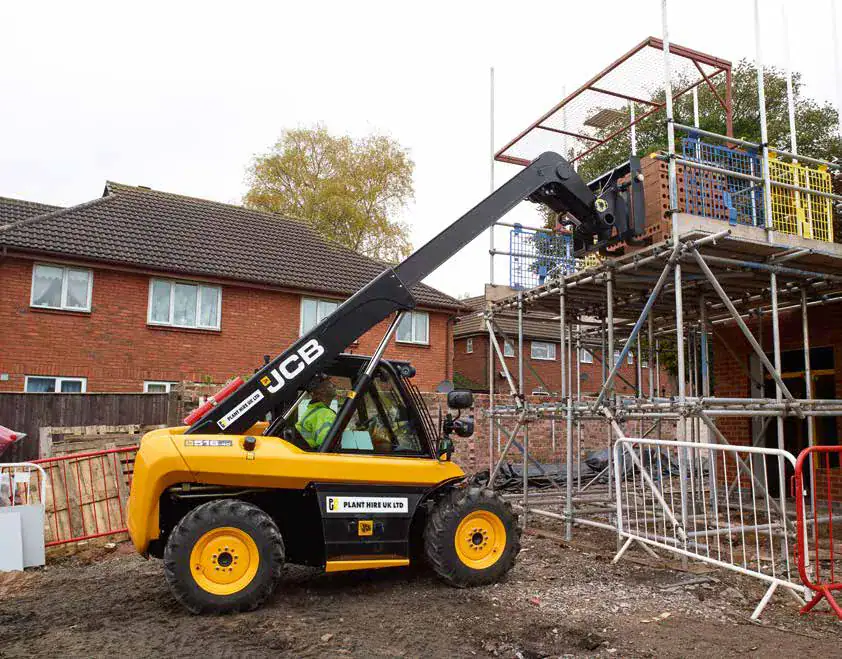
The JCB 516-40 is a compact Loadall that steps up slightly from the smallest 514-40 with more lifting capacity — 1.6 tonnes to a 4-metre height — while keeping the tight dimensions that let it work in confined farm spaces. It’s built for the same job the compact range does best: bringing telescopic-handler reach and versatility into narrow yards, low barns, and livestock buildings where a full-size machine can’t fit. With a slightly larger engine and single-lever control, it’s a capable, maneuverable machine for prairie operations that need real telehandler capability in a compact footprint, from the brand that invented the category.
On Aglist, the value is in understanding where the 516-40 fits in the agricultural telehandler market, with real owner and operator feedback beside the spec sheet. The numbers tell you what it lifts; the reviews tell you how it handles in tight spaces, how the controls feel, and how it holds up. It sits within JCB’s compact Loadall range between the 514-40 and 520-40.
As with any telehandler, the load chart is the most important thing to understand — how much the machine lifts at a given height and reach. We explain that below.
Configurations & Pricing Context
The 516-40 is part of JCB’s compact Loadall range, in the 1.6-tonne class with a 4-metre lift height. It’s a ROPS/FOPS-certified machine with 4WD, single-lever joystick control, and JCB’s Q-fit carriage for pallet forks, buckets, and other attachments. Its larger-displacement Perkins diesel gives it a bit more capability than the 514-40 while staying compact.
The 516-40 runs pallet forks, bale spikes, buckets, and other attachments via single or double auxiliary services. It’s suited to tight-access farm work — livestock buildings, low barns, and confined yards.
Pricing varies by configuration, attachments, and dealer. Because Dmytro has direct knowledge of Saskatchewan dealer and used pricing, we defer to local market figures over manufacturer-advertised numbers.
Key Specifications
| Specification | JCB 516-40 |
|---|---|
| Machine class | Compact telehandler |
| Maximum lift capacity | 1.6 tonne (~3,527 lb) |
| Maximum lift height | 4.0 m (~13 ft 1 in) |
| Engine | Perkins 403J-17 diesel |
| Engine power | ~18.4 kW (~25 hp) |
| Displacement | 1.7 L, 3-cylinder |
| Hydraulic flow | ~40 L/min |
| Drive | 4WD |
| Joystick | Single lever |
| Carriage | JCB Q-fit |
| Certification | ROPS / FOPS |
Specifications are verified against JCB specification data and independent spec databases. Confirm exact figures for the specific machine, year, and configuration with your dealer, and always consult the load chart for capacity at a given height and reach.
Understanding the Load Chart (Read This First)
On any telehandler, the load chart is the most important spec to understand, and the 516-40 is no exception.
The 516-40’s headline figures are a 1.6-tonne maximum capacity and a 4-metre maximum lift height — but those don’t occur simultaneously. The load chart shows how much the machine lifts safely at every combination of height and forward reach, and capacity drops as the boom extends up and out, because the load moves farther from the machine’s center of gravity. The full 1.6 tonnes is available low and close; at height or reach, safe capacity is lower.
The practical approach: match your real tasks to the chart. Stacking bales, loading a trailer, placing feed — check what the 516-40 lifts at that specific height and reach, not just the maximum. The 516-40’s role is compact, maneuverable handling, so its load chart rewards tasks where access matters as much as lift. Its slightly higher capacity than the 514-40 gives it a bit more headroom for the same kind of confined-space work.
Build & Engineering Detail
The 516-40 shares the compact range’s design focus — telehandler capability in a tight package — with a step up in capability over the 514-40. Its Perkins 1.7-litre three-cylinder diesel and higher hydraulic flow (about 40 L/min versus the 514-40’s 23) give it more productive performance for attachment work and lifting, while the single-lever joystick simplifies control. 4WD provides traction on prairie ground.
The Q-fit carriage accepts JCB’s range of attachments, single and double auxiliary services run hydraulic tools, and the high-tensile-steel boom with low-maintenance wear pads is built to last. ROPS and FOPS certification protects the operator, and the compact cab prioritizes visibility for tight work.
Like the rest of the compact range, the 516-40’s value is its dimensions — small enough for narrow aisles, gates, and low buildings, making it well suited to livestock sheds and older, tighter farm structures where reach and maneuverability both matter.
Best Applications
The 516-40 is a strong fit for:
- Tight-access livestock and yard work — narrow aisles, low barns, and confined spaces.
- Bale, feed, and bedding handling — compact handling with a bit more capacity than the 514-40.
- Older or restricted farm buildings — where dimensions matter as much as lift.
- Operations wanting compact reach with modest extra capability — a step up from the smallest Loadall.
It is a compact, light-duty machine. For higher stacking, heavier loads, or more reach, step up to the 520-40, 525-60 Hi-Viz, or a full-size Loadall. Its niche is confined-space handling with slightly more muscle than the entry machine.
How the 516-40 Fits the JCB Loadall Range
The 516-40 sits in JCB’s compact Loadall range between the smallest 514-40 and the 520-40, offering a bit more lifting capacity while keeping the compact dimensions that define the range. Above it, the 525-60 Hi-Viz adds a taller 6-metre lift, and the full-size AGRI Loadalls step up to serious capability. It’s the choice for buyers who want compact access with slightly more capacity than the entry machine. Explore the full range on the JCB brand hub.
JCB 516-40 Reviews & Ratings
On Aglist, open the Reviews & Ratings section on this page to see how the 516-40 performs where it matters: access and maneuverability, lifting for its size, visibility, reliability, and ease of use. If you own a 516-40, your review helps the next prairie buyer judge this compact Loadall.
Frequently Asked Questions
How much can the JCB 516-40 lift? Maximum lift capacity is 1.6 tonnes (about 3,527 lb) to a maximum height of 4 metres (about 13 feet). Full capacity is available at low height and close reach; capacity decreases as the boom extends, so consult the load chart for your tasks.
What’s the difference between the JCB 516-40 and the 514-40? The 516-40 has more lifting capacity (1.6 tonnes vs 1.4) and a larger engine (1.7 L vs 1.1 L) with higher hydraulic flow, plus single-lever control. Both share the compact range’s tight dimensions. The 516-40 offers a bit more capability for the same confined-space work.
What engine does the JCB 516-40 have? A Perkins 403J-17 diesel — a 1.7-litre three-cylinder engine of about 25 horsepower, with higher hydraulic flow than the smaller 514-40 for better attachment performance.
Can the JCB 516-40 work in low farm buildings? Yes — its compact dimensions suit narrow aisles, low barns, and livestock buildings, bringing telehandler reach into spaces larger machines can’t access.
What attachments does the JCB 516-40 use? It uses JCB’s Q-fit carriage, accepting pallet forks, bale spikes, buckets, and other attachments, with single or double auxiliary services for hydraulic tools.
Is the JCB 516-40 4WD? Yes — 4WD is standard, providing traction on muddy or uneven prairie ground, and it uses single-lever joystick control for simplicity.
Should I choose the 516-40 or step up to the 525-60 Hi-Viz? The 525-60 Hi-Viz offers a taller 6-metre lift height, more capacity (2.5 tonnes), and a full-size cab with a more powerful engine. If you need to stack higher or lift more, it’s the step up; if compact dimensions and modest capability suit your work, the 516-40 is lighter and simpler.
Related Models
- Agricultural Telehandlers — browse and compare telehandlers across all brands on Aglist.
- JCB 514-40 — the smallest Loadall, one step down in capacity.
- JCB brand hub — explore the full JCB equipment lineup.
Share your experience
Help other Canadian buyers — leave a quick review for the
JCB 516-40
There are no reviews yet. Be the first one to write one.