Overview & Specs
JCB 560-80 Telehandler
On This Page
ToggleIntroduction
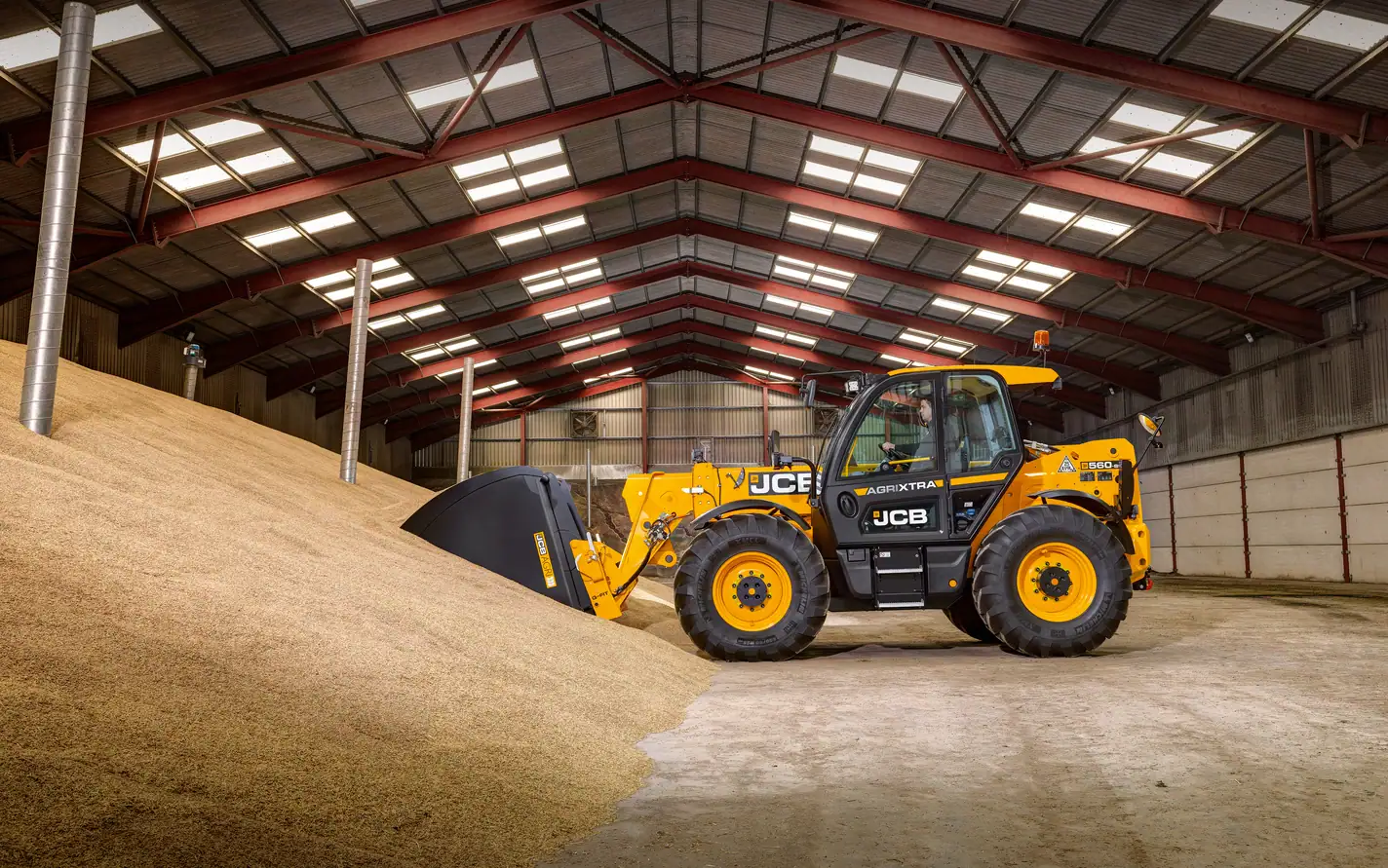
The JCB 560-80 is the heavy-lift champion of the agricultural Loadall range — the highest-capacity machine JCB builds for farming, lifting a full 6 tonnes (roughly 12,000 lb) to an 8-metre (26-foot) height. Where the rest of the range balances capacity, reach, and agility, the 560-80 is unapologetically about muscle: moving the heaviest loads, handling bulk grain and muck at volume, stacking dense square bales, and doing the work that would otherwise demand a wheel loader — while retaining a telehandler’s reach and placement precision. For large prairie grain operations and contractors handling serious tonnage, it’s the top of JCB’s agricultural lineup, from the brand that invented the telescopic handler.
On Aglist, the value is in understanding where the 560-80 fits in the agricultural telehandler market, with real owner and operator feedback beside the spec sheet. The numbers tell you what it lifts; the reviews tell you how it handles under maximum load, how stable it feels, and how it holds up under heavy daily use. It’s the highest-capacity machine in JCB’s agricultural Loadall range.
As with any telehandler, the load chart is the most important thing to understand — how much the machine lifts at a given height and reach. We explain that below.
Configurations & Pricing Context
The 560-80 is the highest-capacity machine in JCB’s agricultural Loadall range, in the 6-tonne class with an 8-metre lift height. It’s built around the CommandPlus cab with single-lever servo joystick control, all-wheel steering with three modes, and JCB’s Q-fit self-levelling carriage, powered by a DieselMAX engine with Smart Hydraulics. Its travel speed is 33–37 km/h depending on tyre choice — slightly lower than the rest of the range, reflecting its heavier build.
The 560-80 runs the full range of agricultural attachments via its hydraulics, with hydraulic auxiliary venting for quick changes. Its capacity suits the heaviest bulk-handling work on large operations.
Pricing varies by configuration, attachments, and dealer. Because Dmytro has direct knowledge of Saskatchewan dealer and used pricing, we defer to local market figures over manufacturer-advertised numbers.
Key Specifications
| Specification | JCB 560-80 |
|---|---|
| Machine class | Heavy-lift agricultural telehandler |
| Maximum lift capacity | 6.0 tonne (~12,000 lb) |
| Maximum lift height | ~8.0 m (~26 ft) |
| Engine | JCB DieselMAX |
| Engine power | ~125–145 hp depending on spec |
| Transmission | Powershift / DualTech VT (spec dependent) |
| Top speed | ~33–37 km/h (tyre dependent) |
| Steering | All-wheel steer, three modes |
| Carriage | JCB Q-fit self-levelling |
| Cab | CommandPlus (69 dBA) |
| Hydraulics | JCB Smart Hydraulics (regenerative) |
Specifications are verified against JCB specification data and independent spec databases. Confirm exact figures for the specific machine, year, and configuration with your dealer, and always consult the load chart for capacity at a given height and reach.
Understanding the Load Chart (Read This First)
On any telehandler, the load chart is the most important spec to understand — and even on the highest-capacity machine in the range, capacity varies across the working envelope.
The 560-80’s headline figures are a 6-tonne maximum capacity and an 8-metre lift height — but those don’t happen at the same time. The load chart shows how much the machine lifts safely at every combination of height and forward reach, and capacity drops as the boom extends up and out. The full 6 tonnes is available at low height and close reach; at the full 8-metre height, or reaching well forward, safe capacity is lower.
That said, the 560-80’s advantage is exactly that its higher base capacity carries through the chart — at any given height and reach, it typically lifts more than any other agricultural Loadall. For the heaviest prairie tasks (bulk grain, dense square bales, heavy muck, loaded pallets), that extra headroom throughout the working range is the reason to choose it. As always, confirm the capacity at your specific working height and reach rather than relying on the 6-tonne maximum alone.
Build & Engineering Detail
The 560-80 is built to lift heavy, and its engineering reflects that priority. As the highest-capacity agricultural Loadall JCB builds, it uses a heavier, more robust chassis and driveline to handle 6-tonne loads, with the DieselMAX engine (part of JCB’s fully in-house drivetrain) providing power and torque. Its travel speed of 33–37 km/h (tyre dependent) is modestly lower than the 40 km/h of lighter machines — a straightforward consequence of the heavier build and higher capacity.
The CommandPlus cab provides best-in-class space (12% larger), a 69 dBA noise level, and improved all-round and upward visibility through one-piece curved glazing — comfortable for the long, heavy days this machine is built for. Single-lever servo control with proportional auxiliaries keeps operation precise even under maximum load.
Smart Hydraulics brings regenerative boom lowering (harnessing gravity to speed cycles and save fuel — meaningful when moving high tonnages), boom-end damping for load retention (important with heavy loads), and auto bucket control for metering material. All-wheel steering with three modes (two-wheel, four-wheel, crab) keeps it maneuverable despite its size, and an eye-level load moment indicator continuously monitors forward stability — essential on a machine routinely working near high capacities.
Best Applications
The 560-80 is a strong fit for:
- Maximum-capacity bulk handling — bulk grain, muck, and heavy materials at volume on large operations.
- Dense square bale handling — the heaviest bales, stacked with capacity to spare.
- Wheel-loader-class work in a telehandler — retaining reach and placement precision at loader-like capacity.
- Large grain operations and contractors — the top of JCB’s agricultural lineup, for serious tonnage.
For more agility with strong capacity, the new 555-70 (5.5 tonnes, 7-metre) is lighter and faster; for maximum reach instead of capacity, the 536-95 (9.5-metre) is the high-lift specialist. The 560-80’s niche is unmatched capacity in the agricultural Loadall range — buy it when you need to lift the most.
How the 560-80 Fits the JCB Loadall Range
The 560-80 sits at the top of JCB’s agricultural Loadall range as the highest-capacity machine, lifting a massive 6 tonnes — more than any other agri Loadall. It stands opposite the high-lift 536-95 (which maximizes reach at 9.5 metres rather than capacity) and above the new 555-70 (5.5 tonnes, 7 metres, more agile). Where the compact Loadalls prioritize access and the mid-range machines balance capability, the 560-80 exists to lift the heaviest loads. It’s the choice for large operations where capacity is the constraint. Explore the full range on the JCB brand hub.
JCB 560-80 Reviews & Ratings
On Aglist, open the Reviews & Ratings section on this page to see how the 560-80 performs where it matters for a heavy-lift machine: lifting capacity under maximum load, stability when working near capacity, cab comfort during long heavy days, hydraulic performance with big attachments, fuel efficiency under load, and reliability. If you own a 560-80, your review helps the next prairie buyer judge JCB’s heaviest agricultural Loadall.
Frequently Asked Questions
How much can the JCB 560-80 lift? Maximum lift capacity is 6 tonnes (about 12,000 lb) — the highest of any agricultural Loadall JCB builds — to a lift height of around 8 metres (about 26 feet). Full capacity is available at low height and close reach; capacity decreases as the boom extends, so consult the load chart for your specific tasks.
What is the highest-capacity JCB agricultural telehandler? The 560-80, with a 6,000 kg (6-tonne) lift capacity. It’s the top of JCB’s agricultural Loadall range for lifting capacity, built for the heaviest bulk-handling work.
Is the JCB 560-80 slower than other Loadalls? Slightly — its travel speed is 33–37 km/h depending on tyre choice, compared to 40 km/h on lighter machines (and 50 km/h on AGRI Pro versions of some models). That’s a straightforward consequence of its heavier build and much higher lifting capacity.
Can the JCB 560-80 replace a wheel loader? For many bulk-handling tasks, yes — its 6-tonne capacity approaches loader territory while retaining a telehandler’s telescopic reach and placement precision (reaching over trailer sides, into bins, onto high stacks), which a wheel loader can’t match. Whether it fully replaces a loader depends on your volume and the nature of the work; check the load chart against your heaviest regular tasks.
Should I choose the JCB 560-80 or the 555-70? The 560-80 lifts more (6 tonnes vs 5.5) to a taller height (8 m vs 7 m), as the range’s capacity champion. The new 555-70 is lighter, faster, and more agile while still offering strong 5.5-tonne capacity. Choose the 560-80 for maximum capacity; the 555-70 if you want heavy capacity with better agility and road speed.
Should I choose the 560-80 or the high-lift 536-95? They serve opposite purposes. The 560-80 maximizes capacity (6 tonnes) at 8 metres; the 536-95 maximizes reach (9.5 metres) with a much lower 3.6-tonne capacity. If you need to lift heavy, choose the 560-80; if you need to stack high, choose the 536-95. Match the load chart to whether weight or height is your real constraint.
What engine does the JCB 560-80 have? A JCB DieselMAX engine, in the region of 125–145 horsepower depending on specification, part of JCB’s fully in-house drivetrain, paired with a Powershift or DualTech VT transmission.
Related Models
- Agricultural Telehandlers — browse and compare telehandlers across all brands on Aglist.
- JCB 555-70 — high capacity with more agility, one step down.
- JCB 536-95 — the high-lift specialist, trading capacity for 9.5-metre reach.
- JCB brand hub — explore the full JCB equipment lineup.
Share your experience
Help other Canadian buyers — leave a quick review for the
JCB 560-80
There are no reviews yet. Be the first one to write one.