

Between August 30, 1960 — the day Deere unveiled the New Generation in Dallas — and the last Iron Horses of 1982, John Deere built the row-crop dynasty that still defines the Canadian vintage tractor market. Twelve models tell that story: the 3010 and 4010 that started the revolution, the 3020 and 4020 that perfected it, the turbo trio (4520, 4320, 4620) that transformed it, Generation II’s 4030, 4230, and 4430 that civilized it, and the 4440 and 4640 that carried it to 155 horsepower. Every one of them was independently tested at the Nebraska Tractor Test Laboratory. Every one of them still trades in Canada today — some by the dozen, some by the handful — and every one has a full standalone review on Aglist.
This guide is the map: all twelve in one Nebraska-verified table, the engineering threads that connect them, the buying watersheds that split their markets, honest Canadian price ranges anchored to current listing data, and the decision framework for matching one to your work or your collection. (For the small Yanmar-built Deere compacts of 1978–2007, see our separate John Deere Yanmar tractors guide — a different family for a different job.)
The Dynasty in Three Acts — Plus a Prologue
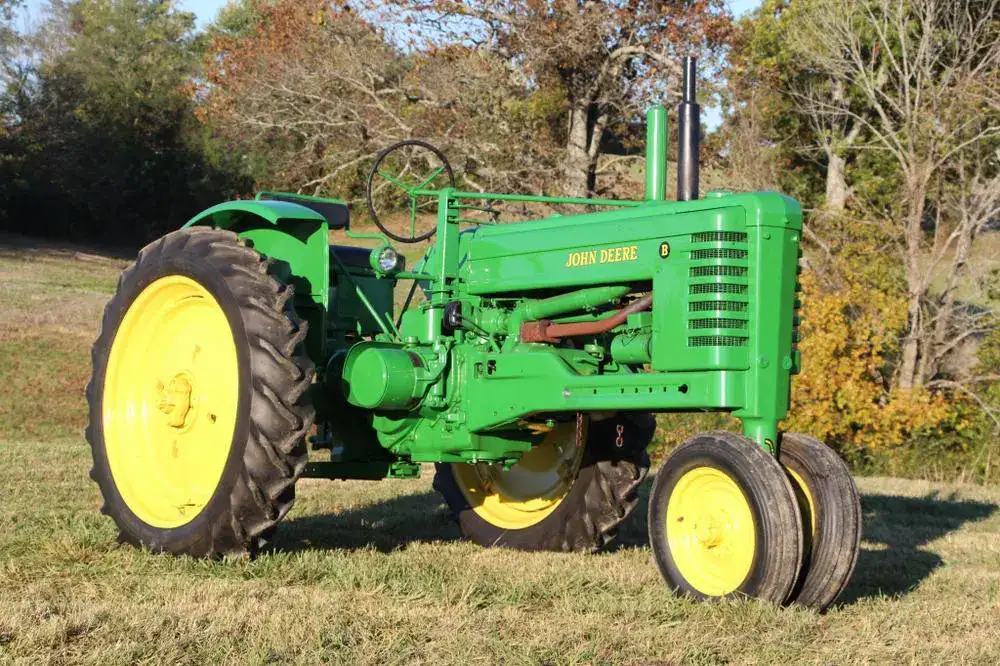
Prologue — the two-cylinder era (1934–1960). Before Dallas, there were Johnny Poppers: the John Deere A and John Deere B built Deere’s row-crop reputation across three hundred thousand units apiece. They’re covered in their own collector-focused reviews; everything below begins where they ended.
Act I — the New Generation (1960–1972). A clean-sheet revolution: closed-centre hydraulics, power steering and brakes, independent PTO. The 3010 and 4010 launched it; the 3020 and 4020 matured it (adding the diff lock and the landmark Power Shift); and the final years added turbocharging — the pioneer 4520, the row-crop 4320, and the intercooled 4620.
Act II — Generation II (1973–1977). The operator’s era: the rubber-isolated Sound-Gard Body (Deere pointedly never called it a cab), the sixteen-speed Quad-Range, and the wet Perma-Clutch, across the 4030, 4230, and best-selling 4430.
Act III — the Iron Horses (1978–1982). The 466 engine era: the beloved 4440 and the intercooled flagship 4640 — the tractors that farmed the big Prairie fields and, in the 4440’s case, still refuse to depreciate.
Every Model at a Glance — The Master Table
Ordered by Nebraska-tested PTO horsepower — the number that determines what a tractor can actually run. Every figure below comes from the Nebraska Tractor Test Laboratory data cited on each model’s full Aglist review.
| Model | Years | Engine | PTO HP (tested) | Transmissions | Cab option | Typical CAD (2026) |
|---|---|---|---|---|---|---|
| John Deere 3010 | 1961–63 | 254 diesel | 59.44 | Syncro 8F/3R | No | $6,000–$25,000 |
| John Deere 3020 | 1964–72 | 270 diesel | 71.26 | Syncro / Power Shift | Aftermarket | $8,000–$35,000 |
| John Deere 4030 | 1973–77 | 329 diesel | ≈80 | Syncro / Quad-Range | Sound-Gard | $8,000–$38,000 |
| John Deere 4010 | 1960–63 | 380 diesel | 84.0 | Syncro 8F/3R | No | $5,000–$30,000 |
| John Deere 4020 | 1964–72 | 404 diesel | 91–96 | Syncro / Power Shift | Aftermarket | $7,000–$69,000 |
| John Deere 4230 | 1973–77 | 404 diesel | ≈100 | Syncro / QR / PS | Sound-Gard | $10,000–$61,000 |
| John Deere 4320 | 1971–72 | 404 turbo | 116.55 | Syncro only | Period option | $12,000–$45,000 |
| John Deere 4520 | 1969–70 | 404 turbo | ≈123 | Syncro / Power Shift | Period option | $12,000–$40,000 |
| John Deere 4430 | 1973–77 | 404 turbo | 125.88 | Syncro / QR / PS | Sound-Gard | $17,000–$54,000 |
| John Deere 4440 | 1978–82 | 466 turbo | 130.58 / 130.41 | QR / Power Shift | Sound-Gard | $26,000–$81,500 |
| John Deere 4620 | 1971–72 | 404 turbo-intercooled | 135.6–135.7 | Syncro / Power Shift | Period option | $14,000–$47,000 |
| John Deere 4640 | 1978–82 | 466 turbo-intercooled | 155 (rated) | QR / Power Shift | Sound-Gard std | $10,000–$48,000 |
Three things the table can’t show: the 4440’s range starts where most models’ middles sit because the Canadian market currently averages $45,010 on it — the dynasty’s value-retention phenomenon; the 4620’s and 4640’s PTOs run 1,000 rpm only (a hard implement gate the table’s neighbours don’t share); and the 4320 is the lone Syncro-only machine — no Power Shift was ever offered on it, whatever a listing claims.
The Engineering Threads
One engine family, three escalations. The dynasty runs on shared architecture. The 10-series’ 254 four and 380 six share identical bore and stroke — one 400-series design in two lengths. The 404 that succeeded the 380 powered five models across three states: naturally aspirated (4020, 4230), turbocharged (4520, 4320, 4430), and turbo-intercooled (4620). The 466 repeated the pattern for the Iron Horses: turbo in the 4440, turbo-intercooled in the 4640 — with overhaul parts that interchange across tractors and even Deere combines of the era, which is why this family remains the cheapest big horsepower on earth to keep alive.
The turbo trilogy, in order. The 4520 (1969) was Deere’s first turbocharged tractor — powerful, but built on a scaled-down standard frame. Two 1971 answers fixed it: the 4320 put the turbo into the true row-crop chassis with 700 pounds of driveline reinforcement and piston-cooling jets, while the 4620 added the intercooler — Deere’s first intercooled row-crop — restoring compression and taming heat. Everything turbocharged since, from the 4430 to modern iron, descends from those three experiments.
The transmission story — and two dead heats. Syncro-Range carried the sixties; the 4020’s Power Shift (1964) brought clutch-free shifting; Generation II’s Quad-Range (1973) added sixteen speeds with powershifting inside each range. And here is the cross-model insight no spec site prints: Nebraska tested both transmissions on two different models — the 4620 in 1971 (Power Shift 135.6 vs Syncro 135.7) and the 4440 in 1978 (Quad-Range 130.58 vs Power Shift 130.41) — and both times the result was a statistical tie. On this dynasty, transmission choice is about your work pattern; the dyno has never had a preference.
The Sound-Gard revolution. From 1973, Generation II offered the rubber-isolated Sound-Gard Body — curved noise-deflecting windshield, the famous offset door, Dreyfuss design throughout — and it split every subsequent model’s market in two: cab-heat-and-air tractors occupy their own price bracket, and interior condition trades as its own asset, with complete refresh kits an established Canadian economy.
The Buyer’s Watersheds
24 volts, 12 volts, and 1969. Every 10-series diesel (3010, 4010) ran the 24-volt generator system for its entire life; the 20-series (3020, 4020) carried it until the 1969 “console” update brought 12-volt alternators. Sixty years on, each early diesel lives as original-and-sorted, converted (well-supported kits), renewed, or a neglected hybrid — and classifying which, before turning the key, is inspection rule one on anything pre-1969.
The PTO gate. Most of the dynasty runs 540 and 1,000 rpm. The 4620 and 4640 run 1,000 only, on the large shaft — a genuine compatibility check for mixed and hay farms before any money moves.
Documentation beats the tachometer. The market’s mature honesty: engine rebuilds are routine life events on these tractors, hour meters get replaced at overhaul (Canadian 4430 listings say so in print), and a 9,000-hour tractor with paperwork routinely outsells a vague 6,000-hour one. Buy receipts and load tests, never the dial.
The name-collision minefield. Four of these models share names with unrelated modern machines that flood Canadian searches: the 4320 and 4520 with 2000s compact utilities, the 4640 with a GreenStar display, and the 4030 with the R4030 sprayer (sellers drop the R). Each Aglist review carries the filter strategy; forewarned is an hour of scrolling saved.
Which One Should You Buy?
Under $10,000 and honest work → 3010 or 4010. The revolution at entry prices — the 3010 as the dealer-stocked utility bargain (where restoration math runs upside-down, making finished projects the smart buy), the 4010 for launch-year history and 84 tested horses.
The all-round benchmark → 4020. A hundred listings deep, parts-immortal, 91–96 tested horses: the 4020 remains the default vintage workhorse, with the 1969+ console diesels the buy-once configuration. The 3020 delivers the same design at ~71 horses — and its near-identical gasoline version is the era’s value backdoor.
Comfort per dollar → 4230 or 4030. Generation II’s Sound-Gard at 100 horses (4230 — currently averaging near $31,000) or the same engineering at the thrifty 80-horse scale most mixed farms honestly need (4030).
The hay-country kings → 4430 and 4440. Both PTO speeds, 125–130 turbo horses, Sound-Gard comfort: the 4430 is the volume value (89 Canadian listings, $8,000–$15,000 cheaper than its successor at equal grade), the 4440 the beloved icon averaging $45,010 — the one vintage Deere that doubles as a store of value.
Big acres → 4640. 155 rated horses, 83-gallon tank, Sound-Gard standard, work-priced: the 4640 is the cheapest honest 150-plus horsepower in the country — provided your implements run 1,000 rpm.
Scarcity and story → the turbo trio. The 4520 (first turbo), 4320 (21,485 built), and 4620 (6,928 built — the dynasty’s rarest) form the collecting frontier, ideally side by side.
The Canadian Market Map
The dynasty’s Canadian depth, at a glance: the 4020 and 4430 trade in ~90–100-listing markets; the 4440 in an 80-listing market with wanted-ads chasing supply; the 4230 and 4640 in steady dozens; the two-year turbos in single digits (the 4620 currently at six). Prairie provenance runs through it all — Leon (Yorkton, SK), Allied (Winnipeg, MB), Ezee-On (Vegreville, AB), and Cancade (Brandon, MB) loaders, Hold-On (SK) hitch assemblies — details that mark a tractor’s working biography and, increasingly, its value. Supply flows through MarketBook, AgDealer, Kijiji, Ritchie Bros, and retirement auctions; for winter-operation setup on any open-station survivor, our prairie winter equipment operation guideapplies across the family, and all tractors on Aglist maps the full coverage.
The Universal Inspection Doctrine
Twelve models, one discipline. Load-test the transmission before discussing money — every Syncro station, every Quad-Range transition and step, every Power Shift gear, with the Hy-Gard paper trail in hand; transmission condition moves more dollars than any other single item across this entire family. Classify the electrical system on anything pre-1969. Verify induction completeness on every turbo (de-turboed and intercooler-bypassed units exist), and treat cooling as the purchase decision it is on the 4520 especially. Grade the Sound-Gard as its own asset where fitted. Reconcile hour claims with blow-by, pedal wear, and receipts — and read every tach as an anecdote. Confirm the PTO speeds match your implements. And on genuine rarities — hi-crops, factory front-wheel assist, one-year gas engines, low-serial originals — let casting numbers and documentation settle what listings claim.
Vintage John Deere Tractors — FAQ
What is the best vintage John Deere tractor overall? For work, the 4020 (depth, parts, 91–96 tested horses) and the 4430 (comfort, 125.88 HP, both PTO speeds) split the crown by budget; for value retention, nothing touches the 4440; for collecting, the turbo trio and the rare configurations lead. The master table above matches models to missions.
Which vintage John Deere has the most horsepower? Of this dynasty, the 4640 at 155 rated PTO HP, followed by the 4620’s 135.7 Nebraska-tested — both 1,000-rpm-PTO-only machines. The 4440’s 130.58 leads among 540/1000-equipped models.
Were all of these tractors really Nebraska-tested? Yes — every model in the master table carries independent Nebraska Tractor Test Laboratory data, cited by test number on its Aglist review. Two models (the 4620 and 4440) were tested with both transmissions, finishing in statistical ties both times.
Syncro-Range, Quad-Range, or Power Shift — which is best? Nebraska says none: the dyno ties them. Syncro for simplicity and lowest cost, Quad-Range for field flexibility (and the resale market’s clear favourite where offered), Power Shift for loader and direction-change work — and condition under load beats configuration every time.
Why do 4440s cost so much more than 4430s? Icon status plus late-era refinement plus resale strength: the Canadian market averages $45,010 on the 4440 while equal-grade 4430s run $8,000–$15,000 less for about 95% of the work. Whether the gap is worth it is the honest question each buyer answers.
Which models have the 540 PTO? All except the 4620 and 4640, which run 1,000 rpm only on the large shaft — check your implement fleet before shopping either.
Why do searches for these tractors show modern machines? Name reuse: the 4320 and 4520 share names with 2000s compacts, the 4640 with a precision-ag display, and the 4030 with the R4030 sprayer. Each affected Aglist review includes the search-filter strategy.
What about the small vintage John Deere compacts? Different family entirely — the Yanmar-built 650–1050, 770, and 790 of 1978–2007 are covered in our dedicated John Deere Yanmar tractors guide, and the two-cylinder Model A and Model B antiques have their own collector reviews.
Disclaimer
Specifications on this page are compiled from John Deere technical literature and Nebraska Tractor Test Laboratory reports cited individually on each model’s full Aglist review, cross-checked against reference and market sources; figures marked as rated reflect manufacturer ratings aligned with test data. All models covered are discontinued — availability is limited to the used and collector market, and price ranges are indicative Canadian figures for 2026, anchored to current listing data where stated, that vary by region, condition, configuration, transmission health, documentation, and originality. Reviews on Aglist are written by real users and moderated for spam — opinions are personal. Always confirm specifications and condition against the operator’s manual, a serial-number decode, and a thorough physical inspection — led by transmission load-testing — before committing to any specific machine, and see each model’s full Aglist review for detailed specifications, known issues, and inspection guidance.
