Overview & Specs
John Deere 4030 Specs, Reviews & Used Price Canada (2026)
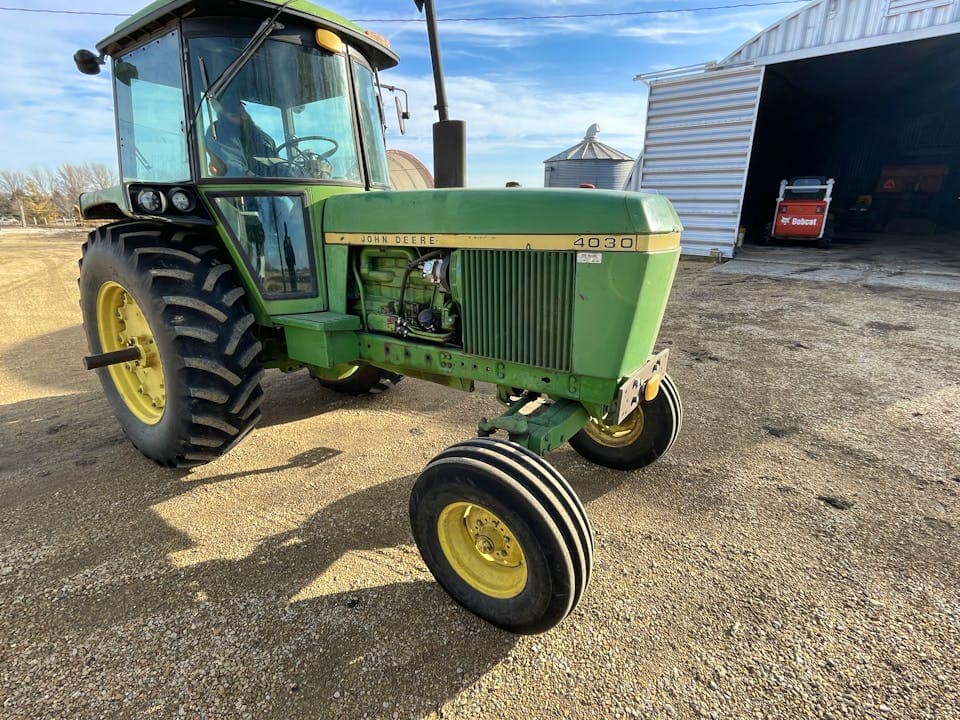
The John Deere 4030 is the quiet one of Generation II — the 80-horsepower heir to the 3020’s class, built 1973–1977 in Waterloo alongside the celebrity 4230 and 4430, and largely overlooked in its own era. The used market has since corrected that oversight: a mid-size tractor with the 30-series’ wet Perma-Clutch drivetrain, both PTO speeds, a differential lock, planetary final drives, and the Sound-Gard Body option is exactly what today’s mixed farms, hay operations, and acreages hunt for — and the 4030 is the smallest, thriftiest way to own that package.
One naming note first: John Deere’s modern R4030 self-propelled sprayer floods the same searches — sellers routinely drop the “R,” so “2021 John Deere 4030” listings are six-figure sprayers, not this tractor. This page covers the 1973–77 row-crop. Status disclosure: the 4030 is long out of production, succeeded by the 40-series 4040 in 1978, and this page is written for the 2026 used buyer — typically someone who looked at John Deere 4230 prices and asked what the same era offers one size down.
Aglist quick take: The 4030 is the Generation II package at its most usable scale — big-tractor engineering (wet clutch, wet brakes, closed-centre hydraulics, Quad-Range) around an understressed 329 six that sips where the turbos drink. The honest framing: two facts separate informed buyers from listings. First, no Power Shift was ever offered — Syncro-Range or Quad-Range are the only boxes, so any “power shift 4030” ad describes the Quad-Range’s partial powershifting. Second, the horsepower confusion is vocabulary: ~80 tested PTO horses (Nebraska Test 1111) versus the “88 HP” engine estimate dealers quote — same tractor, and current Canadian listings use both numbers on identical machines.
On This Page
ToggleQuick Verdict — Who the 4030 Is For
Buy it if: you want the ideal vintage mixed-farm size — haying with mid-size balers on 540 or 1,000 rpm, loader and feed duty, 4–5 bottom tillage — with Gen II comfort available and running costs the turbo models can’t match, at roughly CAD $13,000–$30,000 for working examples. A Sound-Gard Quad-Range diesel with dual remotes is the buy-once configuration; the diff lock comes standard everywhere.
Skip it if: your implements genuinely demand 100-plus horses — the John Deere 4230 exists precisely there, and the John Deere 4430 above it — or your budget conversation starts lower, where the previous-generation John Deere 3020covers similar work with fewer comforts for less money.
Full John Deere 4030 Specifications
Compiled from John Deere technical literature and Nebraska Tractor Test 1111 (Quad-Range diesel, October 1972), cross-checked against reference sources. Verify transmission, operator platform, and fuel type on any unit.
| Category | Spec | Value |
|---|---|---|
| Equipment type | Row-crop tractor | Generation II (“30” series); Waterloo, Iowa |
| Production | Model years | 1973–1977 |
| Engine (diesel) | Type | John Deere 329 cu in (5.4 L) inline-6, naturally aspirated |
| Bore × stroke / compression | 4.02 × 4.33 in. (102 × 110 mm) / 16.2:1 | |
| Engine (gasoline) | Type | 303 cu in (5.0 L) inline-6 — 1973 model year only; survivors are one-year rarities |
| Tested power | PTO | ≈80 HP (Nebraska Test 1111, Quad-Range) |
| Listing-quote note | “88 HP” | Engine estimate quoted by most dealers — same tractor as the ~80 tested PTO |
| Transmission (option 1) | Syncro-Range | 8F/2R — four stations, on-the-move shifts within each; optional creeper adding slow speeds to gears 1–5 (interlock blocks 6–8 while engaged) |
| Transmission (option 2) | Quad-Range | 16F/6R partial powershift — powershift between gears 1-2 and 3-4 in each range, synchronized 2-3 shift |
| Power Shift | Never offered on the 4030 | |
| Clutch | Type | Wet Perma-Clutch |
| Final drives / brakes | Type | Planetary / hydraulic wet disc |
| Diff lock | Standard | Yes |
| Steering | Type | Power steering |
| Hydraulics | Type | Closed centre; dual remotes typical |
| PTO | Type / speeds | Independent; 540 and 1,000 rpm (1-3/8 in. shaft) |
| Operator platform | Options | Open station; Roll-Gard ROPS/canopy; Sound-Gard Body |
| Electrical | System | 12-volt, alternator |
| Tires | Typical | 18.4-34 / 13.6-38 class rears; 11L-15 fronts |
| Succession | Class lineage | Took over the 3020’s slot (1973); replaced by the 4040 (1978) |
The horsepower decode, verified live. Current Canadian listings sell the same tractor as “80 HP” (a canopy unit, quoting the PTO rating) and “88 HP” (cab units, quoting the engine estimate). Nebraska Test 1111 settles it: about 80 at the PTO shaft is what your implements receive. Compare tractors on that number and on condition — the seller’s choice of figure is vocabulary.
Owner Reviews & Ratings on Aglist
Nebraska’s numbers date to October 1972; the ownership record — one-owner Quad-Range cab tractors still selling on their original paperwork — has compounded since. As owners share their experience on Aglist, the rating system tracks:
- Reliability — the 329’s record, cooling health, overhaul history
- Transmission — Quad-Range shift quality or Syncro engagement and clutch history
- Sound-Gard condition — where fitted: bushings, glass, heat and A/C function
- Hydraulics — remote response and seepage at working hours
- Value for money — the running-cost advantage over the turbo 30s, quantified by owners
If you own or run a 4030 in Canada, please leave a star rating and a short note below — fuel type (the 1973 gas units especially), transmission, and cab status are exactly what listings blur.
John Deere 4030 vs the Alternatives
The class question, framed by its neighbours — every column reviewed on Aglist.
| Spec | John Deere 3020 | John Deere 4030 | John Deere 4230 |
|---|---|---|---|
| Era | New Generation (1964–72) | Generation II (1973–77) | Generation II (1973–77) |
| Engine (diesel) | 270 cu in 4-cyl | 329 cu in 6-cyl NA | 404 cu in 6-cyl NA |
| PTO HP (tested) | 71.26 | ≈80 | ≈100 |
| Transmissions | Syncro / Power Shift | Syncro / Quad-Range | Syncro / Quad-Range / Power Shift |
| Clutch | Dry | Wet Perma-Clutch | Wet Perma-Clutch |
| Cab | Aftermarket only | Sound-Gard option | Sound-Gard option |
| Typical Canadian price | CAD $8,000–$35,000 by grade | CAD $10,000–$32,000 by grade | CAD $10,000–$61,000 by grade |
Where the 4030 wins: the balance. Nine more tested horses than the John Deere 3020 with the wet clutch, Quad-Range, factory cab option, and diff lock the older tractor lacks in various combinations — and meaningfully lower purchase and fuel costs than the John Deere 4230 for farms whose implements never ask for the extra twenty horses. The understressed 329 pulling 80 horsepower is the thriftiest engine-to-work ratio in Generation II.
Where the math flips: big balers, 6-bottom tillage, and grain-cart ambition belong to the 4230 and John Deere 4430; minimum-budget shoppers still land on a console John Deere 4020 or the 3020 itself. The 4030 owns the middle — which is exactly where most Canadian mixed farms live.
Real-World Performance
Engine — the understressed six
The 329 makes its ~80 PTO horses without a turbo, without an intercooler, and without drama — the smallest-stress engine-to-rating ratio in the 30-series, which owners translate as easy starts, modest fuel bills, and overhauls that arrive late and cost little (the 300-series-derived architecture shares its parts ecosystem widely). Canadian listings show the mature pattern: documented overhauls (“500 hours on establishment”) sold as credentials, and one-owner tractors with shifter-and-pedal wear honestly described. The one-year 1973 gasoline version (303 cu in) survives in the wild — a working curiosity today and a quiet collectible tomorrow.
Syncro or Quad-Range — and the Power Shift that never was
Two boxes only: the simple Syncro-Range 8F/2R (with a rare creeper option that adds slow speeds to gears 1–5 behind an interlock) and the Quad-Range 16F/6R whose partial powershifting explains every “power shift 4030” ad you’ll ever read — the full 8F/4R Power Shift was never offered on this model. The exams are the family standard: every Syncro station engaged cleanly and held under load; every Quad-Range transition and powershift step worked under load with a Hy-Gard paper trail. Quad-Range dominates Canadian supply and resale for the usual reasons.
Drivetrain, hitch & loader work
The wet Perma-Clutch, planetary final drives, hydraulic wet brakes, and standard diff lock are the 30-series’ whole argument in one paragraph — durable, low-maintenance, and sure-footed in spring ground. Both PTO speeds on the 1-3/8-inch shaft cover everything from small-square balers to 1,000-rpm tools, dual remotes run the implements, and loader duty is a genuine second career: cab-and-loader 4030s are a Canadian listing staple, sized right for bale and feedlot work without the turbo models’ bulk.
Canadian Winters
A Sound-Gard 4030 with working heat is a proper January feed tractor at the family’s lowest fuel burn; open-station and canopy units are the honest-work discount tier. The formula is standard — block heater, strong batteries, winter fuel — with the naturally aspirated six being the family’s least fussy cold starter. New cab kits and A/C compressors appear in Canadian listings, the familiar refresh economy at this model’s scale. Our prairie winter equipment operation guide covers the rest.
Common Problems & Reliability Notes
Transparency note: patterns reported across a fifty-year ownership base, not confirmed defects on any given unit — and hour meters remain estimates; documented overhauls outrank them.
Transmission condition equals price. Quad-Range range-forcing wear and Syncro station grind are the two testable, priceable items — twenty minutes under load answers both.
Hydraulic seepage at hours. Remotes, couplers, steering circuit, rockshaft — weep is normal, drip is negotiation, lazy warm response is a pump conversation.
Sound-Gard aging — where fitted. Bushings, glass seals, headliners, climate control: all fixable, all quotable, and frequently already refreshed (verify how well).
Cooling housekeeping. The NA 329 is forgiving, but loader and feed tractors pack radiators; fins, gauge honesty, and coolant condition are first-order checks.
Gas-unit specifics. The 1973-only gasoline tractors add carburetion and ignition tune to the checklist — and originality questions, since some were repowered over the decades.
The quiet one endures. Understressed engine, wet drivetrain, shared 30-series parts bench, and steady salvage supply make the 4030 arguably the cheapest Generation II tractor to keep alive per horsepower — the structural reason clean ones rarely sit unsold.
Used Price Range in Canada (2026)
The 4030 trades in a steady, work-priced market a clear step below the 4230 — supply modest but constant across MarketBook, AgDealer, and auctions:
- Projects and tired open-stations: roughly CAD $8,000–$13,000
- Honest workers — Syncro or Quad-Range, canopy/ROPS, higher hours: roughly CAD $13,000–$20,000
- Solid Sound-Gard cab tractors — functioning climate control, dual remotes, often with loaders: roughly CAD $20,000–$30,000 — the heart of the market
- Exceptional units — one-owner low-hour Quad-Ranges, documented overhauls, and the one-year 1973 gas survivors: CAD $30,000–$38,000+
Value movers: transmission health under load, cab status and systems, overhaul documentation, loader presence, and (for collectors) the 1973 gas rarity. Filter every search past the R4030 sprayers that share the name — the six-figure “4030” listings are agricultural aircraft carriers, not this tractor.
Best Use Cases in Canadian Conditions
Mixed and hay farms (ON / SK / AB / MB). Mid-size balers, mower-conditioners, and rakes on either PTO speed — the 4030’s exact design brief, still. Loader and feed duty. Cab-and-loader units at the right scale for bales and pens, all winter in Sound-Gard heat. 4–5 bottom tillage. The understressed 329’s comfort zone. The one-tractor acreage-plus.Big enough for real work, small enough for real sheds, cheap enough on fuel to run daily. Emerging collecting. The 1973 gas one-years and low-hour originals lead a quiet 4030 niche. Not ideal for: 100-plus-horse implement fleets, buyers wanting the full Power Shift (this model never had it), or heavy grain-cart duty better served up-series.
Maintenance & Service
- Daily: engine oil, coolant, air cleaner, tire pressure, grease points — radiator fins on loader/feed tractors
- Fluids: genuine JD Hy-Gard (or true equivalent) throughout the wet drivetrain — Quad-Range, Perma-Clutch, and wet brakes all depend on it
- Quad-Range habit: deliberate range changes at or near a stop; powershift freely within the gear pairs
- Gas units (1973): carburetion and ignition kept in tune — plugs, points, timing
- Cab systems: climate control serviced, bushings and seals maintained where the Sound-Gard is fitted
- Winter: block heater, load-tested batteries, winter-blend diesel
Parts support rides the deep 30-series and 300/329-engine ecosystems — Deere stock, aftermarket, and salvage — at the family’s lowest price points.
Where to Find a Used John Deere 4030 in Canada
Steady supply through MarketBook and AgDealer dealer inventory, Kijiji private sales, and farm auctions — with the R4030 sprayer filtered out of every search first. Inspection priorities, in order: load-test the transmission — every Quad-Range transition and step, or every Syncro station — before discussing money; reconcile hour claims with overhaul paperwork and wear honesty (pedals, shifter, seat); grade the Sound-Gard as its own asset where fitted; run both remotes and the hitch warm; confirm both PTO speeds engage on the 1-3/8 shaft; verify fuel type against the story (a “gas 4030” is either a 1973 rarity or a mislabel — casting numbers settle it); and identify the loader and its duty history. A documented Sound-Gard Quad-Range diesel with dual remotes and a loader is the buy-once 4030 — Generation II’s most sensible tractor, at Generation II’s most sensible price.
John Deere 4030 FAQ
How much horsepower does a John Deere 4030 have? About 80 PTO horsepower as tested at Nebraska (Test 1111, Quad-Range diesel, October 1972) from the naturally aspirated 329 cu in six. The “88 HP” in most listings is the engine estimate — same tractor, and current Canadian ads use both numbers.
What years was the John Deere 4030 made? Model years 1973–1977 in Waterloo, Iowa — Generation II’s entry row-crop, taking over the 3020’s class and replaced by the 4040 in 1978.
Did the John Deere 4030 come with a Power Shift? No — only the Syncro-Range 8F/2R (with an optional creeper) and the Quad-Range 16F/6R were offered. Ads describing a “power shift 4030” mean the Quad-Range’s partial powershifting.
Was there a gasoline John Deere 4030? Yes — a 303 cu in six, offered for the 1973 model year only. Survivors still appear in Canadian listings and are quiet one-year collectibles; verify originality by casting numbers.
Does the John Deere 4030 have both 540 and 1000 PTO? Yes — independent PTO at both speeds on the 1-3/8-inch shaft, plus a standard differential lock: the practical mixed-farm combination.
Is this the same 4030 as the John Deere sprayer? No — the modern R4030 is a self-propelled sprayer whose listings (often missing the “R”) flood the same searches at six-figure prices. This page covers the 1973–77 tractor.
What is a John Deere 4030 worth in Canada? As of 2026: roughly CAD $13,000–$20,000 for honest workers, $20,000–$30,000 for solid Sound-Gard cab tractors (the market’s heart), and $30,000–$38,000+ for exceptional and rare units — with projects from about $8,000.
John Deere 4030 vs 4230 — which should I buy? The 4230 for 100-horse implements and the deeper market; the 4030 for everything smaller, at lower purchase and fuel cost with the same Generation II engineering. Most mixed farms honestly need the 4030 and want the 4230.
Related Models on Aglist
- John Deere 3020 — the class predecessor this tractor succeeded
- John Deere 4230 — one size up in the same generation
- John Deere 4430 — Generation II’s best-seller, two sizes up
- John Deere 4020 — the era-spanning value baseline
- All tractors on Aglist — full tractor coverage
Disclaimer
Specifications compiled from John Deere technical literature and Nebraska Tractor Test 1111 (Quad-Range diesel, October 1972), cross-checked against reference and market sources; the 4030 was offered with two transmissions (no Power Shift), an optional Syncro creeper, three operator platforms, and a 1973-only gasoline engine, and the unrelated modern John Deere R4030 self-propelled sprayer appears throughout search results under the same name. The John Deere 4030 is a discontinued model — availability is limited to the used market, and pricing reflects indicative Canadian ranges that vary by region, condition, configuration, transmission health, and documentation. Reviews on Aglist are written by real users and moderated for spam — opinions are personal. Always confirm specifications, fuel type, and condition against the operator’s manual, casting and serial numbers, and a thorough physical inspection — led by transmission load-testing — before committing to any specific machine.
John Deere 4030 Reviews & Ratings
Share your experience
Help other Canadian buyers — leave a quick review for the
John Deere 4030
There are no reviews yet. Be the first one to write one.