Overview & Specs
John Deere 3020 Specs, Reviews & Used Price Canada (2026)
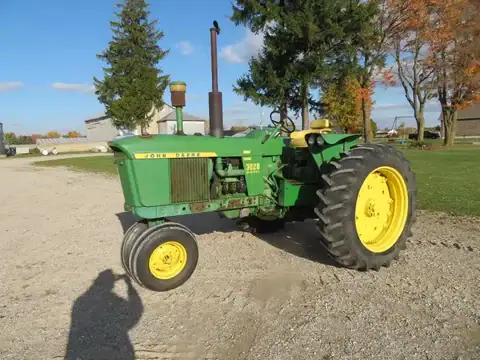
The John Deere 3020 is the 4020’s smaller brother and the second pillar of the New Generation line — the same engineering, the same transmissions, the same 1969 modernization, scaled to a 4-cylinder ~71 PTO horsepower package that fit the mid-sized family farm. Built in Waterloo, Iowa from 1964 to 1972 with production exceeding 82,000 units, it replaced the nearly identical 3010 and offered diesel, gasoline, and LP engines across an unusually wide range of configurations: standard, narrow-front row-crop (with or without Roll-O-Matic), wide-front row-crop, row-crop utility, and orchard.
Status disclosure up front: the 3020 is long out of production — when Generation II arrived for 1973, the 80-hp 4030 took over its class — and this page is written for the 2026 used buyer. One finding from the Nebraska Tractor Test Laboratory frames this tractor’s market better than anything else: tested in 1966, the diesel made 71.26 PTO horsepower and the gasoline version made 70.59. Near-identical power across fuels means the humble gas 3020 — often thousands cheaper — is one of the quiet value plays of the entire vintage market, with caveats this page covers honestly.
Aglist quick take: The 3020 gives you the whole New Generation experience — closed-centre hydraulics, independent 540/1000 PTO, diff lock, Syncro or Power Shift — in a package that costs less to buy, feed, and re-tire than a 4020. The honest framing: it’s the same three-decision purchase as its big brother (fuel, transmission, pre- or post-1969 electrics), plus a fourth question unique to the smaller tractor: on standard/wheatland units, confirm whether the three-point hitch is factory or a prairie-aftermarket Hold-On assembly, because plenty of Canadian 3020s left the factory without one.
On This Page
ToggleQuick Verdict — Who the 3020 Is For
Buy it if: ~70 PTO horses cover your work — haying with smaller balers, 3–4 bottom tillage, loader and chore duty, grain-auger and mixed-farm jobs — and you’d rather put CAD $12,000–$24,000 into a console diesel (or meaningfully less into a strong gas unit) than 4020 money into capacity you won’t use. A 1969+ console diesel Syncro with dual remotes and 540/1000 PTO is the buy-once configuration.
Skip it if: your implements genuinely need 90+ horsepower — the John Deere 4020 exists for exactly that, at surprisingly similar money in worker grades — or you need cab-era comfort, where the Generation II John Deere 4230 enters the conversation.
Full John Deere 3020 Specifications
Compiled from John Deere technical literature and Nebraska Tractor Test Laboratory reports (Tests 940–942, May–June 1966), cross-checked against reference sources. The 3020 was built over nine model years in three engines, two transmissions, and six chassis configurations — verify the exact configuration on any unit.
| Category | Spec | Value |
|---|---|---|
| Equipment type | Row-crop / utility tractor | New Generation series; built in Waterloo, Iowa |
| Production | Model years | 1964–1972; production exceeded 82,000 units |
| Engine (diesel) | Type | John Deere 4.4 L (270 cu in) inline-4, naturally aspirated |
| Rated speed / compression | 2,500 rpm / 16.4:1 | |
| Engine (gasoline) | Displacement | 3.7 L (227 cu in) inline-4 |
| Engine (LP gas) | Displacement | 3.7 L (227 cu in) inline-4 |
| Tested power | PTO | Diesel 71.26 HP (Nebraska Test 940); gasoline 70.59 HP (Test 941); LP tested in Test 942 |
| Drawbar (diesel) | Approx. 63 HP | |
| Transmission (standard) | Syncro-Range | 8F/2R — four stations, on-the-move shifts within each |
| Transmission (optional) | Power Shift | 8F/4R full powershift, no foot clutch |
| Differential lock | Standard | Yes |
| Steering / brakes | Type | Power steering; hydraulic power brakes |
| Hydraulics | Type | Closed centre (shared design with the 4020); up to three remotes |
| 3-point hitch | Category | 2; lift approx. 2,400 lb at 24 in. behind lift points |
| PTO | Type | Independent; 540 and 1,000 rpm |
| Electrical | 1964–1968 diesels | 24-volt positive-ground, generator |
| 1969–1972 | 12-volt negative-ground, alternator | |
| Fuel | Capacity | 29 gal (gas/diesel); larger LP tank |
| Weight | Operating | Approx. 7,695 lb (gas) / 7,945 lb (diesel) |
| Dimensions | Wheelbase | 90 in.; rear tread adjustable 60–113 in. |
| Tires | Typical | 6.00-16 front; 13.6-38 / 15.5-38 rear (18.4-38 on some) |
| Configurations | Offered | Standard, narrow-front row-crop (Roll-O-Matic optional), wide-front row-crop, row-crop utility, orchard |
| Rarities | Documented | 76 LP standard/wheatland units built; hi-crop Power Shift units exist |
| Front loaders | Seen on units | John Deere 48; Cancade (Brandon, MB) and other prairie aftermarket loaders common in Canada |
| Family | Relations | Replaced the 3010 (1960–63); JD 500 industrial series shared its platform |
| Succession | Class taken over by | Generation II John Deere 4030 (1973) |
The fuel-parity finding, plainly. Nebraska measured the diesel and gasoline 3020 within seven-tenths of a horsepower of each other. The diesel wins on fuel economy, torque character, and resale; the gas wins on purchase price, winter starting simplicity, and cheaper injection-free upkeep — and loses on consumption and the carburetion quirks covered below. For light-duty and acreage buyers, a strong gas 3020 is the market’s honest bargain; for daily workers, the diesel remains the default.
Owner Reviews & Ratings on Aglist
Nebraska’s numbers are from 1966; Canadian ownership knowledge is from every year since. As owners share their experience on Aglist, the rating system tracks:
- Reliability — engine health by fuel type, electrical condition (especially pre-1969 units)
- Transmission — Syncro station wear or Power Shift condition and fluid history
- Hydraulics — closed-centre response, remotes, rockshaft, cold-weather behaviour
- Parts and service — new, aftermarket, and salvage sourcing in your region
- Value for money — gas versus diesel economics in real ownership
If you own or run a 3020 in Canada, please leave a star rating and a short note below — fuel type, transmission, and 3-point provenance (factory or Hold-On) are exactly the details buyers can’t verify from listings.
John Deere 3020 vs the Alternatives
The 3020 sits between the tractor it perfected and the big brother it’s forever measured against.
| Spec | John Deere 3010 | John Deere 3020 | John Deere 4020 |
|---|---|---|---|
| Years | 1960–1963 | 1964–1972 | 1964–1972 |
| Engine (diesel) | 4-cyl, smaller bore | 4-cyl, 4.4 L | 6-cyl, 6.6 L |
| PTO HP (tested) | ~59 | 71.26 | 91–96 |
| Transmissions | Syncro 8F/3R | Syncro 8F/2R or Power Shift 8F/4R | Syncro 8F/2R or Power Shift 8F/4R |
| Diff lock | No | Yes | Yes |
| Electrical (diesel) | 24V | 24V (’64–68) / 12V (’69–72) | 24V (’64–68) / 12V (’69–72) |
| Typical Canadian price | Less | CAD $8,000–$35,000 by grade | CAD $7,000–$69,000 by grade |
Where the 3020 wins: cost of everything. Purchase price runs meaningfully below equivalent-grade 4020s, 38-inch rubber costs less than the 4020’s typical sizes, the 4-cylinder sips comparatively, and the tractor still carries the full New Generation feature set — closed-centre hydraulics, independent PTO, diff lock, Power Shift availability. For mixed farms and acreages that don’t need six cylinders, it’s the rational pick, and its narrower configurations (row-crop utility, orchard) fit where a 4020 doesn’t.
Where the math flips: worker-grade 4020s often sell close enough to worker-grade 3020s that buyers needing headroom should just buy the John Deere 4020 — its deeper market and stronger resale are real assets. Collectors chasing the family’s origin story should read about the John Deere 4010 that started it all; comfort-first buyers should compare the Generation II John Deere 4230.
Real-World Performance
Engine — one design, three fuels
The diesel’s 4.4 L four-cylinder spins to 2,500 rpm — a busier, higher-revving character than the 4020’s loping six — and delivers its 71 tested horses with the same durability record as the rest of the family. The gasoline 227 makes essentially identical power with easier winter starts and simpler fuel-system upkeep, at the cost of real thirst under load and the carburetion sensitivity owners report (rich running and plug fouling when tuning drifts). The LP version is now primarily a collector item — Canadian market documentation puts the LP standard/wheatland run at just 76 units, making a running example a genuine rarity rather than a fuel choice.
Syncro-Range vs Power Shift
Identical logic to the 4020, at 3020 prices: Syncro-Range’s eight speeds in four stations for simplicity and the lowest ownership cost; Power Shift’s clutch-free 8F/4R for loader work, baling, and direction changes — at a purchase premium and with specialist service economics. Every Power Shift candidate gets the same exam: all gears under load, no slip, and a verifiable Hy-Gard history. Hi-crop Power Shift 3020s exist and sit firmly in collector territory.
Hydraulics, Hitch & the Hold-On question
The closed-centre system delivers the family’s signature instant remote response and strong rockshaft — with one age note owners report: response can be lazy until fluid warms in deep cold, which is normal behaviour to verify rather than a defect to fear. Category 2 hitch lifts roughly 2,400 lb at 24 inches — ample for 3–4 bottom plows and modern rotary cutters. The Canadian specific: many standard/wheatland 3020s shipped without a three-point at all, and Saskatchewan’s Hold-On Industries built the aftermarket assemblies that fixed that. A Hold-On-equipped standard is a perfectly good working tractor — just know what you’re pricing, because factory-3PH units carry a premium.
The 1969 console update
Same watershed as the 4020: model year 1969 brought the right-hand console, hydraulically engaged PTO, and — the part that matters most at inspection time — the switch from 24-volt positive-ground generators to 12-volt negative-ground alternators on diesels. Console 3020s are the easier ownership; earlier tractors are fine buys with a healthy original system or a documented 12V conversion, and the conversion economy is so established that Canadian classifieds regularly carry take-off 24V components from converted tractors.
Canadian Winters
Block heater, strong batteries, winter fuel — the family formula, with the gas engine holding a genuine cold-morning advantage over the diesel. Aftermarket Year-A-Round cabs appear on Canadian units and range from cozy to crude; inspect fitment and visibility rather than assuming. Our prairie winter equipment operation guide covers the setup details that apply directly.
Common Problems & Reliability Notes
Transparency note: patterns reported across a sixty-year ownership base, not confirmed defects on any given unit — and hour meters at this age are estimates at best, so buy condition, not the tach.
24-volt electrics on 1964–68 diesels. The family’s signature frustration: verify the original system is genuinely sorted, or price a 12V conversion — a routine, well-supported job.
Gas carburetion drift. The most-reported gas-specific item: rich running and plug fouling when the carb and ignition wander out of tune. Cheap to fix, diagnostic of overall care.
Power Shift condition equals value. Slip in any gear is a specialist conversation — test all eight forward and four reverse under load and demand the fluid story.
Cold-slow hydraulics. Closed-centre response that’s lazy until warm is common and normal; response that stays lazy warm is a pump-and-valve conversation.
Syncro station wear and jump-out. Grinding into stations or popping out of gear under load — a known, priceable repair and a negotiation point.
Front-end and steering play. Spindles, tie-rod ends, and Roll-O-Matic knuckles (on narrow fronts) are routine wear items to price before purchase.
The core endures. Shared architecture with the 4020 means the 3020 rides the same exceptional parts ecosystem — Deere stock, deep aftermarket, shared service literature (the family IT manual covers 3010/3020/4010/4020), and salvage supply.
Used Price Range in Canada (2026)
The 3020 trades in a deep Canadian market — around fifty active listings at any time — at a consistent discount to the 4020, with an average near $17,500. The grade ladder:
- Projects and parts tractors: under CAD $6,000–$8,000
- Honest gas workers: roughly CAD $8,000–$13,000 — the value backdoor of the vintage market
- Honest diesel workers: roughly CAD $10,000–$16,000
- Solid console diesels (1969+, Syncro, dual remotes): roughly CAD $16,000–$26,000 — the heart of the market
- Power Shift, exceptional originals, and rarities (hi-crop PS units, the 76-unit LP standards, preserved orchards): CAD $26,000–$35,000+
Premium movers mirror the 4020: transmission, console/12V era, factory 3-point and dual hydraulics, originality — plus the 3020-specific check of factory versus Hold-On hitch on standards. Supply is steady on MarketBook, AgDealer, Kijiji, and at Prairie auctions.
Best Use Cases in Canadian Conditions
Mixed and hobby farms (SK / AB / MB / ON). Haying with mid-size balers, feed and chore duty, 3–4 bottom tillage — the 3020’s home for sixty years. Loader tractor. JD 48 or Cancade-equipped units with closed-centre response make honest yard machines. Grain support. Augers and harrows on the independent 540/1000 PTO. Acreage all-rounder on a budget. Especially the gas versions. Collecting. Orchards, hi-crop Power Shifts, and the 76-unit LP standards anchor 3020 collecting. Not ideal for: work that genuinely needs 90+ hp, all-winter cab duty, or buyers wanting modern-era ergonomics.
Maintenance & Service
- Daily: engine oil, coolant, air cleaner, tire pressure, grease points
- Fluids discipline: genuine JD Hy-Gard (or true equivalent) in the transmission-hydraulic system — the closed-centre and Power Shift spec is non-negotiable; avoid bargain “303-type” oils
- Gas engines: keep carburetion and ignition in tune — plugs, points, timing — and the 227 rewards you with diesel-matching power
- Electrical: sort or convert pre-1969 24V systems once, properly; load-test batteries each fall
- Power Shift: oil and filter strictly on schedule; pressure-check per the manual rather than driving around slip
- Winter: block heater, winter-blend fuel (diesel), strong batteries — the Prairie formula
Parts support is family-grade excellent: shared components with the 4020 era, deep aftermarket, and continuous salvage supply keep the 3020 among the easiest vintage tractors to own.
Where to Find a Used John Deere 3020 in Canada
Steady supply on MarketBook and AgDealer dealer listings, Kijiji private sales, and Prairie farm auctions. Inspection priorities: identify the tractor honestly first — fuel, transmission, dash versus console, configuration, and on standards, factory versus Hold-On three-point; on Power Shift units, load-test every gear and get the fluid history; on pre-1969 diesels, assess the 24V system or price the conversion; check closed-centre response warm, not just cold; on gas units, read the plugs and ask about carb work; walk the front end (including Roll-O-Matic knuckles on narrow fronts); and treat the hour meter as folklore. A 1969+ console diesel Syncro with dual remotes and a factory hitch is the buy-once tractor; a tuned, straight gas unit is the budget sleeper.
John Deere 3020 FAQ
How much horsepower does a John Deere 3020 have? The diesel tested at 71.26 PTO horsepower (Nebraska Test 940, 1966) and the gasoline version at a nearly identical 70.59 (Test 941) — about 63 drawbar HP for the diesel. The LP version was tested separately in Test 942.
What years was the John Deere 3020 made? Model years 1964–1972 in Waterloo, Iowa, with production exceeding 82,000 units across standard, row-crop, row-crop utility, and orchard configurations. It replaced the nearly identical 3010.
Is a gas John Deere 3020 worth buying? Often, yes — Nebraska measured it within a horsepower of the diesel, and gas units typically sell thousands cheaper. Budget for real fuel consumption under load and keep the carburetion tuned; the reported rich-running and plug-fouling issues are tuning items, not design flaws.
Syncro-Range or Power Shift on a 3020? Same answer as the 4020: Syncro for simplicity and lowest cost; Power Shift for loader and baling work — at a premium, and only after load-testing every gear and verifying the Hy-Gard history.
What does the 1969 update mean on a 3020? The console model year: right-hand controls, hydraulically engaged PTO, and the switch from 24-volt generator systems to 12-volt alternators on diesels. Console tractors are the easier ownership; earlier units are fine with a sorted system or documented conversion.
What is a John Deere 3020 worth in Canada? As of 2026: roughly CAD $8,000–$13,000 for gas workers, $10,000–$16,000 for diesel workers, $16,000–$26,000 for solid console diesels (the market average sits near $17,500), and $26,000–$35,000+ for Power Shift units, exceptional originals, and rarities like the 76-unit LP standards.
Did all 3020s have a three-point hitch? No — many standard/wheatland units shipped without one, and Saskatchewan-built Hold-On Industries assemblies were the common aftermarket fix on the Prairies. Factory-hitch tractors carry a premium; confirm which you’re pricing.
What replaced the John Deere 3020? Generation II arrived for 1973, with the 80-hp John Deere 4030 taking over the 3020’s class.
Related Models on Aglist
- John Deere 4020 — the six-cylinder big brother and the era’s benchmark
- John Deere 4010 — the 1960 original that started the New Generation
- John Deere 4230 — Generation II comfort in the next class up
- All tractors on Aglist — full tractor coverage
Disclaimer
Specifications compiled from John Deere technical literature and Nebraska Tractor Test Laboratory reports (Tests 940, 941, and 942, May–June 1966), cross-checked against reference sources; the 3020 was built over nine model years in three engine types, two transmissions, and six chassis configurations, including the significant 1969 console and electrical-system update, so individual units vary substantially. The John Deere 3020 is a discontinued model — availability is limited to the used market, and pricing reflects indicative Canadian ranges that vary by region, condition, configuration, and originality; hour-meter readings at this age are frequently unreliable. Reviews on Aglist are written by real users and moderated for spam — opinions are personal. Always confirm specifications and condition against the operator’s manual, a serial-number decode, and a thorough physical inspection — including transmission load-testing, electrical assessment, and three-point-hitch provenance — before committing to any specific machine.
John Deere 3020 Reviews & Ratings
Share your experience
Help other Canadian buyers — leave a quick review for the
John Deere 3020
There are no reviews yet. Be the first one to write one.