Overview & Specs
John Deere 4010 Specs, Reviews & Used Price Canada (2026)
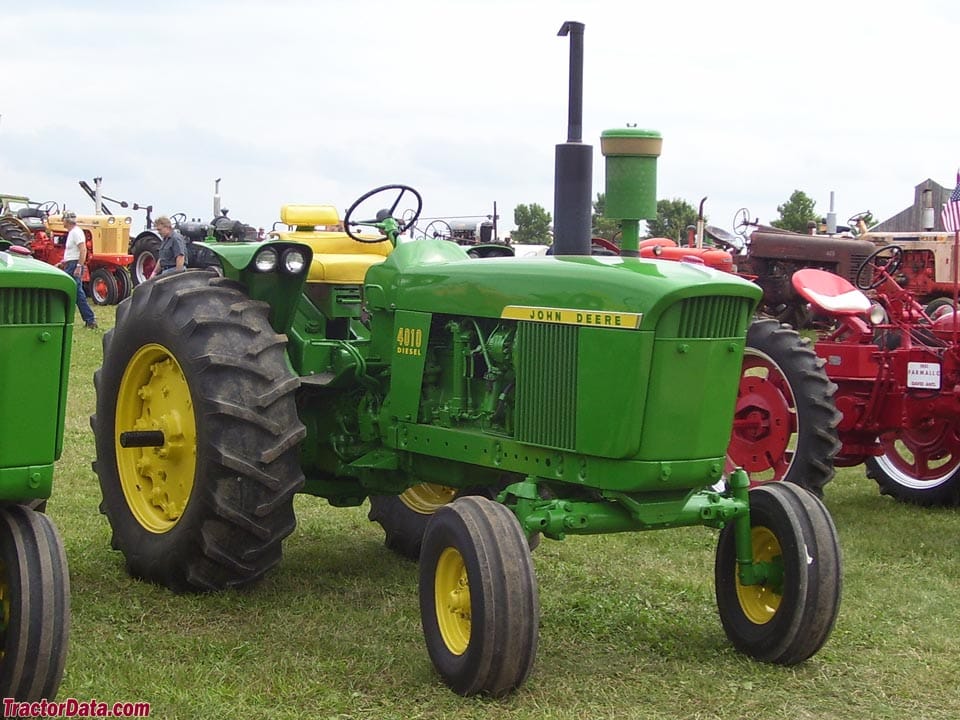
The John Deere 4010 is where modern John Deere begins. Unveiled to stunned dealers on August 30, 1960 — the famous “Deere Day in Dallas” — it ended the two-cylinder era with a clean-sheet design: a six-cylinder engine, closed-centre hydraulics, hydrostatic power steering, hydraulic power brakes, planetary final drives, and an 8F/3R Syncro-Range transmission. Rated at 80 PTO horsepower when the biggest competitors offered 59–65, it tested at 84 — a 35% leap over Deere’s own 730 — and sold more than 58,000 units in just four model years (1960–1963), driving Deere’s market share from 23% to 34% and making it America’s number-one farm equipment maker by the time the 4020 replaced it.
One naming note before anything else: John Deere reused “4010” on a 2001–2005 sub-compact tractor (~18 HP, hydrostatic drive). Listings and search results mix the two constantly. This page covers the 1960s New Generation row-crop tractor; if you’re researching the little green hydro, you’re one generation of naming confusion away. Status disclosure: the 4010 is long out of production, succeeded directly by the John Deere 4020 in 1964, and this page is written for the 2026 used buyer and collector.
Aglist quick take: The 4010 is the affordable door into New Generation ownership — worker-grade units routinely sell thousands below equivalent 4020s while sharing the same fundamental architecture and parts ecosystem. The honest framing: every 1960–63 diesel left the factory with the 24-volt electrical system (there was no factory 12V era on this model), it never offered a Power Shift or differential lock, and the early-production teething points the 4020 later fixed — final drives, seals, cooling — deserve inspection attention six decades on. Know also that 404-engine transplants from 4020s are common in the market; verify which block is actually under the hood before you price “originality.”
On This Page
ToggleQuick Verdict — Who the 4010 Is For
Buy it if: you want genuine New Generation capability — 84 tested PTO horses for haying, loader duty, and 4-bottom tillage — at the family’s lowest entry price (honest Canadian workers from roughly CAD $6,000–$12,000), or you’re a collector drawn to the tractor that changed the industry, where restored hi-crops and rare LP units anchor the top of the market.
Skip it if: you want the sorted, later ownership experience — the John Deere 4020 adds the diff lock, Power Shift availability, strengthened driveline, and (from 1969) factory 12V electrics for often-modest extra money in worker grades — or your work fits ~70 horses, where the John Deere 3020 is the rational pick.
Full John Deere 4010 Specifications
Compiled from John Deere technical literature and Nebraska Tractor Test 761 (September 19, 1960), cross-checked against reference sources. Built in Waterloo, Iowa (with additional Mexican production) in agricultural and industrial variants — verify configuration and, critically, the original engine on any unit.
| Category | Spec | Value |
|---|---|---|
| Equipment type | Row-crop tractor | New Generation (“10” series) flagship; Waterloo, Iowa |
| Production | Model years | 1960–1963; more than 58,000 built |
| Historical note | Significance | Ended Deere’s two-cylinder era; drove market share from 23% (1959) to 34% (1964) |
| Engine (diesel) | Type | John Deere 380 cu in (6.2 L) inline-6, naturally aspirated |
| Bore × stroke / rated speed | 4.15 × 4.78 in. / 2,200 rpm | |
| Engine (gasoline) | Type | John Deere 302 cu in (4.9 L) inline-6, 4.03 × 4.03 in. |
| Engine (LP gas) | Type | 302 cu in (4.9 L) inline-6 |
| Power | Claimed PTO | 80 HP |
| Tested PTO (diesel) | 84.0 HP (Nebraska Test 761) | |
| Transmission | Syncro-Range | 8F/3R, partially synchronized, constant mesh, dry clutch |
| Speeds | Max 14.3 mph forward / 8.5 mph reverse | |
| Power Shift | Never offered (introduced with the 4020) | |
| Differential lock | — | Not offered (added on the 4020) |
| Final drives | Type | Planetary |
| Steering / brakes | Type | Hydrostatic power steering; hydraulic power brakes |
| Hydraulics | Type | Closed centre, 2,000 psi, 13 gpm |
| 3-point hitch | Category | 2; independent 540/1000 PTO |
| Electrical | Diesel | 24-volt system, generator — entire production run |
| Gasoline / LP | 12-volt | |
| Weight | Operating | Approx. 7,100 lb (row-crop, gas); industrial 8,378–8,678 lb; ballasted to ~9,595 lb in testing |
| Dimensions | Wheelbase | 99.25 in. (ag); 96.3 in. (industrial) |
| Configurations | Offered | Row-crop (single, dual narrow, or wide adjustable front), standard tread, hi-crop; industrial variant |
| Front loaders | Seen on units | John Deere 46A (61-in. bucket), 48, and 58; Farm Hand F11 and other aftermarket |
| Original price | 1963 | Approx. USD $5,500 |
| Succession | Replaced / replaced by | Replaced the two-cylinder 730 (59 PTO HP); succeeded by the John Deere 4020 (1964) |
The underpromise, on the record. Deere advertised the 4010 at 80 PTO horsepower. Nebraska measured 84.0 in September 1960 — at a time when the industry’s biggest row-crops made 59–65. That four-horse cushion over the brochure is part of why the 4010’s reputation outran even its sales, and why a healthy 380 diesel still surprises first-time drivers today.
Owner Reviews & Ratings on Aglist
Nebraska’s numbers are sixty-five years old; the ownership record has been compounding ever since — including Canadian 4010s that crossed 9,000 hours on original bottom ends. As owners share their experience on Aglist, the rating system tracks:
- Reliability — the 380’s longevity, cooling-system health, electrical condition
- Originality — original 380 block versus 404 transplant, paint, and configuration provenance
- Transmission — Syncro-Range engagement, clutch history
- Parts and service — sourcing across the shared New Generation ecosystem
- Value for money — worker economics versus collector appreciation
If you own or run a 4010 in Canada, please leave a star rating and a short note below — engine provenance and electrical status are exactly what listings routinely leave out.
John Deere 4010 vs the Alternatives
The 4010 is best understood between what it overthrew and what perfected it.
| Spec | John Deere 730 | John Deere 4010 | John Deere 4020 |
|---|---|---|---|
| Era | Two-cylinder (to 1960) | New Generation (1960–63) | New Generation (1964–72) |
| Engine | 2-cyl | 6-cyl, 380 cu in diesel | 6-cyl, 404 cu in diesel |
| PTO HP (tested, diesel) | 59 | 84.0 | 91–96 |
| Transmission | 6F/1R | Syncro 8F/3R only | Syncro 8F/2R or Power Shift 8F/4R |
| Diff lock | No | No | Yes |
| Electrical (diesel) | Varies | 24V (entire run) | 24V (’64–68) / 12V (’69–72) |
| Typical Canadian price | Collector market | CAD $5,000–$30,000 by grade | CAD $7,000–$69,000 by grade |
Where the 4010 wins: entry price into the New Generation, historical gravity, and the collector story — this is the tractor that made everything after it possible, and clean examples appreciate on that fact. Worker-grade 4010s also share enough architecture with the 4020 era that the family’s exceptional parts ecosystem (Deere stock, aftermarket, shared IT service manuals, salvage) covers them fully.
Where the math flips: for a daily worker, the John Deere 4020 is simply the more developed machine — diff lock, stronger final drives and seals, Power Shift availability, and factory 12V from 1969 — often within a few thousand dollars at worker grade. Buyers a class down should read the John Deere 3020; comfort-era shoppers, the Generation II John Deere 4230.
Real-World Performance
Engine — and the transplant question
The 380 cubic inch diesel is understressed, torquey, and famously durable — Canadian owner histories include units bought with 3,000 hours in the 1980s that passed 9,800 hours still running a 12-foot haybine on the original bottom end, with clutches as the only major repairs. The market wrinkle: because the 4020’s 404 bolts into the same chassis, “4010 with 4020 engine” is a common listing phrase, and overhauled 404 swaps are openly sold. A transplant isn’t a defect — many consider it an upgrade — but it changes parts, value, and collector standing. Confirm which block you’re buying before you pay for “original.”
Transmission & Driveline
The Syncro-Range 8F/3R shifts on the move within its stations, stops between them, and tops out at 14.3 mph — no Power Shift was ever offered, which keeps 4010 ownership mechanically simple and cheap. The early-production honesty: the 4020 specifically strengthened final drives and improved seals and cooling over the 4010, so on any candidate unit, listen to the planetary final drives under load, walk the axle seals, and treat the cooling system as a first-order check rather than a formality.
Hydraulics, Hitch & Loader Work
The closed-centre system — 2,000 psi and 13 gpm, the industry’s revolution in 1960 — still runs loaders and remotes respectably, if a step behind the 4020’s later spec; owners describe response as honest rather than fast. The Category 2 hitch and independent 540/1000 PTO handle 4-bottom plows, big blades, and haying tools comfortably. Period John Deere 46A, 48, and 58 loaders appear on Canadian units alongside Farm Hand and other aftermarket iron — as across the family, identify the loader before pricing.
Electrics — the 24-volt reality
Unlike the 4020, the 4010 never had a factory 12-volt diesel era: every 1960–63 diesel shipped with the 24-volt split-load generator system, while gas and LP tractors ran 12 volts from the start. Six decades later that means every 4010 diesel is either (a) running a genuinely maintained original 24V system, (b) running a converted 12V system — the same well-supported kits that serve the 4020 cover the 4010 — or (c) running a neglected hybrid of the two, which is where the no-start folklore comes from. Identify which of the three you’re inspecting before anything else electrical.
Canadian Winters
Block heater, strong batteries (two healthy 12-volts on unconverted diesels), winter fuel — the formula that has kept 4010s working through Prairie winters since Diefenbaker was in office. Open station is the honest limit for January duty; period cabs are rare and rough. Our prairie winter equipment operation guide covers the setup details.
Common Problems & Reliability Notes
Transparency note: patterns reported across a 65-year ownership base, not confirmed defects on any given unit — and hour meters of this vintage are folklore. Buy condition, provenance, and paperwork.
24-volt electrics on every diesel. The model’s signature checkpoint: original-and-sorted, converted-and-documented, or neglected-hybrid. The first two are fine ownership; the third is your negotiation leverage.
Early-generation driveline and sealing. The specific items Deere strengthened on the 4020 — final drives, seals, cooling — are the 4010’s inspection priorities. Growl from the planetaries, weeping axle seals, or a marginal radiator are known, priceable, and worth pricing before purchase.
Engine provenance. Original 380 versus transplanted 404 changes parts lists and collector value both ways. Casting numbers settle arguments that listings start.
No diff lock. Not a defect — a design fact that matters in wet Prairie ground and on loader pads. Ballast and tire strategy are the historical workarounds.
Syncro wear and clutch history. Clean engagement in every station, no jump-out under load; Canadian long-hour histories suggest budgeting for a clutch as the model’s routine major job.
The core endures. The 4010 rides the same parts ecosystem as the rest of the New Generation family — Deere stock, deep aftermarket, shared 3010/3020/4010/4020 service literature, and steady salvage supply — which is precisely why 9,000-hour originals still show up for sale rather than for scrap.
Used Price Range in Canada (2026)
The 4010 is the New Generation’s affordable entry, with a thinner but steady Canadian market — roughly twenty active listings at a time — spanning parts units under a thousand dollars to restored rarities above twenty:
- Parts and project tractors: under CAD $3,000–$5,000 — knocking engines, stuck clutches, long-stored units
- Honest workers: roughly CAD $6,000–$12,000 — the heart of the market; straight diesels with a remote or two
- Overhauled and loader-equipped units: roughly CAD $12,000–$18,000 — fresh engine work, JD 46A/48/58 loaders, documented conversions
- Exceptional originals and rarities: CAD $18,000–$30,000+ — low-hour survivors, rare LP row-crops, and restored hi-crops at the top
Premium movers: engine provenance (original 380 documented), electrical status (sorted or converted, not hybrid), configuration rarity (hi-crop, LP), and restoration quality. Supply flows through MarketBook, AgDealer (Prairie dealers included), Kijiji, and farm auctions — filter out the 2001–2005 compact 4010s that share every search.
Best Use Cases in Canadian Conditions
Working second tractor (SK / AB / MB / ON). Haying, feed and loader duty, augers, and 4-bottom tillage at the family’s lowest buy-in. Collector cornerstone. The tractor that started modern Deere — Dallas-launch history, restored hi-crops, LP rarities, and yes, the Elvis connection. Budget New Generation entry. All the architecture, most of the capability, least of the money. Parade and heritage duty. Few tractors draw a crowd like a straight 4010. Not ideal for: loader-cycle-heavy work a Power Shift 4020 does better, wet-ground work where the missing diff lock bites, or buyers who want the later model’s sorted electrics without a project.
Maintenance & Service
- Daily: engine oil, coolant, air cleaner, tire pressure, grease points — plus a habit of watching the temperature gauge on this generation
- Fluids discipline: genuine JD Hy-Gard (or true equivalent) in the transmission-hydraulic system; never bargain “303-type” oils
- Electrical: commit to one system — maintain the 24V properly or convert completely and correctly; hybrids cause the headaches
- Driveline: listen to final drives under load seasonally; keep axle seals and breathers honest
- Engine: the 380 wants clean fuel, honest cooling, and little else; document any 404 transplant for the next owner
- Winter: block heater, load-tested batteries each fall, winter-blend diesel — the sixty-five-year formula
Parts support remains family-grade excellent through Deere, the aftermarket, and salvage — the shared New Generation ecosystem carries the 4010 fully.
Where to Find a Used John Deere 4010 in Canada
Supply runs through MarketBook and AgDealer dealer listings (Saskatchewan dealers included), Kijiji private sales, and farm auctions. Inspection priorities, in order: confirm you’re looking at the 1960s row-crop and not the 2000s compact (it happens); verify the engine block — original 380 or transplanted 404 — against casting numbers and the story; classify the electrical system (original-sorted / converted-documented / hybrid) before turning the key; listen to planetary final drives under load and walk the axle seals; check cooling honestly, radiator to thermostat; run every Syncro station and hold gears under load; identify the loader; and price the tach at zero informational value. A straight, cool-running diesel with documented electrics and its original 380 is the collector-grade worker; the same tractor with a fresh 404 and a conversion is the value worker. Both are good buys at the right number — just not the same number.
John Deere 4010 FAQ
How much horsepower does a John Deere 4010 have? Deere advertised 80 PTO horsepower; the Nebraska Tractor Test Laboratory measured 84.0 (Test 761, September 1960) from the 380 cu in diesel — a 35% jump over the two-cylinder 730 it replaced.
Is this the same John Deere 4010 as the small hydrostatic tractor? No — Deere reused the name on a 2001–2005 sub-compact (~18 HP, hydro drive). This page covers the 1960–1963 New Generation row-crop tractor; listings and search results mix the two constantly.
What years was the John Deere 4010 made, and how many were built? Model years 1960–1963, in Waterloo, Iowa — more than 58,000 units, making it by far the most popular of the “10” series that launched on Deere Day in Dallas, August 30, 1960.
Does the John Deere 4010 have a Power Shift or diff lock? Neither — both arrived with the 4020 in 1964. The 4010 ran the 8F/3R Syncro-Range exclusively, with no differential lock.
Are John Deere 4010 diesels 24 volt? Yes — every 1960–63 diesel shipped with the 24-volt generator system; gas and LP units were 12-volt. Well-supported 12V conversion kits (shared with the 4020) make modernization routine; just verify any conversion was done completely.
What does “4010 with a 4020 engine” mean? A common transplant — the 4020’s 404 cu in diesel bolts into the 4010 chassis, and swapped tractors are openly sold. It’s a capability upgrade and an originality downgrade; verify the block before pricing.
What is a John Deere 4010 worth in Canada? As of 2026: roughly CAD $6,000–$12,000 for honest workers, $12,000–$18,000 for overhauled or loader-equipped units, and $18,000–$30,000+ for exceptional originals, LP rarities, and restored hi-crops — with parts tractors below $5,000.
Did Elvis really own a John Deere 4010? He did — a 1963 model acquired in 1967 that ended up at Graceland, where it reportedly stayed on working duty for four decades. It’s the most famous 4010 of the 58,000.
What replaced the John Deere 4010? The John Deere 4020 in 1964 — the same fundamental design with more displacement, a diff lock, strengthened driveline, and the optional Power Shift that completed the formula.
Related Models on Aglist
- John Deere 4020 — the perfected successor and the era’s benchmark
- John Deere 3020 — the same engineering one class down
- John Deere 4230 — where the family went next: Generation II
- All tractors on Aglist — full tractor coverage
Disclaimer
Specifications compiled from John Deere technical literature and Nebraska Tractor Test 761 (September 1960), cross-checked against reference sources; the 4010 was built in multiple engine, chassis, and industrial configurations, all 1960–63 diesels carried 24-volt electrical systems from the factory, and engine transplants from later models are common in today’s market, so individual units vary substantially from factory specification. The John Deere 4010 is a discontinued model — availability is limited to the used market, and pricing reflects indicative Canadian ranges that vary by region, condition, configuration, provenance, and originality; hour-meter readings at this age are unreliable. Reviews on Aglist are written by real users and moderated for spam — opinions are personal. Always confirm specifications, engine provenance, and condition against the operator’s manual, casting and serial numbers, and a thorough physical inspection before committing to any specific machine.
John Deere 4010 Reviews & Ratings
Share your experience
Help other Canadian buyers — leave a quick review for the
John Deere 4010
There are no reviews yet. Be the first one to write one.