Overview & Specs
John Deere 4230 Specs, Reviews & Used Price Canada (2026)
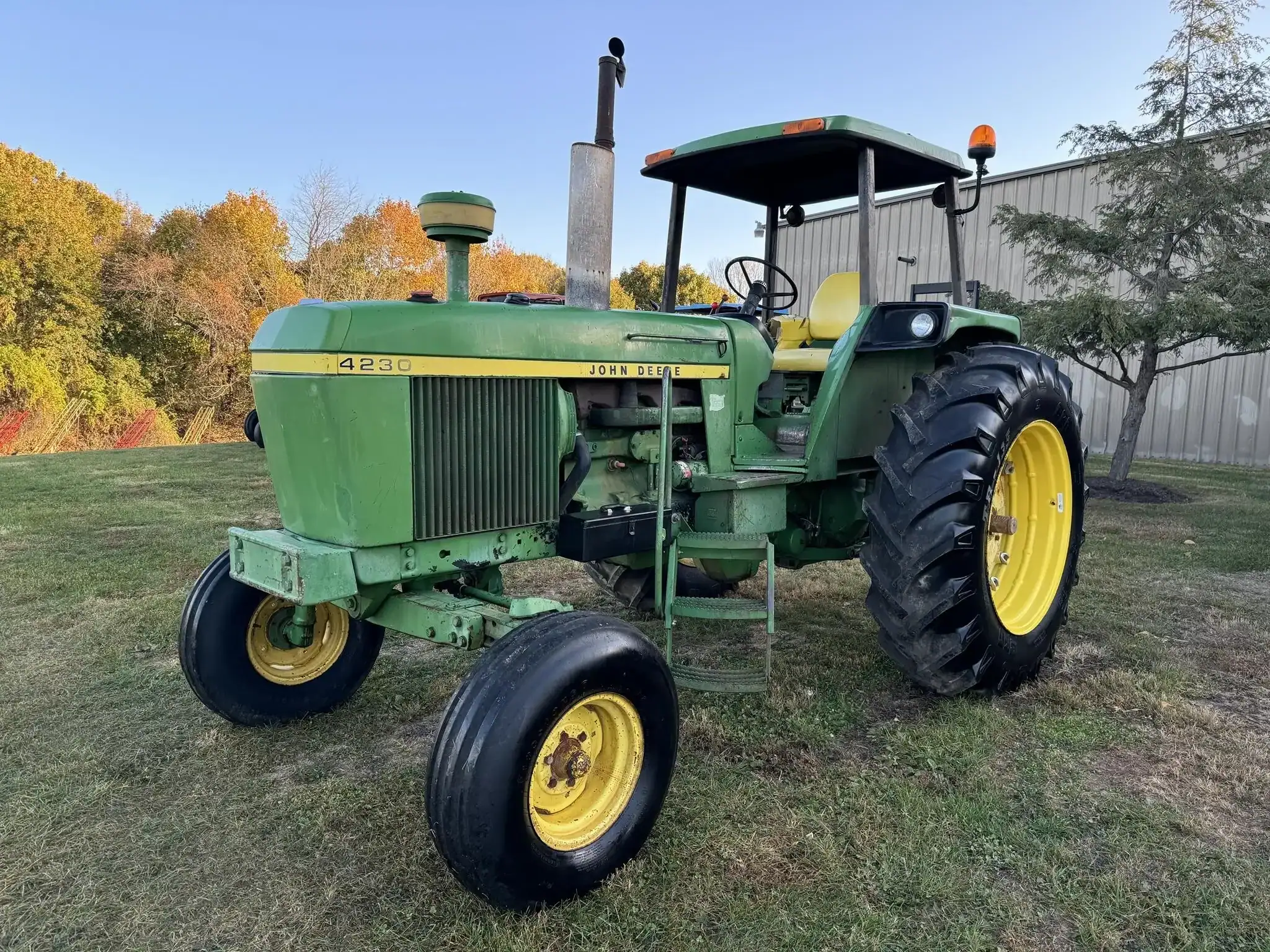
The John Deere 4230 is what happened when Deere gave the 4020’s formula everything farmers had asked for. Launched with Generation II in the fall of 1972 and built through 1977, it kept the beloved 404 cubic inch six-cylinder at roughly 100 PTO horsepower and wrapped it in the era’s two great innovations: the rubber-isolated Sound-Gard Body — Deere pointedly never called it a “cab” — and the new Quad-Range 16F/6R partial powershift, alongside carried-over Syncro-Range and Power Shift options and a wet Perma-Clutch that ended the dry-clutch era. Half a century later, the 4230 trades above the 4020 on the Canadian market — an average near $31,000 against the 4020’s $23,000 — because it remains a genuinely usable front-line chore tractor, not just a classic.
Status disclosure up front: the 4230 is long out of production. It took over the 4020’s 100-horse class for 1973 and was itself succeeded by the 40-series 4240 in 1978. This page is written for the 2026 used buyer, and one framing fact organizes the whole market: a 4230’s price is mostly its Sound-Gard story — cab-and-air tractors occupy an entirely different bracket from open-station units of identical mechanical health.
Aglist quick take: The 4230 is the vintage market’s best answer to “I want a 4020 I can drive all day in January.” Same displacement, better hydraulic pump, wet clutch, and the Quad-Range that Canadian auction data shows buyers overwhelmingly prefer. The honest framing: this is a two-decision purchase — Quad-Range versus Power Shift versus Syncro, and Sound-Gard versus open station — plus one habit to verify: Quad-Range boxes reward operators who learned to shift them and punish those who forced them, so the transmission’s history matters more than the hour meter. Listings will quote anywhere from 90 to 111 horsepower for the same tractor; that spread is measurement vocabulary, not mechanical difference, and this page settles it.
On This Page
ToggleQuick Verdict — Who the 4230 Is For
Buy it if: you want a ~100 PTO horsepower daily workhorse — haying, loader and feedlot duty, grain-cart and auger work, 5–6 bottom tillage — with cab-era comfort and the vintage world’s deepest parts commonality (the 404 shares major components with everything from the 4040 to Deere’s 6600/7700 combines). A Sound-Gard Quad-Range diesel with dual remotes is the buy-once configuration, roughly CAD $22,000–$38,000 in solid working grade.
Skip it if: open-station simplicity at lower cost serves you — a console John Deere 4020 delivers most of the capability for less — or you need more than 100 horses, where the turbocharged 4430 (and, from the New Generation’s final years, the John Deere 4320) enters the picture.
Full John Deere 4230 Specifications
Compiled from John Deere technical literature and Nebraska Tractor Test 1112 (Quad-Range diesel), cross-checked against reference sources. The 4230 was Generation II’s most configurable tractor — verify transmission, operator platform, and configuration on any unit.
| Category | Spec | Value |
|---|---|---|
| Equipment type | Row-crop tractor | Generation II (“30” series); Waterloo, Iowa |
| Production | Model years | 1973–1977 |
| Engine (diesel) | Type | John Deere 404 cu in (6.6 L) inline-6, naturally aspirated |
| Engine (gasoline) | Availability | Row-crop only; not available with Sound-Gard |
| Tested power (diesel) | PTO | ≈100 HP (Nebraska Test 1112, Quad-Range) |
| Listing-quote note | 90–111 HP | Drawbar / PTO / engine ratings quoted interchangeably by sellers — same tractor |
| Transmission (favourite) | Quad-Range | 16F/6R partial powershift — the market’s dominant choice |
| Transmission (options) | Syncro-Range / Power Shift | 8F/2R / 8F/4R full powershift |
| Creeper | Rare planetary creeper option from 1974 (extra slow speeds for PTO work) | |
| Clutch | Type | Wet Perma-Clutch (versus the 4020’s dry clutch) |
| Hydraulics | Type | Closed centre, uprated pump versus the 4020; multiple SCVs |
| 3-point hitch | Category | 2; independent 540/1000 PTO |
| Operator platform | Options | Sound-Gard Body (rubber-isolated, curved windshield), 4-post Roll-Gard, or open station |
| Restrictions | No Sound-Gard on hi-crop or gasoline units; low-profile open station only | |
| Comfort | Personal Posture cloth seat from 1974 (Sound-Gard only) | |
| Electrical | System | 12-volt, alternator |
| Configurations | Offered | Row-crop, standard, hi-crop, low-profile (orchard/grove, from 1972); HFWD variants exist |
| Historical note | Front end | The last John Deere offered with a tricycle (narrow) front |
| Rarity | Documented | 51 Power Shift Low Profile units built |
| Front loaders | Seen on units | John Deere 146/148/158; Farmhand, Boss, Super Stars and other aftermarket |
| Parts commonality | 6.404 family | Major engine components shared with 4000/4020/4040 tractors and 6600/7700 combines |
| Succession | Replaced / replaced by | Took over the 4020’s class (1973); succeeded by the 4240 (1978) |
The horsepower-quote confusion, settled. Canadian listings for the same mechanical tractor advertise “90 HP,” “100 HP,” “105 HP,” and “111 HP.” All describe a healthy 4230: roughly 90 at the drawbar, ≈100 at the PTO per Nebraska Test 1112, and 105–111 as engine ratings dealers pull from spec sheets. Compare tractors on PTO horsepower and condition — not on which number the seller chose.
Owner Reviews & Ratings on Aglist
Nebraska tested a new 4230 in the early seventies; Canadian owners have been compounding the record ever since — including 10,000-hour Quad-Range units on fresh rebuilds still working. As owners share their experience on Aglist, the rating system tracks:
- Reliability — the 404’s record, cooling health, rebuild history at working hours
- Transmission — Quad-Range shift quality and history, or Power Shift condition under load
- Sound-Gard condition — bushings, glass, headliner and upholstery, heater and A/C function
- Hydraulics — SCV response and seepage at hours
- Value for money — cab versus open-station economics on today’s market
If you own or run a 4230 in Canada, please leave a star rating and a short note below — Quad-Range shift history and Sound-Gard condition are exactly what listings gloss over.
John Deere 4230 vs the Alternatives
The 4230 sits between the legend it replaced and the sibling that outsold it.
| Spec | John Deere 4020 | John Deere 4230 | John Deere 4430 |
|---|---|---|---|
| Era | New Generation (1964–72) | Generation II (1973–77) | Generation II (1973–77) |
| Engine | 404 NA | 404 NA | 404 turbocharged |
| PTO HP (tested) | 91–96 | ≈100 | ≈126 |
| Transmissions | Syncro / Power Shift | Quad-Range / Syncro / Power Shift | Quad-Range / Syncro / Power Shift |
| Clutch | Dry | Wet Perma-Clutch | Wet Perma-Clutch |
| Cab | Aftermarket only | Sound-Gard Body option | Sound-Gard Body option |
| Typical Canadian price | CAD $7,000–$69,000 by grade | CAD $10,000–$61,000 by grade | Comparable, strong demand |
Where the 4230 wins: it’s the direct upgrade path from the 4020 — same proven displacement with the wet clutch, stronger hydraulics, the Quad-Range’s sixteen right-gear choices, and the only factory-quiet workplace of its era. For mixed farms running balers, feed equipment, and mid-size tillage, it’s arguably the most usable vintage Deere per dollar in Canada today.
Where the math flips: the turbocharged 4430 outsold the 4230 nearly two-to-one for a reason — by 1973, plenty of implements wanted more than 100 horses, and buyers needing that headroom should shop up. Budget-first buyers get most of the 4230’s work from a console John Deere 4020; heritage-minded ones will find the whole story starts with the John Deere 4010 and runs through the smaller John Deere 3020.
Real-World Performance
Engine — the 404, matured
The naturally aspirated 404 at ≈100 PTO horsepower is the same fundamental engine that made the 4020’s reputation, running cooler and easier than its turbocharged 4430/4630 siblings — which is why unmolested 4230 bottom ends routinely reach 8,000–12,000 hours before their first rebuild, and why rebuilds are cheap by vintage standards: the 6.404’s overhaul parts interchange across 4000/4020/4040 tractors and even Deere’s 6600/7700 combines, keeping every component in constant production. A gasoline 4230 exists (row-crop only, no Sound-Gard) and is now collector territory.
Quad-Range — the transmission that won
Generation II’s headline gearbox gives sixteen forward speeds as four powershiftable gears in four ranges — enough “right gear” choices that Canadian auction data shows Quad-Range 4230s vastly outnumbering both Syncro and Power Shift units in the resale market. The honest part: there’s an art to shifting one, and boxes that spent decades being forced between ranges wear where properly driven ones sail past 10,000 hours. On a test drive, work every range transition and all four powershift steps under load; clean, positive engagement is the tractor’s value. The 8F/4R Power Shift remains the loader-work favourite (same load-test discipline as on the 4020), the Syncro the simplicity pick, and the rare 1974-on creeper option a specialist’s find.
Sound-Gard — the Body that changed the price sheet
Deere designed Generation II around the operator rather than bolting a cab on afterward: the Sound-Gard Body rides on rubber bushings instead of the frame, its curved windshield deflects noise, and its famously offset door lines up with the intake and exhaust stacks so all three vanish from the operator’s sightline — Henry Dreyfuss’s team at work. In 2026 it’s the single biggest value variable on a 4230: heater-and-air Sound-Gard tractors occupy a bracket of their own, and interior condition (bushings, glass seals, headliner, upholstery — full kits exist and Canadian units get them) is worth real money either present or absent. Open-station and 4-post Roll-Gard tractors are the honest-work discount tier; hi-crops never got the Body at all.
Hydraulics, Hitch & Loader Work
The uprated closed-centre pump was one of Deere’s headline improvements over the 4020, and it shows in SCV and rockshaft response on healthy units — check it warm, and treat seepage at valves, couplers, and hoses as the standard high-hour negotiation item. Category 2 hitch and independent 540/1000 PTO handle big balers, 6-bottom-class tillage, and feed equipment. Canadian 4230s wear everything from JD 146/148/158 loaders to Farmhand, Boss (with grapples on cattle outfits), and Super Stars units, plus Yorkton-built Leon blades — as always, identify the loader before pricing, and note that grapple-and-loader cattle tractors have usually worked hardest.
Canadian Winters
This is where the 4230 earns its premium over every open-station ancestor: a sorted Sound-Gard with working heat turns January feeding into a shirt-sleeve job, and units with functioning A/C carry summer value too. The formula otherwise is unchanged — block heater, strong batteries, winter fuel — and the 12-volt alternator electrics remove the vintage-Deere electrical anxiety entirely. Our prairie winter equipment operation guide covers the rest.
Common Problems & Reliability Notes
Transparency note: patterns reported across a fifty-year ownership base, not confirmed defects on any given unit — and on tractors this age, rebuild history matters more than the hour meter, which is often on its second lap.
Quad-Range abuse wear. The model’s defining check: forced range changes chip and wear what patient shifting preserves. Any hesitation, grinding, or jump-out in specific ranges is a specialist conversation — priceable, but four figures.
Power Shift condition equals value. Same rule as the 4020 era: all gears under load, clean Hy-Gard history, no slip tolerated at asking price.
Sound-Gard aging. Perished body bushings (vibration returning to the seat), leaking glass seals, dead heater/A/C, and tired interiors are the cab tractor’s honest deductions — all fixable, all worth quoting before purchase.
Hydraulic seepage at hours. SCVs, couplers, steering circuit, and rockshaft — weep is normal, drip is negotiation, lazy warm response is a pump conversation.
Cooling neglect on worked units. The NA 404 is forgiving, but feedlot and loader tractors with packed radiators run hot for years before complaining. Clean fins, honest gauge, real coolant — first-order checks.
The core endures exceptionally. Between the 6.404 parts commonality (tractors and combines alike), Deere stock, a huge aftermarket, and steady salvage, the 4230 is among the cheapest 100-horse tractors on earth to keep alive — the structural reason Canadian averages sit above $30,000.
Used Price Range in Canada (2026)
The 4230 trades in a deep, confident Canadian market — around forty active listings at a time, spanning $10,221 to $61,466 with an average near $30,800, notably above the 4020. The grade ladder:
- Projects and tired high-hour units: roughly CAD $8,000–$14,000
- Honest open-station and Roll-Gard workers (Quad-Range): roughly CAD $14,000–$22,000
- Solid Sound-Gard cab-and-air tractors: roughly CAD $22,000–$38,000 — the heart of the market and the average band
- Exceptional low-hour Sound-Gard units, documented rebuilds: roughly CAD $38,000–$50,000
- Collector rarities (the 51-unit Power Shift Low Profiles, hi-crops, preserved gassers, tricycle-front originals): CAD $50,000–$61,000+
Premium movers, in order: Sound-Gard with working heat/air, Quad-Range with clean shift history, documented engine rebuild, dual remotes and 540/1000, and configuration rarity. Supply runs through MarketBook, AgDealer, Kijiji, and Prairie auctions — with Manitoba and Saskatchewan dealer service culture (five-figure work orders on good units are common and worth paying for) a genuine plus when documented.
Best Use Cases in Canadian Conditions
Front-line chore and feedlot tractor (SK / AB / MB / ON). Loader, grapple, bale and feed duty all winter in a heated Sound-Gard — the 4230’s second career and the reason values hold. Haying. Big balers and mower-conditioners on 100 PTO horses with sixteen gears to match ground speed. Grain support. Carts, augers, and harrows on 540/1000. Mid-size tillage. 5–6 bottom class in most Prairie soils. Collecting, emerging. Generation II is the new collector frontier — low-profiles, hi-crops, gassers, and the last tricycle fronts lead it. Not ideal for: buyers needing 120+ horses (shop the 4430 class), or minimum-budget shoppers better served by an open 4020.
Maintenance & Service
- Daily: engine oil, coolant, air cleaner, tire pressure, grease points — and radiator fins on loader/feed tractors
- Fluids discipline: genuine JD Hy-Gard (or true equivalent) throughout the transmission-hydraulic system — Quad-Range, Power Shift, and Perma-Clutch all depend on the real spec
- Quad-Range habit: shift ranges deliberately at a stop or near-stop; the box repays technique with five-figure hour counts
- Sound-Gard care: body bushings, glass seals, and heater/A/C service protect the tractor’s single biggest value component
- Hydraulics: keep SCVs and couplers tight; investigate lazy warm response early
- Winter: block heater, load-tested batteries, winter-blend diesel — plus the luxury of a heater that works
Parts support is the best in the vintage 100-horse class: the 6.404 engine family’s tractor-and-combine commonality keeps everything from gasket sets to cranks in continuous supply.
Where to Find a Used John Deere 4230 in Canada
Deep supply through MarketBook and AgDealer dealer listings, Kijiji private sales, and Prairie consignment auctions. Inspection priorities, in order: identify the drivetrain honestly (Quad-Range / Power Shift / Syncro — and test it accordingly: every range transition and powershift step under load on a QR, all gears on a PS); grade the Sound-Gard as its own asset — bushings, seals, headliner, heat and A/C — or price the open station as the work tier it is; check the 404 warm for oil pressure, blow-by, and cooling honesty, and ask directly about rebuild history (fresh in-frames are common and documented ones are worth paying for); work every SCV warm; identify the loader and its duty history (grapple tractors worked hardest); and read the hour meter as an anecdote. A documented Sound-Gard Quad-Range diesel with working climate control and dual remotes is the buy-once 4230 — the tractor that explains why this model out-prices its own legendary father.
John Deere 4230 FAQ
How much horsepower does a John Deere 4230 have? Approximately 100 PTO horsepower from the naturally aspirated 404 cu in diesel, per Nebraska Tractor Test 1112 (Quad-Range). Listings quoting 90, 105, or 111 HP describe the same tractor via drawbar or engine ratings.
What years was the John Deere 4230 made? Model years 1973–1977 in Waterloo, Iowa, as part of Generation II — taking over the 4020’s 100-horse class and succeeded by the 4240 in 1978.
Quad-Range, Power Shift, or Syncro — which 4230 should I buy? Quad-Range is the market’s overwhelming favourite: sixteen speeds, four powershiftable gears per range, and 10,000-hour durability when shifted with technique. Power Shift suits loader-heavy work; Syncro is the simplicity pick. Whichever you choose, test it under load — transmission condition is the tractor’s value.
What is the Sound-Gard on a 4230? Deere’s rubber-isolated operator enclosure — deliberately marketed as a “Body,” not a cab — with a curved noise-deflecting windshield and the famous offset door. It’s the single biggest price variable on a 4230; it was never offered on hi-crop or gasoline units, and low-profiles came open-station only.
Is the 4230 better than the 4020? It’s the 4020’s formula upgraded: same 404 displacement with a wet Perma-Clutch, stronger hydraulic pump, the Quad-Range option, and factory cab comfort. The 4020 counters with lower entry prices and its own legend — which is why both remain Canadian market staples.
What is a John Deere 4230 worth in Canada? As of 2026: roughly CAD $14,000–$22,000 for honest open-station workers, $22,000–$38,000 for solid Sound-Gard cab-and-air units (the market average sits near $31,000), and $38,000–$61,000+ for exceptional and rare tractors — including the 51-unit Power Shift Low Profiles.
What loader fits a John Deere 4230? John Deere 146/148/158 loaders are common factory-pattern matches, with Farmhand, Boss, and Super Stars aftermarket units frequent on Canadian tractors. Identify the loader — and its duty history — before pricing.
Was the 4230 the last John Deere with a tricycle front end? Yes — the 4230 closed the narrow-front era, which makes surviving tricycle units a growing collector niche within Generation II.
What replaced the John Deere 4230? The John Deere 4240 (1978), as the 30-series gave way to the 40-series; buyers needing more power in the same era shopped the turbocharged 4430.
Related Models on Aglist
- John Deere 4020 — the legend this tractor was built to succeed
- John Deere 4320 — the New Generation’s turbocharged bridge to this era
- John Deere 3020 — the previous generation one class down
- John Deere 4010 — where the whole dynasty began
- All tractors on Aglist — full tractor coverage
Disclaimer
Specifications compiled from John Deere technical literature and Nebraska Tractor Test 1112 (Quad-Range diesel), cross-checked against reference and market sources; the 4230 was Generation II’s most configurable model — three transmissions plus a rare creeper option, four chassis configurations, gasoline and diesel engines, and three operator platforms with documented availability restrictions — so individual units vary substantially, and rebuild history typically matters more than hour-meter readings at this age. The John Deere 4230 is a discontinued model — availability is limited to the used market, and pricing reflects indicative Canadian ranges that vary by region, condition, configuration, and Sound-Gard status. Reviews on Aglist are written by real users and moderated for spam — opinions are personal. Always confirm specifications and condition against the operator’s manual, a serial-number decode, and a thorough physical inspection — including transmission load-testing across all ranges and Sound-Gard systems assessment — before committing to any specific machine.
John Deere 4230 Reviews & Ratings
Share your experience
Help other Canadian buyers — leave a quick review for the
John Deere 4230
There are no reviews yet. Be the first one to write one.