Overview & Specs
John Deere 4020 Specs, Reviews & Used Price Canada (2026)
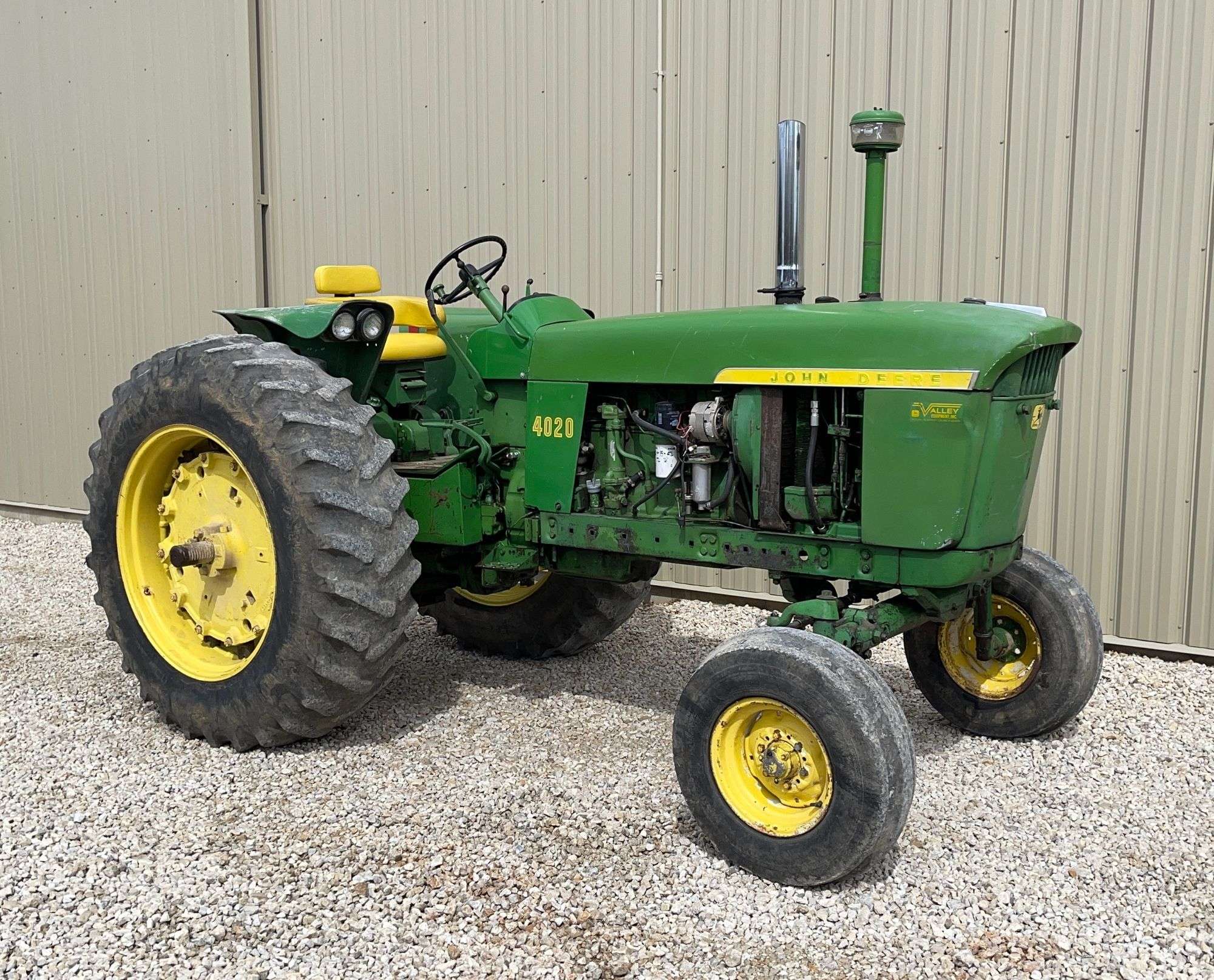
The John Deere 4020 is, by most measures, the most popular farm tractor North America ever built — 184,879 units between 1964 and 1972, of which 168,311 were diesels. It defined what a modern tractor is: independent PTO, closed-centre hydraulics, standard power steering, hydraulic wet-disc brakes, a differential lock, and the choice between the 8F/2R Syncro-Range gearbox and Deere’s landmark 8F/4R Power Shift. Half a century later it remains the benchmark vintage workhorse on Canadian farms — and one of the most actively traded, with roughly a hundred units listed on Canadian market platforms at any given time.
Status disclosure up front: the 4020 is long out of production. It replaced the nearly identical 4010 (1960–1963), and when the Generation II line arrived in late 1972, the 100-hp 4230 took over its power class — while the turbocharged 4320 (1971–72) had briefly offered a step up alongside it. Everything on this page is written for the 2026 used buyer, whether that’s a cattle operation needing an honest loader-and-chore tractor or a collector hunting one of the 768 hi-crops ever made.
Aglist quick take: The 4020 earned its legend honestly — it’s a ~95 PTO horsepower tractor with modern-pattern controls, an unkillable 404 cubic inch diesel, and a parts ecosystem (new, aftermarket, and salvage) that rivals tractors forty years younger. The honest framing: this is a three-decision purchase. Diesel is the market default for good reason; Syncro-Range versus Power Shift decides both how it drives and what it costs to service; and the 1969 “console” update — which brought the 12-volt electrical system — splits the model run into the tractors that need electrical patience and the ones that don’t. Get those three right and hours matter surprisingly little.
On This Page
ToggleQuick Verdict — Who the 4020 Is For
Buy it if: you want the definitive vintage workhorse — 91–96 tested PTO horses for haying, loader work with a JD 148/158, grain-cart and auger duty, and 4–5 bottom tillage — with the best parts support in the vintage world, at roughly CAD $12,000–$30,000 for a working console diesel. A 1969+ side-console diesel with dual hydraulics and 540/1000 PTO is the configuration that does everything.
Skip it if: you need a cab and modern comfort at this power (a later utility tractor serves better as a daily driver), your budget stops below CAD $10,000 (that money buys projects and pre-1969 tractors needing electrical work), or you’re actually shopping the smaller-farm slot — the John Deere 3020 delivers the same design at ~71 PTO hp for less money.
Full John Deere 4020 Specifications
Compiled from John Deere technical literature and Nebraska Tractor Test Laboratory reports (Test 849, fall 1963, and subsequent tests of later configurations), cross-checked against reference sources. The 4020 was built in row-crop, standard, and hi-crop configurations with three engines and two transmissions — verify the exact configuration on any unit.
| Category | Spec | Value |
|---|---|---|
| Equipment type | Row-crop / utility tractor | New Generation series; built in Waterloo, Iowa |
| Production | Model years | 1964–1972 |
| Total built | 184,879 (168,311 diesel; 8,445 LP; 8,123 gasoline) | |
| Engine (diesel) | Type | John Deere 404 cu in (6.6 L) inline-6, naturally aspirated |
| Rated speed | 2,200 rpm | |
| Torque | Approx. 278 lb-ft @ 1,600 rpm | |
| Engine (gasoline) | Displacement | 340 cu in through 1965; 362 cu in from 1966 |
| Engine (LP gas) | Displacement | 359 cu in |
| Tested power (diesel) | PTO | 91 HP (Nebraska Test 849, 1963); later Power Shift and 1969+ console tests recorded 94.9–95.9 HP |
| Drawbar | 84 HP (Test 849); approx. 83.8 HP in later testing | |
| Max pull (ballasted) | 11,249 lb | |
| Transmission (standard) | Syncro-Range | 8F/2R — four stations, on-the-move shifts within each; top 19.2 mph |
| Transmission (optional) | Power Shift | 8F/4R full powershift, no foot clutch; engine-disconnect lever for starting; top 20.5 mph |
| Drive | Layout | 2WD; rare hydrostatic front-wheel-drive option from MY 1969 |
| Differential lock | Standard | Yes — new versus the 4010 |
| Steering / brakes | Type | Power steering standard; hydraulic wet-disc power brakes |
| Hydraulics | Type | Closed centre, 2,250 psi; single or dual remotes (triple on some) |
| 3-point hitch | Category | 2 |
| PTO | Type | Independent (hydraulically engaged on 1969+); 540 and 1,000 rpm via interchangeable dual-spline stub shafts |
| Electrical | 1964–1968 | 24-volt positive-ground, generator |
| 1969–1972 | 12-volt negative-ground, alternator | |
| Fluids | Coolant / engine oil / trans-hyd | 24.4 qt / 12 qt (diesel) / 40.1 qt (Syncro; JD Hy-Gard spec) |
| Weight | Shipping | Approx. 8,600–8,945 lb; 10,000+ lb as typically equipped |
| Dimensions | Wheelbase | 97.5 in. (row-crop) / 100.3 in. (standard) |
| Configurations | Offered | Row-crop, standard, hi-crop (768 hi-crops built) |
| Front loaders | Factory matches | John Deere 148 (3,100 lb at pins) and 158 (3,800 lb) |
| Family | Economy sibling | John Deere 4000 (1969–72, ~1,000 lb lighter, 7,987 built) |
| Succession | Replaced / replaced by | Replaced the 4010 (1960–63); power class taken over by the Generation II 4230 (1973–77) |
Why you’ll see both “91 hp” and “95 hp” quoted — settled. Both are real Nebraska numbers from different tests. The original fall-1963 test of the Syncro diesel (Test 849) recorded 91 PTO horsepower. Deere kept improving the engine through the run — block, pistons, liners — and later tests of Power Shift and 1969+ console diesels recorded 94.9–95.9 PTO horsepower at the same 2,200 rpm. When two sellers advertise “91 hp” and “96 hp” 4020s, they’re describing test vintage, not different tractors.
Owner Reviews & Ratings on Aglist
Nebraska measured new 4020s six decades ago; Canadian owners know what ten thousand hours and fifty winters do. As owners share their experience on Aglist, the rating system tracks:
- Reliability — the 404 diesel’s record, electrical condition (especially pre-1969 units), cooling health
- Transmission — Syncro station wear or Power Shift condition and service history
- Hydraulics — closed-centre system health, remote and rockshaft response
- Parts and service — new, aftermarket, and salvage sourcing in your region
- Value for money — worker versus collector economics on today’s market
If you own or run a 4020 in Canada, please leave a star rating and a short note below — transmission type and electrical history in particular are exactly what buyers can’t reliably get from listings.
John Deere 4020 vs the Alternatives
The 4020’s real comparison set is its own bloodline — what it improved on, and what improved on it.
| Spec | John Deere 4010 | John Deere 4020 | John Deere 4230 |
|---|---|---|---|
| Years | 1960–1963 | 1964–1972 | 1973–1977 |
| Generation | New Generation (first) | New Generation (matured) | Generation II |
| PTO HP (diesel, tested) | ~80 | 91–96 | ~100 |
| Transmissions | Syncro 8F/3R | Syncro 8F/2R or Power Shift 8F/4R | Quad-Range, Syncro, or Power Shift |
| Diff lock | No | Yes | Yes |
| Electrical (diesel) | 24V | 24V (’64–68) / 12V (’69–72) | 12V |
| Operator platform | Open, dash controls | Open; side console from 1969 | Gen II styling, cab option |
| Typical Canadian price | Less than 4020 | CAD $7,000–$69,000 by grade | Comparable, more for cabs |
Where the 4020 wins: the balance point of the whole vintage market. It has the power and hydraulics to do modern chore work, the simplicity to be owner-serviced, the production volume that keeps parts cheap, and the reputation that keeps resale strong. The 4010 costs less but gives up the diff lock, seven-plus horsepower, and the strengthened driveline; collectors love it, workers pick the 4020.
Where the math flips: if daily comfort matters, the John Deere 4230 brings Generation II ergonomics and cab availability for similar money. If ~70 horsepower covers the work, the John Deere 3020 is the same engineering in a smaller, cheaper package. And buyers drawn to the 4020’s era but needing more punch should read about the turbocharged John Deere 4320 before paying premium money for a worked-over 4020 — period M&W turbo kits on 4020s exist, and a factory-turbo tractor is the cleaner buy. The John Deere 4010 completes the family picture.
Real-World Performance
Engine — the 404 that built the legend
Deere created the 4020’s diesel by boring the 4010’s engine an eighth of an inch — 24 more cubic inches, about seven more horsepower, and a torque curve (roughly 278 lb-ft at 1,600 rpm) that lugs instead of stalling. It starts easily for its age, burns 5–6.5 gal/hr under real load, and routinely runs past 10,000 hours between overhauls when the cooling system is kept honest. Gasoline (88 hp) and LP versions exist and carry collector interest, but the diesel is the working default — 91% of production, and the version every parts shelf is stocked for.
Syncro-Range vs Power Shift — the decision
The standard Syncro-Range gives eight forward speeds in four stations: within a station you shift on the move; between stations you stop and clutch. It’s simple, durable, and cheap to maintain — the default for tillage and general work. The optional Power Shift shifts all eight gears and four reverses under full load with no foot clutch — transformative for loader work, baling, and anything with direction changes, which is why PS tractors command a real premium today. The trade: a Power Shift lives on clean Hy-Gard and correct adjustment, and major service is specialist money. On any PS candidate, test every gear under load for slip and check the oil-change story; on a Syncro, confirm every station engages cleanly and the tractor stays in gear under load.
Hydraulics, PTO & Loader Work
The closed-centre system at 2,250 psi was the industry’s benchmark — instant remote response, strong rockshaft, and the reason 4020s took to loaders so naturally. The JD 148 (3,100 lb at the pins) and 158 (3,800 lb) are the factory matches, with TAS and other aftermarket loaders common on Canadian units. The independent PTO runs 540 and 1,000 rpm via interchangeable dual-spline stub shafts — a swap involving enough cleaning and fluid management that most tractors live their whole lives on one shaft; confirm the one you need is present and unmolested. Category 2 hitch handles 4–5 bottom plows, big blades, and modern rotary cutters without drama.
The 1969 console update — the other decision
Model year 1969 modernized the 4020: controls moved to a right-hand console, the PTO went hydraulically engaged with its lever on the dash, a slimmer oval exhaust improved sightlines — and, most importantly for a 2026 buyer, the electrical system changed from 24-volt positive-ground with a generator to 12-volt negative-ground with an alternator. The market calls these “side console” tractors and prices them above earlier “dash” units for good reason: everything electrical is easier, cheaper, and stocked everywhere. Earlier tractors are far from disqualified — 24-to-12-volt conversion kits are an industry of their own, including John Deere’s factory kit (SE501474) — but an unconverted 24V system’s condition belongs at the top of any pre-1969 inspection. The same model year also introduced the rare hydrostatic front-wheel-drive option: fragile in period, collectible now.
Canadian Winters
A 4020 with a block heater, healthy batteries, and winter fuel starts and works through Prairie winters the way it has for sixty of them — many Canadian listings feature the block heater as installed equipment. Open station is the honest limit for all-day January work; aftermarket cabs exist and vary wildly in quality. Our prairie winter equipment operation guide covers cold-weather setup that applies directly.
Common Problems & Reliability Notes
Transparency note: these are patterns reported across a sixty-year ownership base, not confirmed defects on any given unit. Configuration and care vary enormously — and hour meters on tractors this age are routinely inaccurate, so buy condition, not the tach.
24-volt electrics on 1964–68 diesels. The era’s most common frustration: generator, regulator, and split-load wiring faults, plus scarcer, pricier components. Either verify the original system is genuinely healthy, budget for a 12V conversion (a well-established job with complete kits), or shop 1969+ tractors and skip the question.
Power Shift condition is the tractor’s value. A healthy PS is a joy; a slipping one is a four-figure conversation with a specialist. Test all eight forward and four reverse gears under load, verify clean Hy-Gard on schedule, and treat any hesitation as a pricing event.
Closed-centre hydraulic health. Slow rockshaft, lazy steering, or weak remotes point to the main hydraulic system — serviceable, well-documented, and priceable, but not pocket change. Check response when warm, not just cold.
Syncro station wear. Grinding into stations or jumping out of gear under load is the gearbox’s honest age signal — a known repair path, and a negotiation point.
Front-end and steering wear. Wide-front spindles, tie-rod ends, and steering play are routine sixty-year items; sloppy steering is cheap to diagnose and worth pricing before purchase.
The core endures better than almost anything. Between Deere’s own parts, a massive aftermarket, and a salvage industry that dismantles 4020s specifically for used parts, there is no vintage tractor easier to keep alive — the reason so many are still working rather than parked.
Used Price Range in Canada (2026)
The 4020 trades in the deepest, most transparent vintage market in the country — Canadian platforms typically show around a hundred active listings, currently spanning $6,936 to $68,808 with an average near $23,100. The grade ladder:
- Projects and parts tractors: under CAD $7,000–$10,000 — bad blocks, stuck Power Shifts, rough early units
- Honest workers (running, usable, cosmetics optional): roughly CAD $10,000–$16,000
- Solid console diesels (1969+, Syncro, dual hydraulics): roughly CAD $16,000–$30,000 — the heart of the market and the average price band
- Power Shift, factory duals, exceptional one-owner originals: roughly CAD $30,000–$45,000
- Collector grade and rarities (hi-crops — only 768 built; factory FWD; low-hour LP and gas survivors; concours restorations): CAD $45,000–$69,000+
The premium movers, in order: Power Shift, 1969+ console/12V, dual or triple hydraulics with 540/1000 PTO, documented ownership, and originality. Supply is constant on MarketBook, AgDealer, Kijiji, and at every farm auction in the Prairie provinces.
Best Use Cases in Canadian Conditions
Haying and livestock operations (SK / AB / MB / ON). Baler, mower-conditioner, bale-hauling, and feed duty — the 4020’s second career and the reason working examples never sit long. Loader and chore tractor. The 148/158 loaders plus closed-centre response make it a genuinely good yard tractor for its age. Grain support. Augers, grain carts within reason, and harrow duty on 540/1000 PTO. Light-to-medium tillage. 4–5 bottoms in most Prairie soils. Collecting and shows. Hi-crops, LP units, FWD tractors, and one-owner originals anchor the Canadian vintage-Deere scene. Not ideal for: all-day winter work without a proper cab, buyers needing warranty-era reliability economics, or anyone sizing for sub-70-hp jobs the 3020 covers cheaper.
Maintenance & Service
- Daily: engine oil, coolant, air cleaner, tire pressure, grease points — the 404 forgives everything except dirty air and hot running
- Fluids discipline: modern JD Hy-Gard (or exact equivalent) in the transmission-hydraulic system — never bargain “303-type” oils, which don’t meet the spec the closed-centre system and Power Shift depend on
- Electrical: on pre-1969 units, keep the 24V system fully sorted or convert once and be done; on all units, load-test batteries each fall
- Power Shift: oil and filter strictly on schedule; pressure-test and adjust per the manual rather than driving around slip
- PTO: confirm and maintain the 540/1000 stub-shaft situation; the swap wants cleanliness and patience
- Winter: block heater, winter-blend diesel, strong batteries — the sixty-year-old Prairie formula
Parts availability is the 4020’s superpower: Deere still lists components, the aftermarket covers nearly everything, and salvage yards dismantle 4020s continuously for used assemblies.
Where to Find a Used John Deere 4020 in Canada
Supply is the deepest of any vintage tractor — MarketBook and AgDealer dealer listings, Kijiji private sales, and virtually every farm auction. Inspection priorities, in order: identify the tractor honestly (year, dash vs console, transmission, engine fuel) before believing the ad; on Power Shift units, load-test every gear and get the fluid history; on pre-1969 tractors, assess the 24V system or price a conversion; check closed-centre hydraulic response warm; confirm which PTO stub is fitted; listen to the 404 cold-start without pre-warming; walk the front end for spindle and tie-rod slop; and discount the hour meter entirely in favour of oil analysis, blow-by, and general honesty. A 1969+ console Syncro diesel with dual remotes and both PTO shafts on hand is the buy-once configuration; a verified-healthy Power Shift is the buy-once-and-smile one.
John Deere 4020 FAQ
How much horsepower does a John Deere 4020 have? The diesel tested at 91 PTO horsepower in the original 1963 Nebraska test, with later tests of Power Shift and 1969+ console versions recording 94.9–95.9 PTO HP at 2,200 rpm — which is why both “91 hp” and “95 hp” circulate. Drawbar figures ran about 84 HP. Gasoline versions made about 88 HP.
What years was the John Deere 4020 made, and how many were built? Model years 1964–1972, in Waterloo, Iowa — 184,879 in total: 168,311 diesels, 8,445 LP, and 8,123 gasoline tractors, making it the best-selling tractor of its era.
Syncro-Range or Power Shift — which 4020 should I buy? Syncro for simplicity, tillage, and the lowest ownership cost; Power Shift for loader work, baling, and on-the-go shifting — at a purchase premium and with service that belongs to specialists. A verified-healthy Power Shift is the most desirable working 4020; a neglected one is the most expensive.
What does the 1969 “console” 4020 mean? The 1969 model-year update: right-hand control console, hydraulically engaged PTO, slimmer exhaust — and the switch from the 24-volt generator system to 12-volt negative ground with an alternator. Console tractors are the easier ownership and price accordingly.
Can I convert an early 4020 from 24 volts to 12 volts? Yes — it’s one of the most common vintage-Deere jobs, with complete kits available including John Deere’s own (SE501474). Converted early tractors are fully practical; just verify the work was done properly.
What is a John Deere 4020 worth in Canada? As of 2026: roughly CAD $10,000–$16,000 for honest workers, $16,000–$30,000 for solid console diesels (the market average sits near $23,000), $30,000–$45,000 for Power Shift and exceptional originals, and $45,000+ for collector-grade and rarities like the 768-unit hi-crop.
What loader fits a John Deere 4020? The factory matches are the John Deere 148 (3,100 lb at the pins) and 158 (3,800 lb); TAS and other aftermarket loaders are common on Canadian units. The closed-centre hydraulics make it one of the better vintage loader tractors.
What oil does the 4020 transmission take? John Deere Hy-Gard (or a true equivalent) — the modern successor to the original “303” specification. Avoid bargain oils sold as “303 type”; the closed-centre hydraulics and especially the Power Shift depend on the real spec.
What replaced the John Deere 4020? Generation II arrived for 1973, with the 100-hp 4230 taking over the 4020’s class; the turbocharged 4320 (1971–72) had briefly offered more power alongside it in the final New Generation years.
Related Models on Aglist
- John Deere 3020 — the same New Generation engineering at ~71 PTO hp
- John Deere 4010 — the 1960 original the 4020 perfected
- John Deere 4230 — the Generation II successor with cab-era comfort
- John Deere 4320 — the factory-turbo step up from the same era
- All tractors on Aglist — full tractor coverage
Disclaimer
Specifications compiled from John Deere technical literature and Nebraska Tractor Test Laboratory data (Test 849, 1963, and subsequent tests of later configurations), cross-checked against reference sources; the 4020 was built over nine model years in multiple engine, transmission, and chassis configurations, including the significant 1969 console and electrical-system update, so individual units vary substantially. The John Deere 4020 is a discontinued model — availability is limited to the used market, and pricing reflects indicative Canadian ranges that vary by region, condition, configuration, and originality; hour-meter readings on tractors of this age are frequently unreliable. Reviews on Aglist are written by real users and moderated for spam — opinions are personal. Always confirm specifications and condition against the operator’s manual, a serial-number decode, and a thorough physical inspection — including transmission load-testing and electrical-system assessment — before committing to any specific machine.
John Deere 4020 Reviews & Ratings
Share your experience
Help other Canadian buyers — leave a quick review for the
John Deere 4020
There are no reviews yet. Be the first one to write one.