Overview & Specs
John Deere 4320 Specs, Reviews & Used Price Canada (2026)
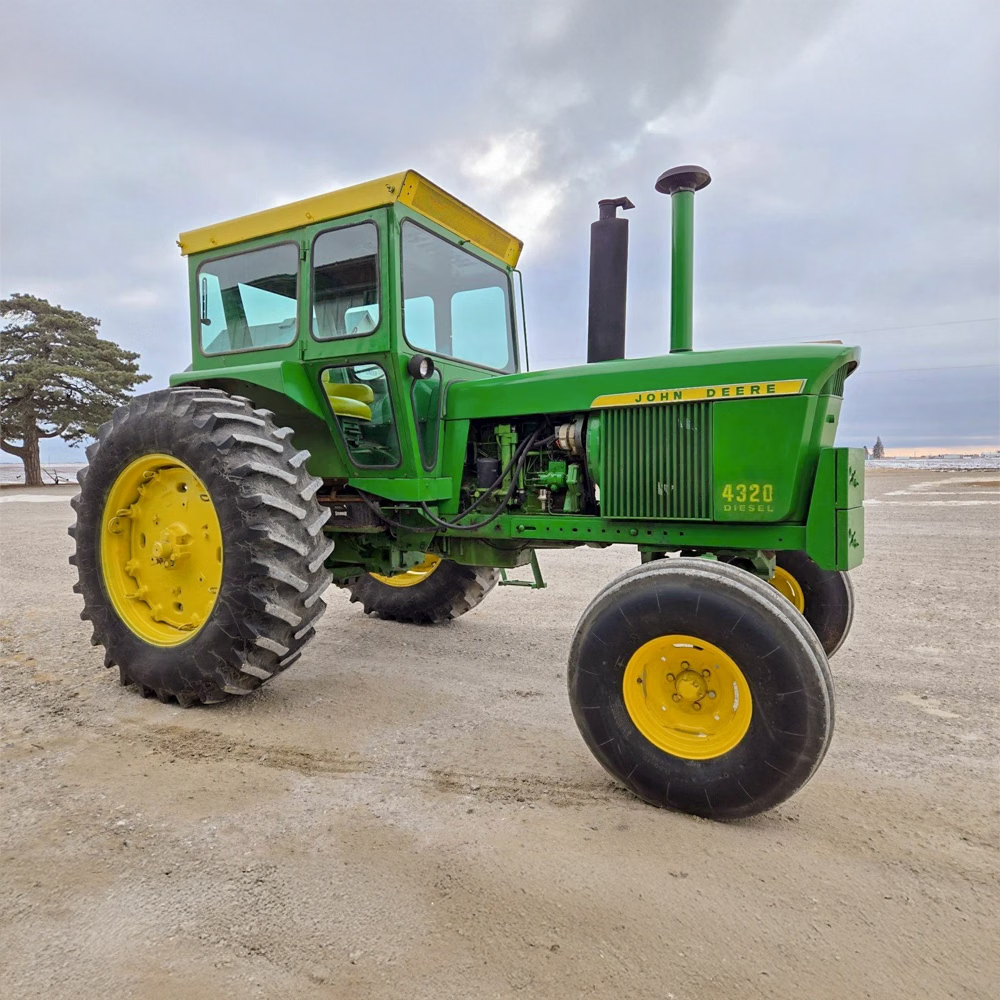
The John Deere 4320 is the two-year tractor that bridged two eras. Built only for model years 1971 and 1972 — 21,485 units — it answered a simple demand Deere could no longer ignore: farmers wanted more than the 4020’s 95 horsepower without stepping up to the standard-frame 4520. The answer was the 4020’s beloved 404 cubic inch six with a turbocharger, Nebraska-tested at 116.55 PTO horsepower — but engineered, not improvised: Deere added roughly 700 pounds of drivetrain reinforcement and rebuilt the cooling strategy around the turbo rather than simply changing the decal.
One naming note before anything else, and it matters more here than on any other page: John Deere reused “4320” on a 2005–2013 compact utility tractor (48 HP, hydrostatic or PowrReverser, typically wearing a 400X loader) — and Canadian listing platforms are dominated by that modern machine under this exact name. This page covers the 1971–72 New Generation turbo row-crop. Status disclosure: the vintage 4320 is long out of production; Generation II’s turbocharged 4430 took over its slot for 1973, while the 100-horse class went to the 4230.
Aglist quick take: The 4320 is the connoisseur’s New Generation tractor — 4430-class power with 4020 simplicity, in a production run small enough (21,485 versus the 4020’s 184,879) that clean examples carry quiet collector gravity. The honest framing: it was Syncro-Range only — no Power Shift was ever offered — its early under-hood air cleaner was a genuine design miss (the vertical intake stacks on many survivors are the factory’s fix, and the identifier to look for), and its turbo 404 is desirable enough as a transplant into 4020s that verifying the original engine is inspection item one on any candidate.
On This Page
ToggleQuick Verdict — Who the 4320 Is For
Buy it if: you want serious vintage power — 116 tested PTO horses for big balers, grain carts, 6-bottom-class tillage, and heavy PTO work — with the New Generation’s mechanical simplicity, or you’re a collector drawn to a two-year, 21,000-unit run that history remembers as the 4020’s hot-rod finale. A late unit with the vertical air stacks, dual remotes, and its original engine documented is the one to hold out for.
Skip it if: you want a cab and on-the-go shifting — the Generation II John Deere 4230 (and the 4430 above it) brings Sound-Gard comfort and the Quad-Range for similar or better money — or the John Deere 4020 already covers your horsepower needs with a far deeper parts-and-supply market.
Full John Deere 4320 Specifications
Compiled from John Deere technical literature and Nebraska Tractor Test data (1971), cross-checked against reference and period sources. A two-year run with meaningful mid-run changes (notably the air-intake fix) — verify configuration and engine provenance on any unit.
| Category | Spec | Value |
|---|---|---|
| Equipment type | Row-crop tractor | New Generation series; Waterloo, Iowa |
| Production | Model years | 1971–1972 only |
| Total built | 21,485 | |
| Engine | Type | John Deere 404 cu in (6.6 L) inline-6, turbocharged |
| Bore × stroke / compression | 4.25 × 4.76 in. (108 × 121 mm) / 15.7:1 | |
| Tested power | PTO | 116.55 HP (Nebraska testing, 1971); 115 HP claimed |
| Drawbar | 101.7 HP | |
| Engineering | Versus the 4020 | ~700 lb of drivetrain reinforcement; piston cooling orifices; turbo oil-cooling circuit |
| Air intake | Early / late | Under-hood cleaner (service-intensive) / vertical intake stacks (factory fix — the survivor’s identifier) |
| Transmission | Type | Syncro-Range 8F/2R only — no Power Shift offered |
| Clutch | 13.5 in. dry disc | |
| Steering / brakes | Type | Power steering; hydraulic wet-disc brakes |
| Hydraulics | Type | Closed centre; 22 gpm pump, 14-gal system |
| 3-point hitch | Category | 2; 540/1000 PTO |
| Electrical | System | 12-volt, alternator |
| Fuel | Tank | 44 gal (167 L) |
| Weight | Operating | 10,000+ lb |
| Drive | Options | 2WD standard; front-wheel assist rare |
| Operator platform | Options | Open station; 2-post Roll-Gard and canopy optional; period cab optional (no Sound-Gard — that arrived with Generation II) |
| Front loaders | Factory matches | John Deere 148 and 158 |
| Original price | 1972 | Approx. USD $12,000 |
| Positioning | In the range | Filled the gap between the 4020 (95 HP) and 4520/4620 (123/135 HP) |
| Succession | Replaced by | Generation II John Deere 4430 (turbo class, 1973) |
Not a decal job — the record shows it. Deere could have bolted a turbo to the 4020 and shipped it; instead the 4320 got a strengthened driveline several hundred pounds heavier, oil jets cooling the pistons from beneath, and a dedicated turbo lubrication-and-cooling circuit off an upgraded oil cooler. The one thing they got wrong at launch — an under-hood air cleaner that a turbocharged 404 could pack with dust in half a working day — they fixed in production with the vertical intake stacks that mark many surviving tractors. That stack is worth looking for: it’s the factory’s own verdict on which configuration to own.
Owner Reviews & Ratings on Aglist
Nebraska measured a new 4320 in 1971; five decades of owners know what the turbo, the Syncro, and Canadian winters have done since. As owners share their experience on Aglist, the rating system tracks:
- Reliability — the turbo 404’s health, cooling-system condition, oil-change discipline
- Originality — original engine present and documented (donor pressure is real), intake configuration
- Transmission — Syncro-Range engagement and clutch history through the 13.5-in. disc
- Parts and service — 6.404-family commonality versus 4320-specific turbo items
- Value for money — worker economics versus two-year-run collector gravity
If you own or run a 4320 in Canada, please leave a star rating and a short note below — engine provenance and intake configuration are exactly what listings omit.
John Deere 4320 vs the Alternatives
The 4320 buyer’s real triangle: stay New Generation, or cross into Generation II.
| Spec | John Deere 4020 | John Deere 4320 | John Deere 4230 |
|---|---|---|---|
| Era | New Generation (1964–72) | New Generation (1971–72) | Generation II (1973–77) |
| Engine | 404 NA | 404 turbo | 404 NA |
| PTO HP (tested) | 91–96 | 116.55 | ≈100 |
| Transmissions | Syncro or Power Shift | Syncro only | Quad-Range / Syncro / Power Shift |
| Cab | Aftermarket only | Period cab option, no Sound-Gard | Sound-Gard Body option |
| Production | 184,879 | 21,485 | Five-year run |
| Typical Canadian price | CAD $7,000–$69,000 by grade | Indicative $12,000–$45,000 by grade | CAD $10,000–$61,000 by grade |
Where the 4320 wins: power per era. It out-pulls every non-turbo tractor on this page by a class, keeps the New Generation’s owner-serviceable simplicity, and carries scarcity the mass-produced siblings can’t — a one-of-21,485 machine reads very differently at a show than a one-of-184,879.
Where the math flips: for daily work, Generation II’s case is honest — the 4430 delivered ~126 turbo horses with the Quad-Range and Sound-Gard a year after the 4320 retired, and the John Deere 4230 offers the comfort formula at 100 HP. Within the New Generation, the John Deere 4020 remains the value benchmark, and buyers exploring the turbo family’s origins should read the John Deere 4520 — Deere’s first turbocharged tractor — before deciding where in the trio (4320, 4520, and the 135-HP 4620) their money belongs.
Real-World Performance
Engine — the turbo 404, done properly
The 4320’s engine answers to throttle the way no naturally aspirated 404 does, and the engineering under it is why these tractors worked rather than grenaded: piston-cooling oil jets, an uprated oil cooler feeding the turbocharger, and a driveline reinforced for the torque. Ownership discipline is standard turbo practice, fifty years early — clean oil on schedule, an idle-down after hard pulls, honest cooling — plus one model-specific habit: on early under-hood-intake units, air-filter service isn’t maintenance, it’s operation. The market wrinkle to respect: the turbo 404 is a coveted transplant into 4020s, Canadian listings openly advertise the swaps, and that donor demand means some “4320s” for sale are missing their reason for existing. Casting numbers before money.
Transmission — Syncro only, by design
No Power Shift was ever offered on the 4320 — the 8F/2R Syncro-Range with its 13.5-inch dry clutch is the only drivetrain. For tillage and PTO work that’s no handicap; for loader-cycle work it’s the honest limitation that sends buyers to a Power Shift 4020 or a Quad-Range 4230 instead. The upside is what isn’t there: no powershift pack to slip, no specialist bills — a healthy Syncro 4320 is about as simple as 116 horsepower gets.
Hydraulics, Hitch & Implements
The closed-centre system’s 22 gpm pump was serious flow for 1971, and it shows in remote and rockshaft response on sorted units. Category 2 hitch, 540/1000 PTO, and a 44-gallon tank make the 4320 a genuine long-day tractor: big balers, forage equipment, grain carts, and 6-bottom-class tillage were its brief, and remain within it. JD 148/158 loaders fit — though at 10,000-plus pounds on 2WD, this was never primarily a loader tractor, and the rare front-wheel-assist units are collector finds today.
Canadian Winters
Twelve-volt alternator electrics, a block heater, strong batteries, and winter fuel — the sorted-era formula, with the turbo addendum: gentle first minutes when stone cold, idle-down before shutdown even in January. Open station (or a period cab of varying quality) is the honest comfort limit; our prairie winter equipment operation guide covers the setup details that apply directly.
Common Problems & Reliability Notes
Transparency note: patterns reported across a fifty-year ownership base of a 21,000-unit run, not confirmed defects on any given tractor — and hour meters of this vintage are anecdotes.
Early air-intake service burden. The launch configuration’s under-hood cleaner packs with dust under turbo airflow; the factory’s vertical-stack fix is the configuration to prefer, and retrofits exist. On any pre-stack unit, filter condition tells you how it’s been run.
Turbo condition is value. Shaft play, oil in the intake, smoke under load, and the oil-change story — the standard turbo exam, with fifty years of stakes.
Engine provenance under donor pressure. The desirable transplant works both ways: verify the original turbo 404 is present, numbers-consistent, and not a tired core swapped in after the good one left for a 4020.
Cooling neglect. Everything Deere engineered into the 4320 assumes the cooling system works: clean fins, honest gauge, real coolant, functional oil cooler. First-order checks, always.
Syncro wear and clutch history. Clean engagement in every station, no jump-out under load; the 13.5-inch clutch is a known, priceable job on high-hour units.
Parts: family-easy, model-specific-patient. The 6.404 architecture shares heavily with the 4020/4040/combine ecosystem, keeping engine internals plentiful; 4320-specific turbo plumbing, intake parts, and trim take more hunting befitting a two-year run.
Used Price Range in Canada (2026)
One honesty first: Canadian listing platforms bury the vintage 4320 under the 2005–2013 compact of the same name — the CAD $20,000–$60,000 cluster dominating search results is mostly the modern 48 HP machine. Genuine 1971–72 units surface less often, mostly through estate sales, auctions, and collector channels, and the indicative ladder below is benchmarked against comparable-grade New Generation turbo tractors:
- Projects, tired units, and engine-absent rollers: roughly CAD $7,000–$12,000
- Honest workers (running, original engine, pre- or post-stack): roughly CAD $12,000–$20,000
- Solid originals — vertical stacks, dual remotes, documented engine: roughly CAD $20,000–$32,000
- Exceptional low-hour survivors, original paint, and rare front-wheel-assist units: CAD $32,000–$45,000+ — the two-year scarcity premium is real and growing as Generation-adjacent collecting matures
Value movers: original engine documented, intake configuration, overall originality, and provenance. When a genuine vintage 4320 does list publicly, it rarely lingers — set alerts on MarketBook, AgDealer, and auction houses rather than expecting standing supply.
Best Use Cases in Canadian Conditions
Heavy PTO and hay work (SK / AB / MB / ON). Big balers, forage harvest support, and grain carts on 116 tested horses. Serious tillage. 6-bottom-class plows and heavy discs within the strengthened driveline’s design brief. Long-day field duty. The 44-gallon tank was made for Prairie quarter-sections. Collecting — the smart-money tier. Two model years, 21,485 units, a genuine engineering story, and the last hurrah of New Generation power: everything a maturing collector class rewards. Not ideal for: loader-cycle work (no Power Shift), buyers needing cab comfort (that’s Generation II’s job), or anyone who won’t keep turbo discipline.
Maintenance & Service
- Daily: engine oil, coolant, air cleaner (religiously on pre-stack units), tire pressure, grease points
- Turbo discipline: oil and filter strictly on schedule; idle-down after hard work; investigate new smoke or whistle immediately
- Cooling first: fins, cap, thermostat, coolant, and the oil-cooler circuit the turbo depends on
- Fluids: genuine JD Hy-Gard (or true equivalent) in the transmission-hydraulic system — never bargain “303-type” oils
- Syncro care: clutch free-play and clean station engagement as routine owner checks
- Winter: block heater, load-tested batteries, winter-blend diesel; gentle cold starts and idle-down shutdowns
Engine internals ride the abundant 6.404 family supply; budget patience (not despair) for 4320-specific turbo and intake components.
Where to Find a Used John Deere 4320 in Canada
Filter first: add “1971,” “1972,” or “turbo 404” to every search, or you’ll drown in 48-horse compacts. Genuine units flow through estate and consignment auctions, collector networks, and occasional dealer listings on MarketBook and AgDealer. Inspection priorities, in order: verify the original turbo 404 by casting numbers and story — donor pressure makes this item one; identify the intake configuration (vertical stacks preferred, early under-hood priced accordingly); run the full turbo exam (shaft play, intake oil, smoke under load, oil records); check cooling honestly, radiator through oil cooler; work every Syncro station under load and assess the 13.5-inch clutch; confirm dual remotes and 540/1000 function; and treat the tach as a rumour. A stack-equipped, numbers-consistent 4320 with dual remotes and paperwork is the buy-once tractor — and increasingly, the buy-and-hold one.
John Deere 4320 FAQ
How much horsepower does a John Deere 4320 have? The 1971–72 turbo row-crop tested at 116.55 PTO horsepower and 101.7 drawbar horsepower in Nebraska testing, against a 115 HP claim, from the turbocharged 404 cu in six.
Is this the same John Deere 4320 as the newer compact tractor? No — Deere reused the name on a 2005–2013 compact utility (48 HP, hydrostatic or PowrReverser). That modern machine dominates Canadian listings under this name; this page covers the 1971–72 New Generation turbo row-crop.
Is the 4320 just a 4020 with a turbo? No — and the record is specific: Deere added roughly 700 pounds of drivetrain reinforcement, piston-cooling oil jets, and a dedicated turbo cooling circuit. The one launch mistake, the under-hood air cleaner, was fixed in production with vertical intake stacks.
Why do some 4320s have vertical air stacks and some don’t? The turbo overwhelmed the original under-hood air cleaner — operators were cleaning filters mid-day — so Deere moved the intake up into cleaner air. Stack-equipped tractors are the factory-corrected configuration and the ones to prefer.
Did the John Deere 4320 come with a Power Shift? No — Syncro-Range 8F/2R was the only transmission offered. Buyers wanting on-the-go shifting in this power class shopped the Power Shift 4020 then, and shop the Quad-Range 4230/4430 now.
How many John Deere 4320s were built? 21,485, across model years 1971 and 1972 only — scarcity that increasingly matters as Generation-era collecting matures.
What is a vintage John Deere 4320 worth in Canada? Indicatively, as of 2026: roughly CAD $12,000–$20,000 for honest workers, $20,000–$32,000 for solid documented originals, and $32,000–$45,000+ for exceptional survivors — with the caveat that public listings under this name are dominated by the modern compact, so genuine vintage sales flow heavily through auctions and collector channels.
What replaced the John Deere 4320? Generation II’s turbocharged John Deere 4430 took over the class for 1973 — the tractor that went on to outsell everything around it — while the 4320’s brief was retired after two model years.
Related Models on Aglist
- John Deere 4020 — the legend this tractor turbocharged
- John Deere 4520 — Deere’s first turbo tractor, the other half of the story
- John Deere 4230 — Generation II’s answer at 100 HP with the Sound-Gard
- All tractors on Aglist — full tractor coverage
Disclaimer
Specifications compiled from John Deere technical literature, Nebraska Tractor Test data (1971), and period engineering documentation, cross-checked against reference and market sources; the 4320 was built for two model years with a significant mid-run air-intake change, engine transplants from this model into 4020s are documented in the current market, and Canadian listing platforms mix the unrelated 2005–2013 John Deere 4320 compact utility into every search under this name. The vintage John Deere 4320 is a discontinued model — availability is limited to the used and collector market, and pricing reflects indicative Canadian ranges benchmarked against comparable-grade New Generation turbo tractors, varying by region, condition, configuration, originality, and engine provenance; hour-meter readings at this age are unreliable. Reviews on Aglist are written by real users and moderated for spam — opinions are personal. Always confirm specifications, engine provenance, and condition against the operator’s manual, casting and serial numbers, and a thorough physical inspection — including a full turbocharger and cooling-system assessment — before committing to any specific machine.
John Deere 4320 Reviews & Ratings
Share your experience
Help other Canadian buyers — leave a quick review for the
John Deere 4320
There are no reviews yet. Be the first one to write one.