Overview & Specs
John Deere 4520 Specs, Reviews & Used Price Canada (2026)
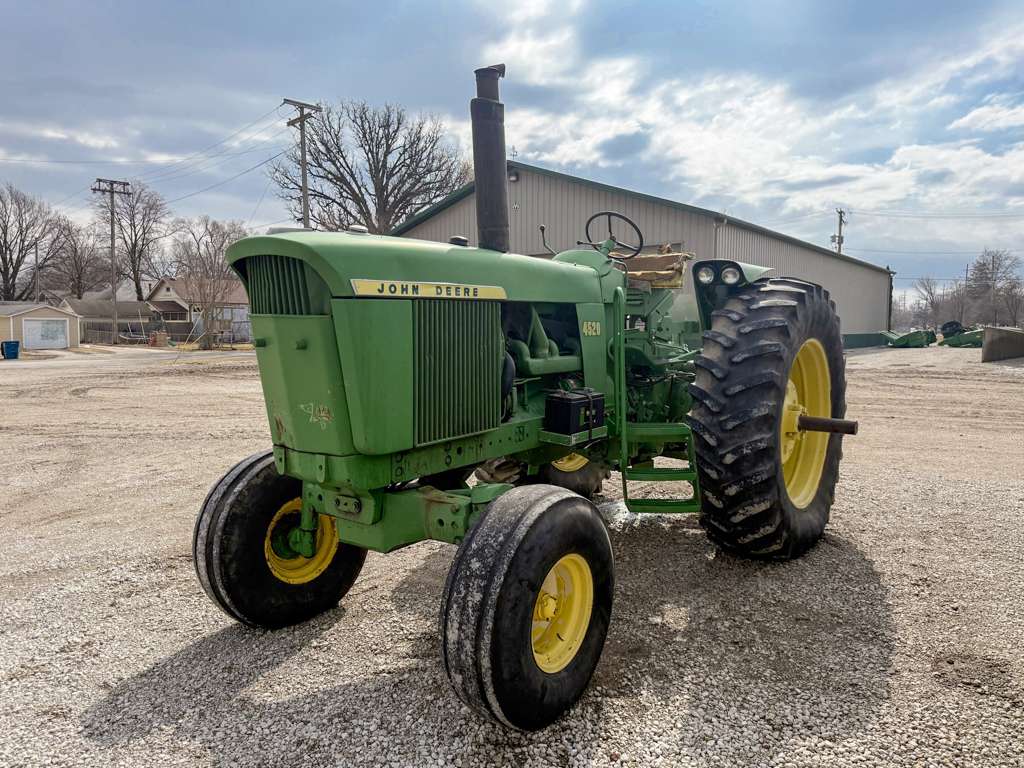
The John Deere 4520 is where turbocharging began at Deere — the company’s first factory-turbocharged tractor, built for just two model years (1969–1970) in Waterloo. It took the 4020’s 404 cubic inch six, added a turbocharger at a 16.4:1 compression ratio, and delivered roughly 123 PTO horsepower in Nebraska testing — nearly 5020 power for thousands less. Every turbocharged Deere that followed, from the 4320 and 4620 through the 4430 and 4640 dynasty, traces its bloodline to this machine.
One naming note first: John Deere reused “4520” on a 2004-onward compact utility tractor (eHydro and PowrReverser family), and that modern machine dominates listings and searches under this name — the two even share the distinction of Nebraska tests, forty years apart. This page covers the 1969–70 pioneer. Status disclosure: the vintage 4520 is long out of production, updated into the intercooled 4620 for 1971 (the same year the 4320 finally put turbo power into the true row-crop chassis), and this page is written for the 2026 used buyer and collector.
Aglist quick take: The 4520 is the origin story with a compromise built in — Deere scaled it down from the 5020’s standard frame, so the first turbo row-crop was, honestly, a row-crop tractor on a standard tractor’s bones: heavier and less nimble than the 4020 it out-powered, which is precisely why the 4320 exists. The honest framing for a buyer: unlike the 4320, the 4520 offered both Syncro-Range and Power Shift; as the turbo pioneer it predates the piston-cooling refinements Deere added two years later, so cooling-system health and turbo discipline matter even more here; and the short, low-volume run gives clean examples genuine “first of the breed” collector gravity.
On This Page
ToggleQuick Verdict — Who the 4520 Is For
Buy it if: you want serious late-New-Generation power — ~123 tested PTO horses for heavy tillage, big PTO implements, and grain-cart duty — with the option of a Power Shift the 4320 never got, or you’re a collector who understands what “Deere’s first turbo” means on a show card. A 1970 unit (the refined year) with a healthy, documented turbo and cooling system is the one to hold out for.
Skip it if: you want the same power in the nimbler true row-crop package — that’s the John Deere 4320, built to fix exactly this tractor’s compromise — or Generation II comfort matters, where the John Deere 4230 and the 4430 above it take over.
Full John Deere 4520 Specifications
Compiled from John Deere technical literature and Nebraska Tractor Test 1014 (Power Shift, June 1969), cross-checked against reference sources. A two-year run with first-year refinements — verify configuration, engine health, and provenance on any unit.
| Category | Spec | Value |
|---|---|---|
| Equipment type | Row-crop tractor (standard-frame architecture) | New Generation series; Waterloo, Iowa |
| Production | Model years | 1969–1970 only — a short, low-volume run |
| Historical note | Significance | John Deere’s first factory-turbocharged tractor |
| Engine | Type | John Deere 404 cu in (6.6 L) inline-6, turbocharged |
| Bore × stroke / compression | 4.25 × 4.76 in. (108 × 121 mm) / 16.4:1 | |
| Rated speed / max output | 2,200 rpm / ≈133 engine HP | |
| Tested power | PTO | ≈123 HP (Nebraska Test 1014, Power Shift, 1969) |
| Drawbar | ≈111 HP tested | |
| Transmission (option 1) | Syncro-Range | 8F/2R, partially synchronized, dry disc clutch |
| Transmission (option 2) | Power Shift | 8F/4R full powershift, wet disc — offered here, unlike on the later 4320 |
| Chassis | Architecture | Scaled down from the 5020’s standard frame — heavier than true row-crops |
| Drive | Options | 2WD or 4WD (front-wheel assist) |
| Diff lock | Type | Hydraulic rear differential lock |
| Steering / brakes | Type | Power steering; differential hydraulic wet-disc brakes |
| Hydraulics | Type | Closed centre, generous capacity |
| 3-point hitch / PTO | Category | Cat 2/3-class hitch; 540/1000 PTO |
| Electrical | System | 12-volt, alternator (console-era electrics) |
| Fuel | Tank | 50 gal (189 L) |
| Operator platform | Options | Open station; Roll-Gard ROPS or heated cab optional (pre-Sound-Gard era) |
| Succession | Updated into / paralleled by | 4620 (intercooled, 135 HP, 1971); 4320 (turbo in the row-crop chassis, 1971) |
The compromise, stated plainly. Deere built its first turbo tractor the fast way — by scaling down the 5020 rather than reinforcing the 4020 — and farmers noticed: the 4520 carried standard-tractor weight and geometry into row-crop work. It sold on power and pioneered the technology, but the market’s verdict arrived in 1971 as two tractors: the intercooled 4620 refining this platform, and the 4320 delivering turbo power in the chassis buyers had wanted all along. Understanding that fork is understanding the 4520’s place — and its price.
Owner Reviews & Ratings on Aglist
Nebraska measured the pioneer in June 1969; five decades of owners know what the first-generation turbo installation does with age. As owners share their experience on Aglist, the rating system tracks:
- Reliability — the turbo 404’s health on the pioneer installation, cooling-system condition
- Originality — original engine and turbo setup documented; first-year (1969) versus refined 1970 build
- Transmission — Syncro engagement or Power Shift condition under load
- Parts and service — 6.404-family commonality versus 4520-specific items on a two-year run
- Value for money — worker economics versus first-turbo collector gravity
If you own or run a 4520 in Canada, please leave a star rating and a short note below — build year, turbo history, and transmission health are exactly what listings leave out.
John Deere 4520 vs the Alternatives
The turbo trio of the late New Generation frames every 4520 decision.
| Spec | John Deere 4520 | John Deere 4320 | John Deere 4620 |
|---|---|---|---|
| Years | 1969–1970 | 1971–1972 | 1971–1972 |
| Role | The pioneer | Turbo in the true row-crop chassis | The 4520, refined and intercooled |
| Engine | 404 turbo, 16.4:1 | 404 turbo, 15.7:1, piston-cooling jets | 404 turbo-intercooled |
| PTO HP (tested) | ≈123 | 116.55 | ≈135 |
| Transmissions | Syncro or Power Shift | Syncro only | Syncro or Power Shift |
| Chassis | 5020-derived standard frame | 4020 row-crop frame, reinforced | 4520-derived, updated |
| Typical Canadian price | Indicative $10,000–$40,000 by grade | Indicative $12,000–$45,000 by grade | Two-year scarcity, comparable |
Where the 4520 wins: history and the Power Shift. It’s the only way to own “Deere’s first turbo,” it out-tested the 4320 by six-plus horses, and it’s the only tractor in the trio’s opening act that pairs turbo power with clutch-free shifting — a combination loader-and-cart operations still appreciate.
Where the math flips: for pure working ergonomics, the John Deere 4320‘s row-crop chassis is the one farmers asked for; for the refined version of this exact platform, the 4620 (page coming to Aglist) adds the intercooler and the lessons learned. And the value baseline of the whole era remains the John Deere 4020 — the tractor all three were built to out-muscle.
Real-World Performance
Engine — the pioneer installation
The 4520’s turbo 404 runs a higher 16.4:1 compression than the 4320’s later 15.7:1 — and that detail tells the engineering story: Deere’s second turbo tractor added piston-cooling oil jets, a dedicated turbo oil circuit, and lower compression, a fair signal of what the company learned on this one. That’s inference about lineage, not a documented 4520 defect — but it sets the ownership rule: on the pioneer, cooling-system health and turbo discipline (clean oil on schedule, idle-down after hard pulls, honest radiator) aren’t maintenance items, they’re the purchase decision. A 4520 that’s been cooled and oiled for fifty years pulls like the 123 tested horses it is; one that hasn’t is a core.
Two transmissions — the 4520’s quiet advantage
Unlike its 4320 successor, the 4520 offered both boxes: the simple Syncro-Range 8F/2R with its dry clutch, and the wet 8F/4R Power Shift that Nebraska itself tested in 1969. The exams are the family standard — every Syncro station engaged cleanly from a stop and held under load; every Power Shift gear loaded with zero slip and a verifiable Hy-Gard history. A healthy Power Shift 4520 is the rarest working combination of the late New Generation: first-turbo power, clutch-free shifting.
Chassis, Hitch & Implements
The standard-frame architecture that compromised row-crop agility is an asset in straight-line heavy work: the 4520 plants its weight into big tillage, heavy PTO implements on 540/1000, and grain-cart duty without ballast gymnastics, and the 50-gallon tank matches the mission. The hydraulic rear diff lock and available front-wheel assist help where the geometry doesn’t. Loader work was never the brief — buyers wanting that era’s loader tractor shop Power Shift 4020s.
Canadian Winters
Console-era 12-volt electrics, block heater, strong batteries, winter fuel — the sorted formula, with the turbo addendum stricter here than anywhere: gentle first minutes stone-cold, idle-down before every shutdown. Open station or a period Roll-Gard/cab is the comfort ceiling (the Sound-Gard was still three years away); our prairie winter equipment operation guide covers the setup that applies directly.
Common Problems & Reliability Notes
Transparency note: patterns reported across a fifty-five-year ownership base of a short-run pioneer, not confirmed defects on any given unit — and hour meters of this vintage are folklore.
Turbo and cooling condition is the tractor. The pioneer installation predates Deere’s later thermal refinements: shaft play, intake oil, smoke under load, radiator and thermostat honesty, and the oil-change story are the whole inspection, run first.
First-year versus refined-year. 1969 units carry the earliest configuration; 1970 builds incorporate running changes. Decode the year and price teething accordingly — and note that surviving early tractors in original form now interest collectors for exactly that reason.
Power Shift condition equals value. The family rule at its most valuable: a slipping pack on a two-year-run tractor is a specialist search, not just a bill.
Standard-frame realities. Weight and turning geometry are design facts, not wear items — walk the front end and steering for the loads they’ve carried, and match the tractor to straight-line work.
Parts: engine-easy, model-specific-patient. The 6.404 family keeps internals abundant; 4520-specific turbo plumbing, sheet metal, and trim reward the patient on a run this short.
The pioneer endures — when respected. Cooled, oiled, and shifted with care, 4520s cross five decades intact; the ones that didn’t get that care left the population early, which is partly why survivors carry gravity.
Used Price Range in Canada (2026)
The honesty first, as with the 4320: listings under “John Deere 4520” are dominated by the 2004-onward compact utility, so genuine 1969–70 tractors surface mainly through auctions, estates, and collector channels. Indicative Canadian ranges, benchmarked against the 4320’s comparable two-year market:
- Projects, tired turbos, unknown histories: roughly CAD $7,000–$12,000
- Honest workers — running, cooled, transmission tested: roughly CAD $12,000–$20,000
- Solid documented originals, especially Power Shift units: roughly CAD $20,000–$30,000
- Exceptional survivors and first-year collector pieces: CAD $30,000–$40,000+ — “Deere’s first turbo” is a show-card line the market increasingly pays for
Value movers: turbo-and-cooling documentation, transmission (a verified Power Shift carries a real premium), build year and originality, and provenance. Set alerts rather than expecting standing supply — and filter every search by “1969,” “1970,” or “turbo 404.”
Best Use Cases in Canadian Conditions
Heavy straight-line field work (SK / AB / MB). Big tillage, land packing, and grain-cart duty where the standard-frame weight helps rather than hinders. Big PTO implements. 540/1000 duty at 123 tested horses. Collecting — the historical tier. The first turbocharged Deere, in a two-year run, at the exact hinge between the New Generation and everything after: few vintage tractors carry a cleaner one-line significance. Parade and heritage pairing. A 4520 beside a 4320 tells the whole turbo story in two machines. Not ideal for: tight-headland row work (the 4320 exists for that), loader-first duty, or buyers who won’t verify a fifty-five-year-old turbo before paying.
Maintenance & Service
- Daily: engine oil, coolant, air cleaner, tire pressure, grease points — and the temperature gauge as a habit
- Turbo discipline, strictest edition: oil and filters on schedule without exception; gentle cold starts; idle-down every shutdown; investigate new smoke or whistle immediately
- Cooling first: radiator fins, cap, thermostat, hoses, honest coolant — the pioneer’s insurance policy
- Fluids: genuine JD Hy-Gard (or true equivalent) in the transmission-hydraulic system; the Power Shift depends on the real spec
- Transmission care: clutch free-play and clean station engagement (Syncro) or pressure checks per the manual (Power Shift)
- Winter: block heater, load-tested batteries, winter-blend diesel
Engine internals ride the abundant 6.404 supply; budget patience for 4520-specific turbo and trim components on a two-year run.
Where to Find a Used John Deere 4520 in Canada
Filter aggressively — add “1969,” “1970,” or “turbo 404” to every search, or the compact utility drowns the results. Genuine units flow through estate and consignment auctions, collector networks, and occasional dealer listings. Inspection priorities, in order: run the full turbo-and-cooling exam before anything else — this is the purchase decision on the pioneer; identify the transmission and test it accordingly (every Syncro station under load, or every Power Shift gear with the fluid history in hand); decode the build year (1969 earliest configuration versus refined 1970) against the story being told; verify the original engine by casting numbers on a short-run tractor whose 404s interchange widely; work the hitch, remotes, and 540/1000 PTO warm; and read the tach as a rumour. A cooled, documented 1970 Power Shift is the working pick; a straight, original 1969 is the collector’s — both are buys at the right number, for different reasons.
John Deere 4520 FAQ
How much horsepower does a John Deere 4520 have? The 1969–70 turbo row-crop tested at approximately 123 PTO horsepower and 111 drawbar horsepower (Nebraska Test 1014, Power Shift, June 1969) from the turbocharged 404 cu in six — nearly 5020 power at a lower price when new.
Was the John Deere 4520 really Deere’s first turbocharged tractor? Yes — the first factory-turbocharged John Deere, introduced for 1969. Every turbo Deere that followed, from the 4320 and 4620 through the Generation II and Iron Horses flagships, descends from it.
Is this the same John Deere 4520 as the newer compact tractor? No — Deere reused the name on a 2004-onward compact utility, which dominates listings under this name. Both machines were even Nebraska-tested: the vintage tractor in Test 1014 (1969), the compact in Test 1854 (2009). This page covers the 1969–70 pioneer.
Did the 4520 come with a Power Shift? Yes — unlike the later 4320, the 4520 offered both the 8F/2R Syncro-Range and the 8F/4R Power Shift; Nebraska’s official test unit was a Power Shift. Verified-healthy PS examples are the run’s most desirable working configuration.
Why did John Deere replace the 4520 so quickly? The platform was scaled down from the 5020’s standard frame — powerful, but heavier and less nimble than a true row-crop. In 1971 Deere split the answer in two: the intercooled 4620 refined this chassis, and the 4320 put turbo power into the row-crop frame farmers had asked for.
What should I check before buying a John Deere 4520? Turbo and cooling-system condition first — the pioneer installation predates the piston-cooling refinements Deere added on the 4320 — then transmission health under load, build year (1969 versus refined 1970), and engine originality by casting numbers.
What is a vintage John Deere 4520 worth in Canada? Indicatively, as of 2026: roughly CAD $12,000–$20,000 for honest workers, $20,000–$30,000 for solid documented originals (Power Shift units at the top), and $30,000–$40,000+ for exceptional survivors — with the caveat that public listings under this name are dominated by the modern compact, so genuine sales flow through auctions and collector channels.
What replaced the John Deere 4520? The intercooled John Deere 4620 for 1971, alongside the row-crop-chassis 4320 introduced the same year — the two-tractor answer to everything the pioneer taught Deere.
Related Models on Aglist
- John Deere 4320 — the turbo lesson applied to the chassis farmers wanted
- John Deere 4020 — the benchmark all three turbos were built to out-muscle
- John Deere 4230 — where the power class went next: Generation II
- All tractors on Aglist — full tractor coverage
Disclaimer
Specifications compiled from John Deere technical literature and Nebraska Tractor Test 1014 (June 1969), cross-checked against reference sources; the 4520 was built for two model years with first-year running changes, in two transmissions and 2WD/4WD configurations, and Canadian listing platforms mix the unrelated 2004-onward John Deere 4520 compact utility into every search under this name. Engineering-lineage observations (refinements arriving on the 4320) are presented as inference about design evolution, not as documented defects of this model. The vintage John Deere 4520 is a discontinued model — availability is limited to the used and collector market, and pricing reflects indicative Canadian ranges benchmarked against comparable short-run New Generation turbo tractors, varying by region, condition, configuration, originality, and documentation; hour-meter readings at this age are unreliable. Reviews on Aglist are written by real users and moderated for spam — opinions are personal. Always confirm specifications, engine provenance, and condition against the operator’s manual, casting and serial numbers, and a thorough physical inspection — led by a complete turbocharger and cooling-system assessment — before committing to any specific machine.
John Deere 4520 Reviews & Ratings
Share your experience
Help other Canadian buyers — leave a quick review for the
John Deere 4520
There are no reviews yet. Be the first one to write one.