Overview & Specs
John Deere Model A Specs, Reviews & Value Canada (2026)
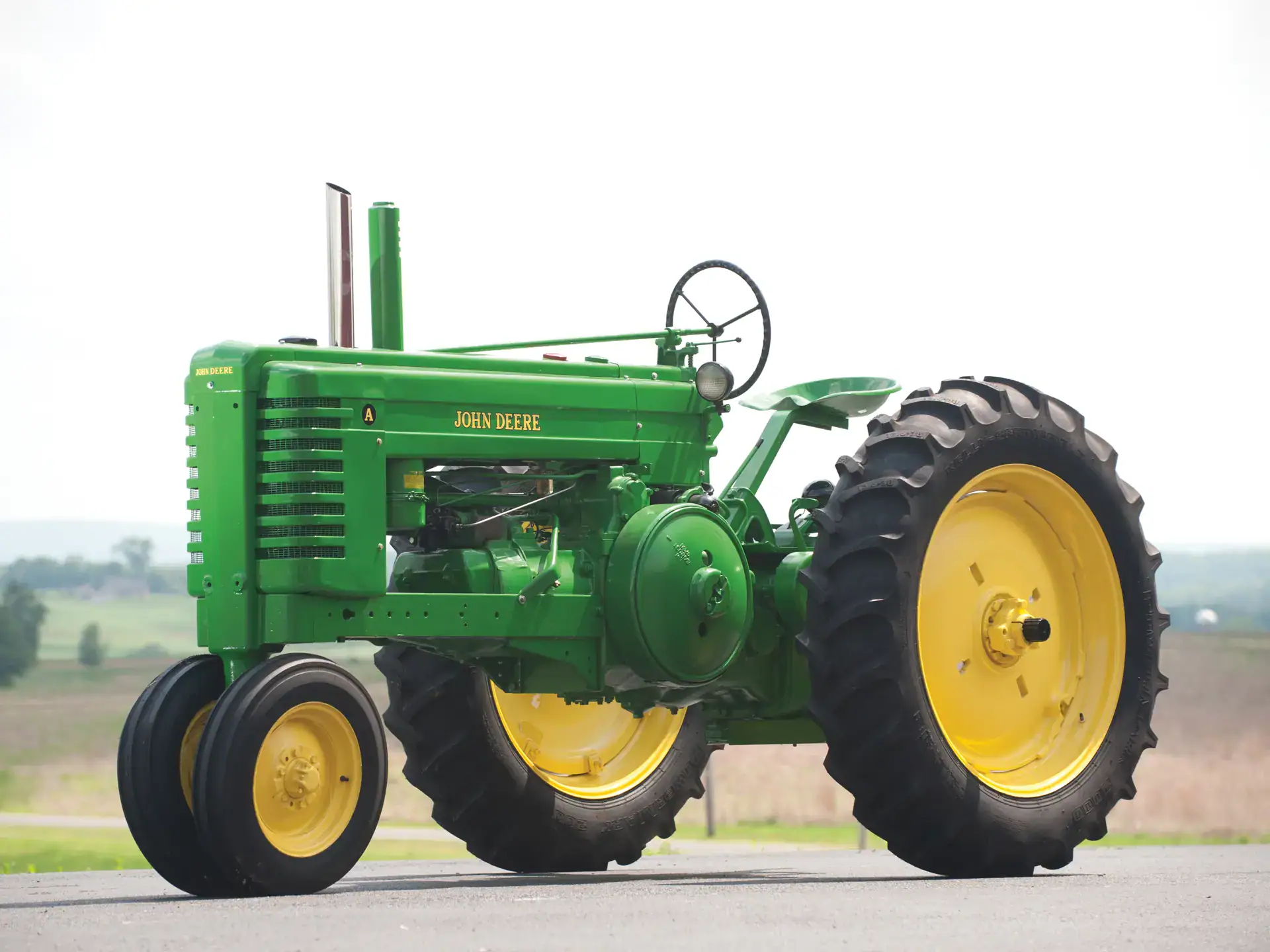
The John Deere Model A is the tractor that built modern John Deere. Introduced in April 1934, in the depths of the Depression, it was the company’s first true row-crop machine — the first production tractor with hydraulically lifted implements (Deere’s Power Lift), the first with adjustable rear wheel tread on splined axles, aimed squarely at International’s Farmall. It stayed in production for eighteen years, sold more than 300,000 units (enthusiast tallies including all variants reach 327,460), and its horizontal two-cylinder exhaust note — the “Johnny Popper” — became the most recognizable sound in agriculture.
Status disclosure up front: the Model A left production on May 12, 1952 (the last unit wore serial number 703,384), evolving into the John Deere 60 and onward through the 620, 630, and eventually the New Generation line. Today’s Model A market is a collector’s market with a working fringe — plow days, parades, belt-pulley demonstrations, and light chores — and this page is written for that buyer: what the eras mean, what Nebraska actually measured across three tests and eighteen years, and what Canadian examples honestly bring in 2026.
Aglist quick take: The A is the most approachable serious antique tractor in Canada — production volume keeps supply and parts flowing, the two-cylinder engine is farmer-simple, and the club culture (plow days, Two-Cylinder gatherings) is welcoming. The honest framing: buying one is an era decision first — unstyled (1934–38), early styled (1939–46, the Dreyfuss redesign), or late styled (1947–52, electric start and creature comforts) — then a variant decision across the AN/AW/AH/AO/AR alphabet, and finally a conditiondecision where a stuck engine, a cracked block from a forgotten winter, or a missing serial tag changes everything. Hand-starting a flywheel is part of the romance on early units; know whether you want the romance daily.
On This Page
ToggleQuick Verdict — Who the Model A Is For
Buy it if: you want the definitive collectible John Deere — historic, mechanically honest, club-supported, and still capable of pulling a plow at a match or powering a belt demonstration — at roughly CAD $4,500–$8,000 for field-ready styled runners, less for projects, more for unstyled and rare variants. A late-styled (1947–52) electric-start A is the easiest ownership; an unstyled one on steel is the purest history.
Skip it if: you actually need a working chore tractor — a John Deere 4010 or later delivers live hydraulics, real PTO convenience, and safety for similar money — or if hand-cranked fuel-tap-and-flywheel rituals hold no charm and you’d resent the maintenance an 80-to-90-year-old machine deserves.
Full John Deere Model A Specifications
Compiled from John Deere literature and Nebraska Tractor Test reports across the production run (Tests 222, 335, and 384), cross-checked against reference sources. Eighteen years of running changes — verify era, variant, and configuration on any unit.
| Category | Spec | Value |
|---|---|---|
| Equipment type | Row-crop tractor | Waterloo, Iowa; Deere’s first true general-purpose row-crop |
| Production | Model years | 1934–1952; 300,000+ built (327,460 incl. all variants per enthusiast tally); last s/n 703,384 |
| Eras | Unstyled | 1934–1938 (through s/n 476999); open fan shaft pre-1938 |
| Early styled | 1939–1946 (from s/n 477000) — Henry Dreyfuss design | |
| Late styled | 1947–1952 — pressed frame, electric start standard, battery, lights, cushioned seat | |
| Engine | Type | Horizontal 2-cylinder (“Johnny Popper”), valves-in-head |
| 1934–ca. 1940 | 309 cu in (5.5 × 6.5 in.) @ 975–1,000 rpm | |
| ca. 1941–1952 | 321 cu in (5.5 × 6.75 in.) | |
| Fuel system | All-fuel | Starts on gasoline (1-gal tank), runs on distillate (15-gal main); straight-gasoline versions also built |
| Tested power | Nebraska Test 222 (1934) | 24.71 belt HP / 23.63 PTO HP / 18.72 drawbar HP |
| Nebraska Test 335 (styled) | 4,110 lb maximum pull @ 2.25 mph | |
| Nebraska Test 384 (1947) | 38.02 belt HP / 34.14 drawbar HP | |
| Transmission | 1934–1940 | 4-speed |
| Late 1940–1952 | 6-speed (2.5–12.7 mph forward; 4 mph reverse) | |
| Clutch | Type | Hand-operated lever, twin 10-in. dry discs |
| Cooling | Type | Thermo-siphon, 9.25 gal — no water pump from the factory (aftermarket pump kits appear on working survivors) |
| Lubrication / air | Systems | Full-pressure with filter (9 qt); oil-wash air cleaner |
| Belt pulley | Spec | 12-3/4 in. dia. @ 975 rpm (3,270 fpm) — the era’s second PTO |
| Firsts | Innovations | Hydraulic Power Lift (industry first); adjustable rear tread on splined axles; centreline hitch; differential (individual) wheel brakes |
| Electric start | Availability | Option from 1939; standard equipment from 1947 |
| Variants | Alphabet | AN (narrow/single front), AW (adjustable wide), AH (hi-crop), AO (orchard), AR (standard tread), AI (industrial) + tricycle standard |
| Family | Siblings | Model B (one-third smaller, 1935) and Model G (425 cu in three-plow, 1937) |
| Succession | Lineage | Became the John Deere 60 (1952) → 620 → 630 → and onward to the 3010/3020 line |
The three-test arc, plainly. The Model A is the tractor that grew up in public: Nebraska measured 24.71 belt horsepower in 1934, then 38.02 in 1947 — a 54% gain across one model name, earned through the 321-inch engine, higher operating discipline, and eighteen years of refinement. When two sellers describe “a 25-horse A” and “a 38-horse A,” both are right; they’re describing eras, not exaggeration.
Owner Reviews & Ratings on Aglist
Nebraska’s numbers span 1934 to 1947; Canadian collector experience spans every year since. As owners share their machines on Aglist, the rating system tracks:
- Era and originality — unstyled/early/late styled, correct components, serial-tag presence
- Engine health — compression, magneto condition, starting behaviour (hand or electric)
- Mechanical condition — clutch, transmission, brakes, steering, Power Lift function
- Parts and club support — sourcing experience, Two-Cylinder community resources in your region
- Ownership joy — the category that matters most on an antique
If you own a Model A in Canada, please leave a star rating and a short note below — era, variant, and starting setup are exactly what fellow collectors want to know.
John Deere Model A vs the Alternatives
The pre-war row-crop trio frames every A decision.
| Spec | John Deere A | John Deere B | John Deere G |
|---|---|---|---|
| Introduced | 1934 | 1935 | 1937 |
| Role | The two-plow benchmark | One-third smaller — the small-farm A | The 425 cu in three-plow brute |
| Tested power (era-typical) | 24.7 → 38.0 belt HP | ~16 → ~23 belt HP | ~36 belt HP |
| Production | 300,000+ | ~300,000+ class | Far scarcer |
| Canadian market | Deepest supply | Most affordable entry | Collector premium |
Where the A wins: it’s the centre of gravity — the most produced, most supported, most club-visible letter-series Deere, with the widest variant alphabet for collectors who catch that particular fever. Supply keeps honest examples affordable in Canada, and parts (from flywheels to magnetos) circulate constantly.
Where the math flips: the John Deere B delivers the identical experience at smaller scale and usually smaller money — the classic first antique; the G rewards buyers chasing rarity and torque. And anyone who wants two-cylinder charm plusa genuinely useful farm tool should read where the story went next: the John Deere 4010 that retired this whole architecture in 1960, and the John Deere 3020 — the A’s own lineal descendant by Deere’s succession chain. Browse all tractors on Aglist for the full landscape.
Real-World Ownership
The starting ritual — and the eras
On a pre-electric A, starting is a ceremony: fuel tap on, choke set, throttle cracked, then spin the exposed flywheel by hand until the Popper catches — and on all-fuel units, warm up on gasoline before switching the tap to distillate. It’s beloved, it’s part of the value, and it’s also the reason late-styled (1947+) electric-start tractors carry a daily-usability premium. The era markers collectors read at a glance: open fan shaft (pre-1938 unstyled), Dreyfuss grille (1939+), slant dash and pressed frame (late styled). Steel wheels versus rubber is its own provenance question — original steel commands unstyled-collector respect; period rubber makes a working tractor.
The hand clutch and the lugging character
The lever-operated twin-disc clutch and that enormous flywheel define the driving experience: an A pulls its engine down to a walking beat and keeps lugging where higher-revving tractors stall — the trait Canadian owners still demonstrate at plow days with three-bottom plows. The belt pulley (3,270 feet per minute at rated speed) was the farm’s power plant for grinders, saws, and threshers, and belt demonstrations remain half the fun of ownership.
Safety, honestly
Two period realities deserve modern respect: the individual wheel brakes that make headland turns brilliant can, on a tricycle front, tip a tractor if one brake is stabbed at speed — Canadian collector accounts say exactly this — and the exposed flywheel on hand-start units demands the classic open-palm technique and full attention. Neither is a defect; both are the 1930s, and both belong in the family briefing before anyone’s grandchild takes a parade lap.
The Model A in Canada today
The A anchors Canadian antique-tractor culture: Prairie and Ontario plow-day clubs, threshing bees, museum fleets, and parade seasons keep hundreds visible every summer, and the classifieds show a healthy churn of projects, runners, and restorations — plus a parts undercurrent right down to spare flywheels. Working survivors often carry sympathetic upgrades (aftermarket water-pump kits on the thermo-siphon system, add-on power steering on late units); collectors debate them, buyers should simply identify them.
Common Problems & Inspection Notes
Transparency note: patterns across a 75-to-90-year-old population, not defects of any given unit — and on antiques, storage history explains more than hours ever could.
Stuck engines and storage sins. Decades in a shed row produce seized pistons, varnished carburetors, and rusted tanks — all recoverable, all priced as projects. Ask when it last ran under load, not just when it last “turned over.”
Freeze damage. The thermo-siphon system holds 9-plus gallons; forgotten water plus one Canadian winter cracks blocks and heads. Inspect for welds, stitching, and sealer around the water jacket before believing any price.
Magneto and ignition. The classic no-start on otherwise healthy engines; rebuilt magnetos are a cottage industry and a known, priceable fix.
Clutch and drivetrain wear. Hand-clutch adjustment and disc wear, transmission engagement in every gear, and rear seals weeping into the clutch area — all standard checks.
Cooling neglect. Scale and sediment in a pumpless system mean overheating on the belt; flush history matters.
Provenance gaps. Missing serial tags (they surface even on restored rarities) complicate era claims and value — casting features and expert eyes settle what paperwork can’t.
The platform endures. Parts supply through the two-cylinder aftermarket, salvage circulation, and club knowledge make the A among the easiest antiques on Earth to keep alive — the reason so many still fire on the first spin.
Value Ranges in Canada (2026)
The A trades across a wide collector spectrum, priced by era, variant, and condition far more than by anything on a meter:
- Parts tractors and stuck projects: roughly CAD $1,500–$4,000 — including unstyled steel-wheel projects around the top of that band
- Honest field-ready runners (styled, rubber, 540 PTO): roughly CAD $4,500–$8,000 — the heart of the market (current dealer anchor: $5,995 field-ready)
- Nice originals and older restorations: roughly CAD $8,000–$14,000
- Unstyled survivors on steel and quality restorations: roughly CAD $10,000–$18,000 (anchor: $10,995 for an inside-stored unstyled)
- Rare variants and show-grade work (restored AH hi-crops, AO orchards, earliest brass-era units, documented low-serial tractors): CAD $18,000–$35,000+
Value movers: era (unstyled premium), variant rarity (the alphabet), originality versus restoration quality, running condition with proof, and provenance. Supply flows through MarketBook and dealer consignment, Kijiji, estate auctions, and — importantly — club networks where the best tractors change hands quietly.
Best Uses in Canada
Collecting and shows. The definitive letter-series Deere — every serious collection wants one, and variant-chasing (AN, AW, AH, AO, AR) becomes its own hobby. Plow days and threshing bees. Two-bottom work and belt-pulley demonstrations are exactly its brief, eighty years on. Parades and heritage events. Nothing draws a crowd like a popping A. Light nostalgia chores. Raking, wagon duty, and small jobs on patient properties. Family history. More Canadians learned to drive on an A than on any other green machine. Not ideal for: genuine daily chore work (safety and convenience have moved on), snow duty, or buyers who want to turn a key and go — unless it’s a 1947-plus.
Maintenance & Care
- Before every start: oil level, coolant (soft water or proper mix — never leave plain water toward winter), fuel tap discipline, a glance at the magneto ground
- Regularly: grease points, hand-clutch free play, brake adjustment, air-cleaner oil bath serviced, wheel bolts (especially on steel)
- All-fuel discipline: start and shut down on gasoline; run distillate only warm — or run straight gas as most collectors now do
- Cooling: periodic flushes for the pumpless system; antifreeze before the first frost, every year, without exception
- Storage: fuel off and carb run dry, battery tended (electric-start units), rodent-proofing — most “problems” begin in the shed
- Community: join a two-cylinder club; the manuals, parts leads, and starting tips are the real ownership toolkit
Parts availability remains remarkable for a 90-year-old design — reproduction, NOS, and salvage channels cover nearly everything, and Canadian classifieds regularly carry components down to flywheels.
Where to Find a John Deere Model A in Canada
Supply runs through MarketBook and dealer consignments, Kijiji and Facebook, estate and farm auctions, and club grapevines. Inspection priorities, in order: establish the era and variant honestly (serial tag, casting features, fan shaft, dash) before discussing money; check the water jacket for freeze-repair evidence — block and head; assess the engine’s real state (compression on both cylinders, magneto spark, what it last did under load); work the hand clutch and every gear; confirm the Power Lift and belt pulley function; identify steel-versus-rubber and any working upgrades (water pump, power steering, 12-volt conversions); and weigh provenance — a documented, tagged, era-correct tractor outvalues a prettier mystery. A field-ready styled A with good sheet metal and a crisp magneto is the entry ticket to the hobby; an honest unstyled survivor is the keepsake.
John Deere Model A FAQ
How much horsepower does a John Deere Model A have? It depends on the era — Nebraska measured 24.71 belt / 18.72 drawbar HP in 1934 (Test 222) and 38.02 belt / 34.14 drawbar HP in 1947 (Test 384). The 309 cu in engine grew to 321 cu in around 1941, and power grew with it.
What years was the John Deere A made, and how many were built? 1934 to May 1952 in Waterloo, Iowa — more than 300,000 units (enthusiast tallies including all variants reach 327,460), making it Deere’s best-selling tractor of the two-cylinder era.
What’s the difference between unstyled and styled Model As? Unstyled (1934–38) tractors wear exposed radiators and, pre-1938, an open fan shaft; early styled (1939–46) brought Henry Dreyfuss’s hood and grille; late styled (1947–52) added the pressed frame, standard electric start, battery, lights, and the “slant dash.” Each era has its own market and its own devotees.
Why is it called a Johnny Popper? The horizontal two-cylinder fires with a distinctive syncopated pop-pop exhaust note — the most famous sound in tractor history, and half the reason people collect them.
How do you start a hand-start Model A? Fuel on, choke and throttle set, ignition live, then spin the exposed flywheel by hand (open palm, never wrapped fingers) until it fires — warming up on gasoline before switching all-fuel units to distillate. Electric start arrived as an option in 1939 and standard in 1947.
What do the variant letters mean — AN, AW, AH, AO, AR? Narrow single-front (AN), adjustable wide-front (AW), hi-crop (AH), orchard (AO), and standard-tread “A-Regular” (AR), plus industrial (AI) — eight configurations in all. Rarer variants carry serious collector premiums.
What is a John Deere Model A worth in Canada? As of 2026: roughly CAD $4,500–$8,000 for honest field-ready runners, $8,000–$14,000 for nice originals and older restorations, $10,000–$18,000 for unstyled survivors and quality restorations, and $18,000–$35,000+ for rare variants and show-grade tractors — with projects from $1,500.
What replaced the Model A? The John Deere 60 in 1952, continuing through the 620 and 630 — and the whole two-cylinder line ended in 1960 when the New Generation 4010 rewrote the company. The A’s lineal descendants run right through the 3010/3020 era.
Related Models on Aglist
- John Deere B — the A’s one-third-smaller sibling and the hobby’s classic first tractor
- John Deere 4010 — the machine that ended the two-cylinder era in 1960
- John Deere 3020 — the A’s lineal descendant, two generations on
- All tractors on Aglist — full tractor coverage
Disclaimer
Specifications compiled from John Deere literature and Nebraska Tractor Test reports spanning the production run (Tests 222, 335, and 384), cross-checked against reference sources; the Model A was built over eighteen model years in three styling eras, two engine displacements, multiple fuel systems, and eight chassis variants, and surviving examples frequently carry period and modern modifications (electric-start conversions, water-pump kits, rubber-tire conversions, added power steering), so individual machines vary substantially from any single specification set. The John Deere Model A is a long-discontinued antique — availability is limited to the collector and used market, and value ranges are indicative Canadian figures for 2026 that vary widely by era, variant, originality, condition, provenance, and restoration quality. Reviews on Aglist are written by real users and moderated for spam — opinions are personal. Always confirm era, variant, and condition through serial and casting evidence, a freeze-damage inspection, and a demonstration under load — ideally with input from the two-cylinder collector community — before committing to any specific machine. Operate antique tractors with period-appropriate caution, particularly regarding hand starting and individual wheel brakes.
John Deere Model A Reviews & Ratings
Share your experience
Help other Canadian buyers — leave a quick review for the
John Deere Model A
There are no reviews yet. Be the first one to write one.