Overview & Specs
John Deere Model B Specs, Reviews & Value Canada (2026)
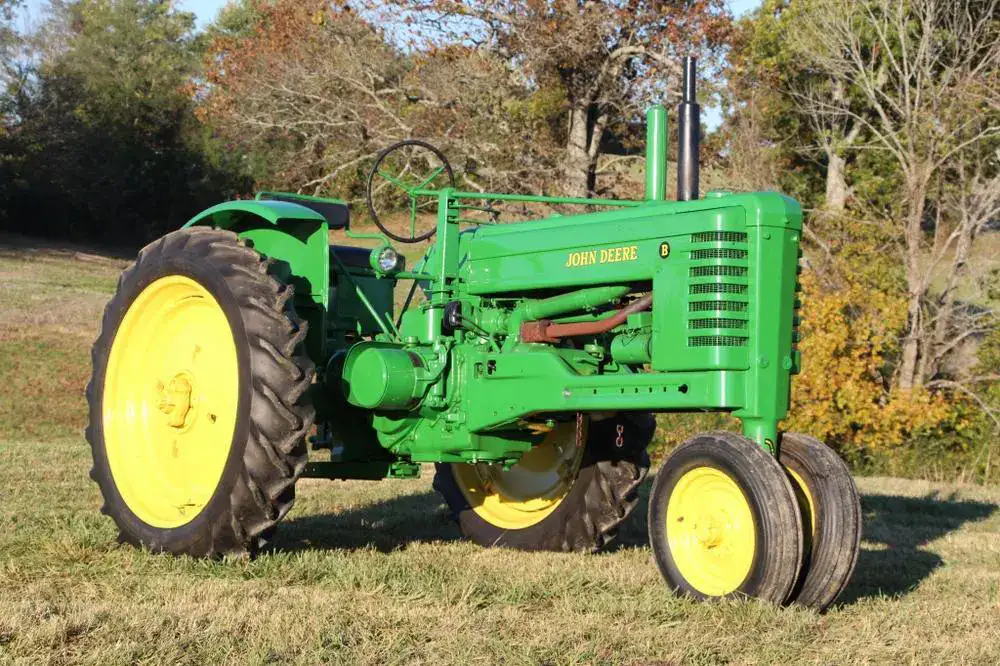
The John Deere Model B is the little brother that matched the legend. Introduced in 1935 as a scaled-down, two-thirds-size version of the Model A — same architecture, same innovations, smaller price — it gave Depression-era farms replacing horse teams a two-plow tractor they could actually afford, and it sold on a scale that still shapes the hobby: over 300,000 across all variants by widely cited tallies, ranking with the A among the most-produced tractors John Deere ever built. Seventeen years of production (1935–1952) took it through the same three eras as its sibling — unstyled, early styled, late styled — while its two-cylinder engine grew from 149 to 190 cubic inches and its tested power rose 72%.Status disclosure up front: the B left production in 1952, replaced by the John Deere 50 and then the 520 and 530 through 1960. Today’s Model B market is the classic entry point into antique tractor collecting — typically the most affordable letter-series Deere, the easiest to hand-start, the cheapest to house and haul — with a rarity ceiling (Brass Tag first-years, hi-crops, and the Lindeman crawler conversions) that runs as high as any collector could want. This page is written for that spectrum.
Aglist quick take: If the hobby has a front door, the B is it — small enough for a single-car garage, light enough for a utility trailer, simple enough to learn every system on, and supported by the same club-and-parts ecosystem as the A at lower cost throughout. The honest framing: it’s the same three-decision purchase as its big sibling — era, variant, condition — with two B-specific wrinkles worth knowing before you shop: the 1937 “long-frame” change (from serial 42200, the frame stretched five inches so the A’s mid-mount tools would fit — making short-frame 1935–37 tractors their own collector niche), and the fact that the earliest 1935 units wear the coveted brass serial tag.
Quick Verdict — Who the Model B Is For
Buy it if: you want your first serious antique tractor — a genuine Johnny Popper with the full 1930s experience at the category’s lowest cost of entry (honest Canadian runners roughly CAD $3,000–$6,000), or you’re a variant hunter, because the B’s rarity ladder (Brass Tags, BNH/BWH hi-crops, BO orchards, and the crown-jewel BO-Lindeman crawlers) climbs as high as letter-series collecting goes.Skip it if: you want the bigger presence and belt power of the John Deere A for modest extra money, or you’re actually shopping for a usable chore tractor — in which case the machine that retired this whole architecture, the John Deere 4010, is where working money belongs.
On This Page
ToggleFull John Deere Model B Specifications
Compiled from John Deere literature and Nebraska Tractor Test reports across the run (Tests 232 and 380), cross-checked against reference sources. Seventeen years of running changes across three engines — verify era, frame, variant, and configuration on any unit.
| CategorySpecValueEquipment typeRow-crop tractorWaterloo, Iowa; the Model A scaled to two-thirds sizeProductionModel years1935–1952; over 300,000 across variants by widely cited tallies (published counts vary; some are era-specific)RatingClassTwo-plow general-purpose row-cropErasUnstyled1935–1938; first-year 1935 units wear the brass serial tag (“Brass Tag” Bs)Early styled1939–1946 (from s/n 60000) — Dreyfuss hood and grilleLate styledMid-1947–1952 (from s/n 201000) — pressed frame, comfort updates, ~15% more powerFrame watershed1937Long frame from s/n 42200 (+5 in., for Model A mid-mount tool compatibility); 1935–37 short-frames are their own nicheEngineTypeHorizontal 2-cylinder (“Johnny Popper”)1935–1938149 cu in (4.25 × 5.25 in.) @ 975–1,150 rpm1939–1946175 cu in (4.5 × 5.5 in.)1947–1952190.4 cu in (4.69 × 5.5 in.) @ up to 1,250 rpmFuelOptionsGasoline or all-fuel (start on gasoline, run on kerosene/distillate); compression ~4.7:1 (early all-fuel) to ~5.9:1 (late gas)Tested powerNebraska Test 232 (1935)16 belt HP / ~11.8 drawbar HPNebraska Test 380 (1947, gasoline)27.58 belt HP / 24.62 drawbar HPTransmissionThrough 1940 / from late 19404F/1R / 6F/1RClutchTypeHand-operated dry discPTO / beltEquipment540 rear PTO; belt pulley — the era’s stationary power sourceCoolingTypeThermo-siphon (no factory water pump)Electric startAvailabilityWith lighting from 1940; standard on late-styled tractorsWeight / dimensionsLate-styled typical~3,275 lb; 120.5 × 85 in.VariantsAlphabetBN (single front, 1935), BW (wide front, 1935), BR (standard tread, 1936–47), BO (orchard, to 1947), BI (industrial, to 1941), hi-crop combinations from 1937 (BNH, BWH)Crown rarityBO-LindemanFactory-supplied crawler conversion, 1943–1946Serial plateLocation (styled)Right side of the transmission case, beneath the magnetoOriginal priceEra-typical~USD $1,900SuccessionLineageJohn Deere 50 (1952) → 520 → 530 (to 1960) |
|---|
The growth arc, plainly. Nebraska measured 16 belt horsepower in 1935 and 27.58 in 1947 — a 72% gain across one model name, earned through two displacement increases (149 → 175 → 190 cubic inches), higher governed speed, and the late-styled update. A “16-horse B” and a “28-horse B” are both telling the truth about different eras — which is exactly why era identification comes before price discussion.
Owner Reviews & Ratings on Aglist
Nebraska’s numbers bracket the run; Canadian collector experience fills everything between. As owners share their machines on Aglist, the rating system tracks:
- Era, frame, and originality — unstyled/early/late, short or long frame, brass tag, correct componentsEngine health — compression, magneto spark, hand- or electric-start behaviourMechanical condition — clutch, gearbox, brakes, PTO and belt pulley functionParts and club support — sourcing experience across the two-cylinder ecosystemOwnership joy — the metric antiques are actually bought on
If you own a Model B in Canada, please leave a star rating and a short note below — era, frame, and variant details are precisely what fellow collectors search for.
John Deere Model B vs the Alternatives
Same trio as always in letter-series shopping — now B-centred.
| SpecJohn Deere AJohn Deere BJohn Deere GIntroduced193419351937RoleThe two-plow benchmarkThe affordable two-thirds AThe 425 cu in three-plow bruteTested belt HP (era arc)24.7 → 38.016 → 27.6~36Hand-start effortRealThe easy spinnerSeriousTypical Canadian entryHigherThe lowest of the threeCollector premium |
|---|
Where the B wins: cost of everything and ease of everything. It’s cheaper to buy at every grade, lighter to trailer, easier to hand-start (the smaller flywheel spins over willingly — the reason instructors put beginners on Bs), and identical in ecosystem support. For a first antique, a parade machine, or a belt-demonstration tractor, it’s the rational and the sentimental choice at once.Where the math flips: the John Deere A brings meaningfully more belt and drawbar authority for plow-day work and a bigger presence on the show line, usually for a modest premium; the G rewards rarity hunters. And anyone who finds themselves wanting to actually use the tractor weekly should be honest and read about the John Deere 4010 instead. Browse all tractors on Aglist for the whole landscape.
Real-World OwnershipThe easy spinner — starting a B
The B shares the A’s ceremony — fuel tap, choke, throttle, then the flywheel — with a friendlier flywheel: lighter, lower compression on early all-fuel engines, and famously willing when the magneto is crisp. Open palm on the spokes, never wrapped fingers, and on all-fuel tractors warm it up on gasoline before switching the tap to distillate — or run straight gasoline as most of the hobby now does. Electric start entered the option list with lighting in 1940 and is standard equipment on late-styled tractors, which is precisely why 1947–52 units carry the daily-usability premium.
Eras, frames, and what the market reads at a glance
Collectors identify a B in seconds: exposed radiator means unstyled; the Dreyfuss grille means 1939-on; the pressed frame and comfort package mean late styled. The B adds one wrinkle the A doesn’t have — the 1937 long-frame change at serial 42200, which stretched the tractor five inches so Model A mid-mounted tools would interchange. Short-frame 1935–37 tractors (and above all the 1935 Brass Tags) are the unstyled connoisseur’s quarry; long-frame styled tractors are the hobby’s daily bread; late-styled electric-start units are the ones that go to parades without drama.
Belt, drawbar, and the two-plow life
A healthy B pulls its rated two bottoms at a walking pop-pop beat, runs a 540 PTO implement, and — the underrated party trick — powers a belt: grinders, elevators, saws, and threshing demonstrations at 3,000-plus feet per minute of flat belt were this tractor’s second job, and Canadian threshing bees still hand it that work. The hand clutch and low-rpm lugging character are the full A experience in miniature.
Safety, honestly
The same two 1930s realities as the A, stated plainly: individual wheel brakes on a narrow tricycle front can tip a tractor if one pedal is stabbed at road speed, and the exposed flywheel demands the open-palm technique and full attention. Brief every family member before parade season — the B’s approachability is exactly why it’s often the tractor grandchildren learn on, and why the briefing matters.
The Model B in Canada today
Bs anchor the affordable end of every Canadian antique auction, club roster, and classified board — project tractors surface constantly (“stored inside, ready for restoration” is the standard Kijiji phrasing), runners circulate through the same plow-day and threshing-bee culture as the A, and the parts undercurrent (magnetos, carburetors, sheet metal, wheels) flows year-round. It is, by a comfortable margin, the easiest letter-series Deere to buy, own, house, and eventually sell in this country.
Common Problems & Inspection Notes
Transparency note: patterns across a 75-to-90-year-old population, not defects of any given unit — storage history explains more than any other single fact.Freeze-cracked blocks and heads. The pumpless thermo-siphon system holds real water volume, and one forgotten Canadian autumn writes the repair bill. Inspect the jacket for welds, stitching, and sealer before believing any price — item one, every time.Stuck engines and varnished fuel systems. Standard shed-find conditions: seized rings, gummed Marvel-Schebler carburetors, rusty tanks. All recoverable; all priced as projects, not runners.Magneto health. The classic hot-restart and no-start culprit; rebuilt magnetos are a well-trodden, priceable fix and the first suspect on a healthy-compression engine that won’t fire.Clutch, gearbox, and seals. Hand-clutch adjustment and disc wear, clean engagement in every gear (four or six, by era), and rear seals weeping toward the clutch — the standard mechanical walk-around.Identity questions. Era, frame length, and variant claims move money; serial plates go missing and tags get swapped. Read the castings, the frame, and the plate location together — and price a documented tractor above a prettier mystery.The platform endures. Reproduction, NOS, salvage, and club knowledge cover the B end to end — the structural reason so many 90-year-old tractors in this country still light on the second spin.
Value Ranges in Canada (2026)
The B trades a consistent step below the A across every grade — the honest reason it’s the hobby’s front door. Indicative Canadian ranges, benchmarked against the letter-series market:
- Parts tractors and stuck projects: roughly CAD $1,200–$3,000Honest runners (styled, rubber, working PTO/belt): roughly CAD $3,000–$6,000 — the heart of the marketNice originals and older restorations: roughly CAD $6,000–$10,000Unstyled survivors, short-frames, and quality restorations: roughly CAD $8,000–$15,000Rarities (1935 Brass Tags, BNH/BWH hi-crops, preserved BO orchards, and above all BO-Lindeman crawlers): CAD $15,000–$35,000+, with exceptional Lindemans beyond
Value movers: era and frame (verified, not claimed), variant rarity, originality versus restoration quality, running proof, and provenance. Supply flows through Kijiji and Facebook, estate and farm auctions, dealer consignment, and — for the best tractors — club networks that never touch a classified.
Best Uses in Canada
The first antique. Lowest cost of entry, easiest starting, simplest systems, friendliest community — the recommended letter-series apprenticeship. Shows, parades, and threshing bees. A popping B on the belt is living history that fits in a single trailer. Plow days. Two honest bottoms at club events. Family heritage. The tractor a remarkable number of Canadians learned on — and the one their grandchildren learn on now. Variant collecting. From Brass Tags to Lindeman crawlers, the B’s rarity ladder rewards a lifetime of hunting. Not ideal for: genuine working duty, snow, or anyone who needs key-and-go without choosing a 1947-plus.
Maintenance & Care
Parts support remains outstanding for a 90-year-old design, and the B’s volume means salvage donors and reproduction runs never dry up.
Where to Find a John Deere Model B in Canada
Kijiji, Facebook, estate and farm auctions, dealer consignments, and club grapevines — with the best examples moving through the last channel quietly. Inspection priorities, in order: establish era, frame, and variant from castings, serial plate (right side of the styled transmission case, under the magneto), and features before money enters the conversation; inspect the water jacket for freeze-repair evidence, block and head both; assess the engine honestly — compression both cylinders, magneto spark, what it last did under load rather than merely whether it turns; work the hand clutch and every gear; prove the PTO and belt pulley; identify steel versus rubber and any period upgrades; and weigh provenance over paint. A field-ready styled B with a crisp magneto and honest sheet metal is the hobby’s best first handshake; a documented short-frame or Brass Tag is the one you keep.
John Deere Model B FAQ
How much horsepower does a John Deere Model B have? By era — Nebraska measured 16 belt / ~11.8 drawbar HP in 1935 (Test 232, 149 cu in) and 27.58 belt / 24.62 drawbar HP in 1947 (Test 380, 190 cu in gasoline). The engine grew twice across the run: 149 → 175 → 190 cubic inches.What years was the John Deere B made, and how many were built? 1935 to 1952 in Waterloo, Iowa. Widely cited tallies put production over 300,000 across all variants — ranking with the Model A among Deere’s most-produced tractors — though published counts vary and some figures describe single eras only.What is a “Brass Tag” Model B? A first-year 1935 tractor wearing the brass serial plate — the B’s most recognizable early-production credential and a firm collector premium.What does “long frame” mean on a Model B? From serial 42200 in 1937, the frame was stretched five inches so the Model A’s mid-mounted cultivating tools would fit the B. Short-frame 1935–37 tractors are a distinct collector niche; verify the frame, not just the year claim.What’s the difference between a Model A and a Model B? Scale and money: the B is roughly two-thirds the A’s size with about two-thirds the power in any given era, at a lower price in every grade — same architecture, same eras, same variants, same Johnny Popper character. The A pulls harder; the B costs less and hand-starts easier.What are the rare Model B variants? The hi-crop BNH/BWH combinations, standard-tread BRs and orchard BOs (both ended 1947), the short-lived BI industrial (to 1941), and above all the BO-Lindeman crawler conversions of 1943–46 — the B’s crown rarity.What is a John Deere Model B worth in Canada? As of 2026: roughly CAD $3,000–$6,000 for honest runners, $6,000–$10,000 for nice originals and older restorations, $8,000–$15,000 for unstyled survivors and quality restorations, and $15,000–$35,000+ for Brass Tags, hi-crops, and Lindeman crawlers — with projects from about $1,200.What replaced the Model B? The John Deere 50 in 1952, then the 520 and 530 through 1960 — when the New Generation retired the two-cylinder line entirely.
Related Models on Aglist
Specifications compiled from John Deere literature and Nebraska Tractor Test reports spanning the production run (Tests 232 and 380), cross-checked against reference sources; the Model B was built over seventeen model years in three styling eras, three engine displacements, two frame lengths, multiple fuel systems, and numerous chassis variants, published production totals differ between sources, and surviving examples frequently carry period and modern modifications, so individual machines vary substantially from any single specification set. The John Deere Model B is a long-discontinued antique — availability is limited to the collector and used market, and value ranges are indicative Canadian figures for 2026, benchmarked against the closely related Model A market, that vary widely by era, frame, variant, originality, condition, provenance, and restoration quality. Reviews on Aglist are written by real users and moderated for spam — opinions are personal. Always confirm era, frame, variant, and condition through serial and casting evidence, a freeze-damage inspection, and a demonstration under load — ideally with input from the two-cylinder collector community — before committing to any specific machine, and operate antiques with period-appropriate caution regarding hand starting and individual wheel brakes.
John Deere Model B Reviews & Ratings
Share your experience
Help other Canadian buyers — leave a quick review for the
John Deere Model B
There are no reviews yet. Be the first one to write one.