Overview & Specs
New Holland CR7.80 Combine
On This Page
ToggleIntroduction
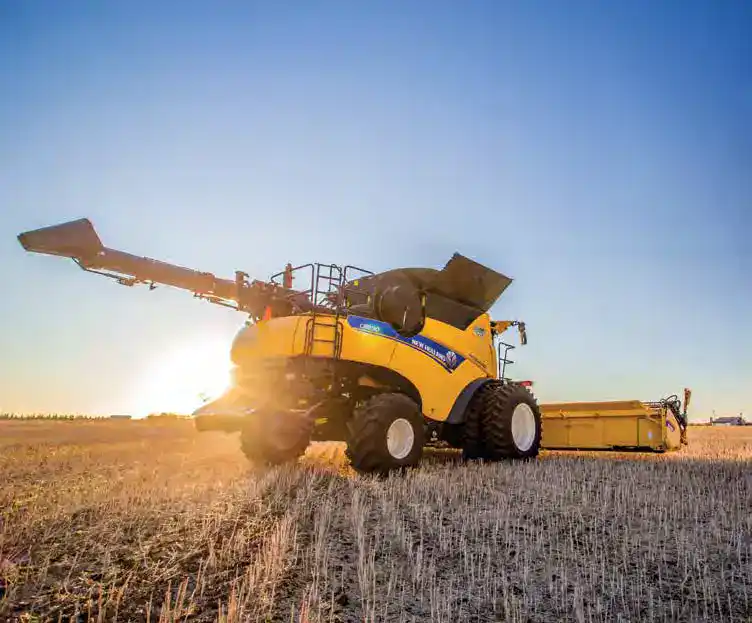
The New Holland CR7.80 is the entry point into New Holland’s traditional North American CR Series.
It produces 374 gross horsepower and up to 415 maximum horsepower, making it considerably less powerful than the larger CR models. But the important part is what New Holland did not remove.
The CR7.80 still uses the company’s Twin Rotor threshing and separation system. It also shares many of the technologies that make the larger CR combines attractive, including available IntelliSense automation, IntelliSteer guidance, SmartTrax and the Harvest Suite Ultra cab.
That makes the CR7.80 interesting for farms that want a Twin Rotor combine but cannot justify the size or capacity of a New Holland CR7.90, CR8.90 or CR9.90.
For many Canadian grain operations, having the smallest combine in a series is not necessarily a disadvantage. A machine that matches the farm can make more sense than paying for capacity that sits unused.
New Holland CR7.80 Key Specifications
| Specification | New Holland CR7.80 |
|---|---|
| Combine type | Twin Rotor rotary combine |
| Gross engine power | 374 hp (279 kW) |
| Maximum engine power | 415 hp (309 kW) |
| Threshing and separation | Twin Rotor |
| Feeding system | Four-chain feeder system |
| Combine automation | IntelliSense available |
| Guidance | IntelliSteer available |
| Cab | Harvest Suite Ultra |
| Display | IntelliView IV |
| Track system | SmartTrax available |
| Residue management | Opti-Spread Plus available |
| Emissions | Tier 4 compliant |
| Manufacturer | New Holland Agriculture |
The CR7.80 currently sits below the CR7.90 in New Holland’s North American CR lineup.
Although it has the lowest horsepower rating in the traditional CR Series, it retains the same basic Twin Rotor harvesting concept used by the larger machines.
What the CR7.80 Does Well
Twin Rotor Capacity Without Moving to a Huge Combine
This is probably the strongest reason to look at a CR7.80.
Not every farm needs 500, 600 or 700 horsepower.
The CR7.80 gives an operation access to New Holland’s Twin Rotor design while keeping engine output at a more moderate 415 maximum horsepower.
That can be a good match for a farm where acreage, header size or grain handling would make a much larger combine difficult to keep busy.
A combine should be sized around the entire harvest operation.
If the grain cart, trucks or storage system cannot keep up with a larger machine, adding horsepower does not automatically improve the number of acres finished in a day.
The CR7.80 offers another way to approach that problem.
Twin Rotor Threshing and Separation
Crop entering the CR7.80 is fed into two longitudinal rotors.
Threshing and separation take place as material moves rearward through the combine.
New Holland’s Twin Rotor concept is built around relatively straight crop flow rather than repeatedly changing the direction of material inside the machine.
The two rotors share the incoming crop load and provide multiple opportunities for grain to separate from the crop mat.
That matters across the range of crops a Prairie operation may harvest.
Wheat, barley, canola and pulses do not behave the same way inside a combine. Crop moisture and straw conditions can also change quickly during a harvest day.
The CR7.80 gives the operator a rotary system that can be adjusted around those changing conditions without requiring the horsepower of one of the biggest CR models.
Grain Quality
New Holland has long promoted grain quality as one of the advantages of the Twin Rotor design.
The crop follows an in-line path through the rotors, with grain released through repeated threshing and separation rather than one extremely aggressive contact point.
New Holland reports very low broken-grain levels from the CR design in its own comparative testing.
Real-world results will still depend on machine settings.
Rotor speed, concave clearance, crop moisture and ground speed all have an effect. Running any combine too aggressively can damage grain.
The advantage of having enough threshing and separation area is that the operator does not always have to compensate for crop load by simply increasing rotor aggressiveness.
For wheat and especially more damage-sensitive pulse crops, that can matter.
Four-Chain Feeding System
The CR Series uses four feeder chains with connecting slats to move crop toward the Twin Rotors.
It sounds like a small detail, but even feeding is important on a rotary combine.
Large slugs of crop entering the rotors can create sudden changes in load and make it harder to maintain consistent threshing and separation.
A smoother flow into the machine helps the rotors work with a more predictable crop load.
That becomes especially useful in fields with uneven crop density or lodged areas.
IntelliSense Combine Automation
IntelliSense automation is available on CR Series combines.
The system monitors harvesting conditions and can make adjustments every 20 seconds.
The operator can select a harvesting strategy based around priorities such as throughput, grain quality or reducing losses.
This can be useful even on the smaller CR7.80.
Conditions rarely stay identical throughout a full day of combining.
Dry wheat in the afternoon may become considerably tougher as moisture increases in the evening. Yield can also vary across the field.
An experienced operator can adjust the machine manually as those conditions change.
IntelliSense helps reduce how often those adjustments need to be made by hand.
It does not replace knowing how to set a combine. It helps keep the machine closer to the target the operator has already chosen.
Cleaning and Grain Loss
Engine horsepower is not always the first limit a combine reaches.
The cleaning system also has to handle everything coming out of the threshing and separation area.
If too much material reaches the cleaning shoe, grain losses can rise even when the engine still has power available.
That is why pushing a combine until the engine is fully loaded is not necessarily the best way to determine its actual capacity.
Operators need to watch grain loss and sample quality as well.
On the CR7.80, the goal is to keep crop flow, threshing and cleaning working together rather than trying to maximize one number on the monitor.
Straw Quality
The CR7.80 is a rotary combine, but rotary does not automatically mean unusable straw.
New Holland designed the Twin Rotor system around relatively gentle in-line crop flow and specifically promotes both grain and straw quality on the CR Series.
Straw condition still depends on crop moisture, rotor settings and how hard the combine is working.
For grain farms that occasionally bale straw, the CR7.80 can still be a realistic option.
A farm where preserving long cereal straw is a major priority should also compare it with the conventional New Holland CX8.90.
The CX uses a straw-walker design, so it approaches crop separation differently and can be attractive for mixed grain and livestock operations where baling straw is a major part of harvest.
Residue Management
When straw is not being baled, it still has to be distributed properly behind the combine.
New Holland offers Opti-Spread Plus residue management on the CR Series.
For minimum-till and direct-seeding farms, even residue distribution is important.
Heavy strips of straw can stay wetter, interfere with seeding equipment and create uneven conditions for the next crop.
Poor spreading becomes more obvious as header widths increase.
The combine may harvest a wide pass efficiently, but all of that material still needs to be redistributed over the same width.
That makes residue management part of the harvest system rather than something to think about only after the grain reaches the tank.
Harvest Suite Ultra Cab
The CR Series uses New Holland’s Harvest Suite Ultra cab.
New Holland lists the cab at 131 cubic feet and a sound level of 73 dB.
Harvest cab specifications can look secondary beside horsepower and threshing capacity, but an operator may spend twelve hours or more in the machine when harvest conditions are good.
Visibility, noise, seat position and control layout matter after that much time.
The CommandGrip multifunction handle groups frequently used functions together, while the IntelliView IV display provides access to machine information and settings.
Automation also reduces some of the constant adjustment an operator would otherwise need to make throughout the day.
IntelliSteer Guidance
Factory-integrated IntelliSteer guidance is available on CR Series combines.
With the appropriate correction signal, New Holland says the system can provide pass-to-pass accuracy of approximately one inch.
On large Prairie fields, the practical advantage is not only having straight passes.
Guidance helps use more of the available header width while reducing overlap.
It also takes steering workload away from the operator.
That leaves more attention available for header feeding, grain losses, machine settings and coordinating with the grain cart.
Over a long harvest day, that can matter just as much as the small efficiency gain from using more of the header.
SmartTrax
SmartTrax is another available CR Series option.
New Holland says the system can reduce ground pressure by up to 57 percent compared with the referenced tire arrangement.
The CR7.80 is still a heavy combine, particularly with grain in the tank.
Tracks do not remove that weight.
They spread it over a larger contact area.
During a wet Saskatchewan or Alberta harvest, that can improve flotation and reduce deep rutting compared with concentrating the machine’s weight onto conventional tires.
There is a trade-off.
Tracks cost more and introduce additional components that need inspection and maintenance.
For farms that normally harvest on firm ground, tires may remain the simpler choice.
For operations that repeatedly deal with wet harvests, the calculation may be very different.
CR7.80 vs CR7.90
The New Holland CR7.90 is the closest comparison.
| Specification | CR7.80 | CR7.90 |
|---|---|---|
| Gross engine power | 374 hp | 420 hp |
| Maximum engine power | 415 hp | 460 hp |
| Threshing system | Twin Rotor | Twin Rotor |
| IntelliSense available | Yes | Yes |
| IntelliSteer available | Yes | Yes |
| SmartTrax available | Yes | Yes |
The CR7.90 provides another 46 gross horsepower and 45 maximum horsepower.
That is a meaningful increase, but the two machines still occupy a similar part of the CR family.
A farm regularly reaching the capacity of a CR7.80 may benefit from stepping up to the CR7.90.
If the CR7.80 already has more capacity than the farm can consistently use, another 45 horsepower may not change much.
This is one of those comparisons where acreage and harvest logistics matter more than simply choosing the higher number.
CR7.80 vs CR8.90
Moving to the New Holland CR8.90 is a much larger jump.
The CR8.90 has 496 gross horsepower and is listed with up to 571 maximum horsepower in its higher-output North American configuration.
That gives it substantially more power reserve than the CR7.80.
For a large operation working heavy crops with big headers, that additional capacity can be useful.
For a farm that does not have the acres or grain-handling infrastructure to keep the larger combine loaded, the CR7.80 may be the more efficient match.
The difference is less about which combine is better and more about the scale of the operation each one is expected to support.
Where the CR7.80 Fits in the Lineup
The traditional North American CR Series starts with the CR7.80 and moves upward through the CR7.90, CR8.90, CR9.90 and CR10.90.
The CR7.80 is therefore the smallest current model in that family.
That gives it a clear role.
It offers Twin Rotor harvesting without immediately moving into the output levels of the larger machines.
At the other end, the New Holland CR10.90 reaches 700 maximum horsepower, showing just how wide the traditional CR family is.
New Holland also offers the newer CR10 and CR11 generation, but those machines use a newer platform and target a higher level of harvesting capacity.
Best Applications
The New Holland CR7.80 makes sense for:
- medium and larger grain farms
- wheat, barley, canola and pulse production
- farms wanting Twin Rotor threshing at the lower end of the CR range
- one-combine operations where machine utilization matters
- farms that do not need 500 to 700 hp
- operations wanting available IntelliSense automation
- farms working across changing Prairie crop conditions
- operations that want a mature CR platform without moving to the largest models
For many farms, the appeal is simply balance.
The CR7.80 is a serious combine without being the biggest combine New Holland can build.
What to Check on a Used CR7.80
Used combine condition can matter more than the difference between two neighbouring models.
When inspecting a CR7.80, pay attention to:
- engine hours
- separator hours
- feeder chains and slats
- rotor condition
- concaves
- cleaning-system wear
- elevator chains and sprockets
- bearings and belts
- unloading auger and drives
- chopper and residue components
- SmartTrax condition if equipped
- guidance and automation functions
- maintenance records
Separator hours are especially useful alongside engine hours.
They give a better idea of how much time the threshing, separation and grain-handling components have actually spent working.
Service history matters as well.
A properly maintained higher-hour combine can be a better choice than a lower-hour machine that has been neglected.
New Holland CR7.80 Reviews & Ratings
Specifications tell you where the CR7.80 fits in the lineup.
Owner experience tells you what it is actually like to harvest with one.
Useful feedback includes how the machine handles wheat and canola, how easy it is to set as conditions change, grain losses under heavier crop loads, straw condition, residue spreading and reliability as separator hours increase.
If you operate a CR7.80, leaving a review on Aglist can help another farm understand the machine beyond the brochure.
Is the CR7.80 Still Worth Considering?
Yes.
The fact that it is the smallest traditional CR model should not be mistaken for a lack of capacity.
A combine with 415 maximum horsepower and Twin Rotor threshing is still a substantial harvesting machine.
For farms that cannot make full use of a CR8.90, CR9.90 or CR10.90, the CR7.80 may actually be easier to justify.
That becomes particularly relevant in the used market.
A well-maintained CR7.80 can provide Twin Rotor harvesting, automation and modern guidance without forcing an operation into the purchase and operating costs of a much larger combine.
The right size combine is not always the biggest one.
Final Thoughts
The New Holland CR7.80 fills a useful position in the CR family.
It gives farms the core Twin Rotor harvesting concept with 374 gross and 415 maximum horsepower, while leaving plenty of room above it for operations that genuinely need more capacity.
For a Prairie farm, that can be a practical combination.
Harvest windows are short, so capacity matters. But machinery costs matter too.
If a CR7.80 can comfortably handle the farm’s acreage inside the available harvest window, there is little value in owning significantly more combine than the operation can keep working.
That is where the CR7.80 makes the most sense.
You can compare the rest of the lineup in the Aglist combines section or browse more equipment on the New Holland brand page.
Frequently Asked Questions
How much horsepower does the New Holland CR7.80 have?
New Holland North America rates the CR7.80 at 374 gross horsepower and 415 maximum horsepower.
Is the CR7.80 the smallest New Holland CR combine?
Yes. In New Holland’s current traditional North American CR Series, the CR7.80 sits below the CR7.90, CR8.90, CR9.90 and CR10.90.
Is the New Holland CR7.80 a rotary combine?
Yes. It uses New Holland’s Twin Rotor system with two longitudinal rotors for threshing and separation.
What is the difference between the CR7.80 and CR7.90?
The CR7.90 has more engine power. It is rated at 420 gross and 460 maximum horsepower compared with 374 gross and 415 maximum horsepower for the CR7.80. Both use the Twin Rotor harvesting concept.
Does the CR7.80 have IntelliSense?
IntelliSense combine automation is available on the CR Series. The system can react to changing harvesting conditions and adjust combine settings every 20 seconds.
Can a New Holland CR7.80 use SmartTrax?
SmartTrax is available on CR Series combines. New Holland says the system can reduce ground pressure by up to 57 percent compared with its referenced tire configuration.
Does the CR7.80 have auto guidance?
IntelliSteer integrated auto guidance is available on CR Series combines. With the appropriate correction source, New Holland states that pass-to-pass accuracy can be as precise as approximately one inch.
Is the CR7.80 good for Saskatchewan grain farms?
It can be a strong fit for farms that need rotary Twin Rotor capacity but do not require one of the larger CR models. Wheat, canola, barley and pulse operations can all benefit from a combine sized properly around acreage, crop volume and harvest logistics.
CR7.80 or CX8.90: which is better?
They use different harvesting systems. The CR7.80 is a Twin Rotor rotary combine, while the CX8.90 is a conventional straw-walker machine. The CR7.80 suits farms wanting rotary crop flow, while the CX8.90 deserves consideration when preserving straw for baling is a major priority.
Related
- New Holland CR7.90 – the next model up in the traditional CR Series.
- New Holland CR8.90 – a higher-capacity CR model with substantially more power.
- New Holland CR9.90 – the 600 hp step further up the CR range.
- New Holland CR10.90 – the 700 hp top model of the traditional CR Series.
- New Holland CX8.90 – conventional straw-walker alternative.
- Combines – compare combine models and harvesting systems.
- New Holland – browse more New Holland equipment.
Note: We try our best to keep specifications accurate, but equipment, options and specifications can vary by model year and configuration. Confirm critical information with New Holland, the operator’s manual, or your dealer.
Share your experience
Help other Canadian buyers — leave a quick review for the
New Holland CR7.80
There are no reviews yet. Be the first one to write one.