Overview & Specs
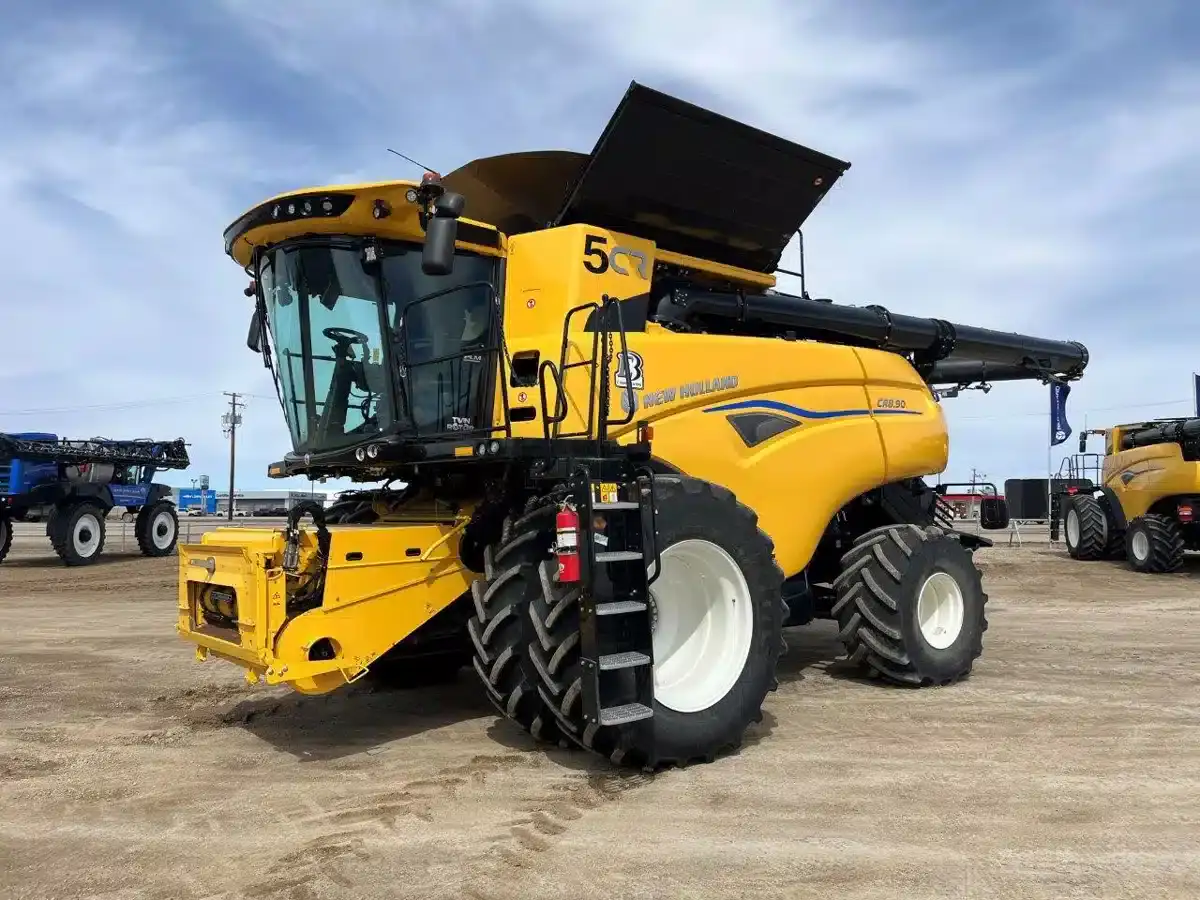
New Holland CR8.90 Combine
On This Page
ToggleIntroduction
The New Holland CR8.90 sits in the middle of the traditional CR Series, below the larger CR9.90 and CR10.90 but still firmly in high-capacity combine territory.
New Holland rates the CR8.90 at 496 gross horsepower. Depending on configuration, maximum engine power is listed at either 544 or 571 hp.
That gives the CR8.90 an interesting place in the lineup. It offers much of the same Twin Rotor harvesting technology found in the larger CR machines without automatically moving into the power and capacity of the New Holland CR9.90 or CR10.90.
For a large Prairie grain farm, that can be a sensible balance. The CR8.90 has enough capacity for substantial wheat, canola, barley and pulse acres, but the farm does not need to justify New Holland’s biggest traditional CR combine to make good use of it.
New Holland CR8.90 Key Specifications
| Specification | New Holland CR8.90 |
|---|---|
| Combine type | Twin Rotor rotary combine |
| Gross engine power | 496 hp (370 kW) |
| Maximum engine power | Up to 571 hp (426 kW), depending on configuration |
| CR8.90 Opti-Clean maximum power | 544 hp (406 kW) |
| Threshing and separation | Twin Rotor |
| Cleaning | Opti-Clean available |
| Combine automation | IntelliSense available |
| Feed-rate control | IntelliCruise |
| Guidance | IntelliSteer available |
| Residue management | Opti-Spread Plus available |
| Track option | SmartTrax |
| Cab | Harvest Suite Ultra |
| Emissions | Tier 4 compliant |
| Manufacturer | New Holland Agriculture |
One specification needs some explanation.
New Holland North America currently lists the standard CR8.90 at 496 gross hp and 571 maximum hp. It also lists a CR8.90 Opti-Clean configuration with the same 496 gross hp but 544 maximum hp.
For that reason, a used CR8.90 should be identified by its exact configuration and model year rather than assuming every CR8.90 carries identical specifications.
Engine and Power
The CR8.90 is rated at 496 gross horsepower.
Maximum power can reach 571 hp on the CR8.90 configuration currently shown by New Holland North America, while the separately listed Opti-Clean configuration is rated at 544 maximum hp.
Either way, this is a powerful combine.
But engine output alone does not tell you how many acres the CR8.90 will harvest in a day.
Crop density, moisture, header width, rotor settings, cleaning capacity and grain-cart logistics all affect actual productivity.
That becomes especially important when comparing the CR8.90 with the larger CR9.90.
The CR9.90 has more available horsepower, but extra power only becomes valuable if the rest of the combine and the harvest operation are being pushed hard enough to use it.
For an operation that rarely reaches the CR8.90’s capacity limit, moving up a model may add cost without adding many harvested acres.
Twin Rotor Threshing and Separation
Like the rest of the traditional CR Series, the CR8.90 uses New Holland’s Twin Rotor system.
Crop enters through the feeder and is divided between two longitudinal rotors. Threshing and separation take place as material moves rearward through the machine.
The layout is different from a conventional combine such as the New Holland CX8.90, which uses a drum and straw-walker system.
Twin Rotor combines are built around high crop flow.
Instead of forcing all material through one large rotor, the crop load is shared between two rotors. New Holland has refined this system over several decades, and it remains the defining feature of the CR Series.
In the field, the important part is consistency.
A combine may move easily through a lighter part of a wheat field and then encounter a much heavier crop minutes later. Canola can change dramatically as moisture increases toward evening. Tough straw can place a completely different load on the machine than dry crop earlier in the day.
The CR8.90 has considerable processing capacity, but it still needs the correct settings for those changing conditions.
Grain Quality
Capacity is only useful if the combine can maintain acceptable grain quality while achieving it.
New Holland’s Twin Rotor system uses a relatively straight crop path through the machine. Grain is released through repeated contact as material passes along the rotors rather than being subjected to one extremely aggressive threshing point.
New Holland reports broken-grain levels as low as 0.2% in its comparative testing of the CR system.
That is a manufacturer test rather than a guarantee of what every farm will see.
Real grain damage depends on crop moisture, rotor speed, concave clearance, crop variety and how aggressively the machine is being operated.
Still, grain quality is one of the main reasons the Twin Rotor design has remained part of New Holland’s combine lineup for so long.
For crops such as peas and other pulses, where cracking can affect grade and value, gentle threshing can be particularly important.
CR8.90 Opti-Clean
Some CR8.90 combines use New Holland’s Opti-Clean cleaning system.
After grain leaves the threshing and separation area, the cleaning shoe still has to separate grain from chaff and lighter material.
This becomes increasingly difficult as crop throughput rises.
If too much material reaches the cleaning shoe at once, losses can increase even if the engine and rotors still have capacity left.
Opti-Clean coordinates movement of the cleaning components to keep material moving through the shoe while reducing unnecessary vibration through the combine.
New Holland also combines its cleaning systems with Opti-Fan technology to help maintain cleaning performance as field conditions change.
For someone comparing used CR8.90 machines, this is one area worth checking carefully because New Holland currently lists more than one CR8.90 configuration.
IntelliSense Combine Automation
IntelliSense automation is available on CR Series combines.
It monitors combine performance and makes adjustments as harvesting conditions change.
New Holland says IntelliSense evaluates settings every 20 seconds.
The operator can choose the priority, including:
- maximum throughput
- lower grain loss
- grain quality
- a balance between multiple objectives
This sounds like a convenience feature, but on a high-capacity combine it can have a real effect on consistency.
A good operator can manually tune a combine very well.
The problem is that crop conditions do not stay constant.
Yield changes across a field. Straw gets tougher in the evening. Crop moisture changes. Ground speed changes. The operator may also be watching the header, grain cart, yield monitor and several other things at the same time.
Automation can make small adjustments without requiring the operator to constantly chase those changes manually.
It does not replace knowing how the combine works.
It helps keep the machine closer to the operator’s target while conditions change.
IntelliCruise Feed-Rate Control
IntelliCruise adjusts combine travel speed according to crop load.
That is useful because one fixed ground speed rarely works equally well across an entire field.
When crop becomes lighter, the combine can increase travel speed.
When the crop becomes heavier, it can slow down to maintain a more consistent amount of material entering the threshing system.
The objective is not simply to make the combine travel faster.
The objective is to keep crop flow more consistent.
That can help the CR8.90 use its capacity more effectively without requiring the operator to make constant manual speed corrections.
Straw Quality
Rotary and conventional combines handle straw differently.
If preserving long straw for baling is one of the highest priorities on the farm, the conventional CX8.90 deserves consideration.
The CR8.90 passes straw through two rotors, so material experiences more rotary action before leaving the combine.
That does not mean every CR8.90 produces poor straw.
New Holland specifically emphasizes the relatively gentle, in-line crop flow of its Twin Rotor design, and straw condition depends heavily on crop moisture, rotor settings and how hard the combine is being pushed.
A grain farm that occasionally bales straw may be perfectly satisfied with the CR8.90.
A mixed operation that depends heavily on large quantities of long cereal straw may have a stronger reason to compare it with the CX Series.
Residue Management
Residue management matters more as combine and header capacity increase.
A wide header collects a large volume of crop from every pass. Once the grain is removed, all that straw and chaff still needs to be handled.
New Holland offers its Opti-Spread Plus system on the CR Series for distributing residue behind the combine.
For Prairie farms using minimum tillage or direct seeding, even distribution is important.
Heavy strips of residue can interfere with opener performance, keep parts of the field cooler and wetter, and create uneven conditions for the following crop.
A high-capacity combine that leaves poor residue distribution can simply move one harvest problem into the next seeding season.
SmartTrax
SmartTrax is available for CR Series combines.
Tracks spread machine weight across a larger contact area than a conventional tire arrangement.
That can be useful during wet harvest conditions or on soils where compaction is a concern.
The CR8.90 is still a heavy machine.
Tracks do not change that.
What they can change is how concentrated that weight is at the soil surface.
For farms that regularly harvest in soft conditions, that may be worth the additional cost and maintenance.
For farms working mostly on firm ground, a tire-equipped machine may be simpler and less expensive to maintain.
Harvest Suite Ultra Cab
The CR8.90 uses New Holland’s Harvest Suite Ultra cab.
New Holland lists the cab at 131 cubic feet and reports a sound level of 73 dB.
Those numbers may not be the first specifications a farmer looks at, but combine operators often spend long days in the cab during harvest.
Seat comfort, visibility, noise and control placement become much more noticeable after ten or twelve hours.
The cab also houses the IntelliView display and controls for combine functions, header operation, guidance and automation.
That matters on a modern combine because the operator is managing far more than steering and ground speed.
IntelliSteer Guidance
IntelliSteer automatic guidance is available on the CR8.90.
With a wide header, even small amounts of overlap or unused header width add up over a large number of acres.
Automatic guidance helps the combine use more of its effective cutting width while reducing the operator’s steering workload.
That gives the operator more time to watch things that can have a larger effect on harvest performance, such as grain loss, header feeding, crop conditions and grain-cart coordination.
On large Prairie fields, that reduction in workload becomes increasingly valuable during long harvest days.
CR8.90 vs CR9.90
The New Holland CR9.90 is the logical next model to compare.
| Specification | CR8.90 | CR9.90 |
|---|---|---|
| Gross engine power | 496 hp | 544 hp |
| Maximum engine power | Up to 571 hp* | 600 hp |
| Threshing system | Twin Rotor | Twin Rotor |
| IntelliSense available | Yes | Yes |
| IntelliSteer available | Yes | Yes |
| SmartTrax available | Yes | Yes |
*New Holland currently lists the CR8.90 Opti-Clean configuration at 544 maximum hp.
The horsepower difference is smaller than the model numbers might suggest.
The CR9.90 provides 48 more gross horsepower and up to 600 maximum hp.
That extra power provides more reserve when crop flow becomes heavy or several machine systems are under load at once.
But the CR8.90 is already a substantial combine.
If field size, crop yield, header capacity or grain handling prevents the CR8.90 from regularly reaching its limit, the CR9.90 may not create a dramatic increase in acres harvested per day.
If a farm consistently pushes a CR8.90 hard, the CR9.90 becomes easier to justify.
CR8.90 vs CR10.90
Moving from the CR8.90 to the New Holland CR10.90 is a larger step.
The CR10.90 reaches 639 gross horsepower and 700 maximum horsepower.
That places it at the top of the traditional North American CR lineup.
The difference is not simply about having a bigger number on the side of the combine.
A CR10.90 makes sense when the farm has enough crop, header capacity, grain carts and trucks to make use of its additional throughput potential.
For many farms, the CR8.90 may already provide all the capacity the harvest system can support.
That can make it the more sensible machine even when the larger combine looks better on paper.
CR8.90 vs New CR10
The names are similar, but the CR8.90 and New Holland CR10 come from different generations.
The CR8.90 belongs to the established CR Series platform.
The CR10 belongs to New Holland’s newer next-generation CR family and uses a redesigned harvesting system, including the newer TwinClean cleaning architecture.
For someone looking at used equipment, that distinction matters.
The CR8.90 represents a mature platform that has been used across many harvest seasons.
The CR10 represents New Holland’s newer approach to increasing capacity and automation.
The newer machine is technically more advanced, but that does not automatically make it the right financial choice for every farm.
Best Applications
The New Holland CR8.90 is a strong fit for:
- medium-to-large and large grain operations
- Prairie farms harvesting substantial wheat acreage
- canola, barley and pulse production
- farms wanting Twin Rotor capacity below the CR9.90
- operations where grain quality matters
- farms using larger headers
- operators wanting IntelliSense automation
- farms that need strong capacity without automatically moving to the top CR models
The CR8.90 may be especially interesting for farms where a CR7-series machine feels too small but a CR9.90 or CR10.90 would be difficult to keep fully loaded.
What to Check on a Used CR8.90
A used combine should never be judged from engine hours alone.
For a CR8.90, check:
- engine hours
- separator hours
- rotor condition
- concaves
- feeder components
- elevator chains and sprockets
- cleaning shoe
- unloading auger and associated drives
- chopper and residue system
- bearings and belts
- SmartTrax condition if equipped
- electronic and automation functions
- maintenance records
- exact cleaning-system configuration
The relationship between engine and separator hours can also tell part of the story.
A documented service history is valuable on a machine with this many moving components.
Two CR8.90 combines with similar hours can have very different remaining life depending on crop conditions, maintenance and how they were operated.
New Holland CR8.90 Reviews & Ratings
Specifications explain the basic machine.
Owner experience explains the parts that do not fit neatly into a spec table.
For the CR8.90, useful owner feedback includes how the combine handles wheat and canola, grain-loss levels, straw condition, fuel use, IntelliSense performance, reliability at higher separator hours and how easy the machine is to set when conditions change.
If you operate a CR8.90, an owner review on Aglist can help other farms understand how the machine performs outside the brochure.
Is the New Holland CR8.90 Still Worth Considering?
Yes.
The CR8.90 no longer represents New Holland’s newest combine technology, but that does not make it outdated as a harvesting machine.
Nearly 500 gross horsepower and Twin Rotor threshing still provide substantial capacity.
Its position in the used market may actually make it more attractive to some farms.
Instead of paying for the newest and largest machine available, an operation can look for a well-maintained CR8.90 that already provides enough capacity for its acreage.
At that point, condition and price matter more than whether another combine has an extra 50 or 100 horsepower.
Final Thoughts
The New Holland CR8.90 is probably best viewed as the middle ground of the traditional high-capacity CR lineup.
It is noticeably more machine than the lower CR models but does not go as far as the CR9.90 or 700 hp CR10.90.
For many farms, that is exactly the point.
A combine only earns its keep when the operation can use its capacity.
The CR8.90 provides serious Twin Rotor harvesting performance without automatically requiring the farm to justify the largest machine New Holland offered in this generation.
For Western Canadian grain operations with substantial acreage, it remains a combine worth comparing carefully.
You can browse the rest of the current and previous-generation machines in the Aglist combines section or see more equipment on the New Holland brand page.
Frequently Asked Questions
How much horsepower does the New Holland CR8.90 have?
New Holland North America lists the CR8.90 at 496 gross horsepower. Maximum power is listed at up to 571 hp for the CR8.90, while the separately listed CR8.90 Opti-Clean configuration is rated at 544 maximum hp.
Why are there two horsepower figures for the CR8.90?
New Holland currently lists more than one CR8.90 configuration on its North American CR Series page. Both have 496 gross hp, but the listed maximum output differs. Check the exact configuration and model year of a specific machine.
Is the CR8.90 a rotary combine?
Yes. It uses New Holland’s Twin Rotor system with two longitudinal rotors for threshing and separation.
What is the difference between the CR8.90 and CR9.90?
The CR9.90 has more engine power, with 544 gross hp and up to 600 maximum hp. Both use New Holland’s Twin Rotor architecture, but the CR9.90 provides more power reserve for higher crop loads.
Does the CR8.90 have IntelliSense?
IntelliSense combine automation is available on the CR Series and can automatically adjust combine settings as harvesting conditions change.
Can a CR8.90 be equipped with tracks?
Yes. New Holland’s SmartTrax system is available on CR Series combines.
Is the CR8.90 good for straw?
The Twin Rotor system is designed for relatively gentle crop flow, and usable straw is possible with correct settings. Farms where preserving long straw for baling is a major priority should also compare the conventional New Holland CX8.90.
Is the CR8.90 suitable for Saskatchewan and Alberta farms?
Yes. It is particularly suited to larger grain operations harvesting wheat, canola, barley and pulses where high capacity is useful during a short Prairie harvest window.
Related
- New Holland CR9.90 – the next CR model up, with up to 600 hp.
- New Holland CR10.90 – the largest traditional CR model, with up to 700 hp.
- New Holland CR10 – New Holland’s newer next-generation CR combine.
- New Holland CX8.90 – conventional straw-walker alternative for farms where straw quality is important.
- Combines – compare combine models and harvesting systems on Aglist.
- New Holland – browse more New Holland equipment.
Note: We try our best to keep specifications accurate, but CR8.90 configurations and specifications can differ by model year and equipment package. Confirm critical specifications with New Holland, the operator’s manual, or your dealer.
Share your experience
Help other Canadian buyers — leave a quick review for the
New Holland CR8.90
There are no reviews yet. Be the first one to write one.