Overview & Specs
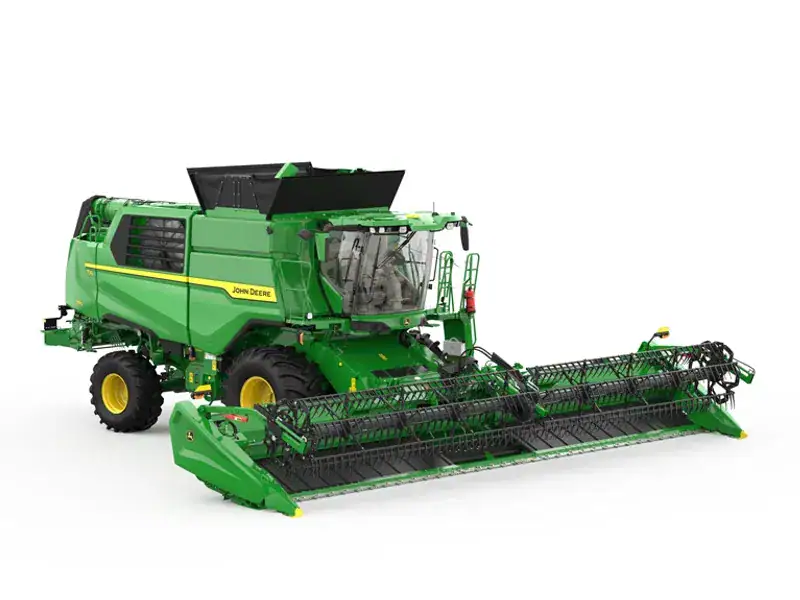
John Deere T6 800 Combine
On This Page
ToggleIntroduction
The John Deere T6 800 is very different from the S7 and X9 combines that sit alongside it in Deere’s current Canadian harvesting lineup.
It is not a rotary combine.
Instead, the T6 800 uses conventional multi-drum threshing followed by six straw walkers, giving farms another option when grain capacity matters but preserving straw quality is also important.
That makes the T6 800 particularly relevant in Western Canada.
John Deere specifically lists wheat, canola and barley among the crops commonly associated with the machine.
For mixed grain and livestock farms, operations selling cereal straw, or farms that simply prefer conventional threshing, the T6 800 fills a role that Deere’s rotary S7 and dual-rotor X9 families do not.
It combines a 9.0 L John Deere engine with a large threshing and separation system, six straw walkers, modern Dyna-Flo Plus cleaning, available Predictive Ground Speed Automation and grain-handling capacity reaching 383 bushels.
The key question is not whether the T6 800 can match the largest rotary combines for maximum throughput.
It is whether its balance of capacity, straw quality and current Deere technology better fits the farm.
John Deere T6 800 Key Specifications
| Specification | John Deere T6 800 |
|---|---|
| Combine type | Conventional / straw walker |
| Separator type | Multi Drum / Straw Walker |
| Engine | John Deere PowerTech PSS |
| Engine displacement | 9.0 L |
| Rated power | 392 hp |
| Rated engine speed | 2,200 rpm |
| Fuel capacity | 211 gal. (800 L) |
| Threshing cylinder diameter | 26 in. (660 mm) |
| Number of rasp bars | 10 |
| Concave wrap angle | 124 degrees |
| Threshing area | 14.5 sq. ft. (1.35 m²) |
| Large separator diameter | 31.5 in. (800 mm) |
| Total active threshing/separation area | Approx. 43 sq. ft. (4.0 m²) |
| Number of straw walkers | 6 |
| Straw walker area | 62.4 sq. ft. (5.8 m²) |
| Current grain tank options | 312 or 383 bu |
| Current peak unloading rate | 4.3 bu/s |
| Manufacturing location | Germany |
John Deere’s current product material also lists Dyna-Flo Plus cleaning, SlopeMaster, Machine Sync capability, Ground Speed Automation and available Predictive Ground Speed Automation.
That makes the T6 800 a conventional combine with a much more modern technology package than the term “straw walker” might suggest.
A Conventional Combine in a Rotary Market
Large modern farms increasingly use rotary combines.
There are good reasons for that.
Rotary machines can process very large crop volumes and are well suited to operations where grain throughput is the main priority.
But rotary is not automatically better for every farm.
The T6 800 takes a different approach.
Crop is first threshed through a conventional cylinder system. Additional drums continue separation before material reaches six straw walkers.
This keeps straw moving through the machine in a comparatively controlled path rather than repeatedly wrapping it around a rotor.
That can help preserve longer straw.
For farms that bale wheat or barley straw for livestock bedding, feed or sale, that difference can have economic value beyond the grain tank.
Deere’s Over-the-Top Feeding System
One of the most distinctive parts of the T6 design is Deere’s over-the-top crop flow.
After initial threshing, an overshot beater transfers material into the main separation area.
Deere says this design allows larger wrapping angles around the concave and separator while maintaining smooth material flow.
The T6 uses:
- 26-inch threshing cylinder
- 10 rasp bars
- 124-degree concave wrap
- 19.7-inch overshot beater
- 31.5-inch separation beater
- rear beater before the straw walkers
The purpose is to remove as much grain as practical before the crop reaches the walkers.
That matters because straw walkers work best when most easily separated grain has already been removed.
They then have more opportunity to recover remaining grain while keeping straw relatively intact.
Six Straw Walkers
The T6 800 uses six straw walkers.
John Deere lists approximately 62.4 square feet of walker area.
This is one of the defining differences between the T6 and Deere’s rotary combines.
Straw leaving the separator moves across the walkers while remaining grain falls through openings toward the cleaning system.
The crop is not being rotated continuously around a rotor.
For farms that want usable cereal straw after harvest, this can be an advantage.
The trade-off is that straw-walker capacity behaves differently from rotary capacity.
As crop volume becomes extremely high, a rotary or hybrid combine may be able to process more material through a more compact separation system.
That does not make the T6 inferior.
It means the architecture is optimized around a different balance.
Why Straw Quality Matters
Straw is sometimes treated as waste in combine comparisons.
On many farms, it is not.
A mixed grain and livestock operation may use thousands of bales during a year.
Straw may be used for:
- bedding
- feed
- sale
- erosion management
- other farm uses
If a harvesting system damages straw more aggressively, the grain side of the operation may benefit while the livestock or baling side loses value.
This is why combine choice should consider everything leaving the machine, not only what enters the grain tank.
For farms where straw has little value and is always chopped, rotary capacity may be more attractive.
For farms where straw has meaningful value, a machine such as the T6 800 deserves consideration.
T6 800 for Wheat
Wheat is one of the most natural applications for the T6 800.
John Deere specifically lists wheat among the machine’s common crops.
The conventional threshing cylinder provides aggressive initial grain removal, while the secondary separator and straw walkers continue separating grain from the material.
This arrangement can be particularly attractive when a farm wants a good grain sample without excessively breaking cereal straw.
Wheat conditions still matter.
Dry afternoon wheat may thresh easily.
As evening moisture increases, straw becomes tougher.
Feeding and separation demands rise.
That is where the T6 800’s large separator and automation tools become increasingly useful.
T6 800 for Barley
Barley is another crop Deere specifically identifies for the T6.
Straw quality can matter even more here because barley straw is commonly used on livestock operations.
A conventional combine can provide a useful balance between grain recovery and straw preservation.
Again, settings matter.
Cylinder speed, concave clearance and crop moisture all affect how aggressively the machine handles material.
A straw-walker combine is not automatically gentle if it is set incorrectly.
The architecture simply gives the operator a different starting point from a rotary machine.
T6 800 for Canola
Canola is an interesting fit because straw preservation is normally less important than in wheat or barley.
Why use a conventional combine at all?
The answer can be crop mix.
A farm may harvest wheat, barley and canola with the same machine.
Choosing a combine around only one crop can create compromises in the others.
John Deere specifically includes canola among the T6 800’s common applications.
The machine’s cleaning capacity and current Ground Speed Automation technology can help maintain throughput as crop conditions change.
For a mixed rotation, the T6 provides a conventional architecture without limiting the machine to cereal crops.
Remote Booster Bar Adjustment
One of the useful current T6 features is Remote Booster Bar Adjustment.
John Deere allows the operator to fine-tune threshing aggressiveness from the cab.
That is useful when conditions change during the day.
The objective is to find enough threshing action to remove grain without unnecessarily damaging kernels or straw.
In easier conditions, less aggressive settings may be sufficient.
In tougher crop, additional threshing action can be added.
This is a good example of how a modern conventional combine differs from older straw-walker machines.
The architecture may be traditional, but adjustment and automation are increasingly electronic.
Dyna-Flo Plus Cleaning System
The T6 800 uses Deere’s Dyna-Flo Plus cleaning system.
The current machine uses an auger-type preparation system with six conveying augers.
Material is distributed across a dual-stage pre-cleaning section before reaching the main chaffer and sieve.
This matters because conventional threshing does not eliminate cleaning limits.
Once grain is separated from straw, the combine still needs to separate clean grain from chaff and other material.
If the shoe becomes overloaded, grain loss can rise even when engine power is still available.
A combine’s practical capacity is therefore determined by the entire crop-processing path, not just horsepower.
SlopeMaster
SlopeMaster is standard on the T6 cleaning system.
Deere states that it helps the machine handle slopes up to approximately 7 percent at the chaffer.
On side slopes, grain and chaff naturally move toward one side of the cleaning shoe.
That can overload part of the system while leaving another section underused.
Slope compensation helps keep material distributed more evenly.
For flatter Prairie land this may not be a deciding factor, but not every Saskatchewan or Alberta field is perfectly level.
HillMaster Availability
John Deere has also offered HillMaster configurations for more substantial slope compensation.
This is particularly relevant in rolling terrain.
However, configuration matters.
The larger 383-bushel grain tank is not available with HillMaster according to Deere’s current product information.
That is exactly why individual-machine specifications should be checked rather than assuming every option can be combined with every other option.
Current Grain Tank Options
Deere’s updated T6 800 information lists two grain tank sizes:
312 bu
and
383 bu
The larger 383-bushel tank requires ProDrive and is not available with HillMaster.
This is a substantial amount of onboard grain for a straw-walker machine.
The larger tank gives the operator more time between unloading cycles.
That can be useful in long Prairie fields or when a grain cart is serving more than one combine.
But tank size still needs to match the rest of the harvest system.
If the cart is always beside the combine, the extra capacity may matter less.
4.3 bu/s Unloading
Current Deere material lists the T6 800 at up to 4.3 bushels per second, or 150 litres per second.
Deere states that the 312-bu tank can theoretically empty in about 73 seconds and the 383-bu tank in about 90 seconds.
Those figures come from the manufacturer and assume the rated unloading performance.
Real unloading cycles vary.
Still, the numbers show that Deere has given the current T6 a grain-handling system designed for serious harvest productivity.
The T6 800 is not an old-school straw walker with old-school unloading capacity.
Machine Sync
Machine Sync can help coordinate the combine with a compatible grain-cart tractor while unloading on the go.
That matters even on a conventional combine.
Stopping to unload wastes harvesting time regardless of threshing architecture.
With Machine Sync, the combine can coordinate the relative position and speed of the grain-cart tractor.
The goal is a smoother unloading cycle and less operator workload.
Ground Speed Automation
The T6 800 now supports Ground Speed Automation.
The system dynamically changes combine travel speed based on information such as:
- terrain
- previous coverage
- grain loss
- engine power
- header position
- operator-selected speed limits
Instead of trying to maintain one fixed field speed, the combine attempts to maintain more consistent crop throughput.
That is a more useful way to operate any combine.
Crop volume rarely stays exactly the same across an entire field.
A fixed ground speed can leave the machine underloaded in one area and overloaded in another.
Automation helps reduce that variation.
ProDrive or ProDrive XL is required for Ground Speed Automation.
Predictive Ground Speed Automation
Deere also lists Predictive Ground Speed Automation for the current T6 800.
This takes the concept farther.
Instead of waiting until crop has entered the machine and affected engine load or grain loss, predictive systems attempt to anticipate crop conditions ahead of the combine.
Ground speed can then change earlier.
For a conventional combine, this can be particularly useful because maintaining a steady material flow helps the threshing, separation and cleaning systems stay balanced.
The goal is not maximum speed.
It is consistent throughput.
ProDrive
ProDrive is an important option on the T6 800.
It provides continuously variable ground-speed control and supports technologies such as Ground Speed Automation.
It is also required for the larger 383-bushel grain tank.
This is one reason individual configurations can differ substantially.
A base T6 and a heavily equipped T6 may have the same model number but very different grain-handling and automation capability.
Modern Cab
The current T6 received substantial cab updates.
John Deere highlights a larger, quieter operator environment along with the G5Plus CommandCenter.
Available comfort equipment includes:
- heated and ventilated seat
- massage function
- increased seat swivel
- improved storage
- heated and cooled floor ventilation
- Apple CarPlay and Android Auto compatibility
- digital touchscreen radio
These features do not increase harvesting capacity directly.
But operator fatigue matters during long harvest days.
A combine may run late into the evening whenever weather conditions remain favourable.
Comfort becomes part of productivity once the operator has been in the cab for ten or twelve hours.
G5Plus CommandCenter
The T6 800 uses Deere’s G5Plus CommandCenter environment.
This brings the conventional T6 into the same broader precision-ag ecosystem as modern Deere tractors and combines.
Depending on configuration, operators can work with guidance, machine information, harvest data and automation through the integrated display.
That is important because farms choosing a straw-walker combine no longer have to give up modern digital integration.
Residue Management
Not every T6 owner wants to bale straw.
When straw is not needed, Deere offers FineCut and Extra FineCut residue systems.
The Extra FineCut system uses more knives to reduce residue size.
That helps distribute material and prepare the field for the next crop.
Residue management becomes particularly important behind wider headers.
Uneven straw and chaff distribution can create:
- uneven soil warming
- seeding problems
- nutrient concentration
- plugging
- uneven crop emergence
A conventional combine still needs an effective residue system when the farm decides not to bale.
T6 800 vs John Deere S7 700
The John Deere S7 700 provides a useful same-brand comparison.
Both machines occupy a broadly similar performance area, but their harvesting systems are fundamentally different.
| T6 800 | S7 700 | |
|---|---|---|
| Harvesting system | Multi-drum + straw walkers | Single rotor |
| Engine | 9.0 L Deere | JD9 9.0 L |
| Rated power | 392 hp | 402 hp |
| Straw handling | Major strength | Rotary |
| Common focus | Wheat, canola, barley | Broad grain/oilseed use |
| Grain tank | Up to 383 bu current configuration | 300 bu |
| Peak unloading | 4.3 bu/s | 4.2 bu/s |
The horsepower figures are remarkably close.
That makes architecture the real decision.
Choose the T6 when straw quality and conventional threshing are important.
Choose the S7 when rotary crop flow better fits the operation.
T6 800 vs John Deere S7 800
The John Deere S7 800 moves considerably farther into rotary capacity.
The S7 800 has Deere’s larger JD14 13.6 L engine, 540 maximum horsepower and a 400-bushel grain tank.
The T6 800 should therefore not be viewed as a direct capacity equivalent.
The T6 offers a different harvesting philosophy.
For a large grain-only operation looking primarily for throughput, the S7 800 may be the more natural machine.
For a farm where straw has meaningful value, the T6 can still be the better fit even if the rotary machine has more peak capacity.
T6 800 vs New Holland CX8.90
The New Holland CX8.90 is one of the most natural cross-brand competitors.
Both are high-capacity conventional combines with straw walkers.
Both target farms that want modern harvesting capacity while maintaining better straw condition than a full rotary system typically provides.
The machines use different threshing and separation designs, so horsepower alone does not settle the comparison.
The useful questions include:
- straw quality
- threshing performance
- cleaning capacity
- grain tank
- unloading
- automation
- header compatibility
- dealer support
- parts availability
For mixed farms, this comparison may be much more useful than comparing the T6 with another Deere rotary combine.
T6 800 vs New Holland CX8.80
The New Holland CX8.80 provides another conventional alternative.
For farms shopping below the largest conventional machines, the CX8.80 can be a useful reference point.
Again, the decision should focus on more than maximum horsepower.
Dealer support and straw quality can matter enormously in this part of the market.
T6 800 vs Rotary Combines
The broader decision is conventional versus rotary.
T6 800 advantages
- strong straw preservation potential
- conventional threshing architecture
- six straw walkers
- large modern grain tank options
- current Deere automation
- well suited to cereals
- good fit for mixed farms
Rotary advantages
- generally higher peak crop-flow potential
- compact separation architecture
- strong fit for large grain-only operations
- broad North American model selection
Neither system wins automatically.
The farm needs to decide what happens to the straw after the grain enters the tank.
That answer often points toward the correct architecture.
Who Should Consider the T6 800?
The T6 800 makes particular sense for:
- wheat-heavy operations
- barley farms
- mixed wheat, barley and canola rotations
- grain and livestock operations
- farms that regularly bale cereal straw
- farms selling straw
- operators who prefer conventional threshing
- farms wanting modern Deere automation without moving to rotary separation
- operations where straw quality has real economic value
It may make less sense for:
- very high-acreage grain-only farms focused almost entirely on maximum throughput
- operations where all straw is chopped
- farms already well matched to a high-capacity rotary system
- operations where straw quality has little value
Is a Straw-Walker Combine Outdated?
No.
The T6 800 is a good example of why.
Its basic separation principle is traditional.
Its execution is not.
The current machine combines straw walkers with:
- Ground Speed Automation
- Predictive Ground Speed capability
- G5Plus CommandCenter
- Machine Sync
- modern grain handling
- remote threshing adjustment
- current residue-management systems
A harvesting architecture does not become obsolete simply because another architecture exists.
The relevant question is whether it still solves a useful problem.
For farms that value straw, it does.
What to Check on a Used T6 800
When inspecting a used T6 800, check:
- engine hours
- separator hours
- engine service history
- threshing cylinder
- rasp bars
- concaves
- overshot beater
- separator drum
- separator grate
- rear beater
- all six straw walkers
- walker bearings and drives
- Dyna-Flo cleaning system
- conveyor augers
- chaffer and sieve
- grain elevators
- grain tank augers
- unloading system
- chopper
- feederhouse
- ProDrive operation if equipped
- tracks or tires
- G5Plus and guidance hardware
- automation equipment
- maintenance records
On a straw-walker combine, walker condition deserves particular attention.
A problem in the separation system can affect both capacity and losses.
John Deere T6 800 Reviews & Ratings
The T6 800 is a machine where owner feedback can be especially useful.
A specification sheet cannot tell you:
How well does it preserve wheat straw in real conditions?
How late into the evening can it work before tough straw begins limiting capacity?
How does it perform in canola?
Is the 383-bushel tank worth choosing?
How useful is Ground Speed Automation?
How does it compare with an S7 on the same farm?
How does Dyna-Flo Plus handle heavy cereal crops?
Those are exactly the questions real farm experience can help answer.
If you operate a T6 800, an Aglist review can help other Canadian farmers understand how it performs outside Deere’s product literature.
Is the T6 800 the Right Combine for a Prairie Farm?
It can be.
Especially when straw matters.
A Prairie farm growing wheat, barley and canola may not need the absolute highest rotary throughput available.
It may get more total value from a combine that produces clean grain while leaving better material for the baler.
That calculation becomes even stronger on mixed livestock farms.
For grain-only operations, the comparison changes.
If straw is always chopped and harvest capacity is the overriding priority, Deere’s S7 or X9 families may offer a more natural direction.
The T6 800 is strongest when the farm values both sides of the combine:
what goes into the grain tank and what comes out behind it.
Final Thoughts
The John Deere T6 800 fills an important gap in Deere’s current combine lineup.
S7 provides Deere’s single-rotor platform.
X9 provides high-capacity dual rotors.
T6 800 provides a modern straw-walker alternative.
It uses a 9.0 L John Deere engine rated at 392 hp in Deere Canada’s technical information and combines conventional cylinder threshing with additional drum separation and six straw walkers.
Current configurations can carry up to 383 bushels and unload at up to 4.3 bu/s.
More importantly, the current T6 brings modern technology such as Ground Speed Automation, available Predictive Ground Speed Automation, Machine Sync and G5Plus into a harvesting architecture designed around both grain productivity and straw quality.
For a grain-only operation, that may not outweigh the capacity of a large rotary.
For a mixed Prairie farm where cereal straw has real value, it can.
That is why the T6 800 should not be viewed as an old-fashioned alternative to Deere’s rotary combines.
It is a different tool for a different harvesting priority.
Browse more machines in the Aglist combines category or see additional equipment on the John Deere brand page.
Frequently Asked Questions
Is the John Deere T6 800 a rotary combine?
No. The T6 800 uses a Multi Drum / Straw Walker harvesting system with conventional threshing followed by six straw walkers.
How much horsepower does the John Deere T6 800 have?
John Deere Canada’s technical information lists the T6 800 at 392 rated horsepower from its 9.0 L PowerTech engine.
What crops is the T6 800 commonly used for?
John Deere Canada specifically lists wheat, canola and barley among the T6 800’s common crops.
How many straw walkers does the T6 800 have?
The T6 800 uses six straw walkers with approximately 62.4 square feet of walker area.
How big is the T6 800 grain tank?
Current Deere product information lists 312-bushel and 383-bushel configurations. The larger tank requires ProDrive and is not available with HillMaster.
How fast does the T6 800 unload?
Current John Deere information lists a peak unloading rate of 4.3 bushels per second, or 150 litres per second.
Is the T6 800 good for wheat straw?
Straw preservation is one of the main reasons to consider the T6. Its conventional multi-drum and straw-walker architecture is designed to maintain smooth crop flow and good straw quality.
T6 800 or S7 700: which is better?
They serve different priorities. The T6 800 uses conventional threshing and straw walkers, while the S7 700 is rotary. The T6 is particularly attractive when straw quality matters, while the S7 is a stronger fit when rotary harvesting is preferred.
Does the T6 800 have Ground Speed Automation?
Yes. Deere’s current T6 800 supports Ground Speed Automation when equipped with the required ProDrive or ProDrive XL transmission.
Does the T6 800 have Predictive Ground Speed Automation?
John Deere currently lists Predictive Ground Speed Automation as available on the T6 800.
Where is the John Deere T6 800 built?
John Deere lists Germany as the manufacturing location for the T6 platform.
Related
- John Deere S7 700 – rotary Deere alternative with similar rated engine power.
- John Deere S7 800 – higher-capacity rotary option.
- New Holland CX8.90 – major conventional straw-walker competitor.
- New Holland CX8.80 – another conventional combine comparison.
- John Deere S7 Series Compared – compare Deere’s current rotary S7 lineup.
- Combines – compare combine types and models.
- John Deere – browse more John Deere equipment on Aglist.
Note: John Deere’s live Canadian T6 800 page currently contains both newer feature information and an older technical specification table dated 2018. Current grain-tank and unloading figures in this guide follow Deere’s newer product feature material. Specifications can vary by configuration and market, so confirm critical details for a specific machine with current John Deere documentation or your dealer.
Share your experience
Help other Canadian buyers — leave a quick review for the
John Deere T6 800
There are no reviews yet. Be the first one to write one.