Overview & Specs
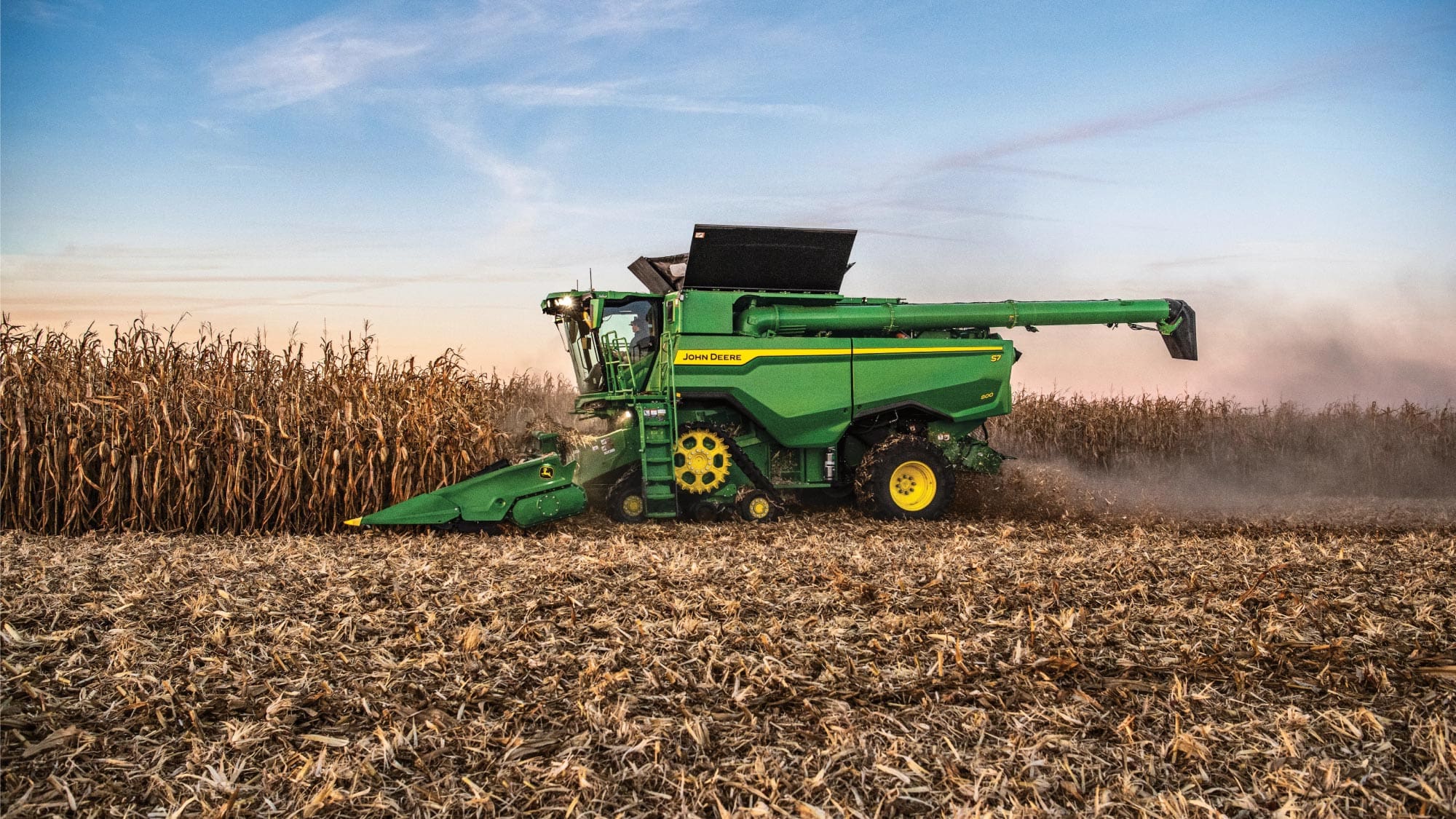
John Deere S7 800 Combine
On This Page
ToggleIntroduction
The John Deere S7 800 is where the current S7 lineup makes its biggest change.
The S7 600 and S7 700 both use Deere’s 9.0 L JD9 engine and 300-bushel grain tanks. The S7 800 moves to the larger 13.6 L JD14 engine, increases grain capacity to 400 bushels, and adds hardware aimed specifically at tougher, higher-volume harvesting.
John Deere rates the S7 800 at 473 horsepower at rated engine speed and 540 maximum horsepower.
It still uses the familiar 30-inch rotary separator found across the S7 family, but the surrounding machine has more capacity. The cleaning system is larger, fuel capacity increases, and Active Concave Isolation becomes available for difficult small-grain conditions.
For a Western Canadian farm, this is an important dividing line in the S7 range.
The S7 800 is not simply an S7 700 with another 80 horsepower. It starts to make sense for operations where heavy wheat, canola, barley and other tough crops can genuinely keep a larger combine loaded.
John Deere S7 800 Key Specifications
| Specification | John Deere S7 800 |
|---|---|
| Combine type | Rotary combine |
| Engine | John Deere JD14 |
| Engine displacement | 13.6 L (830 cu. in.) |
| Rated engine power | 473 hp (353 kW) |
| Maximum engine power | 540 hp (402 kW) |
| Rated engine speed | 2,000 rpm |
| Power boost at rated speed | 50 hp (37 kW) |
| Fuel capacity | 330 gal. (1,250 L) |
| Separator type | Rotary |
| Rotor diameter | 30 in. (76.2 cm) |
| Rotor length | 123 in. (312 cm) |
| Low rotor range | 210–530 rpm |
| High rotor range | 400–1,000 rpm |
| Concave area | 11.8 sq. ft. (1.1 m²) |
| Separating area | 21.4 sq. ft. (1.99 m²) |
| Total cleaning area | 63.5 sq. ft. (5.9 m²) |
| Grain tank capacity | 400 bu (14,100 L) |
| Peak unloading rate | 4.2 bu/s (150 L/s) |
| Unloading auger lengths | 22.5, 26 or 28.5 ft |
| Base weight without header | 49,141 lb (22,286 kg) |
| Emissions | Final Tier 4 |
| Manufacturing location | East Moline, Illinois, USA |
The specification sheet makes the step from the lower S7 models fairly obvious.
This is a heavier combine with a larger engine, more fuel, more grain capacity and additional cleaning area.
JD14 13.6 L Engine
The S7 800 uses Deere’s JD14 13.6 L engine.
Rated output is 473 hp and maximum power reaches 540 hp.
That is a major change from the John Deere S7 700, which uses the smaller 9.0 L JD9 and tops out at 460 hp.
The S7 800 also operates at a lower rated engine speed of 2,000 rpm compared with 2,200 rpm on the JD9-powered models.
Deere lists a 50 hp power boost at rated speed.
More important than any one number is why this engine is here.
Once a combine is processing heavy crop, chopping residue and unloading grain at the same time, engine demand can increase quickly. A larger engine provides more reserve before those simultaneous loads begin to pull the machine down.
That extra power has value when the combine can use it.
If an operation spends much of harvest waiting for carts or trucks, the additional 80 hp over an S7 700 will not solve the real problem.
400-Bushel Grain Tank
The S7 800 moves to a 400-bushel grain tank.
That is 100 bushels more than the S7 600 and S7 700.
The difference sounds simple, but it can change grain-cart logistics noticeably.
A larger tank gives the operator more time between unloads and more flexibility when the grain cart is finishing another pass or briefly servicing another combine.
It can also reduce the number of times the machine has to unload during a field.
But tank capacity should never be considered separately from weight.
Four hundred bushels of grain represents a substantial amount of additional load when the tank is full.
The S7 800 already weighs 49,141 lb as a base machine without a header. Add fuel, the header and a full grain tank, and actual field weight becomes considerably higher.
For wet harvest conditions, that matters.
4.2 bu/s Unloading
Peak unloading rate is 4.2 bushels per second.
That is the same peak rate Deere lists for the S7 700, but the S7 800 has another 100 bushels in its tank.
At the theoretical peak rate, moving 400 bushels would take roughly 95 seconds.
Real unloading time will be different because grain flow does not remain at theoretical peak output through every second of an unloading cycle.
Still, it gives useful perspective.
With a machine at this capacity level, unloading on the go becomes increasingly important.
Stopping a 540 hp combine every time the grain tank fills defeats much of the reason for owning that much harvesting capacity.
The grain cart needs to be part of the plan.
Rotary Threshing and Separation
The S7 800 continues to use Deere’s single-rotor design.
The rotor is 30 inches in diameter and 123 inches long.
Those dimensions are the same as the smaller S7 models, which is an important point.
Deere has not simply made the rotor larger as horsepower increases.
Instead, the S7 800 combines the established rotor dimensions with more engine power, more separating area, more cleaning capacity and additional technology for tough crop conditions.
Rotor speeds range from 210 to 530 rpm in low range and 400 to 1,000 rpm in high.
That gives operators room to work across crops with very different threshing requirements.
The goal is not to run the rotor as fast as possible.
The correct setting is the one that gets grain out of the crop while keeping damage and losses acceptable.
Active Concave Isolation
The S7 800 is the first model in the S7 lineup where Active Concave Isolation becomes available.
That makes it one of the most meaningful differences from the S7 700.
In difficult crop conditions, heavy material moving through the rotor can put substantial pressure on the concave.
John Deere uses hydraulic pressure to help stabilize the concave and maintain the intended relationship between the rotor and threshing surface.
Deere says the updated system can increase machine capacity by around 10 percent in the tough conditions where it is intended to work.
That should be understood as a manufacturer claim under specific operating conditions, not a promise that every S7 800 will harvest 10 percent more crop all day.
The practical benefit is easier to understand.
When crop becomes very tough, keeping the concave stable helps the threshing system behave more consistently rather than allowing heavy crop loads to alter the geometry of the system.
For wheat and canola farms that regularly harvest outside perfect afternoon conditions, that can matter.
Why Active Concave Isolation Matters in Western Canada
Prairie harvest rarely gives operators the same crop conditions from morning until night.
Dry wheat may thresh easily in the middle of the afternoon.
As evening humidity rises, straw gets tougher.
Canola can become even more demanding.
That is where a feature designed specifically around heavy green or tough material has more value than it might on a farm harvesting mostly dry corn and soybeans.
The S7 600 and S7 700 can still harvest small grains.
The difference is that Deere gives the S7 800 another tool for maintaining capacity when conditions become difficult.
That is one reason the jump to an S7 800 should be viewed as more than an engine upgrade.
Variable-Stream Rotor
For tough small grains, Deere recommends its variable-stream rotor configuration.
Adjustable top-cover transport vanes allow the operator to change how quickly material moves through the rotor.
If crop needs more threshing or separation time, material can be retained longer.
When conditions are easier, crop can move through more quickly.
This matters because one fixed crop-flow speed is not ideal for every situation.
Wheat, canola, barley, oats and rice can all place different demands on the threshing system.
Even one wheat field can behave differently several hours apart.
Deere also notes that changing the vane angle can reduce stress on straw as it moves through the rotor.
That can help farms trying to balance rotary capacity with usable straw quality.
TriStream Rotor
For coarse grains, Deere’s TriStream rotor takes a different approach.
The front of the rotor is tapered to help incoming material transition into the threshing area.
Spiral vanes help guide crop rearward through the system.
Deere says the design can reduce the force required to move material through the combine by as much as 20 percent under the operating conditions it references.
Again, that is a manufacturer test claim rather than a universal farm result.
The underlying idea is useful, though.
Engine horsepower should be used to process crop, not wasted overcoming unnecessary resistance inside the threshing system.
A smoother crop path can contribute to both capacity and fuel efficiency.
Larger Dyna-Flo Plus Cleaning System
Cleaning capacity is another important difference between the S7 800 and lower S7 models.
John Deere Canada lists 63.5 square feet of total louvered cleaning area on the S7 800.
The S7 600 and S7 700 are listed with smaller cleaning systems.
Why does that matter?
Because a combine can reach its cleaning limit before it reaches its engine limit.
If too much material reaches the shoe, grain losses can increase even though the engine still appears to have available power.
The S7 800 includes additional front-chaffer area to help deal with higher material flow.
Deere says Dyna-Flo Plus can provide a 14 percent capacity increase in shoe-limited wheat and canola conditions compared with previous Deere designs.
That claim is particularly relevant to Canadian farms because wheat and canola are exactly the crops Deere references.
Feeding Heavy Crop
The S7 800 uses a 55-inch-wide feeder house.
Crop feeding becomes increasingly important as combine capacity rises.
Putting a larger engine behind a feeding system that cannot deliver crop evenly would not accomplish much.
Deere uses large clearances and a high-performance feeder-house design to keep material moving into the rotor.
The front feed drum also has room to move as crop volume changes.
The goal is to avoid large slugs entering the threshing system.
Consistent feeding helps the rotor, cleaning shoe and automation systems work with a more predictable load.
Predictive Ground Speed Automation
Predictive Ground Speed Automation is available on the S7 800.
This system can use information ahead of the combine to anticipate changes in crop volume.
Instead of waiting until a heavy patch has already entered the machine and engine load rises, the combine can adjust travel speed in advance.
That can create more consistent crop flow.
In lighter crop, the combine can travel faster.
When heavier material is coming, speed can be reduced before the machine becomes overloaded.
The value is not maximum ground speed.
The value is spending less time alternating between an underloaded combine and an overloaded one.
On large fields with variable yields, that can reduce operator workload and help the machine stay closer to its useful capacity.
Harvest Settings Automation
Harvest Settings Automation is also available.
The system can help manage combine adjustments as crop conditions change.
An experienced operator still needs to watch grain loss and sample quality.
Automation cannot know what matters to an operation unless the operator gives it the correct targets.
But once those targets are established, automated adjustments can reduce how often the operator has to manually chase changing conditions.
During a twelve-hour harvest day, that can be a real benefit.
It also helps farms where several operators with different levels of combine experience share the machine.
G5Plus CommandCenter, StarFire and JDLink
The S7 800 comes with Deere’s integrated G5Plus CommandCenter, StarFire receiver and JDLink modem.
That connects guidance, machine settings and harvest information within Deere’s precision-ag environment.
For an operation already running Deere tractors, sprayers or seeding equipment, this integration can be useful.
Harvest information can become part of the same field-data system rather than being handled separately.
The advantage depends on whether the farm actually uses the data.
Technology has little value when the system is installed but ignored.
For farms already working with John Deere Operations Center and StarFire guidance, the integration is much easier to justify.
Harvest Cab
The current S7 family uses the larger cab architecture shared with Deere’s X9.
This gives the operator a modern environment with good visibility and integrated controls.
Cab comfort is easy to dismiss when comparing combines on paper.
During harvest it becomes much more important.
Operators may spend ten or twelve hours in the machine when weather conditions are good.
Visibility, noise, seat comfort and control placement all contribute to fatigue.
Automation reduces part of the workload, but the operator still needs to monitor the header, grain cart, crop conditions and combine performance.
ProDrive
ProDrive is available on the S7 platform.
It provides two infinitely variable speed ranges that can be configured around field and transport work.
The operator can move between those ranges without using a conventional manual range-shifting process.
During road travel, the system can also maintain useful transport speed while reducing engine rpm.
This may not increase threshing capacity, but farms with fields spread over a large area can lose a surprising amount of harvest time moving between locations.
Transport efficiency is part of overall machine productivity too.
Tracks and Ground Pressure
The S7 800 is a heavy combine.
John Deere lists the base machine at 49,141 lb without a header.
That is more than 5,000 lb heavier than the S7 700 before adding the header or grain.
Deere offers suspended track systems for the S7 family.
Tracks distribute machine weight over a larger contact area than conventional tires.
During a wet Saskatchewan, Alberta or Manitoba harvest, that can improve flotation and reduce deep rutting.
But tracks do not make the combine light.
A full 400-bushel grain tank adds a substantial amount of weight regardless of what is under the machine.
Tracks simply distribute that load differently.
They also add cost and maintenance.
On firm ground, tires may remain the better fit.
S7 800 vs S7 700
The John Deere S7 700 is where the difference becomes especially interesting.
| Specification | S7 700 | S7 800 |
| Engine | JD9 9.0 L | JD14 13.6 L |
| Rated power | 402 hp | 473 hp |
| Maximum power | 460 hp | 540 hp |
| Fuel capacity | 250 gal. | 330 gal. |
| Grain tank | 300 bu | 400 bu |
| Peak unloading | 4.2 bu/s | 4.2 bu/s |
| Rotor diameter | 30 in. | 30 in. |
| Active Concave Isolation | No | Available |
| Base weight | 43,752 lb | 49,141 lb |
This is a much bigger transition than S7 600 to S7 700.
Maximum horsepower increases by 80 hp.
Fuel capacity grows by 80 gallons.
The grain tank gains 100 bushels.
The engine changes completely from JD9 to JD14.
Active Concave Isolation also becomes available.
The unloading rate, however, remains 4.2 bu/s.
For farms genuinely pushing an S7 700, the S7 800 offers meaningful additional capacity.
For farms where the S7 700 is already rarely fully loaded, the larger machine may simply add cost and weight.
S7 800 vs S7 600
The John Deere S7 600 shows how wide the S7 family really is.
The S7 600 has 382 maximum hp and a 300-bushel tank.
The S7 800 reaches 540 hp and carries 400 bushels.
That is a 158 hp difference.
These machines can therefore suit very different operations even though both carry the S7 name.
The S7 600 makes sense where moderate rotary capacity is enough.
The S7 800 makes much more sense when the farm has enough crop and harvest infrastructure to keep a larger combine working.
S7 800 vs New Holland CR8.90
The New Holland CR8.90 is one of the most natural cross-brand comparisons.
Both sit in the middle-upper part of their respective rotary combine ranges.
The John Deere uses a single 30-inch rotor and is rated at 540 maximum horsepower.
The CR8.90 uses New Holland’s Twin Rotor system and can reach up to 571 maximum horsepower depending on configuration.
That 31 hp difference should not decide the comparison.
The two manufacturers use very different threshing and separation layouts.
The more useful questions are how each machine handles the farm’s crops, which dealer can support it locally, how the cleaning systems perform in the conditions you harvest, and how the complete machine is configured.
This is exactly the type of comparison where one specification can be misleading.
S7 800 vs New Holland CR9.90
Another step up is the New Holland CR9.90.
The CR9.90 reaches 600 maximum horsepower compared with 540 hp for the S7 800.
That gives the New Holland more listed engine power.
But the same rule applies.
More horsepower does not automatically mean more acres per day.
The S7 800’s Active Concave Isolation, cleaning architecture, automation and single-rotor system create a different overall harvesting package than the Twin Rotor CR9.90.
For a farm choosing between these machines, local support and actual crop conditions may matter more than the 60 hp difference.
S7 800 vs Conventional Combines
The S7 800 is built around rotary crop flow and high-capacity harvesting.
That is not automatically the best architecture for every farm.
If maintaining long straw for baling is a major priority, a conventional combine such as the New Holland CX8.90 deserves consideration.
The CX uses conventional threshing and straw walkers.
The S7 800 uses rotary separation.
For a large grain operation where residue is chopped and spread, the rotary Deere may be the more natural fit.
For a mixed livestock and grain operation where straw has substantial value, the conventional alternative can still make sense.
Where the S7 800 Fits Best
The S7 800 makes the most sense for:
- large Prairie grain farms
- wheat and canola operations working in tough conditions
- farms that regularly push an S7 700-sized machine
- operations that can use a 400-bushel grain tank
- farms with grain carts and trucking capable of supporting high throughput
- operators wanting Active Concave Isolation
- farms that need more cleaning capacity for heavy material flow
- operations already using Deere precision-ag technology
- farms where harvest-window risk makes additional capacity valuable
The important phrase is “can use.”
The S7 800 has significantly more capacity than the lower S7 models, but an operation has to be large enough around the combine to convert that capacity into harvested acres.
What to Check on a Used S7 800
When inspecting an S7 800, check:
- engine hours
- separator hours
- JD14 engine service history
- rotor condition
- concaves
- Active Concave Isolation operation if equipped
- feeder-house components
- Dyna-Flo Plus cleaning system
- front chaffer and cleaning components
- elevators and chains
- unloading system
- residue-management components
- ProDrive operation
- tracks if equipped
- G5Plus display
- StarFire receiver
- JDLink connection
- installed automation packages
- maintenance records
The S7 800 can be equipped in different ways.
Do not assume every used machine includes every feature Deere lists as available.
Configuration matters.
John Deere S7 800 Reviews & Ratings
The S7 800 is exactly the type of combine where owner feedback can add information a specification table cannot provide.
How much does Active Concave Isolation help in tough wheat?
How well does the larger cleaning system handle heavy canola?
Is the 400-bushel tank well matched to the farm’s grain-cart cycle?
How does Predictive Ground Speed behave in variable yields?
Those are questions that become clearer after several harvest seasons rather than during a dealer walkaround.
If you operate an S7 800, adding a review on Aglist can help another farm understand what the machine is actually like to own.
Is the S7 800 the Best Balance in the S7 Range?
For a large grain operation, it may be.
The S7 800 introduces many of the changes that separate the upper S7 family from the lower machines.
You get the 13.6 L JD14, 540 maximum horsepower, 400-bushel grain capacity, larger cleaning area and available Active Concave Isolation.
The S7 900 goes farther again, but not every farm needs the top model.
That makes the S7 800 particularly interesting for operations that have outgrown the capacity of an S7 700 but do not necessarily need the highest-output S7 available.
It is a genuine middle ground, but at the higher-capacity end of the lineup.
Final Thoughts
The John Deere S7 800 is where the S7 family becomes a substantially different combine.
The move from S7 700 brings a larger 13.6 L engine, 80 more maximum horsepower, 100 additional bushels of grain capacity, more fuel capacity, a larger cleaning system and Active Concave Isolation.
Those are meaningful changes.
For a large Western Canadian grain farm dealing with wheat, canola and other heavy crops during a short harvest window, that additional capacity can be valuable.
But the same rule applies here as everywhere else in the combine market.
Capacity only matters when the farm can use it.
If the S7 800 can stay fed, unload on the go and send grain into a logistics system that keeps moving, it offers a serious step up from the lower S7 models.
If it spends much of harvest waiting, the bigger engine and grain tank become expensive unused potential.
Browse other machines in the Aglist combines category or see more equipment on the John Deere brand page.
Frequently Asked Questions
How much horsepower does the John Deere S7 800 have?
John Deere Canada rates the S7 800 at 473 hp at rated engine speed and 540 maximum horsepower.
What engine does the S7 800 use?
The S7 800 uses John Deere’s JD14 13.6 L diesel engine.
How big is the S7 800 grain tank?
The S7 800 has a 400-bushel, or approximately 14,100-litre, grain tank.
How fast does the S7 800 unload?
John Deere lists a peak unloading rate of 4.2 bushels per second, or approximately 150 litres per second.
Does the S7 800 have Active Concave Isolation?
Active Concave Isolation is available on the S7 800. Deere currently limits the feature to S7 800 and S7 900 combines.
How much does a John Deere S7 800 weigh?
John Deere lists a base weight of 49,141 lb without a header. Actual field weight is higher after adding the header, fuel, grain and installed equipment.
What is the difference between the S7 700 and S7 800?
The S7 800 moves from the 9.0 L JD9 to the 13.6 L JD14, increases maximum power from 460 to 540 hp, grain capacity from 300 to 400 bushels, and fuel capacity from 250 to 330 gallons. Active Concave Isolation also becomes available.
Is the S7 800 a rotary combine?
Yes. It uses a single longitudinal rotor measuring 30 inches in diameter and 123 inches long.
Is the S7 800 good for wheat and canola?
Yes. Deere specifically highlights the S7 800’s variable-stream rotor, Dyna-Flo Plus cleaning system and Active Concave Isolation for tough small-grain conditions including wheat and canola.
Does the S7 800 have Predictive Ground Speed Automation?
Predictive Ground Speed and Harvest Settings Automation are available. Exact capability depends on the technology package installed on the individual combine.
Related
- John Deere S7 700 – 460 hp JD9-powered model directly below the S7 800.
- John Deere S7 600 – entry point to the current S7 lineup.
- New Holland CR8.90 – Twin Rotor alternative with similar listed power.
- New Holland CR9.90 – higher-powered Twin Rotor comparison.
- New Holland CX8.90 – conventional straw-walker alternative.
- Combines – compare combine types, models and brands.
- John Deere – browse more John Deere equipment on Aglist.
Note: Specifications, technology packages and available equipment can vary by model year and configuration. Confirm critical specifications for a particular machine with John Deere documentation, the operator’s manual or your dealer.
Share your experience
Help other Canadian buyers — leave a quick review for the
John Deere S7 800
There are no reviews yet. Be the first one to write one.