Overview & Specs
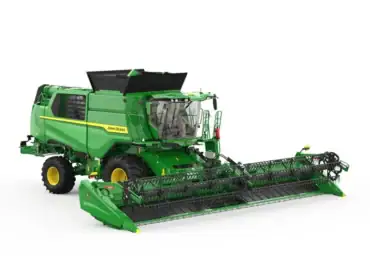
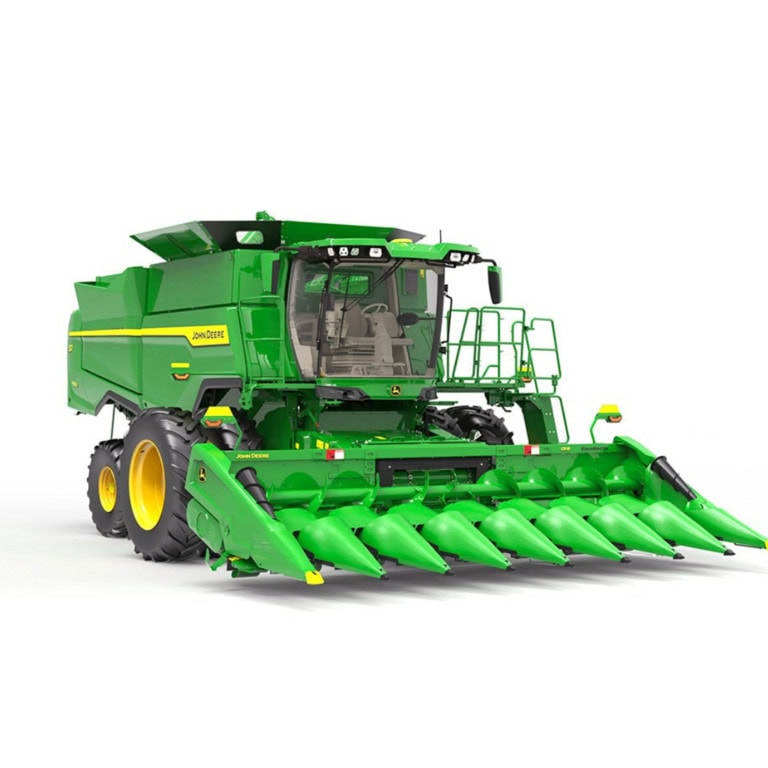
John Deere S7 600 Combine
On This Page
ToggleIntroduction
The John Deere S7 600 is the smallest model in Deere’s current S7 combine family, but it is not a small combine.
It uses a 9.0 L John Deere JD9 engine with 333 rated horsepower and up to 382 maximum horsepower, a 300-bushel grain tank, and a single rotary separator.
The S7 600 is aimed at farms that want the technology and harvesting system of the current S7 generation without moving immediately into the much higher power and grain-handling capacity of the S7 800 or S7 900.
That position makes it particularly interesting for Canadian grain farms.
A Prairie operation may need enough capacity to handle wheat, canola, barley and pulses during a short harvest window, but that does not automatically mean it needs a 500 or 600 hp combine.
The S7 600 provides a more moderate starting point in the current Deere rotary lineup while retaining features such as the G5Plus CommandCenter, integrated StarFire receiver, JDLink connectivity and available harvest automation.
John Deere S7 600 Key Specifications
| Specification | John Deere S7 600 |
|---|---|
| Combine type | Rotary combine |
| Engine | John Deere JD9 |
| Engine displacement | 9.0 L (549 cu. in.) |
| Rated engine power | 333 hp (249 kW) |
| Maximum engine power | 382 hp (285 kW) |
| Rated engine speed | 2,200 rpm |
| Power boost at rated speed | 34 hp (25 kW) |
| Fuel capacity | 250 gal. (950 L) |
| Rotor diameter | 30 in. (76.2 cm) |
| Rotor length | 123 in. (312 cm) |
| Rotor speed, low | 210–530 rpm |
| Rotor speed, high | 400–1,000 rpm |
| Concave area | 11.8 sq. ft. (1.1 m²) |
| Total cleaning area | 54.9 sq. ft. (5.1 m²) |
| Grain tank | 300 bu (10,600 L) |
| Peak unloading rate | 3.6 bu/s (127 L/s) |
| Unloading auger lengths | 22.5, 26 or 28.5 ft |
| Base weight without header | 43,006 lb (19,504 kg) |
| Emissions | Final Tier 4 |
| Manufacturing location | East Moline, Illinois, USA |
Those numbers place the S7 600 clearly at the lower end of the S7 family, but the machine still has substantial grain-processing and storage capacity.
The more useful question is whether its 382 maximum horsepower and 300-bushel tank match the acres and harvest logistics of the farm.
JD9 9.0 L Engine
The S7 600 uses John Deere’s JD9 9.0 L engine.
Rated output is 333 hp, while maximum power reaches 382 hp.
This distinction matters because maximum horsepower should not be treated as the power the combine produces continuously in every harvesting situation.
Rated power gives a better indication of the engine’s normal operating output, while additional power is available as loads change.
The S7 600 also has a 34 hp power boost at rated engine speed.
Compared with the larger S7 models, the S7 600 is intentionally more moderate.
The S7 700 still uses the 9.0 L JD9 but increases output considerably. S7 800 and S7 900 move to Deere’s larger 13.6 L JD14 engine.
For a farm that does not need that extra capacity, the smaller engine is not necessarily a disadvantage.
More horsepower only helps when crop flow, header size and the rest of the harvest system can put it to work.
Single-Rotor Threshing and Separation
The S7 600 is a rotary combine.
John Deere uses one longitudinal rotor rather than the two-rotor arrangement found in New Holland CR combines.
The S7 600 rotor measures 30 inches in diameter and 123 inches long.
It can operate from 210 to 530 rpm in its low range and from 400 to 1,000 rpm in high range.
That range gives the operator room to adjust the machine around different crops and conditions.
The basic job is straightforward.
Crop enters through the feeder house, moves into the rotor, and is threshed and separated as material travels around and along the rotor.
What happens inside the machine is heavily influenced by the crop.
Dry wheat in the afternoon behaves differently from tougher wheat later in the evening. Canola puts different demands on feeding and separation. Pulses can make grain damage a bigger concern.
That is why the rotor specification matters less by itself than the amount of adjustment the machine provides and how well it can maintain crop flow when conditions change.
TriStream and Variable-Stream Rotor Options
Deere describes two rotor approaches within the S7 platform depending on crops and configuration.
The TriStream rotor is focused on moving large volumes of material through the machine efficiently, particularly in coarse grains such as corn and soybeans.
For tougher small grains, Deere highlights its variable-stream rotor configuration.
That is the more interesting discussion for Western Canada.
Wheat, barley, oats and canola can become considerably harder to process when straw is green or moisture increases.
The variable-stream setup uses adjustable transport vanes to change how quickly material moves through the rotor.
Slowing material movement can provide additional threshing or separation time.
Moving it through more quickly can reduce unnecessary crop handling when conditions do not require as much rotor work.
The result is more useful than simply having one fixed rotor behaviour for every crop.
Dyna-Flo Plus Cleaning System
After grain leaves the rotor area, it still has to be cleaned.
The S7 600 uses Deere’s Dyna-Flo Plus cleaning shoe with 54.9 square feet of total louvered cleaning area.
This part of a combine is easy to underestimate.
Engine horsepower may look like the obvious measure of capacity, but the engine is not always the first component that reaches its limit.
If the cleaning shoe becomes overloaded, grain loss can rise even while the engine still has available power.
Deere uses a two-stage pre-cleaning approach. Four conveyor augers distribute material across the shoe, and a front chaffer begins cleaning part of the free grain before material reaches the main chaffer and sieve.
For wheat and canola farms, this is important because the practical capacity of the combine is determined by losses and grain quality, not just how hard the engine is working.
If the machine is throwing grain out the back, another mile per hour of ground speed is not useful capacity.
S7 600 in Wheat and Canola
The S7 600 deserves particular attention in Western Canada because Deere specifically positions the S7 system for tough small-grain conditions, including wheat, canola, barley and oats.
That matters more than generic combine marketing.
Prairie harvesting frequently moves between very different conditions during the same day.
A wheat field that feeds easily in mid-afternoon may become noticeably tougher after sunset. Canola straw can change even faster.
In those conditions, smooth feeding becomes important.
The S7 feeder house uses a pivoting mid-frame design and allows additional movement at the front feed drum to help deal with high-volume and difficult crop flow.
The S7 600 does not get every high-capacity feature offered farther up the S7 family.
For example, Deere limits Active Concave Isolation to the S7 800 and S7 900.
That is an important distinction.
The S7 600 uses the same general S7 harvesting philosophy, but it should not be described as having every technology available on the larger machines.
Grain Tank and Unloading
The S7 600 has a 300-bushel grain tank.
Peak unloading rate is 3.6 bushels per second.
At the theoretical peak rate, 300 bushels represents roughly 83 seconds of unloading if starting with a full tank and assuming ideal conditions throughout the unloading cycle.
Real unloading time will vary.
The auger does not operate at peak flow every second from start to finish, grain characteristics differ, and the tank may not always be completely full.
Still, the calculation gives useful context.
The 300-bushel tank and 3.6 bu/s unloading system are smaller than what Deere provides farther up the S7 lineup.
That is appropriate for the S7 600’s position.
A combine of this size may be used on an operation where extremely large grain carts and continuous high-rate unloading are not necessary.
But logistics still matter.
A 382 hp combine sitting with a full grain tank because the cart is somewhere else is no more productive than a larger machine doing the same thing.
Unloading Auger Options
John Deere lists three unloading auger lengths for the S7 600:
- 22.5 ft
- 26 ft
- 28.5 ft
The correct length depends heavily on the header and grain-cart setup.
With wider headers, additional auger reach makes it easier to maintain safe clearance while unloading on the go.
This is one of those specifications that does not affect threshing performance but can have a noticeable effect on how comfortable the machine is to operate all day.
Deere also supports an adjustable auger spout on current S7 combines, allowing the operator to make smaller changes to where grain enters the cart.
That becomes especially useful when filling a moving grain cart rather than stopping to unload.
Fuel Capacity
Fuel capacity is 250 gallons, or 950 litres.
Actual fuel use per hour will depend on crop, engine load, chopping, terrain and how aggressively the combine is being operated.
That makes fuel-tank size more useful than trying to quote one universal fuel-consumption number.
During harvest, the real question is whether the machine can comfortably work through the intended shift without fuel becoming another interruption.
The S7 600’s 250-gallon tank gives it substantial working capacity while remaining smaller than the powertrain requirements of the upper S7 models.
Predictive Ground Speed Automation
One of the biggest differences between a modern S7 and older combines is how much of the operator’s workload can be automated.
Predictive Ground Speed Automation is available on the S7 600.
Instead of reacting only after crop enters the combine, Deere can use forward-looking information to anticipate crop volume and adjust ground speed.
That approach makes sense.
When a combine enters a heavier section of crop, waiting for engine load or grain loss to rise means the machine is already reacting late.
If the system sees the heavier crop before it reaches the feeder house, ground speed can be adjusted earlier.
The benefit is not simply driving faster.
The useful part is keeping the combine loaded more consistently.
A machine that alternates between being underloaded and overloaded is harder to operate efficiently than one that maintains steadier crop flow.
Harvest Settings Automation
Harvest Settings Automation is also available on the S7.
The idea is to reduce the amount of continuous manual adjustment required as conditions change.
That can be particularly useful when experienced combine operators are difficult to find.
An experienced operator still needs to understand grain loss, sample quality and what the machine is doing.
Automation does not remove that responsibility.
What it can do is reduce the number of small adjustments the operator has to make over a long harvest day.
That leaves more attention for the header, grain cart, field conditions and the overall harvest operation.
G5Plus CommandCenter and StarFire
The current S7 600 comes with an integrated G5Plus CommandCenter display, StarFire receiver and JDLink modem.
This gives Deere a strong technology ecosystem around the combine.
Guidance, machine information and harvest data can all be handled through the integrated system rather than requiring several unrelated displays in the cab.
For farms already using Deere guidance or Operations Center, that integration can matter.
The value is less about having another screen and more about keeping machine and field information connected across the operation.
X9-Style Cab
One interesting part of the current S7 generation is that Deere uses the same basic cab as the larger X9.
That does not give the S7 600 X9 harvesting capacity.
It does mean the smallest S7 does not automatically get a stripped-down operator environment simply because it sits at the bottom of the series.
Visibility and comfort become important during harvest because the operator may spend ten or twelve hours in the combine when conditions are good.
Small improvements matter much more after a full day than they do during a five-minute walkaround.
ProDrive
ProDrive is available on the S7 platform.
It gives the operator two infinitely variable speed ranges rather than requiring conventional manual range changes.
One range can be set around field work and another around transport.
This makes transitions between harvesting and road travel easier and allows the machine to lower engine rpm during transport while maintaining useful travel speed.
The system also works with an electrohydraulic differential lock for additional traction when conditions become difficult.
On Prairie operations where fields can be spread across several locations, transport behaviour is worth considering alongside field performance.
Tracks and Wet Conditions
John Deere offers suspended track systems on the S7 family with 30- or 36-inch belts.
Deere lists road speeds approaching 25 mph with the track system.
The practical reason to consider tracks is flotation.
A combine is heavy before grain enters the tank and considerably heavier when the tank is full.
The S7 600 itself has a base weight of 43,006 lb without a header.
Tracks spread that weight over a larger contact area.
During a wet Saskatchewan or Manitoba harvest, that can help the machine stay working and reduce deep rutting.
Tracks still come with additional cost and complexity.
A farm that normally harvests on firm ground may have little reason to choose them.
A farm that repeatedly fights soft conditions may see them very differently.
Base Weight
John Deere lists the S7 600 at 43,006 lb without a header.
This is worth emphasizing because combine weight is often discussed without specifying what is included.
That figure is the base machine.
A header adds more weight.
Grain in the 300-bushel tank adds considerably more.
Fuel adds more again.
So 43,006 lb should not be interpreted as the fully loaded field weight of the machine.
That distinction matters when thinking about soil compaction, transport and whether tracks make sense.
John Deere S7 600 vs S7 700
The next model in the family is the S7 700.
Both use Deere’s JD9 9.0 L engine, but the S7 700 is tuned for considerably more power.
| Specification | S7 600 | S7 700 |
| Engine | JD9 9.0 L | JD9 9.0 L |
| Rated power | 333 hp | 402 hp |
| Maximum power | 382 hp | 460 hp |
| Grain tank | 300 bu | 300 bu |
| Peak unloading | 3.6 bu/s | 4.2 bu/s |
| Rotor diameter | 30 in. | 30 in. |
The interesting part is that the jump is not just 78 maximum horsepower.
Both machines keep the same 300-bushel grain tank, but the S7 700 gets the faster 4.2 bu/s unloading system.
That makes the S7 700 more attractive when the operation can use additional crop-processing and unloading capacity.
The S7 600 remains the better fit when 382 maximum horsepower already matches the farm’s acreage and harvest logistics.
A dedicated S7 Series comparison on Aglist will cover all four models once the full series has been added.
S7 600 vs New Holland CR7.80
A useful cross-brand comparison is the New Holland CR7.80.
The two machines occupy a broadly similar lower position within their respective rotary families, but they approach threshing differently.
The S7 600 uses one 30-inch longitudinal rotor.
The CR7.80 uses New Holland’s Twin Rotor system with two rotors.
The New Holland also has more listed maximum engine power at 415 hp versus 382 hp for the Deere.
That does not automatically make the CR7.80 the higher-capacity machine in every crop.
Rotor design, cleaning capacity, header setup, automation and crop conditions all affect real performance.
This is a good example of why horsepower should not decide a cross-brand combine comparison by itself.
S7 600 vs a Conventional Combine
Not every farm looking at an S7 600 necessarily needs a rotary combine.
If straw is a major part of the operation, a conventional machine such as the New Holland CX8.80 deserves comparison.
The S7 600 uses rotary threshing and separation.
The CX8.80 uses conventional threshing with straw walkers.
For a grain operation focused on crop flow and rotary harvesting, the Deere is the more natural architecture.
For a mixed farm that bales a large amount of cereal straw, the way the conventional machine handles straw may be more important than the rotary design.
Neither approach wins automatically.
It depends on what the farm needs after the grain has been separated.
Where the S7 600 Fits Best
The S7 600 makes the most sense for:
- medium-to-large grain farms
- wheat, canola, barley and pulse operations
- farms wanting a current-generation John Deere rotary combine without moving into the upper S7 models
- operations that can make good use of a 300-bushel grain tank
- farms interested in predictive ground-speed and harvest automation
- operations already using John Deere precision-ag technology
- farms where 382 maximum horsepower provides enough capacity for the normal harvest window
The biggest advantage of the S7 600 may simply be that it does not force an operation into more combine than it needs.
What the S7 600 Does Not Have
It is also worth being clear about what changes farther up the lineup.
The S7 600 does not get Active Concave Isolation.
John Deere reserves that system for the S7 800 and S7 900.
It also has the smallest grain tank and slowest unloading rate in the S7 family.
The S7 600 and S7 700 use 300-bushel tanks, while the S7 800 and S7 900 move to 400 bushels.
S7 600 unloads at 3.6 bu/s, while the other S7 models are listed at 4.2 bu/s.
Those differences are not weaknesses if the farm does not need the extra capacity.
They are simply where Deere has separated the S7 600 from the larger machines.
What to Check on a Used S7 600
The S7 600 is a newer-generation machine, so condition and configuration may matter more than total age for quite some time.
Important areas include:
- engine hours
- separator hours
- rotor and concave condition
- feeder-house wear
- Dyna-Flo cleaning components
- elevator chains and sprockets
- unloading system
- residue-management components
- track condition if equipped
- ProDrive operation
- G5Plus display and integrated electronics
- StarFire and JDLink functions
- automation packages actually installed
- maintenance and service records
Do not assume every S7 600 has every automation feature Deere advertises for the platform.
Technology packages and configuration matter.
Confirm what is actually installed on the individual machine.
John Deere S7 600 Reviews & Ratings
Specifications describe the hardware.
Owner experience tells you how the combine behaves when wheat gets tough at night, whether the 300-bushel tank fits the farm’s grain-cart cycle, how well automation handles variable crop and what maintenance looks like after several seasons.
Those are exactly the details that become useful once several machines look similar on paper.
If you operate an S7 600, an owner review on Aglist can help other farms understand how the machine performs outside manufacturer testing.
Is the S7 600 Enough Combine?
For many operations, yes.
That answer depends much more on the farm than on the fact that the S7 600 sits at the bottom of its series.
Three hundred thirty-three rated horsepower, a 300-bushel tank and a full-size rotary threshing system already represent substantial harvesting capacity.
The farm should move farther up the S7 range when the S7 600 would genuinely become the limiting part of harvest.
If trucking, grain carts, storage or field layout are already the constraint, a larger combine may simply reach the same bottleneck sooner.
That is why the lowest model in a combine series can sometimes be the smartest fit.
Final Thoughts
The John Deere S7 600 is best understood as the entry point to Deere’s current S7 technology, not as a small or basic combine.
It has a 9.0 L JD9 engine, 382 maximum horsepower, a 300-bushel grain tank, 3.6 bu/s unloading and a full rotary threshing system.
It also brings the newer Deere technology package into this part of the lineup, including integrated G5Plus, StarFire and JDLink hardware with available predictive ground-speed and harvest-setting automation.
For Western Canadian farms, the strongest argument for the S7 600 is balance.
It provides serious rotary harvesting capacity without automatically moving into the power, 400-bushel tanks and additional hardware of the upper S7 models.
The right question is not whether an S7 700, S7 800 or S7 900 is bigger.
They are.
The useful question is whether the farm can actually turn that additional capacity into more crop harvested during the available window.
Browse other machines in the Aglist combines category or see more equipment on the John Deere brand page.
Frequently Asked Questions
How much horsepower does the John Deere S7 600 have?
John Deere Canada lists the S7 600 at 333 rated horsepower and 382 maximum horsepower.
What engine is in the John Deere S7 600?
The S7 600 uses a John Deere JD9 9.0 L diesel engine. Deere lists a rated engine speed of 2,200 rpm and a 250-gallon fuel tank.
Is the John Deere S7 600 a rotary combine?
Yes. The S7 600 uses a single longitudinal rotary separator with a 30-inch diameter and 123-inch length.
How big is the S7 600 grain tank?
The grain tank holds 300 bushels.
How fast does the S7 600 unload?
John Deere lists a peak unloading rate of 3.6 bushels per second.
How much does a John Deere S7 600 weigh?
John Deere lists a base machine weight of 43,006 lb without the header. Actual operating weight will be higher after adding a header, fuel, grain and equipment.
What is the difference between the S7 600 and S7 700?
The S7 700 uses the same 9.0 L JD9 engine family but has substantially more power at 402 rated and 460 maximum horsepower. Both have 300-bushel grain tanks, but the S7 700 unloads at up to 4.2 bu/s compared with 3.6 bu/s for the S7 600.
Does the S7 600 have Predictive Ground Speed Automation?
It is available on the S7 600 as part of Deere’s current S7 technology offering. Exact automation capability depends on the machine’s installed technology package.
Does the S7 600 have Active Concave Isolation?
No. John Deere currently lists Active Concave Isolation only for the S7 800 and S7 900.
Is the S7 600 suitable for wheat and canola?
Yes. Deere specifically discusses the S7 platform for tough small-grain crops including wheat, canola, barley and oats. Actual performance depends on crop conditions, rotor configuration and machine settings.
Related
- New Holland CR7.80 – Twin Rotor alternative with up to 415 hp.
- New Holland CX8.80 – conventional straw-walker alternative.
- New Holland CR Series Compared – compare New Holland’s established rotary CR lineup.
- Combines – compare combine types, brands and models.
- John Deere – browse John Deere equipment covered on Aglist.
Note: Specifications, technology packages and available equipment can vary by model year and configuration. Confirm critical specifications for a particular machine with John Deere documentation, the operator’s manual or your dealer.
Share your experience
Help other Canadian buyers — leave a quick review for the
John Deere S7 600
There are no reviews yet. Be the first one to write one.