Overview & Specs
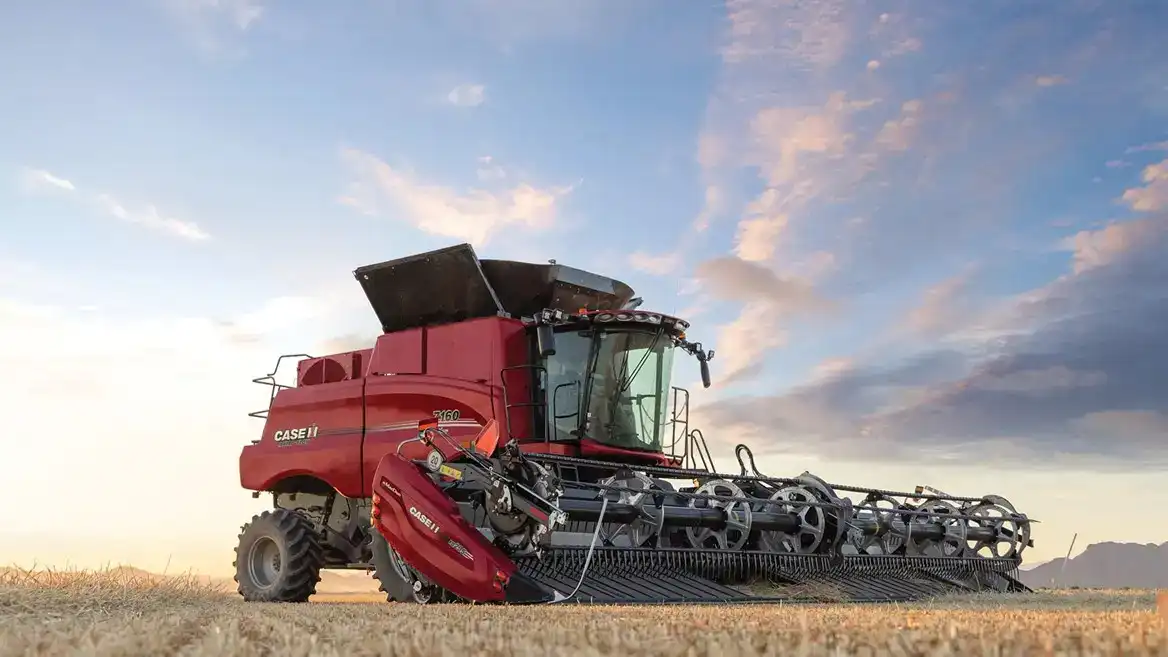
Case IH Axial-Flow 6160 Combine
On This Page
ToggleIntroduction
The Case IH Axial-Flow 6160 is the smaller of the two current Axial-Flow 160 Series combines offered in North America.
It uses the single-rotor harvesting concept that has defined Case IH combines for decades, but the current 6160 combines that relatively simple mechanical layout with a much newer technology package.
Case IH rates the machine at 348 horsepower at rated engine speed and 411 peak horsepower. Grain tank capacity is 300 bushels.
Those numbers put the 6160 into an interesting position for Canadian grain farms.
It offers serious rotary harvesting capacity without moving directly into the larger Axial-Flow 7160 or the much higher-capacity 260 and AF Series machines.
For wheat, canola, barley and other Prairie crops, the appeal is straightforward: a proven single-rotor system, relatively simple driveline, modern automation and enough capacity for farms that do not need the biggest combine available.
Case IH Axial-Flow 6160 Key Specifications
| Specification | Case IH Axial-Flow 6160 |
|---|---|
| Combine type | Rotary combine |
| Threshing system | Single AFX rotor |
| Engine | FPT diesel |
| Engine displacement | 8.7 L |
| Rated power | 348 hp |
| Power rise | 63 hp |
| Peak power | 411 hp |
| Unloading Power on Demand boost | 34 hp |
| Grain tank capacity | 300 bu |
| Cleaning system | Cross Flow |
| Preparation system | Six-auger bed |
| Automation | Harvest Command available |
| Displays | Dual Pro 1200 |
| Guidance | AccuGuide |
| Machine data sharing | AccuSync |
| Connectivity | Subscription-free on qualifying current machines |
The 6160 is not simply an older mechanical combine with a new cab.
Case IH has kept the single-rotor layout but added much of the precision and automation technology now expected from a modern harvesting machine.
The Classic Case IH Single-Rotor Layout
The 6160 uses Case IH’s AFX single rotor.
That is one of the biggest differences between Case IH and many of its competitors.
New Holland uses two longitudinal rotors in its CR Series.
John Deere uses one rotor in the S7 family but moves to two rotors in the larger X9 platform.
Case IH has built much of the Axial-Flow identity around a single longitudinal rotor.
Crop enters the rotor area and moves around and along the rotor while threshing and separation take place.
The design has relatively few major crop-processing components compared with more complicated multi-drum or hybrid systems.
For farmers, the attraction is not simply that the combine has one rotor.
It is the combination of crop adaptability, grain quality potential and mechanical simplicity.
Why the AFX Rotor Still Matters
A combine rotor has to do several things at once.
It must remove grain from the crop.
It must separate that grain from the remaining material.
It must move straw and residue through the machine without creating unnecessary blockages.
And it needs to do that across different crops and moisture conditions.
Case IH allows the AFX rotor to be configured for different crop and threshing conditions.
That becomes particularly useful on Canadian farms moving between wheat, canola, barley, pulses and other crops.
A combine that performs well in one crop but requires major mechanical changes every time the crop changes can create unnecessary downtime.
The Axial-Flow concept is built around avoiding that problem.
348 Rated Horsepower and 411 Peak Horsepower
Case IH lists the 6160 at:
- 348 rated hp
- 63 hp power rise
- 411 peak hp
There is also a 34 hp unloading Power on Demand boost.
These figures need to be understood correctly.
Rated horsepower is the engine output around normal rated operation.
Peak horsepower represents the additional output available as load increases.
That does not mean the engine operates at 411 hp continuously throughout harvest.
The extra reserve becomes useful when crop conditions get heavier or when several systems require power at the same time.
That can include:
- heavy crop entering the rotor
- tough straw
- residue chopping
- unloading on the go
- rolling terrain
For Prairie farms, those conditions can change several times during the same day.
8.7 L FPT Engine
The current 160 Series uses an 8.7 L FPT engine.
Case IH designed the powertrain to operate at relatively low engine speed, which helps reduce unnecessary engine load and wear while maintaining harvesting power.
The 6160 therefore provides more than 400 peak horsepower without moving to the much larger engines found in Case IH’s high-capacity combines.
For farms where the 6160-sized crop-processing system is enough, that can be a sensible balance.
The goal should not be to own the largest possible engine.
It should be to have enough engine reserve to keep the combine working efficiently in the farm’s most demanding normal crop.
300-Bushel Grain Tank
The 6160 has a 300-bushel grain tank.
That puts it in a similar grain-storage range to several mid-size modern combines.
A 300-bushel tank can work very well when:
- one grain cart services the combine reliably
- field runs are not excessively long
- trucking is close to the field
- harvest yields match the machine’s capacity
It can become restrictive when the combine regularly fills before the cart returns.
This is why grain tank capacity should always be considered together with grain logistics.
A larger combine tank does not harvest more crop by itself.
It simply gives the combine more time before it must unload.
Power on Demand During Unloading
Case IH lists a 34 hp unloading Power on Demand boost for the 6160.
This is useful because unloading grain while continuing to harvest creates another engine load.
The rotor is still processing crop.
The cleaning system is still working.
The residue system may still be chopping and spreading material.
Then the unloading system begins moving hundreds of bushels of grain.
Additional power during that period helps the combine maintain crop flow rather than forcing the operator to reduce harvesting speed simply because the auger is running.
For farms routinely unloading on the move, that reserve can matter more than the specification initially suggests.
Cross Flow Cleaning System
The 6160 uses Case IH’s Cross Flow cleaning system.
Cleaning is one of the most important parts of combine capacity and one of the easiest to overlook.
A combine can still have available engine horsepower while already losing too much grain from the cleaning shoe.
Case IH uses an automatically controlled cleaning system designed to keep material distributed more evenly across the sieve as terrain changes.
The system creates an elliptical movement rather than relying only on simple front-to-back motion.
Case IH says this can increase cleaning-system productivity by up to 20 percent under the conditions used for its comparison.
That is a manufacturer claim rather than a guaranteed 20 percent increase on every farm.
The important part is the purpose of the system: maintaining usable cleaning area instead of allowing grain and material to pile toward one side.
Six-Auger Preparation Bed
Before crop reaches the main cleaning shoe, six augers help distribute material.
Case IH says this system can handle crop flow of up to 5,000 bushels per hour in its referenced conditions.
Again, that is not a universal 6160 harvest rate.
Actual throughput depends on:
- crop
- yield
- moisture
- grain-loss target
- header
- field conditions
- combine settings
The six-auger figure is more useful for understanding the design.
The preparation system is intended to distribute material evenly before it reaches the cleaning shoe.
Uniform loading helps the full cleaning area work effectively.
Harvest Command Automation
One of the biggest updates to the current Axial-Flow 160 Series is Harvest Command.
Case IH officially supports Harvest Command on the 160 Series for crops including:
- corn
- soybeans
- canola
- barley
- wheat
- rice
That crop list makes the system particularly relevant to Canadian farms.
The operator chooses the harvest priority and operating limits, then Harvest Command manages adjustments as conditions change.
Instead of constantly chasing the machine through a field with changing crop density or moisture, automation can help keep the combine closer to the selected target.
What Harvest Command Is Trying to Do
Every combine operator balances several competing goals.
Harvest faster.
Keep grain loss down.
Maintain a clean sample.
Avoid unnecessary grain damage.
Those goals do not always point toward the same machine settings.
Harvest Command allows the operator to choose priorities around grain quality, grain savings and throughput.
The system then manages combine operation around those goals.
Automation does not eliminate the need for an operator who understands harvesting.
Someone still needs to recognize when the selected target does not make sense for the crop.
But once the target is correct, automation can reduce repetitive adjustments.
Why Automation Matters on a Smaller Combine
Automation is sometimes associated only with the biggest Class 9 or Class 10 machines.
That misses an important benefit.
A farm running a 6160 may have fewer combine operators available.
The owner may operate the combine one day and another employee the next.
Harvest Command can help reduce the difference between operators by keeping the machine closer to the same target.
It can also help an experienced operator concentrate on:
- header performance
- grain-cart traffic
- field conditions
- obstacles
- weather
rather than constantly changing internal combine settings.
Dual Pro 1200 Displays
The updated 160 Series uses dual Pro 1200 displays.
That is a substantial technology update from older Axial-Flow machines.
The displays allow the operator to monitor different combine functions simultaneously and configure the information around the job.
Case IH also uses the screens for:
- Harvest Command
- guidance
- machine settings
- harvest data
- grain-quality imaging
- connectivity functions
For long harvest days, having important information visible without constantly switching between screens can reduce workload.
Grain Quality Imaging
The current Pro 1200 system can provide a high-definition view of harvested grain.
That gives the operator another way to monitor sample quality from the cab.
It does not replace physically checking the grain tank.
But it can make changes easier to notice.
On crops where cracked grain or excessive foreign material affects value, that additional information can be useful.
AccuGuide
The 160 Series can use Case IH AccuGuide integrated guidance.
Case IH states that the system can provide sub-inch-level accuracy with an appropriate correction signal.
The exact accuracy depends on:
- correction source
- receiver
- field conditions
- system configuration
For combine harvesting, accurate guidance is particularly useful with wide headers.
Small steering errors become more significant as cutting width increases.
Integrated guidance also reduces operator fatigue over long passes.
AccuSync
AccuSync allows multiple machines to share coverage and guidance information.
That becomes useful when two or more combines work in the same field.
Operators can see where other machines have already worked rather than treating each combine as an isolated unit.
On larger operations, that can improve coordination and reduce unnecessary overlap.
The technology is less important for a farm running one combine alone, but it shows that Case IH is bringing higher-level fleet features into the 160 Series rather than reserving them only for larger models.
Subscription-Free Connectivity
Case IH currently includes subscription-free connectivity on qualifying MY26 and newer Axial-Flow 160 Series combines.
That means the modem’s basic connectivity does not depend on an annual access fee for the life of the qualifying hardware.
For farms using connected equipment, this can make ownership simpler.
Machine information can be used through Case IH’s FieldOps environment for functions such as:
- location
- machine status
- field progress
- equipment monitoring
- data management
Connectivity should not decide a combine purchase by itself.
But once machines become more connected, recurring subscription requirements can affect the long-term experience.
Feeding System
Case IH uses a high-capacity feederhouse designed to deliver crop smoothly toward the rotor.
This sounds basic, but feeding quality affects everything behind it.
If crop arrives in large slugs:
- rotor load changes suddenly
- engine demand increases
- threshing becomes less consistent
- cleaning load changes
- grain loss can rise
Smooth feeding allows the rotor to operate with a more predictable material flow.
That is especially important in canola and lodged cereals where the header can sometimes send uneven crop into the feederhouse.
Wheat Performance
The 6160 is a natural candidate for Canadian wheat farms.
Its single-rotor architecture gives operators considerable flexibility in threshing and separation.
In dry afternoon wheat, the machine may operate comfortably at relatively low load.
As evening moisture arrives, straw becomes tougher.
The rotor requires more power to keep material moving.
That is where the engine’s power rise and automation become increasingly useful.
The goal is not to maintain one ground speed all day.
It is to keep throughput high while grain loss and sample quality remain acceptable.
Canola Performance
Canola creates a different challenge.
The seed is small.
Losses can become expensive quickly.
Crop flow can also change substantially as straw conditions become tougher.
Case IH officially includes canola among the crops supported by Harvest Command on the 160 Series.
That makes the technology particularly relevant to Saskatchewan and Alberta operations.
Automation can help manage changes in crop load, but operators should still check actual losses behind the combine.
A monitor is useful.
A physical loss check is still valuable.
Barley Performance
Barley is also officially supported by Harvest Command.
Grain quality can be important, and so can straw quality on mixed farms.
The Axial-Flow rotor can be configured for different crop conditions, allowing the operator to balance threshing aggressiveness against grain damage and residue condition.
The right setup depends heavily on moisture.
Dry barley and tough barley can require very different settings.
What About Peas and Lentils?
Case IH’s current Canadian 160 Series Harvest Command list specifically names corn, soybeans, canola, barley, wheat and rice.
Peas and lentils are not included in that official supported-crop list.
That does not mean the 6160 cannot harvest pulses.
It means we should not claim Harvest Command automation is officially supported for those crops without confirmation from Case IH.
For a Saskatchewan pulse farm, that distinction is worth checking before choosing the machine primarily for automation.
Grain Quality
Case IH has long promoted Axial-Flow around gentle threshing and grain quality.
The single-rotor concept uses centrifugal force for much of the separation process rather than repeatedly moving grain through multiple aggressive threshing components.
Actual grain quality still depends on:
- crop
- moisture
- rotor speed
- concave clearance
- machine load
No combine architecture guarantees perfect grain.
The advantage of the Axial-Flow design is that it gives the operator a relatively direct crop path and a wide range of rotor adjustment.
Residue Management
The 160 Series can manage residue in several ways depending on how the farm intends to use it.
Case IH offers chopping, spreading and windrowing options.
Rotor discharge deflectors direct material toward the residue system.
The chopper uses blades arranged in a chevron pattern.
Hydraulic spreaders can be adjusted from the cab.
That gives the operator flexibility between:
- chopping and spreading
- leaving straw for baling
For a Prairie mixed farm, this flexibility matters.
Wheat straw may be worth saving one day while canola residue is chopped and spread the next.
Straw From a Rotary Combine
The 6160 is still a rotary combine.
If preserving long cereal straw is one of the highest priorities on the farm, a conventional straw-walker machine deserves comparison.
Examples already covered on Aglist include the New Holland CX8 Series and John Deere T6 800.
Rotor settings and crop conditions can still allow usable straw from an Axial-Flow.
But the crop experiences a different path through a rotor than through a conventional straw-walker combine.
The choice depends on how much economic value the farm assigns to straw.
Case IH 6160 vs John Deere S7 600
The John Deere S7 600 is one of the most logical competitors.
Both are current single-rotor combines aimed below the highest-capacity machines in their respective lineups.
The Deere reaches 382 maximum horsepower.
Case IH lists the 6160 at 411 peak horsepower.
Those figures should still be treated carefully because manufacturers can describe engine ratings differently.
The bigger comparison is architecture and ownership.
Both use a single longitudinal rotor, but crop flow, cleaning systems, automation and precision ecosystems differ.
The Case IH uses Harvest Command and Cross Flow cleaning.
The Deere uses its S7 automation environment and Dyna-Flo Plus cleaning.
Dealer support can easily become the deciding factor.
Case IH 6160 vs New Holland CR7.80
Another strong comparison is the New Holland CR7.80.
The New Holland reaches 415 maximum horsepower, very close to the 6160’s listed 411 peak hp.
But the rotor architecture is completely different.
Case IH uses one AFX rotor.
New Holland uses two rotors in its Twin Rotor design.
That makes this an excellent example of why horsepower alone cannot decide a combine comparison.
The farm should consider:
- crop flow
- grain quality
- cleaning
- residue
- automation
- header compatibility
- dealer support
The engine numbers are only the starting point.
Case IH 6160 vs John Deere T6 800
The John Deere T6 800 represents a completely different harvesting philosophy.
The Case IH is rotary.
The Deere T6 uses multi-drum threshing followed by six straw walkers.
For a grain-focused operation where throughput and rotary separation are priorities, the 6160 is the more natural architecture.
For a mixed farm where cereal straw is particularly valuable, the T6 deserves serious consideration.
This decision should often be made before comparing brand names.
First choose the harvesting architecture.
Then choose the machine.
Where the Axial-Flow 6160 Fits Best
The 6160 makes the most sense for:
- medium-to-large grain operations
- farms wanting a current Case IH single-rotor combine
- wheat and barley farms
- canola operations
- farms that do not need the capacity of the larger 7160 or 260 Series
- operations interested in Harvest Command
- farms already using Case IH precision technology
- operators who value a relatively simple rotor and driveline concept
- farms with grain-cart logistics that match a 300-bushel tank
It is less compelling when the farm consistently needs much more grain-tank or crop-processing capacity.
In that situation, the 7160 or 260 Series may be a better place to look.
What to Check on a Used 6160
When inspecting a used Axial-Flow 6160, check:
- engine hours
- separator hours
- engine service history
- AFX rotor condition
- rotor bars
- concaves
- rotor cage
- feederhouse
- feeder chain
- Cross Flow cleaning system
- auger bed
- chaffer and sieve
- grain elevators
- unloading system
- grain-tank augers
- residue chopper
- spreader
- transmission
- guidance hardware
- Pro displays
- Harvest Command equipment
- connectivity hardware
- maintenance records
Separator hours are particularly important.
A combine can process a very large amount of crop without accumulating an extreme number of engine hours.
Wear needs to be judged from the entire machine.
Case IH Axial-Flow 6160 Reviews & Ratings
Specifications tell you where the machine sits in the lineup.
They do not tell you what it is like after several harvest seasons.
Useful owner questions include:
How well does it handle tough evening wheat?
How does Harvest Command perform in variable canola?
Is the 300-bushel tank enough?
How clean is the grain sample?
How quickly can the combine switch between wheat, barley and canola?
What parts show wear first?
How expensive is normal seasonal maintenance?
Those are exactly the details owner reviews can add to a model page.
Is the 6160 Enough Combine?
For many farms, yes.
A combine with 348 rated horsepower, 411 peak horsepower and a 300-bushel grain tank is already a substantial harvesting machine.
The important question is not whether the 7160 is larger.
It is.
The useful question is whether the farm can turn the additional capacity of the larger machine into a shorter harvest.
If the 6160 is consistently limited by engine or crop-processing capacity, moving higher makes sense.
If the combine already spends time waiting for:
- grain carts
- trucks
- storage
- field moves
then buying a larger combine may do little.
The bottleneck needs to be identified first.
Final Thoughts
The Case IH Axial-Flow 6160 is a modern version of a very established harvesting idea.
One rotor.
A relatively direct crop path.
A simple mechanical concept.
But around that traditional Axial-Flow architecture, Case IH has added Harvest Command, dual Pro 1200 displays, integrated guidance, connected equipment tools and updated sensors.
With 348 rated horsepower, 411 peak horsepower and a 300-bushel grain tank, the 6160 occupies a useful position below the larger Case IH combines.
For Western Canadian farms growing wheat, canola and barley, it offers enough capacity to be taken seriously without automatically moving into a much larger machine.
The deciding question is the same one that applies throughout the combine market.
Can the farm actually use more capacity?
If the answer is no, the smaller machine may be the more efficient choice.
Browse more machines in the Aglist combines category.
Frequently Asked Questions
How much horsepower does the Case IH Axial-Flow 6160 have?
Case IH lists the 6160 at 348 rated horsepower and 411 peak horsepower.
What engine is in the Case IH 6160?
The current Axial-Flow 160 Series uses an 8.7 L FPT diesel engine.
Is the Case IH 6160 a rotary combine?
Yes. The 6160 uses Case IH’s single AFX rotor for threshing and separation.
How big is the Case IH 6160 grain tank?
The Axial-Flow 6160 has a 300-bushel grain tank.
Does the Case IH 6160 have Harvest Command?
Yes. Harvest Command automation is available on the current Axial-Flow 160 Series.
Which crops does Harvest Command support on the 160 Series?
Case IH Canada currently lists corn, soybeans, canola, barley, wheat and rice as supported crops.
Does the 6160 have Pro 1200 displays?
The updated 160 Series uses dual Pro 1200 displays.
Is connectivity included with the 6160?
Qualifying MY26 and newer Axial-Flow 160 Series combines are included in Case IH’s subscription-free Connectivity Included program for the life of the qualifying modem hardware.
Case IH 6160 or John Deere S7 600?
Both are current single-rotor combines in a broadly similar capacity range. The Case IH uses the AFX rotor, Cross Flow cleaning and Harvest Command, while Deere uses its S7 single-rotor architecture and Deere automation ecosystem. Crop performance and local dealer support should be compared alongside specifications.
Case IH 6160 or New Holland CR7.80?
The Case IH uses one rotor while the New Holland uses two. Their listed peak or maximum engine outputs are close, but rotor architecture, cleaning systems and dealer support make this a much deeper comparison than horsepower alone.
Related
- John Deere S7 600 – current single-rotor Deere comparison.
- New Holland CR7.80 – Twin Rotor alternative with similar listed maximum power.
- John Deere T6 800 – conventional straw-walker alternative.
- John Deere S7 Series Compared – compare Deere’s current S7 rotary family.
- Combines – compare combine types, brands and models.
Specifications, technology equipment and available configurations can vary by model year and market. Confirm critical specifications for an individual combine with current Case IH documentation, the operator’s manual or your dealer.
Share your experience
Help other Canadian buyers — leave a quick review for the
Case IH Axial-Flow 6160
There are no reviews yet. Be the first one to write one.