Overview & Specs
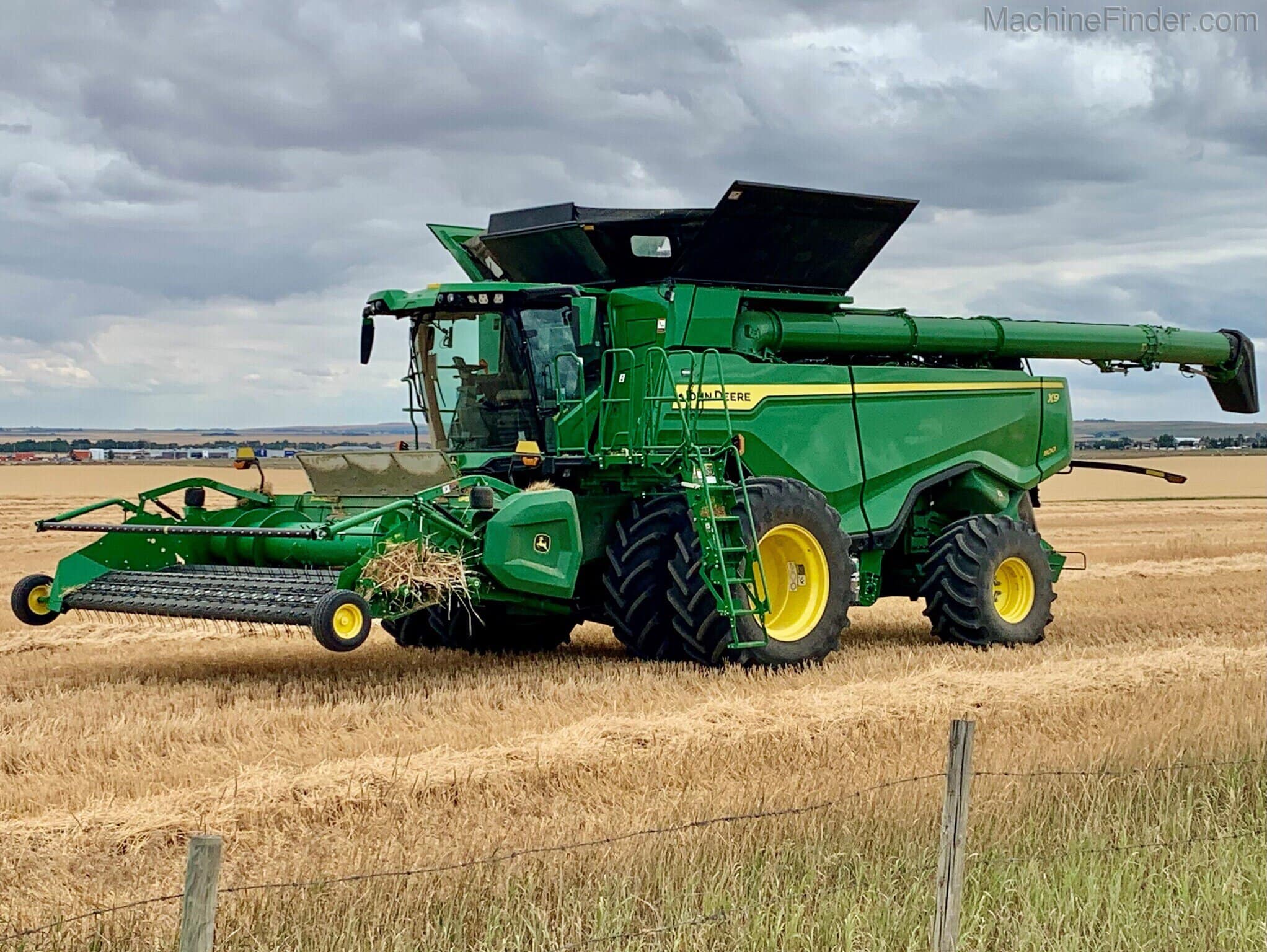
John Deere X9 1100 Combine
On This Page
ToggleIntroduction
The John Deere X9 1100 sits at the top of Deere’s current X Series combine lineup.
It is powered by a 13.6 L John Deere JD14 engine producing 603 rated horsepower and up to 690 maximum horsepower. It uses Deere’s X Series Dual Separator with two 24-inch rotors, has 75.02 square feet of total cleaning area, carries 460 bushels in its standard grain tank, and unloads at up to 5.3 bushels per second.
Those numbers make the X9 1100 one of Deere’s highest-capacity harvesting machines.
But the most useful way to understand it is not by looking at the 690 hp number alone.
The John Deere X9 1000 uses essentially the same dual-rotor harvesting architecture. It has the same rotor dimensions, the same listed threshing and separating areas, the same cleaning area, the same 13.6 L engine displacement, and the same 330-gallon fuel capacity.
The X9 1100 adds more engine output, a larger standard grain tank, and a significantly faster unloading system.
That makes the real question fairly specific:
Does the operation need more output from the X9 platform, or is the X9 1000 already enough combine?
For very large Prairie grain farms and operations where every usable harvest hour matters, the answer can favour the X9 1100.
For others, the additional capacity may simply reach the next harvest bottleneck sooner.
John Deere X9 1100 Key Specifications
| Specification | John Deere X9 1100 |
|---|---|
| Combine type | Dual-rotor rotary combine |
| Engine | John Deere JD14 / PowerTech |
| Engine displacement | 13.6 L (830 cu. in.) |
| Rated engine power | 603 hp (450 kW) |
| Maximum engine power | 690 hp (515 kW) |
| Rated engine speed | 1,900 rpm |
| Power boost at rated speed | 53 hp |
| Fuel capacity | 330 gal. (1,249 L) |
| Separator type | Dual rotor |
| Number of rotors | 2 |
| Rotor diameter | 24 in. (60.1 cm) each |
| Rotor length | 11.5 ft (3.51 m) |
| Rotor speed range | 300-1,300 rpm |
| Concave area | 17.22 sq. ft. (1.6 m²) |
| Separating area | 38.75 sq. ft. (3.6 m²) |
| Discharge grate area | 4.85 sq. ft. (0.45 m²) |
| Total cleaning area | 75.02 sq. ft. (6.97 m²) |
| Cleaning fan speed | 570-1,430 rpm |
| Standard grain tank | 460 bu (16,200 L) |
| Optional grain tank | 550 bu, configuration dependent |
| Peak unloading rate | 5.3 bu/s (186 L/s) |
| Feederhouse width | 67.7 in. (1,720 mm) |
| Standard unloading augers | 26, 28.5 or 31 ft |
| Longer current option | Up to 35 ft |
| Emissions | Final Tier 4 |
| Manufacturing country | United States |
The specifications show that Deere did not create the X9 1100 by simply installing a bigger grain tank on the X9 1000.
It is the higher-output version of the same basic X Series architecture.
JD14 13.6 L Engine
The X9 1100 uses Deere’s 13.6 L JD14 engine.
Rated output is 603 hp and maximum power reaches 690 hp.
Rated engine speed is 1,900 rpm.
Deere also lists a 53 hp power boost at rated speed.
For comparison, the X9 1000 uses the same displacement but produces 549 rated and 630 maximum horsepower.
That gives the X9 1100 another 60 maximum horsepower.
The difference becomes useful when several systems demand power at the same time.
A combine may be:
- processing heavy crop
- chopping a large volume of residue
- climbing a grade
- unloading on the move
- operating through tough straw
All of those loads can overlap.
Additional engine reserve helps the combine maintain throughput when conditions become difficult.
But horsepower still does not determine total harvesting capacity by itself.
The X9 platform works because the entire machine around the engine was designed for high crop flow.
X Series Dual Separator
The heart of the X9 1100 is Deere’s X Series Dual Separator.
Instead of the single rotor used in the S7 family, X9 uses two longitudinal rotors.
Each rotor measures approximately 24 inches in diameter and 11.5 feet long.
Rotor speed ranges from 300 to 1,300 rpm.
The system provides:
- 17.22 sq. ft. of concave area
- 38.75 sq. ft. of separating area
- 4.85 sq. ft. of discharge grate area
Those areas are identical to the X9 1000.
This tells us something important.
The X9 1100 does not get a larger separator than the X9 1000.
Instead, Deere gives the same basic crop-processing architecture more engine output and more grain-handling capability.
That is why the difference between these two machines is quite different from the jump from S7 into X9.
Why Dual Rotors Matter
With very high crop flow, separation becomes one of the main challenges.
Threshing grain from the head is only part of the job.
The grain then has to leave the crop mat before the remaining straw and residue exit the combine.
If crop is pushed through faster than the separation system can handle it, rotor losses rise.
Two rotors give Deere a large amount of separating area without relying on one very large rotor.
Each side of the crop stream has its own path through the separator.
This is one of the main reasons why comparing X9 only by horsepower misses the point.
The machine was designed around moving a large volume of material efficiently through the entire harvesting system.
75-Square-Foot Dyna-Flo XL Cleaning Shoe
Both X9 models use Deere’s Dyna-Flo XL cleaning system.
John Deere lists total louvered cleaning area at 75.02 square feet.
That includes:
- 10.4 sq. ft. front chaffer
- 33.69 sq. ft. chaffer
- 30.89 sq. ft. sieve area
Fan speed ranges from 570 to 1,430 rpm.
A large cleaning system is essential on a combine like the X9 1100.
There is little value in creating more threshing and separating capacity if the shoe cannot clean the additional grain and material arriving from the rotors.
Cleaning loss can become the combine’s practical capacity limit even when engine load still looks acceptable.
This is why good combine operation should never focus only on engine percentage.
The useful limit is the point where throughput, grain quality and losses still remain acceptable.
Why Cleaning Capacity Matters in Wheat and Canola
For Western Canada, the X9 cleaning system becomes especially relevant in wheat and canola.
High-yielding wheat can send a large volume of grain and material into the cleaning shoe.
Canola adds its own challenges because the seed is small and losses can become expensive quickly.
As crop conditions become tougher, more material can reach the cleaning system.
Deere promotes the Dyna-Flo XL system as having 36 percent more cleaning area and substantially more airflow than the earlier machines used in its comparison.
Those are manufacturer comparisons, not guarantees of a specific increase on every Canadian farm.
The useful point is that Deere increased cleaning capacity alongside the dual-rotor separator.
That balance is important in a machine designed for this level of crop flow.
X9 1100 in Tough Wheat
Wheat is one of the crops where Deere has published specific capacity comparisons for the X9 platform.
In Deere’s comparison against the previous S790, the company lists the X9 1100 at 170 percent of the S790’s harvesting capacity in tough wheat under its referenced test conditions.
That means Deere is describing up to a 70 percent capacity increase in that comparison.
The X9 1000 was listed at 134 percent in the same tough-wheat comparison.
Those numbers should not be treated as universal field results.
Actual wheat capacity depends on:
- yield
- moisture
- straw condition
- header
- crop height
- terrain
- grain-loss target
- residue settings
- machine configuration
- operator strategy
Still, the comparison reveals where Deere expects the X9 1100 to differentiate itself.
Tough, high-volume crop is exactly where additional engine reserve and dual-rotor separation can become valuable.
X9 1100 in Canola
Deere’s published comparison also lists the X9 1100 at 140 percent of S790 capacity in canola under the conditions of its test.
The X9 1000 was listed at 135 percent.
That is interesting because the gap between X9 1000 and X9 1100 in Deere’s canola comparison was much smaller than the gap in tough wheat.
That illustrates an important combine-selection principle.
The biggest model does not provide the same percentage advantage in every crop.
Different crops stress different parts of the machine.
In some conditions, engine power can become critical.
In others, cleaning, feeding or separation can reach the practical limit first.
This is why farms should choose a combine around their crop mix rather than simply buying the model with the highest horsepower.
460-Bushel Standard Grain Tank
The X9 1100 comes with a 460-bushel standard grain tank.
The X9 1000 standard tank holds 420 bushels.
That gives the X9 1100 another 40 bushels of onboard capacity.
Forty bushels may not sound dramatic on a machine this size, but tank size matters when crop is entering the combine quickly.
More capacity gives the operator additional time before the next unload.
That can help when:
- the grain cart is servicing another combine
- the cart is travelling to a truck
- the combine is opening a field
- long field runs make unloading points less predictable
- high yield fills the grain tank quickly
The standard 460-bushel tank is therefore part of the X9 1100’s overall higher-output package.
Optional 550-Bushel Grain Tank
Current X9 configurations can also be equipped with an optional 550-bushel grain tank.
Deere notes that the larger tank requires the appropriate machine setup, including 710 duals or tracks.
This is important.
A 550-bushel tank carries a very large amount of grain when full.
That additional weight has consequences for:
- tires
- tracks
- final drives
- soil compaction
- flotation
- field conditions
Deere pairs the larger tank with heavy-duty final-drive requirements because grain capacity cannot be treated independently from the rest of the machine.
For large, dry Prairie fields and operations needing longer runs between unloads, the 550-bushel option can be attractive.
For farms unloading almost continuously on the go, the standard tank may already be enough.
Do You Need 550 Bushels?
Bigger is not automatically better.
The optional tank is most useful when grain-tank capacity is actually limiting harvest.
It can make sense when:
- long fields make cart timing difficult
- one grain cart services several machines
- harvest yield is extremely high
- opening fields requires additional onboard capacity
- carts travel significant distances to trucks
- the farm wants a larger buffer between unloads
It matters less when the cart remains beside the combine most of the time.
A farm should solve a logistics problem with the larger tank, not simply choose it because 550 is a bigger number than 460.
5.3 bu/s Unloading
This is one of the clearest advantages of the X9 1100 over the X9 1000.
The X9 1100 unloads at up to 5.3 bushels per second.
The X9 1000 peaks at 4.6 bu/s.
At the theoretical peak rate, unloading 460 bushels represents roughly 87 seconds.
A 550-bushel load at the same theoretical rate represents roughly 104 seconds.
Actual unloading time varies because the system does not maintain theoretical peak flow through every second of the cycle.
But the relative comparison remains useful.
The X9 1100 has both a larger standard grain tank and a faster way to empty it.
That is exactly what you want on the higher-capacity version of the platform.
Why Unloading Rate Matters More at This Capacity
Stopping any combine to unload costs time.
Stopping a high-capacity combine costs even more potential production because the machine was purchased specifically to process a large amount of crop each hour.
The X9 1100 makes the most sense when unloading happens on the move.
That means grain-cart capacity becomes part of combine performance.
A grain cart needs to:
- arrive before the combine fills
- match combine speed
- accept grain quickly enough
- leave without interrupting harvest
- transfer grain to trucks efficiently
If that chain fails, 690 horsepower and dual rotors spend time waiting.
67.7-Inch Feederhouse
The X9 1100 uses a 67.7-inch-wide feederhouse.
A four-strand chain with formed steel slats moves crop toward Deere’s Feed Accelerator and Stone Trap system.
The feederhouse can use fixed or variable speed drive.
Deere also uses a modulated feederhouse reverser.
This is important because a high-capacity separator needs a high-capacity feeding system in front of it.
If crop arrives in large, inconsistent slugs, the combine becomes more difficult to keep balanced.
Steady feeding helps:
- engine load
- threshing
- separation
- cleaning
- automation
work with a more predictable material flow.
Feed Accelerator and Stone Trap
Before crop reaches the rotors, Deere uses its eight-wing chevron Feed Accelerator and Stone Trap system.
The accelerator helps transition material from the feederhouse into the separator.
The stone trap provides protection against rocks and other foreign material entering the threshing system.
This is particularly relevant in crops harvested close to the ground.
Prairie pulse operations can encounter exactly those conditions.
Machine protection becomes increasingly important as combine capacity and component cost rise.
Faster Crop Changeover
Modern Canadian grain farms often move between several crop types during harvest.
A machine might finish wheat, move into canola, and then switch to pulses.
Current X9 updates include changes intended to make those transitions easier.
Deere has moved rotor and FAST speed-shift access closer to the cab entrance.
The current Tru-Thresh concaves use a modular design, and Deere describes the half-width concaves as lighter and easier to handle.
No-tools-required grain-tank cleanout also helps when removing remaining grain before changing crops.
None of these features increases horsepower.
But they can reduce non-harvesting time.
On a high-acreage operation, that matters.
Tru-Thresh Concaves
Deere’s current Tru-Thresh concave system uses a modular design.
Different crops require different threshing characteristics.
A wheat setup is not necessarily the ideal setup for corn or pulses.
Making concaves easier to change allows the machine to be configured properly instead of encouraging the operator to leave a less-than-ideal setup installed because changing it takes too much work.
Current X9 configurations can also use remote concave and separator grate covers.
These allow additional crop-processing adjustments from the cab.
For farms harvesting several crops, flexibility can be as important as peak capacity.
Predictive Ground Speed Automation
Predictive Ground Speed Automation is available with Deere’s Ultimate X9 Technology Package.
The system uses forward-facing stereo cameras to measure crop height and volume ahead of the combine.
Deere also uses pre-harvest field information to help predict crop conditions.
The combine can then adjust ground speed before changing crop reaches the feederhouse.
That is the important distinction.
A reactive system waits for:
- engine load to change
- crop volume to increase
- losses to rise
and then reacts.
Predictive automation attempts to respond before the heavy crop is already inside the machine.
Deere states that the technology can provide up to 20 percent higher productivity under its referenced conditions.
That is a manufacturer claim, not a guaranteed increase for every X9 1100.
Its real value is more consistent crop flow and reduced operator workload.
Harvest Settings Automation
Harvest Settings Automation is included with Deere’s Premium and Ultimate X9 technology packages.
The operator defines acceptable outcomes for:
- grain loss
- foreign material
- broken grain
The combine can then adjust settings such as:
- rotor speed
- fan speed
- concave clearance
- chaffer clearance
- sieve clearance
That is useful on a machine capable of processing very large crop volumes.
Small setting errors can create significant losses when multiplied across thousands of bushels.
Automation helps keep the machine closer to the operator’s desired targets as conditions change.
It does not eliminate the need to understand the combine.
A poor target entered into an automated system is still a poor target.
Select, Premium and Ultimate Technology Packages
Current X9 machines are offered with three technology-package levels.
Select
The base technology package includes integrated equipment such as:
- G5Plus CommandCenter
- StarFire receiver
- JDLink
- AutoTrac
- documentation and Data Sync
- Ground Speed Automation
Additional licensed functions can include tools such as Machine Sync and AutoTrac Turn Automation.
Premium
Premium builds on Select and adds ActiveVision cameras and Harvest Settings Automation, among other functions.
Ultimate
Ultimate adds forward cameras and Predictive Ground Speed Automation along with additional advanced harvesting tools.
This matters when comparing individual X9 1100 combines.
Two machines with the same model number can have very different levels of automation.
Do not assume every X9 1100 has every feature Deere advertises for the X9 family.
Machine Sync
Machine Sync helps coordinate unloading between the combine and grain-cart tractor.
With compatible equipment and connectivity, the combine can control aspects of the cart tractor’s speed, direction and position during unloading on the go.
This reduces part of the communication and positioning workload between operators.
At X9 1100 capacity, that can be particularly useful.
The combine should spend as little time as possible waiting for the cart or correcting poor positioning.
Automation does not make grain logistics irrelevant.
It helps a good logistics system operate more consistently.
AutoTrac Turn Automation
AutoTrac Turn Automation can automate more of the headland-turn process.
Current Deere combine technology can also incorporate automatic header raise and lower functions during turns.
The value is not that turning a combine manually is difficult.
The value is repetition.
A long harvest day can involve hundreds of turns.
Reducing repetitive tasks helps the operator keep more attention available for crop flow, losses, grain-cart traffic and field conditions.
That becomes especially useful during long Prairie harvest shifts.
ActiveYield
ActiveYield automatically calibrates the combine’s yield-measurement system as the grain tank fills.
Instead of relying entirely on repeated manual calibration loads, the system continually updates the yield calibration.
For farms using John Deere Operations Center, that can improve the workflow around yield mapping and harvest records.
Yield data does not make the X9 1100 harvest faster.
But accurate information becomes increasingly valuable when a large operation is trying to understand field productivity, crop variability and future input decisions.
G5Plus, StarFire and JDLink
Current X9 combines use Deere’s integrated G5Plus CommandCenter, StarFire receiver and JDLink connectivity.
For farms already operating inside the Deere precision-ag ecosystem, that can be a significant advantage.
The combine can share data and guidance information with the rest of the operation rather than functioning as an isolated machine.
Connected support can also allow dealers and farm managers to see machine information remotely, depending on permissions and configuration.
At the top end of combine capacity, downtime becomes expensive quickly.
Connectivity does not prevent every failure, but faster diagnosis can have real value during a short harvest window.
Residue Management
High-capacity harvesting creates high-capacity residue.
The X9 1100 has to manage everything that does not enter the grain tank.
That includes:
- straw
- chaff
- husks
- other crop material
Deere’s residue system is designed for wide spreading behind large headers.
The company advertises uniform residue distribution up to approximately 50 feet depending on equipment and conditions.
This becomes important for the following crop.
Poor residue distribution can cause:
- uneven soil warming
- variable seeding depth
- nutrient concentration
- poor emergence
- plugging problems
A combine capable of using a 50-foot header needs a residue system capable of covering a similar width.
Header Capacity
The X9 platform is designed around high-capacity headers.
Current Deere header families include large draper platforms and corn heads suited to X Series machines.
Headers up to approximately 50 feet can be used in current configurations.
But maximum width is not automatically the correct width.
Header choice should consider:
- crop density
- field shape
- terrain
- desired ground speed
- transport
- feeding consistency
- residue distribution
A very wide header in an extremely heavy crop may overload the combine at the desired speed.
A header that is too small may leave a high-capacity machine underfed.
The goal is consistent loading.
35-Foot Power-Folding Unloading Auger
Current X9 configurations also offer a 35-foot power-folding unloading auger.
This option addresses the increasing width of headers and size of grain carts.
More auger reach creates additional clearance between the combine header and grain cart during unloading.
Power folding reduces the machine’s transport size when the auger is not in use.
Standard listed auger lengths on the X9 1100 remain 26, 28.5 and 31 feet, with the longer current configuration providing another option.
X9 1100 vs X9 1000
This is the comparison that matters most.
| Specification | X9 1000 | X9 1100 |
|---|---|---|
| Engine | JD14 13.6 L | JD14 13.6 L |
| Rated power | 549 hp | 603 hp |
| Maximum power | 630 hp | 690 hp |
| Fuel capacity | 330 gal. | 330 gal. |
| Separator | Dual rotor | Dual rotor |
| Rotor size | 2 x 24 in. | 2 x 24 in. |
| Rotor length | 11.5 ft | 11.5 ft |
| Concave area | 17.22 sq. ft. | 17.22 sq. ft. |
| Separating area | 38.75 sq. ft. | 38.75 sq. ft. |
| Cleaning area | 75.02 sq. ft. | 75.02 sq. ft. |
| Standard grain tank | 420 bu | 460 bu |
| Optional grain tank | 550 bu | 550 bu |
| Peak unloading | 4.6 bu/s | 5.3 bu/s |
The table makes the relationship very clear.
The X9 1100 does not have:
- larger rotors
- more listed separation area
- more cleaning area
- a larger engine displacement
- more fuel capacity
It does have:
- 60 more maximum horsepower
- 40 more bushels in the standard grain tank
- a considerably faster unloading rate
That means X9 1000 vs X9 1100 is fundamentally a question about how hard the farm can push the common X9 architecture.
When X9 1000 Is Enough
The X9 1000 may be the better fit when:
- 630 maximum horsepower already provides enough reserve
- a 420-bushel standard tank works for the operation
- 4.6 bu/s unloading is sufficient
- cleaning and separation rather than engine power become the practical limit first
- the farm cannot consistently keep the larger model fully loaded
- the rest of the harvest logistics do not need additional throughput
Remember that both machines have the same basic dual separator and cleaning architecture.
The X9 1000 is already a very high-capacity combine.
When X9 1100 Makes More Sense
The X9 1100 becomes easier to justify when:
- the X9 1000 platform can be consistently loaded near its power limit
- tough wheat is a major crop
- very high crop flow is normal
- the additional 40 bushels of standard grain capacity are useful
- faster 5.3 bu/s unloading improves grain-cart cycles
- the harvest window is particularly short
- losing a harvest day carries a high cost
- carts, trucks and storage can support the additional output
The last point is critical.
The combine is only one part of harvest.
X9 1100 vs John Deere S7 900
The John Deere S7 900 is also worth understanding before moving into X9 territory.
S7 900 reaches 617 maximum horsepower.
X9 1100 reaches 690.
That 73 hp difference is not the biggest difference between them.
S7 uses one rotor.
X9 uses two.
The X9 also has substantially more cleaning and separation capacity.
A farm should therefore move from S7 into X9 when it needs the larger harvesting architecture, not simply more engine power.
Our John Deere S7 Series comparison explains how the S7 600, S7 700, S7 800 and S7 900 fit below the X9 family.
X9 1100 vs New Holland CR11
The New Holland CR11 is one of the most natural cross-brand competitors.
Both machines represent next-generation high-capacity combine architecture.
Both use two rotors.
Both target farms where throughput and harvest-window management are major priorities.
But the rotor systems, cleaning architecture, grain handling and automation approaches differ.
At this level, choosing between them should involve far more than horsepower.
Compare:
- crop mix
- field conditions
- separation losses
- grain sample
- header options
- residue management
- automation
- dealer support
- parts availability
- grain-cart logistics
- operator familiarity
A machine with slightly higher theoretical capacity can still be the worse choice if the local support system is weaker.
X9 1100 vs New Holland CR10.90
The New Holland CR10.90 provides another interesting comparison.
The traditional CR10.90 reaches 700 maximum horsepower, slightly above the X9 1100’s 690 hp.
But the X9 is a newer high-capacity Deere architecture built around its X Series Dual Separator and large Dyna-Flo XL cleaning system.
The 10 hp difference tells almost nothing about which combine will perform better on a specific farm.
This is another reminder that modern combines cannot be ranked properly from horsepower alone.
What About Deere’s 7,200 bu/hr Claim?
John Deere markets the X Series with harvesting capability of up to 7,200 bushels per hour in high-yielding corn under the company’s referenced conditions.
That number is useful for understanding the scale of the X9 platform.
It should not be used as a universal prediction for an X9 1100.
A Saskatchewan wheat or canola operation will see very different conditions.
Actual throughput changes with:
- crop
- yield
- moisture
- straw
- header
- losses
- field shape
- operator targets
- grain-cart availability
- residue settings
The relevant lesson is not that every X9 1100 will harvest 7,200 bu/hr.
It is that Deere built the X Series around very high crop flow.
Who Actually Needs an X9 1100?
The X9 1100 makes the most sense for:
- very large grain operations
- farms with short harvest windows
- custom harvesting operations
- high-yielding crop
- heavy wheat and canola workloads
- farms using large headers
- operations unloading on the go
- farms with high-capacity grain carts
- operations with sufficient trucking
- farms with fast grain receiving and storage systems
- operations where weather exposure makes every harvest hour valuable
It is harder to justify when:
- the combine regularly waits
- trucks are already the bottleneck
- storage cannot receive grain quickly
- field size prevents consistent high-capacity operation
- an X9 1000 already finishes harvest comfortably
- much of the machine’s available power would remain unused
The Grain Cart Becomes Part of the Combine
At X9 1100 capacity, it makes less sense to discuss the combine independently from the cart.
A 460-bushel standard tank can fill quickly in a heavy crop.
The cart needs to arrive before that becomes a reason to stop.
If the optional 550-bushel tank is installed, the combine has more buffer, but eventually that grain still has to move somewhere.
Then trucks become part of the equation.
Then storage.
A harvest system is only as fast as its slowest major component.
That is why buying the highest-capacity combine without addressing logistics can create disappointing real-world results.
What to Check on a Used X9 1100
When inspecting an X9 1100, look beyond engine hours.
Check:
- separator hours
- JD14 service history
- both rotors
- concaves
- separator grates
- feederhouse chain and slats
- Feed Accelerator
- stone trap
- Dyna-Flo XL cleaning shoe
- chaffer
- sieves
- clean-grain elevator
- tailings system
- grain-tank augers
- unloading system
- residue system
- tracks or duals
- final drives
- ProDrive operation
- G5Plus display
- StarFire receiver
- JDLink
- automation cameras
- technology package
- licenses and activations
- maintenance history
A high-capacity machine may process an enormous amount of crop during relatively few separator hours.
Hours alone do not tell the full wear story.
John Deere X9 1100 Reviews & Ratings
The X9 1100 is exactly the kind of machine where owner experience can add more value than another specification table.
Useful questions include:
How much faster is it than an X9 1000 in tough wheat?
Does the extra 60 hp make a noticeable difference in canola?
How useful is the faster 5.3 bu/s unloading system?
Is 460 bushels enough, or is the 550-bushel option worth having?
How does Predictive Ground Speed behave in variable Prairie crop?
Can the residue system maintain an even spread behind a 50-foot header?
What components show wear after several high-acreage seasons?
These are questions manufacturer specifications cannot fully answer.
Owner reviews on Aglist can help farms understand how the machine performs outside controlled comparisons.
Is the X9 1100 Better Than the X9 1000?
It is more powerful and has more grain-handling capacity.
That does not automatically make it the better choice.
Both machines share the same basic:
- 13.6 L engine architecture
- dual 24-inch rotors
- 17.22 sq. ft. concave area
- 38.75 sq. ft. separating area
- 75.02 sq. ft. cleaning area
- 330-gallon fuel tank
The X9 1100 adds:
- 60 maximum horsepower
- 40 bushels of standard grain capacity
- unloading that increases from 4.6 to 5.3 bu/s
So the decision should be based on whether those differences solve actual problems for the farm.
If they do, X9 1100 is the stronger fit.
If they do not, X9 1000 already provides most of the same harvesting architecture.
Final Thoughts
The John Deere X9 1100 is the highest-output model in Deere’s current X Series.
Its JD14 produces 603 rated horsepower and 690 maximum horsepower.
The X Series Dual Separator uses two 24-inch rotors, while the Dyna-Flo XL system provides 75.02 square feet of cleaning area.
Standard grain capacity is 460 bushels and peak unloading reaches 5.3 bu/s.
Those are serious numbers.
But what makes the X9 1100 interesting is not simply that every number is large.
Compared with X9 1000, much of the core harvesting architecture stays the same.
The X9 1100 adds power and grain-handling capacity to an already high-capacity platform.
For a very large Prairie operation that can keep the machine loaded and move grain away continuously, that additional output can have real value during a short harvest window.
For a farm that cannot fully use an X9 1000, the X9 1100 will not fix the problem.
The deciding factor is not which model is biggest.
It is whether the entire operation can turn the extra capacity into more crop safely harvested before the weather changes.
Browse more equipment in the Aglist combine category or see additional machines on the John Deere brand page.
Frequently Asked Questions
How much horsepower does the John Deere X9 1100 have?
John Deere Canada lists the X9 1100 at 603 rated horsepower and 690 maximum horsepower.
What engine does the X9 1100 use?
The X9 1100 uses Deere’s 13.6 L JD14 / PowerTech engine.
Is the John Deere X9 1100 a dual-rotor combine?
Yes. It uses two longitudinal rotors, each approximately 24 inches in diameter and 11.5 feet long.
How big is the X9 1100 grain tank?
The standard tank holds 460 bushels. Current compatible X9 configurations can also be equipped with an optional 550-bushel tank.
How fast does the X9 1100 unload?
John Deere lists a peak unloading rate of 5.3 bushels per second.
How large is the X9 1100 cleaning shoe?
Deere lists 75.02 square feet of total louvered cleaning area.
What is the difference between X9 1000 and X9 1100?
Both use the same basic 13.6 L engine architecture, dual 24-inch rotors and 75.02-square-foot cleaning system. X9 1100 increases maximum power from 630 to 690 hp, standard grain capacity from 420 to 460 bushels, and unloading from 4.6 to 5.3 bu/s.
Does the X9 1100 have a bigger rotor than X9 1000?
No. Deere lists the same two 24-inch-diameter, 11.5-foot-long rotors for both machines.
Can an X9 1100 have a 550-bushel grain tank?
Yes. Deere currently offers an optional 550-bushel grain tank on compatible X9 configurations. Appropriate dual or track equipment is required.
Does the X9 1100 have Predictive Ground Speed Automation?
It is available through Deere’s Ultimate X9 Technology Package. Forward-facing cameras and predictive field information are used to adjust ground speed before changing crop volume reaches the machine.
Does the X9 1100 have Harvest Settings Automation?
Yes, it is available through Deere’s Premium and Ultimate X9 technology packages. The system can adjust several threshing and cleaning settings around operator-selected grain-loss and sample-quality targets.
Is the X9 1100 good for wheat and canola?
The X9 platform is designed for high-capacity harvesting across crops that include wheat and canola. Deere’s own comparisons show particularly strong gains in tough wheat, although actual farm results vary with conditions and machine setup.
X9 1000 or X9 1100: which should I choose?
Choose X9 1100 when the additional 60 hp, larger standard grain tank and faster unloading system solve real capacity or logistics constraints. If an X9 1000 already provides enough capacity, both machines share much of the same harvesting architecture.
Is X9 1100 the largest John Deere S7 or X9 combine?
X9 1100 is the higher-output model in Deere’s current X9 family. The S7 family is a separate lower-capacity combine range.
Related
John Deere X9 1000 is the closest model comparison, while S7 900 helps show the difference between Deere’s single-rotor S7 architecture and the dual-rotor X9 platform.
For cross-brand comparisons, New Holland CR11 and CR10.90 provide useful reference points at the high-capacity end of the combine market.
Specifications, technology packages and available equipment can vary by model year and machine configuration. Current optional 550-bushel grain tanks, longer unloading augers and automation packages may not be installed on earlier X9 1100 combines. Confirm critical specifications for a particular machine with John Deere documentation, the operator’s manual or your dealer.
Share your experience
Help other Canadian buyers — leave a quick review for the
John Deere X9 1100
There are no reviews yet. Be the first one to write one.