Overview & Specs
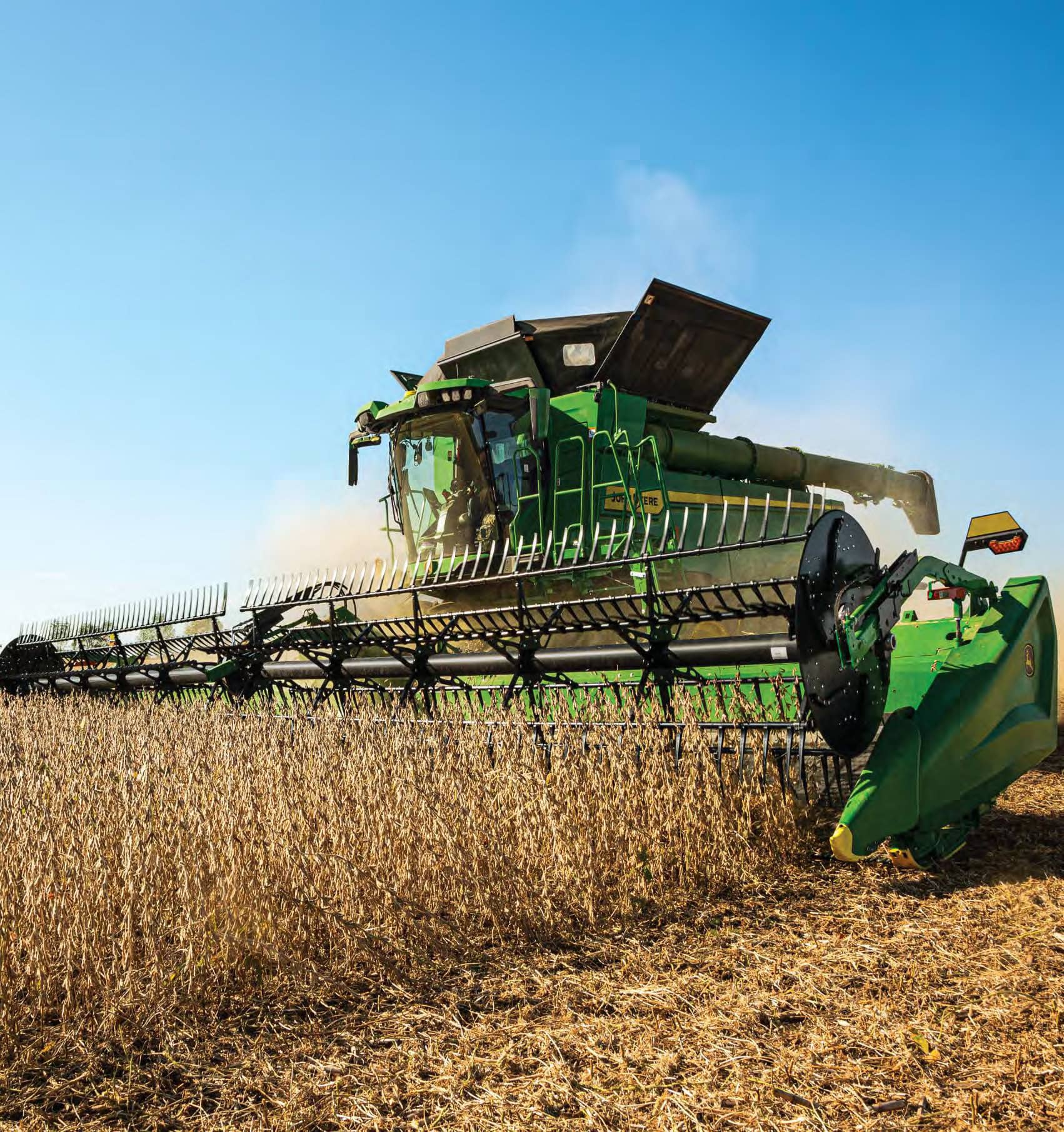
John Deere X9 1000 Combine
On This Page
ToggleIntroduction
The John Deere X9 1000 sits above the S7 Series in Deere’s current combine lineup, but the difference is much bigger than the model number suggests.
At first glance, the horsepower figures are surprisingly close.
The John Deere S7 900 reaches 617 maximum horsepower.
The X9 1000 reaches 630 horsepower.
That is only a 13 hp difference.
If horsepower were the main measure of combine capacity, moving from an S7 900 to an X9 1000 would make very little sense.
But horsepower is not the main story here.
The X9 1000 changes the harvesting architecture around the engine. It uses two 24-inch rotors instead of the S7’s single 30-inch rotor, provides substantially more threshing and separating area, increases cleaning area to 75 square feet, carries a larger grain tank, and moves grain out faster.
That makes the X9 1000 a high-capacity harvesting platform rather than simply a more powerful S7.
For large Prairie grain farms, custom harvesters, and operations where finishing wheat, canola, barley, pulses or other crops inside a short harvest window has a high value, this distinction matters much more than the 630 hp figure.
John Deere X9 1000 Key Specifications
| Specification | John Deere X9 1000 |
|---|---|
| Combine type | Dual-rotor rotary combine |
| Engine | John Deere JD14 / PowerTech PWS |
| Engine displacement | 13.6 L (830 cu. in.) |
| Rated engine power | 549 hp (410 kW) |
| Maximum engine power | 630 hp (470 kW) |
| Rated engine speed | 1,900 rpm |
| Power boost at rated speed | 53 hp |
| Fuel capacity | 330 gal. (1,249 L) |
| Separator type | Dual rotor |
| Number of rotors | 2 |
| Rotor diameter | 24 in. (60.1 cm) each |
| Rotor length | 11.5 ft (3.51 m) |
| Rotor speed range | 300-1,300 rpm |
| Concave area | 17.22 sq. ft. (1.6 m²) |
| Separating area | 38.75 sq. ft. (3.6 m²) |
| Discharge grate area | 4.85 sq. ft. (0.45 m²) |
| Total cleaning area | 75.02 sq. ft. (6.97 m²) |
| Cleaning fan speed | 570-1,430 rpm |
| Standard grain tank | 420 bu (14,800 L) |
| Optional grain tank | 550 bu (19,400 L), configuration dependent |
| Peak unloading rate | 4.6 bu/s (162 L/s) |
| Feederhouse width | 67.7 in. (1,720 mm) |
| Standard auger options | 26, 28.5 or 31 ft |
| Longer auger option | Up to 35 ft on current X9 configurations |
| Emissions | Final Tier 4 |
| Manufacturing country | United States |
These specifications explain why the X9 1000 should not be judged as an S7 900 with another 13 horsepower.
The crop-processing system around the engine is substantially different.
JD14 13.6 L Engine
The X9 1000 uses Deere’s JD14 13.6 L engine.
Rated output is 549 hp and maximum engine power reaches 630 hp.
The engine operates at a rated 1,900 rpm.
That is lower than the 2,000 rpm rated speed Deere lists for the JD14-powered S7 800 and S7 900.
The important point is not that Deere simply installed a huge engine.
In fact, the X9 1000 and S7 900 have remarkably similar maximum horsepower.
Instead, Deere built a harvesting system designed to process more crop with the available power.
That is one of the most important ideas when comparing modern combines.
A machine does not become high capacity simply by adding horsepower.
The feederhouse has to deliver enough crop.
The threshing system has to process it.
The separating system has to remove grain from the material.
The cleaning shoe has to handle the additional volume.
Then the tank and unloading system have to move grain away.
The X9 1000 increases capacity across that entire chain.
X Series Dual Separator
The biggest mechanical difference between the X9 and S7 is the separator.
The S7 uses one longitudinal rotor.
The X9 uses Deere’s X Series Dual Separator with two longitudinal rotors.
Each rotor measures approximately:
- 24 inches in diameter
- 11.5 feet long
Rotor speed ranges from 300 to 1,300 rpm.
Using two rotors allows Deere to create more threshing and separating area without making one extremely large rotor.
John Deere lists 17.22 square feet of concave area and 38.75 square feet of separating area.
Those numbers matter because crop needs both time and physical area to separate grain efficiently.
When crop flow increases, simply pushing material through faster can increase losses.
More separating area gives grain additional opportunity to leave the crop mat before residue exits the back of the combine.
That is where X9 capacity begins to make sense.
Why Two 24-Inch Rotors Instead of One Larger Rotor?
A quick specification comparison can make the X9 rotors sound smaller.
The S7 has a 30-inch rotor.
The X9 uses 24-inch rotors.
But there are two of them.
That completely changes the comparison.
Each rotor handles part of the incoming crop stream.
The advantage is not simply rotor diameter.
It is the combined threshing and separation area available to process a very large crop flow.
This is a good example of why rotor diameter alone is almost as misleading as horsepower when comparing combines from different platforms.
The entire system has to be considered.
X9 1000 vs S7 900
This is probably the most important comparison for understanding the X9 1000.
| Specification | S7 900 | X9 1000 |
|---|---|---|
| Engine | JD14 13.6 L | JD14 13.6 L |
| Maximum power | 617 hp | 630 hp |
| Separator | Single rotor | Dual rotor |
| Rotor setup | 1 x 30 in. | 2 x 24 in. |
| Cleaning area | 63.5 sq. ft. | 75.02 sq. ft. |
| Grain tank | 400 bu | 420 bu standard |
| Optional tank | No 550-bu X9 option | 550 bu available |
| Peak unloading | 4.2 bu/s | 4.6 bu/s |
| Fuel capacity | 330 gal. | 330 gal. |
Look at the horsepower first.
617 versus 630.
Only 13 hp separates them.
Now look at everything else.
The X9 changes from one rotor to two.
Cleaning area grows substantially.
Grain handling increases.
Threshing and separating architecture changes.
This is why the move from S7 to X9 is about processing capacity, not engine size.
For farms comparing Deere models, our John Deere S7 Series comparison explains where the S7 600, 700, 800 and 900 fit before making the jump into X9 territory.
75-Square-Foot Dyna-Flo XL Cleaning Shoe
The X9 1000 has 75.02 square feet of total louvered cleaning area.
That is noticeably larger than the 63.5-square-foot system Deere lists for the S7 800 and S7 900.
John Deere calls the X9 system Dyna-Flo XL.
A larger cleaning system is essential because there is little value in increasing rotor capacity if the cleaning shoe cannot handle the additional material.
This is a common misunderstanding when comparing combines.
A combine can have available engine horsepower and still be at its practical capacity because grain losses from the cleaning shoe are already increasing.
The X9’s cleaning system is designed around the additional material coming from the dual separator.
John Deere states that the X9 cleaning shoe has 36 percent more cleaning area than the previous machines used in its comparison.
That is a manufacturer comparison, not a promise of 36 percent more total combine capacity in every crop.
What matters is that cleaning capacity was increased alongside threshing capacity.
85 Percent More Airflow Claim
Deere also promotes substantially increased cleaning airflow on the X9 platform.
That becomes important in crops where a large amount of material reaches the cleaning shoe.
High-yielding wheat, canola and high-moisture crops can all challenge the cleaning system differently.
More airflow helps support the increased shoe area.
But more air is not automatically better.
Fan speed still needs to match crop conditions.
Too little airflow can leave excessive material in the sample or overload the shoe.
Too much can carry lighter grain out of the machine.
Automation can help manage those adjustments, but the underlying principles remain the same.
67.7-Inch Feederhouse
The X9 1000 uses a 67.7-inch-wide feederhouse.
At this capacity level, feeding becomes extremely important.
A dual-rotor combine can only use its processing capacity if enough crop reaches the rotors consistently.
The X9 uses a four-strand feeder chain with formed steel slats.
Deere also uses its Feed Accelerator and Stone Trap system before crop reaches the separator.
One particularly useful feature is the modulated feederhouse reverser.
Deere designed the system so the feederhouse can be reversed under full engine rpm.
That matters when harvesting heavy crop.
Clearing a blockage can otherwise consume valuable harvest time and place significant stress on components.
Avoiding the plug is still better than clearing one, but the reversing system gives operators another tool when conditions become difficult.
Tough Wheat and Canadian Conditions
The X9 is particularly interesting for Western Canada because Deere specifically positions the platform for tough-threshing small grains as well as high-volume coarse grains.
Wheat conditions can change quickly.
Dry standing wheat during the afternoon may flow easily.
Later in the day, moisture increases and straw becomes tougher.
The same combine can suddenly require noticeably more power and separation capacity.
At this level, the X9 1000’s dual separator can be more important than the engine specification.
The machine has more area available to separate grain as crop volume rises.
That does not mean grain loss becomes irrelevant.
Quite the opposite.
A high-capacity machine only creates useful capacity when grain remains in the tank rather than leaving with the residue.
X9 1000 for Canola
Canola is another crop where the X9 architecture can make sense.
Heavy canola can create substantial material flow.
Tough straw can increase power demand.
And because canola seed is small and valuable, cleaning and loss management deserve close attention.
The X9’s large cleaning shoe and automation systems are useful here.
But machine setup still matters.
A 630 hp combine cannot compensate for poor rotor, concave, fan or sieve settings.
The goal is not to force maximum crop through the machine.
The goal is to find the highest sustainable throughput that still maintains acceptable grain loss and sample quality.
X9 1000 for Peas and Lentils
Pulse crops add another consideration: grain quality.
Cracked or damaged grain can reduce crop value.
Current Deere Harvest Settings Automation supports a broader group of crops that includes peas and lentils.
That is particularly relevant for Saskatchewan farms.
The operator can define acceptable outcomes around:
- grain loss
- foreign material
- broken grain
The machine can then adjust several internal settings toward those targets.
This does not guarantee perfect grain quality.
Crop moisture, variety, field conditions and operator targets still matter.
But it gives the X9 a useful level of adaptability on farms moving between cereals, oilseeds and pulses.
420-Bushel Standard Grain Tank
The X9 1000 comes with a 420-bushel standard grain tank.
That is 20 bushels more than an S7 900.
At first glance, that seems like a relatively modest increase for a much higher-capacity harvesting platform.
But Deere now also offers an optional 550-bushel grain tank on current X9 configurations.
The optional larger tank requires the appropriate machine configuration, including 710 duals or tracks according to Deere’s current Canadian X9 information.
A 550-bushel tank changes grain-cart logistics considerably.
It gives the combine more time between unloads and more flexibility when carts are temporarily occupied.
But it also adds a large amount of grain weight when full.
That makes tire or track configuration, field conditions and compaction increasingly important.
Do You Need the Optional 550-Bushel Tank?
Not every X9 1000 needs 550 bushels.
A well-organized operation with grain carts consistently beside the combine may have little need for such a large buffer.
The larger tank becomes more useful when:
- fields are long
- opening a field requires additional grain storage
- grain carts service multiple combines
- unloading opportunities are less frequent
- crop yield fills the standard tank very quickly
- the farm wants longer uninterrupted harvesting runs
It becomes less important when the combine is almost always unloading on the go.
Tank capacity should match logistics rather than simply being maximized.
4.6 bu/s Unloading Rate
The X9 1000 unloads at a peak rate of 4.6 bushels per second.
That is faster than the 4.2 bu/s rate used by S7 700, S7 800 and S7 900.
At the theoretical peak rate:
420 bushels represents roughly 91 seconds.
A 550-bushel tank would represent roughly 120 seconds.
Actual unloading takes longer or varies because grain flow does not remain at theoretical peak rate during every second of the process.
Still, the numbers make one point clear.
The X9 is designed to move a lot of grain.
At this capacity level, unloading on the go becomes almost essential if the goal is to use the combine efficiently.
Machine Sync and Unloading on the Go
Current X9 technology packages can include Machine Sync.
Machine Sync allows the combine and compatible grain-cart tractor to coordinate speed and position during unloading.
The combine can control the grain-cart tractor’s speed and position while the two machines move together.
The benefit is simple.
The combine keeps harvesting.
This matters more as combine capacity rises.
Stopping an X9 every time the grain tank fills wastes the expensive capacity that justified the machine in the first place.
Grain-cart logistics are therefore not separate from X9 performance.
They are part of it.
Predictive Ground Speed Automation
Predictive Ground Speed Automation is available through Deere’s Ultimate Technology Package.
The system uses two forward-facing stereo cameras to measure crop height and volume ahead of the combine.
Deere also uses pre-harvest satellite information to create predictive field maps.
The machine can adjust ground speed before changing crop reaches the feederhouse.
That is important because traditional reactive systems wait until something has already changed.
Engine load rises.
Crop enters the rotor.
Loss levels begin to shift.
Then the operator or machine responds.
Predictive automation tries to act earlier.
In variable fields, that can help keep material flow more consistent.
John Deere states that Predictive Ground Speed Automation can improve productivity by up to 20 percent under its referenced conditions.
That is a manufacturer claim and should not be interpreted as a guaranteed 20 percent gain on every farm.
The useful part is the principle: keeping the combine closer to an efficient load throughout variable crop.
Harvest Settings Automation
Harvest Settings Automation is included in Deere’s Premium and Ultimate X9 technology packages.
The operator defines acceptable levels for:
- grain loss
- foreign material
- broken grain
The combine can then automatically adjust:
- rotor speed
- fan speed
- concave clearance
- chaffer clearance
- sieve clearance
That reduces the amount of continuous manual adjustment required as conditions change.
This can be especially useful when a farm has operators with different experience levels.
An experienced combine operator still needs to understand what a good sample looks like and what acceptable loss means.
Automation does not replace that knowledge.
It helps maintain the target once it has been defined.
Terrain Settings Automation
The X9 Premium and Ultimate packages can also include Terrain Settings Automation.
Rolling ground changes how material behaves inside the cleaning system.
When a combine is working on a side slope or changing pitch, grain and chaff do not always distribute across the shoe the same way they do on flat land.
Automation can compensate for some of those changes.
On flatter parts of Saskatchewan, this may be less important than on rolling terrain.
But Canadian Prairie fields are not universally flat, and farms with more variable topography can benefit from additional cleaning control.
Integrated G5Plus, StarFire and JDLink
Current X9 combines come with an integrated G5Plus CommandCenter display, StarFire receiver and JDLink connectivity.
This gives the combine access to Deere’s broader precision-ag ecosystem.
Depending on technology package and licensing, features can include:
- AutoTrac
- AutoPath
- AutoTrac Turn Automation
- Machine Sync
- In-Field Data Sharing
- Ground Speed Automation
- Harvest Settings Automation
- Predictive Ground Speed
- Harvest IPM
- SF-RTK functionality
The important word is depending.
Do not assume every X9 1000 has every Deere automation feature.
Technology package and licensing matter.
When comparing used or configured machines, verify exactly what is installed and activated.
ActiveYield
ActiveYield automatically calibrates the combine’s yield measurement system while harvesting.
Traditional yield calibration requires the operator to harvest grain, obtain a verified weight and adjust the system manually.
ActiveYield uses measurements as the grain tank fills to continually calibrate the yield system.
For farms heavily using yield maps and John Deere Operations Center, this can make data collection easier.
Again, it does not increase rotor capacity.
But modern harvest efficiency includes the quality of the data coming out of the machine as well as grain going into the tank.
AutoTrac Turn Automation
Current Deere automation can also handle more of the headland turn.
AutoTrac Turn Automation reduces steering workload during in-crop turns.
John Deere has also added automatic header raise and lower functionality to the current system.
That may sound minor compared with dual rotors and 630 hp.
Over a long harvest day, repetitive tasks add up.
Reducing them helps the operator pay attention to:
- crop flow
- grain cart position
- loss monitors
- changing crop conditions
- obstacles
- machine performance
Automation is increasingly about reducing accumulated operator workload rather than replacing the operator completely.
Tru-Thresh Concaves
Current X9 combines use Deere’s Tru-Thresh concave design.
Deere has updated the system with a more modular design intended to make concave changes easier.
Optional remote concave and separator grate covers also allow additional adjustment from the cab on current configurations.
This matters on farms harvesting several crop types.
A farm that moves from wheat to canola, then peas or other crops may need different threshing characteristics.
Anything that reduces the time and physical work involved in changing configuration helps the combine move between crops more efficiently.
Residue Management
Processing more crop also means managing more residue.
A high-capacity combine cannot simply thresh additional material and ignore what happens after separation.
The X9 residue system is designed to size and spread crop residue across wide headers.
John Deere advertises residue spreading up to approximately 50 feet depending on equipment and conditions.
Uniform residue distribution matters for the following crop.
Heavy windrows or uneven chaff distribution can create problems with:
- soil warming
- seeding depth
- nutrient distribution
- emergence
- residue decomposition
For farms running 45- or 50-foot headers, residue management becomes a major part of combine performance rather than an afterthought.
Header Compatibility
Deere designed the X9 around large-capacity front-end equipment.
Current compatibility includes large corn heads as well as Deere draper platforms such as the RDF and HDR families.
The X9 platform can work with headers up to 50 feet in current Deere configurations.
But the biggest possible header is not automatically the correct header.
Header size has to match:
- crop density
- field terrain
- desired ground speed
- feeding capacity
- transport requirements
- residue management
A header needs to keep the combine consistently fed without becoming difficult to control or transport.
Optional 35-Foot Unloading Auger
Current X9 configurations also offer a 35-foot power-folding unloading auger.
That longer reach is designed around increasingly wide headers and large grain carts.
More reach gives the operator additional clearance between the header and cart while unloading.
Power folding also helps reduce transport size when the auger is not being used.
Again, it is not a feature that changes threshing capacity.
But on a combine designed around 45- and 50-foot front-end equipment, unloading geometry becomes increasingly important.
X9 1000 vs New Holland CR10.90
One natural cross-brand comparison is the New Holland CR10.90.
| Specification | X9 1000 | CR10.90 |
|---|---|---|
| Maximum engine power | 630 hp | 700 hp |
| Rotor concept | Dual rotor | Twin Rotor |
| Number of rotors | 2 | 2 |
| Manufacturer | John Deere | New Holland |
The CR10.90 has more listed maximum horsepower.
That does not automatically make it the higher-capacity combine in every crop.
The X9 was designed around a large dual-separator system, 75-square-foot cleaning shoe and high-capacity grain handling.
New Holland uses its own Twin Rotor architecture.
This is exactly why cross-brand combine comparisons need more than an engine table.
The farm should compare:
- threshing and separation performance
- losses
- grain quality
- header options
- residue handling
- automation
- local dealer support
- parts availability
- grain-cart compatibility
- actual crop mix
The 70 hp difference is only one part of a much larger decision.
X9 1000 vs New Holland CR11
Another modern comparison is the New Holland CR11.
Both are next-generation high-capacity combines aimed at very large harvesting operations.
The CR11 uses New Holland’s newer Twin Rotor platform, while the X9 uses Deere’s X Series Dual Separator.
These machines are much more naturally compared by total harvesting system than by horsepower.
At this level, farms should be asking questions such as:
Can the grain cart stay with the combine?
Can trucking move the grain away?
Can storage receive it?
Can the header keep the combine properly fed?
What happens in tough evening wheat?
How well does automation respond to variable crop?
How quickly can the dealer support the machine during harvest?
Those questions become increasingly important as combine capacity rises.
What Deere’s 7,200 bu/hr Claim Actually Means
John Deere markets the X Series with harvesting capability of up to 7,200 bushels per hour in high-yielding corn under its referenced conditions.
That is an impressive number.
It should not be treated as an expected universal X9 1000 output.
Actual capacity depends on:
- crop
- yield
- moisture
- header
- ground speed
- losses
- field shape
- unloading logistics
- machine configuration
- residue settings
A wheat farmer in Saskatchewan should not use a high-yield corn test number to predict acres per hour.
The useful takeaway is simpler.
Deere designed the X9 platform for extremely high crop flow.
The actual number on your farm will depend on the conditions the machine is working in.
Who Actually Needs an X9 1000?
The X9 1000 makes the most sense when:
- annual harvest acreage is very high
- the harvest window is short
- heavy crop flow is common
- wide headers are practical
- grain carts can unload the combine on the move
- trucking has enough capacity
- storage can receive grain quickly
- the farm can keep a high-capacity machine busy
- weather delays make additional daily capacity valuable
- automation can help multiple operators maintain consistent performance
An X9 can be technically impressive and still be the wrong combine for a farm.
The question is not whether it can harvest more.
It can.
The question is whether the operation can use that additional capacity.
When an S7 900 May Make More Sense
The S7 900 deserves serious consideration before stepping into an X9.
Its maximum horsepower is already close to the X9 1000.
For an operation where the S7’s single-rotor architecture, 400-bushel tank and cleaning capacity are already enough, the X9 may be unnecessary.
The X9 makes more sense when the physical crop-processing capacity of the S7 platform becomes the limitation.
That is the key difference.
Do not move to X9 because 630 sounds bigger than 617.
Move to X9 because the farm needs what the dual separator and larger cleaning system provide.
What to Check on a Used X9 1000
A used X9 1000 should be inspected as a high-capacity harvesting machine, not just by engine hours.
Check:
- engine hours
- separator hours
- JD14 service history
- dual rotor condition
- concaves
- separator grates
- feederhouse chains and slats
- Feed Accelerator components
- Dyna-Flo XL cleaning shoe
- chaffer and sieve wear
- clean-grain elevator
- tailings system
- unloading auger and gearbox
- grain-tank augers
- residue-management system
- tracks or final drives if equipped
- ProDrive operation
- G5Plus display
- StarFire receiver
- JDLink
- automation cameras
- installed technology package
- active software licenses
- maintenance records
An X9 may cover a very large number of acres each year.
Separator hours and crop history can therefore tell you as much as engine hours.
John Deere X9 1000 Reviews & Ratings
The X9 1000 is a machine where owner reviews are especially valuable.
A specification sheet can tell you it has two rotors and 75 square feet of cleaning area.
It cannot easily answer:
How does it behave in tough evening wheat?
How much does Predictive Ground Speed help in variable crop?
Is the 420-bushel tank enough, or is the 550-bushel option worth having?
How much difference does the dual separator make compared with an S7 900?
How well does it spread residue behind a very wide header?
What parts show wear after several high-acreage seasons?
Those are the questions that matter once a farm is seriously comparing machines.
Owner reviews on Aglist can help fill the gap between manufacturer specifications and long-term field experience.
Is the X9 1000 Worth the Step Up From S7?
For the right farm, yes.
But the reason is not horsepower.
That point deserves repeating.
The S7 900 has 617 maximum horsepower.
The X9 1000 has 630.
Only 13 hp separates them.
The X9 earns its position through:
- dual rotors
- substantially more separation area
- larger cleaning area
- higher grain-handling capacity
- larger available grain tank
- wider feederhouse
- high-capacity front-end equipment
- automation designed around keeping the combine fully loaded
If the operation needs those things, X9 makes sense.
If it does not, S7 may be the more rational platform.
Final Thoughts
The John Deere X9 1000 is best understood as a crop-processing upgrade rather than a horsepower upgrade.
Its 13.6 L JD14 engine produces 630 maximum horsepower, which is only slightly more than an S7 900.
But around that engine Deere has built a much larger harvesting system.
Two 24-inch rotors provide the X Series Dual Separator architecture.
The cleaning shoe grows to 75 square feet.
Standard grain capacity rises to 420 bushels, with a 550-bushel option available on appropriately configured current machines.
Unloading increases to 4.6 bu/s.
And Deere’s current automation packages can manage everything from ground speed and internal settings to turns and grain-cart coordination.
For large Western Canadian grain operations, that combination can provide substantial harvesting capacity during a short weather window.
For farms that cannot keep the machine loaded or move grain away fast enough, much of that potential will remain unused.
That is the real dividing line between S7 and X9.
Not horsepower.
The amount of crop the entire farm can realistically move in a day.
Browse more machines in the Aglist combine category or see additional equipment on the John Deere brand page.
Frequently Asked Questions
How much horsepower does the John Deere X9 1000 have?
John Deere Canada lists the X9 1000 at 549 rated horsepower and 630 maximum horsepower.
What engine does the X9 1000 use?
The X9 1000 uses Deere’s JD14 / PowerTech PWS 13.6 L diesel engine.
Is the John Deere X9 1000 a dual-rotor combine?
Yes. The X9 uses two longitudinal 24-inch rotors in Deere’s X Series Dual Separator.
How big is the X9 1000 grain tank?
The standard power-folding grain tank holds 420 bushels. Deere currently also offers an optional 550-bushel tank on compatible configurations.
How fast does the X9 1000 unload?
Peak unloading rate is 4.6 bushels per second.
How large is the X9 1000 cleaning system?
John Deere lists 75.02 square feet of total louvered cleaning area.
What is the difference between an S7 900 and X9 1000?
The engine power is surprisingly close at 617 max hp for the S7 900 and 630 hp for the X9 1000. The major difference is harvesting architecture. S7 uses one rotor, while X9 uses two rotors and has considerably more cleaning and separation capacity.
Does the X9 1000 have Predictive Ground Speed Automation?
Predictive Ground Speed Automation is available through Deere’s Ultimate Technology Package. It uses forward-facing cameras and predictive field information to adjust speed before crop volume changes reach the combine.
Does the X9 1000 have Harvest Settings Automation?
Harvest Settings Automation is included in Deere’s Premium and Ultimate technology packages. It can adjust rotor speed, fan speed, concave, chaffer and sieve settings according to operator-selected targets.
Can the X9 1000 have a 550-bushel grain tank?
Yes. Deere currently offers an optional 550-bushel tank on compatible X9 configurations. Deere notes that the option requires the appropriate dual or track setup.
Is the X9 1000 suitable for wheat and canola?
Yes. Deere positions the X Series for high-capacity harvesting that includes tough small grains, and its cleaning and automation systems are applicable to wheat and canola conditions.
X9 1000 or S7 900: which should I choose?
Choose the X9 when the S7’s physical crop-processing capacity is the limitation and the rest of the farm can support higher throughput. If an S7 900 already provides enough capacity, the X9 may offer more machine than the operation can use.
Related
- John Deere S7 900 – top S7 model and the most important Deere comparison for X9 1000.
- John Deere S7 Series Compared – compare S7 600, S7 700, S7 800 and S7 900.
- New Holland CR10.90 – 700 hp traditional Twin Rotor competitor.
- New Holland CR11 – next-generation high-capacity Twin Rotor alternative.
- Combines – compare combine types, brands and model families.
- John Deere – browse John Deere equipment covered on Aglist.
Specifications and available equipment can vary by model year, technology package and machine configuration. Current Deere X9 models also have new optional grain-tank, auger and automation configurations that may not be installed on earlier X9 1000 combines. Confirm critical specifications for a particular machine with John Deere documentation, the operator’s manual or your dealer.
Share your experience
Help other Canadian buyers — leave a quick review for the
John Deere X9 1000
There are no reviews yet. Be the first one to write one.