Overview & Specs
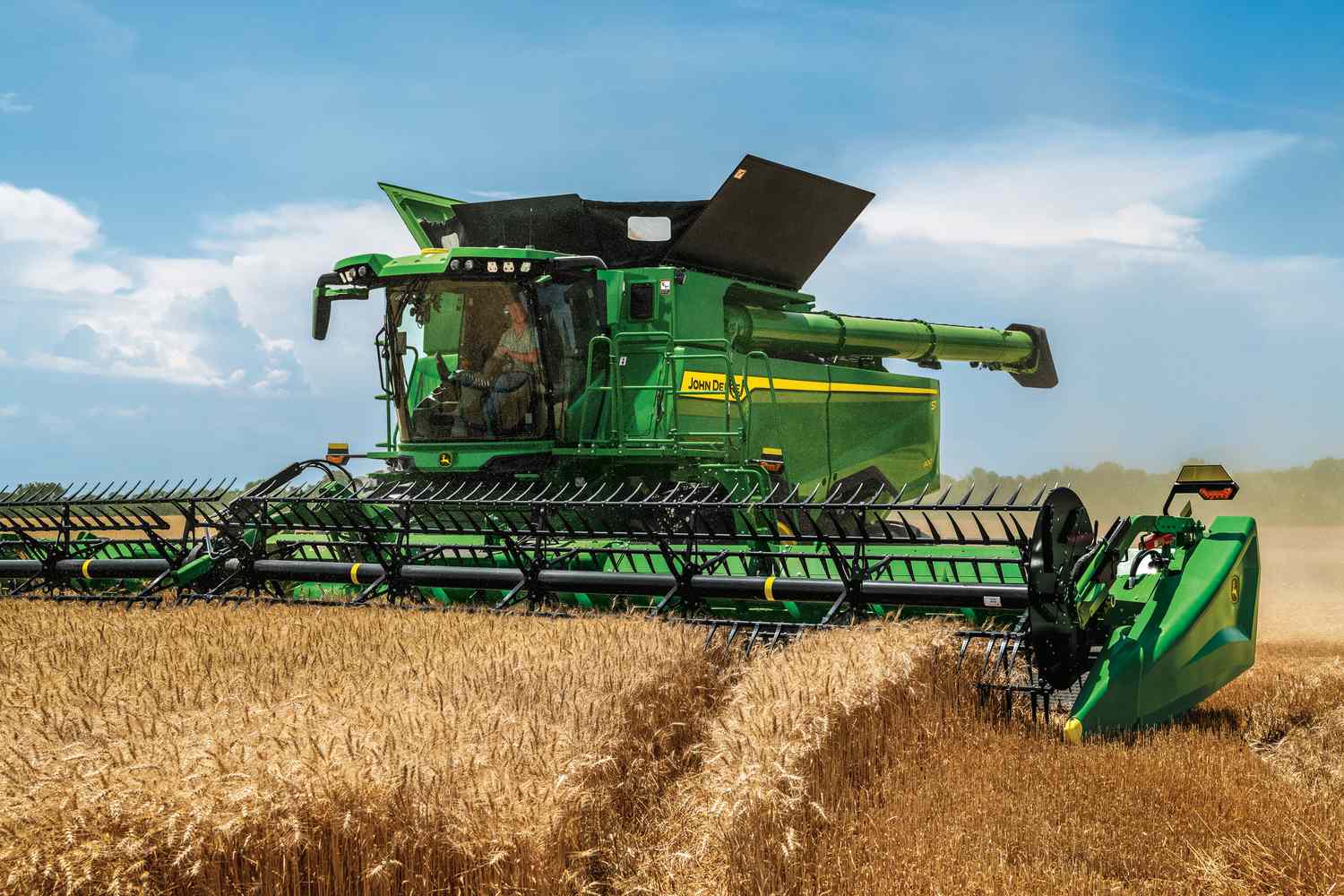
John Deere S7 900 Combine
On This Page
ToggleIntroduction
The John Deere S7 900 sits at the top of Deere’s current S7 combine lineup.
It uses the same 13.6 L JD14 engine family found in the S7 800, but output increases to 543 rated horsepower and 617 maximum horsepower.
The rest of the specification sheet tells an interesting story.
The S7 900 still carries a 400-bushel grain tank, unloads at 4.2 bushels per second, uses a 30-inch rotary separator, and has the same listed cleaning area as the S7 800.
That means the S7 900 is not a completely different combine from the model directly below it.
Instead, it is the highest-powered version of the upper S7 platform.
For a large Western Canadian grain farm, that distinction matters. The extra horsepower has value when wheat, canola, barley or other heavy crops regularly load the machine hard enough to use it.
If an S7 800 already has more capacity than the operation can keep busy, moving to an S7 900 will not automatically put more grain in the bin at the end of the day.
John Deere S7 900 Key Specifications
| Specification | John Deere S7 900 |
|---|---|
| Combine type | Rotary combine |
| Engine | John Deere JD14 |
| Engine displacement | 13.6 L (830 cu. in.) |
| Rated engine power | 543 hp (405 kW) |
| Maximum engine power | 617 hp (460 kW) |
| Rated engine speed | 2,000 rpm |
| Power boost at rated speed | 50 hp (37 kW) |
| Fuel capacity | 330 gal. (1,250 L) |
| Separator type | Rotary |
| Rotor diameter | 30 in. (76.2 cm) |
| Rotor length | 123 in. (312 cm) |
| Low rotor range | 210–530 rpm |
| High rotor range | 400–1,000 rpm |
| Concave area | 11.8 sq. ft. (1.1 m²) |
| Separating area | 21.4 sq. ft. (1.99 m²) |
| Total cleaning area | 63.5 sq. ft. (5.9 m²) |
| Grain tank capacity | 400 bu (14,100 L) |
| Peak unloading rate | 4.2 bu/s (150 L/s) |
| Unloading auger lengths | 22.5, 26 or 28.5 ft |
| Base weight without header | 49,141 lb (22,286 kg) |
| Emissions | Final Tier 4 |
| Manufacturing location | East Moline, Illinois, USA |
The S7 900 is therefore easy to understand on paper.
It combines the larger upper-S7 hardware with the highest engine output in the S7 range.
JD14 13.6 L Engine
The S7 900 uses Deere’s JD14 13.6 L diesel engine.
Rated output is 543 hp, while maximum power reaches 617 hp.
Deere also lists a 50 hp power boost at rated speed.
This is the same engine displacement used in the John Deere S7 800, but the S7 900 is tuned substantially higher.
That gives the S7 900 more reserve when several systems are demanding power at once.
Heavy crop flow can load the rotor and cleaning system. Chopping large volumes of residue adds another demand. Unloading on the go adds more again.
The extra horsepower matters most when those loads overlap.
But the same warning applies here as with every large combine.
Horsepower is only useful if the machine can stay fed.
A 617 hp combine waiting for a grain cart is not using its capacity.
Rotary Threshing and Separation
The S7 900 continues with Deere’s single longitudinal rotor.
The rotor measures 30 inches in diameter and 123 inches long.
That is the same listed rotor size used throughout the current S7 family.
Rotor speed ranges from 210 to 530 rpm in low range and from 400 to 1,000 rpm in high.
Those dimensions are worth paying attention to because the move from S7 800 to S7 900 is not based on a larger rotor.
Instead, Deere gives the S7 900 more engine power around the same basic upper-S7 threshing architecture.
That makes settings and crop flow especially important.
A larger engine does not compensate for poor rotor setup.
Rotor speed, concave clearance, crop moisture and material flow still determine grain damage, separation and losses.
Variable-Stream Rotor for Tough Small Grains
For Western Canadian farms, Deere’s variable-stream rotor configuration is particularly relevant.
Deere specifically discusses it for wheat, canola, barley, oats and other crops that can become difficult when straw is tough.
Adjustable top-cover transport vanes allow crop movement through the rotor to be changed.
If material needs more threshing or separation time, the operator can slow its progression.
In easier conditions, material can move through faster.
That becomes useful over the course of a Prairie harvest day.
Crop that feeds easily during a dry afternoon can behave very differently several hours later.
Canola straw can become tougher quickly as moisture increases. Wheat can become harder to thresh cleanly as evening conditions change.
The S7 900 combines that adjustability with the most engine reserve Deere offers in the S7 family.
Active Concave Isolation
Active Concave Isolation is available on the S7 900.
Deere offers this system on the S7 800 and S7 900 rather than the lower S7 600 and S7 700.
The system applies hydraulic pressure to help hold the concave in position under heavy crop loads.
Why does that matter?
In very tough conditions, a large volume of material moving through the rotor can put significant force against the concave.
If that relationship changes under load, threshing behaviour changes with it.
Active Concave Isolation is intended to keep the threshing geometry more stable.
John Deere states that the system can increase machine capacity by 10 percent in the difficult conditions where it is designed to work.
That should be treated as a manufacturer test claim, not a promise that an S7 900 will always harvest 10 percent more.
Its real value is more specific.
It gives the machine another way to maintain performance when crop conditions are far from ideal.
For Canadian wheat and canola farms, that is a much more useful feature than it might appear from the name alone.
High-Performance Feeder House
High-capacity harvesting begins before material reaches the rotor.
The S7 900 uses a 55-inch-wide feeder house and Deere’s pivoting mid-frame design.
The front feed drum has additional movement to accommodate changing crop volume.
The purpose is to maintain smooth feeding.
If crop enters the rotor in large slugs, engine load and threshing performance can change suddenly.
That makes the rest of the combine harder to keep balanced.
Consistent material flow gives the rotor, cleaning system and automation a more predictable load to work with.
This becomes increasingly important as engine power rises.
There is little value in 617 maximum horsepower if the feeder house cannot deliver crop to the threshing system smoothly enough to use it.
Dyna-Flo Plus Cleaning System
The S7 900 has 63.5 square feet of total louvered cleaning area.
That is the same listed cleaning area as the S7 800 and larger than the cleaning system used on the lower S7 600 and S7 700.
Four conveyor augers distribute material across the shoe.
A front chaffer begins cleaning free grain before the remaining material reaches the main chaffer and sieve.
This two-stage approach is designed to reduce the amount of material the main cleaning area has to deal with at once.
That matters because the cleaning system can become the real combine limit before the engine does.
A farmer can still see comfortable engine load while losses at the cleaning shoe are already increasing.
That is why combine capacity should be judged by grain loss and sample quality rather than engine percentage alone.
Deere states that Dyna-Flo Plus can provide a 14 percent capacity improvement in shoe-limited wheat and canola compared with previous Deere designs.
Again, that is a Deere comparison under specific conditions, but the crop choice makes the claim particularly relevant for Prairie farms.
400-Bushel Grain Tank
The S7 900 carries 400 bushels of grain.
That is the same tank size as the S7 800 and 100 bushels more than the S7 600 and S7 700.
A 400-bushel tank gives a large operation more flexibility between grain-cart visits.
But a larger tank does not replace good harvest logistics.
In a high-yielding crop, an S7 900 can still fill quickly.
The combine needs a grain cart cycle that matches its harvesting capacity.
This becomes increasingly important at the top of the S7 family.
The S7 900 is built to process a lot of crop. If it regularly stops because 400 bushels have nowhere to go, much of that capacity is being wasted.
4.2 bu/s Unloading
Peak unloading rate is 4.2 bushels per second.
At the theoretical peak rate, 400 bushels represents roughly 95 seconds of unloading.
Actual unloading time varies with grain, tank level and the complete unloading cycle.
More interestingly, Deere does not increase unloading rate from the S7 800 to the S7 900.
Both are listed at 4.2 bu/s.
That means an operation considering the S7 900 should not assume every part of the grain-handling system becomes faster with the larger model.
The primary step up is engine power.
Unloading capacity remains part of the same upper-S7 package.
Unloading Auger Options
Available auger lengths are:
- 22.5 ft
- 26 ft
- 28.5 ft
Header width and grain-cart dimensions determine which option makes the most sense.
With a wide draper, additional reach helps maintain clearance while unloading on the move.
The adjustable unloading spout also helps the operator control where grain enters the cart.
That becomes more useful when filling a large cart at field speed.
It is a small feature compared with 617 horsepower, but harvesting productivity often depends on dozens of small things working smoothly together.
Predictive Ground Speed Automation
Predictive Ground Speed Automation is available on the S7 900.
The idea is to adjust combine travel speed before changing crop conditions have already affected machine load.
The system can use forward-looking information to anticipate heavier or lighter crop.
When a heavier area is coming, the combine can slow before that material enters the feeder house.
When conditions become lighter, travel speed can increase.
This is different from simply reacting to engine load.
By the time the engine detects a sudden heavy crop, that material is already inside the machine.
A predictive system has the opportunity to react earlier.
The goal is not maximum speed.
It is more consistent crop flow.
That can help the combine stay closer to its useful capacity while reducing how often the operator has to make manual speed adjustments.
Harvest Settings Automation
Harvest Settings Automation is also available.
Modern combines have a large number of settings that interact with one another.
Rotor speed, concave position, fan speed, sieves and ground speed can all affect the final result.
An experienced operator can make those adjustments manually.
The difficulty is doing it constantly while crop conditions change and the operator is also watching the header, grain cart, yield information and weather.
Automation reduces some of that workload.
It should not be treated as a replacement for understanding grain loss or sample quality.
The system works best when an operator understands what target the combine should be trying to maintain.
Integrated Deere Technology
The S7 900 comes with Deere’s integrated G5Plus CommandCenter display, StarFire receiver and JDLink modem.
For farms already using Deere precision-ag systems, that integration can be one of the more practical reasons to stay within the brand.
Guidance, harvest data and machine information can operate within the same Deere environment used by other equipment.
That can simplify record keeping and field-data management.
It does not directly increase threshing capacity.
But managing a large farm involves more than what happens inside the rotor.
Yield information, field records and machine connectivity have become part of the harvest system too.
X9-Style Cab
The S7 900 uses the same basic cab architecture as Deere’s X9.
That gives the S7 family a more modern operator environment than older S-Series machines.
Visibility matters around a large header.
Comfort matters because harvest days can easily stretch into ten or twelve hours.
And control layout matters because a current combine gives the operator much more information to manage than machines from previous generations.
The best automation system still needs a usable interface.
ProDrive
ProDrive is available on the S7 900.
It provides two infinitely variable speed ranges.
The operator can configure one for harvesting and another for transport, then move between them without stopping for a conventional manual range change.
Deere also uses lower engine rpm during transport while maintaining useful road speed.
For farms with widely separated fields, transport time is part of harvest efficiency.
The combine only produces value when it is harvesting.
Anything that reduces unnecessary time between fields contributes to the season even if it does not appear in an acres-per-hour specification.
Tracks and Wet Harvest Conditions
John Deere offers suspended tracks on the S7 range with 30- or 36-inch belts.
The S7 900 is a heavy machine.
Deere lists base weight at 49,141 lb without a header.
Then add:
- the header
- up to 330 gallons of fuel
- equipment and options
- up to 400 bushels of grain
Actual field weight becomes substantially higher.
Tracks distribute that load over a larger ground-contact area.
That can improve flotation and reduce rutting during a wet Prairie harvest.
But tracks do not make the machine light.
They also cost more and add additional components.
Their value depends heavily on soil and harvest conditions.
John Deere S7 900 vs S7 800
The John Deere S7 800 is the most important comparison.
| Specification | S7 800 | S7 900 |
| Engine | JD14 13.6 L | JD14 13.6 L |
| Rated power | 473 hp | 543 hp |
| Maximum power | 540 hp | 617 hp |
| Fuel capacity | 330 gal. | 330 gal. |
| Grain tank | 400 bu | 400 bu |
| Peak unloading | 4.2 bu/s | 4.2 bu/s |
| Rotor diameter | 30 in. | 30 in. |
| Rotor length | 123 in. | 123 in. |
| Cleaning area | 63.5 sq. ft. | 63.5 sq. ft. |
| Active Concave Isolation | Available | Available |
| Base weight | 49,141 lb | 49,141 lb |
This table explains the S7 900 better than almost anything else.
The two combines share a lot.
Same engine displacement.
Same grain tank.
Same unloading rate.
Same rotor dimensions.
Same listed cleaning area.
Same listed base weight.
Both can have Active Concave Isolation.
The big difference is engine output.
S7 900 provides 70 more rated horsepower and 77 more maximum horsepower.
That makes the decision much more specific than S7 700 versus S7 800.
Choose the S7 900 when an operation can genuinely use additional power within the upper-S7 platform.
If an S7 800 already runs below its practical capacity because grain carts, field conditions or other parts of the harvest system are limiting, the S7 900 may add very little.
S7 900 vs S7 700
The John Deere S7 700 sits on the other side of the major break in the S7 family.
It uses the smaller JD9 9.0 L engine and carries 300 bushels of grain.
The S7 900 uses the JD14 13.6 L and carries 400 bushels.
Maximum horsepower jumps from 460 to 617 hp.
That is a 157 hp difference.
So although both machines carry an S7 badge, they are aimed at noticeably different harvest workloads.
The S7 700 can make sense for farms that need strong rotary capacity but do not require the size of the upper models.
The S7 900 is much easier to justify when the farm has the acres, crop volume and logistics to keep a high-capacity combine working.
S7 900 vs New Holland CR9.90
The New Holland CR9.90 is a particularly interesting cross-brand comparison.
The CR9.90 is listed at up to 600 hp.
The S7 900 reaches 617 hp.
On horsepower alone, the Deere has a small advantage.
But the harvesting systems are very different.
The Deere uses one longitudinal rotor.
The New Holland uses two rotors in its Twin Rotor system.
That makes the 17 hp difference one of the least useful parts of the comparison.
Crop flow, cleaning capacity, automation, residue handling, headers, local dealer support and operator familiarity are all more meaningful.
This is exactly the kind of comparison where horsepower numbers look important but explain very little by themselves.
S7 900 vs New Holland CR10.90
The New Holland CR10.90 takes the horsepower comparison farther.
The CR10.90 reaches 700 maximum horsepower.
That is 83 hp more than the S7 900.
But again, the two machines use different threshing architectures and were built around different overall harvesting systems.
The CR10.90 represents the top of New Holland’s traditional Twin Rotor range.
The S7 900 represents the top of Deere’s current S7 family, with the X9 range sitting above it in Deere’s own combine lineup.
For a farm seriously considering machines at this capacity level, dealer support and the entire harvest system become critical.
Neither one should be chosen because one line in a brochure shows a larger horsepower number.
S7 900 vs Conventional Combines
The S7 900 is clearly aimed at high-capacity rotary harvesting.
That does not make rotary the right answer for every large farm.
A conventional combine such as the New Holland CX8.90 approaches threshing and separation differently.
The CX uses straw walkers and can be attractive where preserving long straw has significant value.
The Deere is more naturally suited to operations where rotary crop flow and high throughput are priorities.
For a mixed grain and livestock farm, the value of straw after harvest can change the calculation.
The highest-capacity machine is not always the machine that creates the most value across the whole farm.
Where the S7 900 Fits Best
The John Deere S7 900 makes the most sense for:
- large and very large grain farms
- high wheat, canola, barley or coarse-grain acreage
- operations that regularly work an S7 800-sized machine near capacity
- farms capable of keeping a 400-bushel combine moving
- operations with grain carts and trucking sized for high throughput
- farms harvesting tough crop outside ideal conditions
- operators wanting Active Concave Isolation
- farms already invested heavily in Deere precision-ag technology
- operations where additional harvest capacity can reduce weather exposure
It makes less sense when the combine is already waiting on the rest of the farm.
What to Check on a Used S7 900
When inspecting an S7 900, pay attention to:
- engine hours
- separator hours
- JD14 service history
- rotor condition
- concaves
- Active Concave Isolation operation
- feeder-house components
- Dyna-Flo Plus cleaning system
- cleaning fan and chaffer components
- grain elevators and chains
- unloading auger and drives
- residue-management system
- ProDrive operation
- track condition if equipped
- G5Plus CommandCenter
- StarFire receiver
- JDLink connectivity
- installed automation packages
- maintenance and repair records
A high-capacity combine can accumulate substantial wear even when annual engine hours do not look extreme.
Separator hours, crop history and maintenance records deserve just as much attention.
John Deere S7 900 Reviews & Ratings
Specifications can show where the S7 900 sits in the range.
They cannot answer the most interesting ownership questions.
Does the extra 77 hp over an S7 800 make a noticeable difference in heavy wheat?
How useful is Active Concave Isolation in tough evening canola?
Can a farm keep the 400-bushel tank and 4.2 bu/s unloading system working efficiently enough to use 617 hp?
How does Predictive Ground Speed behave across variable-yield fields?
Owner experience is where those answers begin to appear.
If you operate an S7 900, adding a review on Aglist can help other farms understand how the machine performs outside the manufacturer specification sheet.
Is the S7 900 Worth Choosing Over the S7 800?
This may be the most important question about the machine.
The S7 900 is unquestionably more powerful.
But many of its major specifications are identical to the S7 800.
Both have:
- a 13.6 L JD14
- 400-bushel grain tank
- 4.2 bu/s unloading
- 30-inch by 123-inch rotor
- 63.5 sq. ft. cleaning area
- available Active Concave Isolation
- the same listed base weight
The S7 900 adds 77 maximum horsepower.
That is valuable when additional engine reserve is the thing holding the operation back.
If it is not, the S7 800 may provide much of the same hardware without paying for the top power rating.
That makes S7 800 versus S7 900 one of the clearest examples of why combine selection should begin with the farm’s actual bottleneck.
Final Thoughts
The John Deere S7 900 is the highest-powered combine in the current S7 family.
Its JD14 engine produces 543 rated and 617 maximum horsepower while the machine carries 400 bushels of grain and uses Deere’s 30-inch rotary separator.
It also gets the technologies expected at the upper end of the range, including available Active Concave Isolation, Predictive Ground Speed, Harvest Settings Automation and Deere’s integrated precision-ag hardware.
But the most important comparison is with the S7 800.
The two machines share much of their hardware.
The S7 900 earns its place when the farm needs more power from that platform.
For a large Prairie operation regularly pushing an S7 800-sized machine through heavy wheat or canola, another 77 hp can provide useful reserve.
For a farm where logistics already limit the combine, the larger model number will not fix the problem.
Browse more machines in the Aglist combines category or see additional equipment on the John Deere brand page.
Frequently Asked Questions
How much horsepower does the John Deere S7 900 have?
John Deere Canada rates the S7 900 at 543 hp at rated engine speed and 617 maximum horsepower.
What engine does the John Deere S7 900 use?
The S7 900 uses a John Deere JD14 13.6 L diesel engine.
How big is the S7 900 grain tank?
The S7 900 has a 400-bushel, approximately 14,100-litre, grain tank.
How fast does the S7 900 unload?
John Deere lists a peak unloading rate of 4.2 bushels per second, or about 150 litres per second.
Is the S7 900 a rotary combine?
Yes. It uses a single longitudinal rotor measuring 30 inches in diameter and 123 inches long.
What is the difference between the S7 800 and S7 900?
Both use a 13.6 L JD14 engine, 400-bushel tank, 4.2 bu/s unloading system, 30-inch rotor and 63.5 sq. ft. cleaning area. The main specification difference is power: the S7 800 reaches 540 maximum hp while the S7 900 reaches 617 hp.
Does the S7 900 have Active Concave Isolation?
Yes, it is available on the S7 900. Deere currently offers Active Concave Isolation on the S7 800 and S7 900.
How much does a John Deere S7 900 weigh?
Deere lists the base machine at 49,141 lb without a header. Actual operating weight increases after adding the header, fuel, grain and optional equipment.
Does the S7 900 have Predictive Ground Speed Automation?
Predictive Ground Speed and Harvest Settings Automation are available on the S7 900. Exact functionality depends on the installed technology package.
Is the S7 900 suitable for wheat and canola?
Yes. Deere specifically highlights Active Concave Isolation, variable-stream rotor operation and Dyna-Flo Plus cleaning for tough small-grain crops including wheat and canola.
Related
- John Deere S7 800 – closest S7 comparison with the same 13.6 L engine family and 400-bu grain tank.
- John Deere S7 700 – 460 hp JD9-powered S7 below the upper models.
- New Holland CR9.90 – 600 hp Twin Rotor cross-brand alternative.
- New Holland CR10.90 – 700 hp top model of the traditional New Holland CR lineup.
- New Holland CX8.90 – conventional straw-walker alternative.
- Combines – compare combine types, models and brands.
- John Deere – browse more John Deere equipment on Aglist.
Note: Specifications, technology packages and available equipment can vary by model year and configuration. Confirm critical specifications for a particular machine with John Deere documentation, the operator’s manual or your dealer.
Share your experience
Help other Canadian buyers — leave a quick review for the
John Deere S7 900
There are no reviews yet. Be the first one to write one.