Overview & Specs
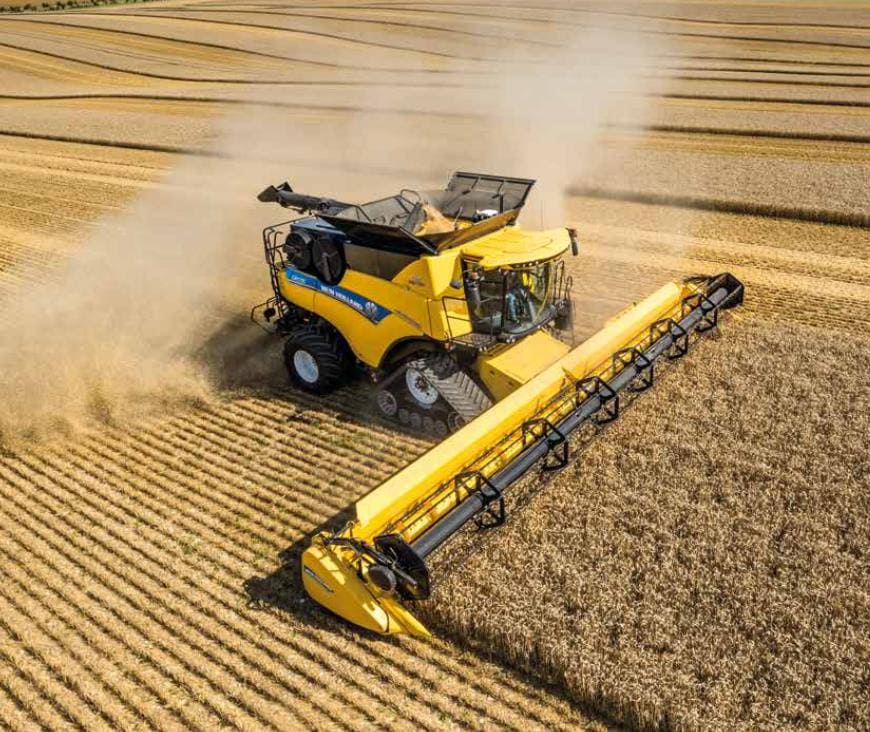
New Holland CR10.90 Combine
The New Holland CR10.90 sits near the top of the traditional CR combine range and is one of the largest Twin Rotor combines New Holland has produced. Its numbers make that obvious: up to 700 hp, a large-capacity harvesting system, and enough processing capacity for farms where getting acres off quickly matters more than having a smaller, simpler machine.
But horsepower alone does not explain the CR10.90.
This combine is really about maintaining crop flow. The Twin Rotor layout threshes and separates crop in a straight path through the machine, while the engine, cleaning system, grain handling components, and residue system are sized around high-volume harvesting.
That makes the CR10.90 a much different machine from a smaller CR7.80 or CR8.90. It also puts it in an interesting position now that New Holland has introduced the newer CR10 and CR11 generation.
On This Page
ToggleNew Holland CR10.90 Quick Specs
| Specification | New Holland CR10.90 |
|---|---|
| Combine type | Twin Rotor rotary combine |
| Engine | FPT Cursor 16 |
| Gross engine power | 639 hp (477 kW) |
| Maximum engine power | 700 hp (522 kW) |
| Threshing system | Twin Rotor |
| Cleaning system | Opti-Clean |
| Guidance available | IntelliSteer |
| Combine automation available | IntelliSense |
| Track option | SmartTrax |
| Emissions | Tier 4 compliant |
| Manufacturer | New Holland Agriculture |
New Holland notes that maximum engine output varies with operating conditions. Extra power is available during unloading and chopping. In swath operation or when using low chopper speed in corn, the CR10.90 is derated to 598 rated hp and 653 maximum hp.
Engine and Power
The CR10.90 uses an FPT Cursor 16 engine.
Gross power is rated at 639 hp, while maximum output reaches 700 hp. Those figures put a substantial amount of reserve power behind the threshing system, unloading system, chopper, and other components that may be working at the same time during a heavy harvest.
That distinction matters.
A combine does not spend its entire day using maximum horsepower. Crop conditions, header load, travel speed, unloading and residue management all change the amount of power being demanded from the engine.
The value of a large engine in a machine like the CR10.90 is having enough reserve when several systems are under load at once.
New Holland also specifically notes that additional power is available during unloading and chopping. In swath mode or with the chopper operating at low speed in corn, output is reduced to a rated 598 hp and maximum 653 hp.
So the 700 hp figure should be understood as maximum available engine power, not the power level the combine continuously runs at in every crop.
Twin Rotor Threshing and Separation
The CR10.90 uses New Holland’s Twin Rotor system rather than a single longitudinal rotor.
Crop enters the machine and is divided between two rotors that thresh and separate grain as material moves rearward.
One of the practical advantages of this arrangement is the relatively straight crop path. There are fewer major changes in direction between the feeder and the rear of the machine, which helps move a large volume of material without repeatedly accelerating and redirecting it.
The system also gives the machine a large threshing and separation area without relying on one extremely large rotor.
For grain farms, the important part is not simply that there are two rotors. What matters is how the system behaves when crop conditions change.
Dry standing wheat may move through a combine very differently from tough canola late in the evening. Heavy straw creates another challenge. A high-capacity combine has to keep separating grain without turning increased throughput into higher losses out the back.
That is the job the CR10.90’s rotor and cleaning systems are built around.
Opti-Clean Cleaning System
The CR10.90 listed by New Holland for North America uses the Opti-Clean cleaning system.
After grain has been threshed and separated from the crop mat, the cleaning shoe still has to remove chaff and other material before clean grain reaches the tank.
At high crop flow, this becomes one of the areas that can limit combine capacity. More horsepower does little good if the cleaning system becomes overloaded before the engine or rotors do.
The CR10.90 combines its Twin Rotor system with a cleaning system sized for a high-volume machine. The goal is to maintain a clean sample while keeping losses under control rather than simply pushing more material through the combine.
Operators still need to set the machine for the crop and conditions. Fan speed, sieve settings, rotor settings and ground speed remain important even on a combine equipped with automation.
IntelliSense Combine Automation
IntelliSense is available on CR Series combines to automate some of those adjustments.
The system monitors operating conditions and can change combine settings as conditions change. New Holland says IntelliSense evaluates and adjusts settings every 20 seconds.
The operator selects the harvesting strategy, and the system works toward that target.
Depending on the priority, that may mean concentrating on:
- lower grain loss
- better grain quality
- higher throughput
- maintaining a balance between several objectives
This is useful on a machine with the capacity of the CR10.90 because the operator can become the limiting factor before the combine itself does.
Conditions can change considerably across one field. Crop density changes, moisture changes, lodged areas appear, and evening conditions can make straw tougher within a relatively short period.
Without automation, the operator has to recognize those changes and continually adjust the machine.
IntelliSense does not remove the need to understand combine settings, but it can reduce how often the operator has to chase changing conditions manually.
Grain Quality and Straw Handling
High capacity is only useful if the combine can move crop through the machine without excessive grain damage or unacceptable loss.
The Twin Rotor layout uses multiple passes around the rotors to release grain while crop moves toward the rear of the combine.
The relatively direct crop path can also be useful for farms that intend to bale straw after harvest. Straw condition depends heavily on crop type, moisture, rotor settings and how aggressively the machine is being operated, so no rotary combine can guarantee perfect straw in every situation.
Still, the CR system was developed to balance threshing capacity with usable residue rather than treating straw condition as an afterthought.
That may matter on mixed farms or Prairie operations where cereal straw has value after the grain is harvested.
Residue Management
A combine this large can process a substantial amount of straw and chaff in a short period of time.
That creates another job after separation: spreading the residue evenly across the width of the header.
Poor residue distribution can show up later during tillage, seeding and crop emergence. Heavy bands of straw retain moisture differently and can interfere with openers, while areas with very little residue behave differently again.
New Holland offers different residue-management configurations for the CR Series, allowing the combine to be set up around whether the operation intends to chop, spread or preserve more straw.
For farms moving to wider headers, residue distribution should be considered part of combine capacity. Harvesting a wider pass is not much of an advantage if the residue system cannot distribute material across it properly.
SmartTrax Option
The CR10.90 can also be equipped with New Holland’s SmartTrax track system.
Tracks increase the contact area between the combine and the soil. New Holland states that its SmartTrax arrangement can reduce ground pressure by up to 57% compared with the referenced tire configuration.
That does not make a fully loaded combine light.
The CR10.90 is still a very large machine, particularly with a full grain tank and a large header. But spreading that weight over a larger contact area can help in softer field conditions and reduce the tendency for the machine to create deep wheel tracks.
There are trade-offs.
Tracks add complexity and cost, and they are not automatically the best choice for every farm. An operation harvesting mostly in firm, dry conditions may place less value on them than a farm regularly dealing with wet harvests or soils that are particularly sensitive to compaction.
IntelliSteer Guidance
Factory-integrated IntelliSteer guidance is available on the CR Series.
Using DGPS or RTK correction, New Holland says the system can provide pass-to-pass accuracy down to approximately one inch when configured with the appropriate correction source.
On a large combine, guidance is about more than keeping straight rows.
It helps use more of the header width on each pass and reduces the amount of attention the operator has to spend steering for long periods.
That becomes increasingly useful during long harvest days, especially when the operator is also monitoring grain loss, crop flow, the grain cart, header performance and changing field conditions.
Unloading on the Go
Large combines work best when they do not have to stop every time the grain tank fills.
That makes unloading logistics a major part of CR10.90 productivity.
New Holland supports Cart Automation on the CR10.90. When paired with compatible equipment, the system can synchronize tractor speed and path with the combine while unloading on the go.
The benefit is fairly simple: the combine keeps harvesting while grain moves into the cart.
On a large farm, the combine itself may not be what limits acres per hour. Grain carts, trucks, field access and the distance to storage can become the bottleneck instead.
Putting a 700 hp combine in a field does not solve a grain-handling problem.
A CR10.90 makes the most sense when the rest of the harvest system is capable of keeping it moving.
What Is the CR10.90 Like in Canadian Conditions?
The CR10.90 makes the most sense on large grain operations where harvest windows are tight and crop volume justifies a high-capacity machine.
That describes parts of Western Canada particularly well.
A Saskatchewan or Alberta farm can have a large number of acres ready within a relatively short window. Weather can then shorten that window further.
In that environment, capacity has a real value. Finishing a field before several days of rain or getting crop off before conditions deteriorate can matter more than achieving the lowest possible machinery cost per individual hour.
But size can work against a farm too.
A CR10.90 requires adequate headers, grain carts, trucks, operators, fuel support and field access. Smaller or irregular fields may never allow the combine to work near its potential.
This is not a machine where the specification sheet should be considered separately from the rest of the farm.
New Holland CR10.90 vs CR9.90
The CR9.90 is the logical model to compare with the CR10.90.
The biggest obvious difference is engine output.
| Specification | CR9.90 | CR10.90 |
| Gross engine power | 544 hp | 639 hp |
| Maximum engine power | 600 hp | 700 hp |
| Threshing concept | Twin Rotor | Twin Rotor |
| IntelliSense available | Yes | Yes |
| IntelliSteer available | Yes | Yes |
The CR10.90 has 100 more maximum horsepower.
That does not mean it will automatically harvest 16 or 17 percent more acres per hour. Combine capacity depends on the crop, header, losses, cleaning load and field logistics as much as engine horsepower.
What the larger engine does provide is more power reserve when crop flow is heavy and systems such as unloading or residue chopping are also demanding power.
For an operation that cannot regularly use that extra capacity, the CR9.90 may already be a very large combine.
For an operation that routinely pushes the CR9.90 to its limits, the CR10.90 gives considerably more headroom.
CR10.90 vs New CR10 and CR11
The model names can be confusing.
The CR10.90 belongs to the previous generation of New Holland’s Twin Rotor combines. It should not be confused with the newer New Holland CR10, which uses the redesigned next-generation CR platform. Above it sits the New Holland CR11, the largest model in New Holland’s newer CR family.
That distinction is important when comparing specifications or looking at used equipment.
A CR10.90 remains a very high-capacity combine, but the CR10 and CR11 represent the newer architecture New Holland developed after it.
For farms comparing these machines, the question is therefore not simply which one has more horsepower.
Age, technology, dealer support, hours, condition, depreciation, header compatibility and the capacity actually required by the farm may be more important than choosing the newest platform.
CR10.90 Strengths
The CR10.90’s strongest points are fairly clear:
- 700 hp maximum engine output
- high-capacity Twin Rotor threshing and separation
- substantial power reserve during heavy crop flow
- IntelliSense automation availability
- IntelliSteer guidance availability
- SmartTrax option for lower ground pressure
- strong fit for large-acre grain operations
- straight-through crop-flow concept
- ability to integrate unloading automation
Its biggest advantage is capacity when the farm has enough crop and enough supporting equipment to use it.
Things to Consider
The same size that makes the CR10.90 attractive can also be its biggest drawback.
A large combine means:
- higher fuel consumption in absolute terms
- more expensive wear components
- larger tires or track components
- more dependence on good grain-cart logistics
- more machine than many smaller farms can fully use
- additional attention to transport width, access and storage
- potentially higher repair exposure as the machine ages
Used CR10.90 condition can also vary considerably.
Engine hours alone do not tell the entire story. Separator hours, crop type, annual acreage, maintenance history, rotor and concave condition, elevators, chains, bearings, unloading components and residue-system wear all matter.
A lower-hour machine that spent its life in abrasive crops with poor maintenance is not automatically a better combine than a higher-hour unit with a documented service history.
Is the New Holland CR10.90 Still Relevant?
Yes, particularly in the used high-capacity combine market.
The arrival of the CR10 and CR11 does not suddenly make the CR10.90 a small or low-output combine. With 700 maximum horsepower and the Twin Rotor system, it still has considerably more capacity than many farms require.
Its position has simply changed.
It is no longer New Holland’s newest flagship architecture. That can make the CR10.90 more interesting for operations that need high harvesting capacity but do not necessarily need the newest combine platform.
The important question is whether the farm can actually use the machine’s capacity.
If the CR10.90 spends much of harvest waiting for a grain cart, truck or operator, the extra horsepower is not accomplishing much.
If the harvest system can keep it supplied with crop and move grain away fast enough, the CR10.90 remains a serious high-acreage combine.
Final Thoughts
The New Holland CR10.90 is best understood as a high-capacity harvest machine rather than simply a 700 hp combine.
Its Cursor 16 engine provides the power, but the Twin Rotor threshing system, cleaning system, grain handling, residue management and available automation are what determine how effectively that power can be used.
For large grain farms in Western Canada, that combination can make sense when the goal is to cover a lot of acres during a short harvest window.
For smaller operations, it may simply be more combine than the farm can keep busy.
And that is probably the most useful way to judge the CR10.90: not by whether 700 hp sounds impressive, but by whether the rest of the harvest operation is large enough to take advantage of it.
Frequently Asked Questions
How much horsepower does the New Holland CR10.90 have?
The CR10.90 has 639 gross horsepower and up to 700 maximum horsepower from its FPT Cursor 16 engine. New Holland notes that output can vary depending on operating mode.
What engine is in the New Holland CR10.90?
The CR10.90 uses an FPT Industrial Cursor 16 engine that complies with Tier 4 emissions requirements.
Is the New Holland CR10.90 a rotary combine?
Yes. It uses New Holland’s Twin Rotor system with two longitudinal rotors for threshing and separation.
What is the difference between the CR10.90 and CR9.90?
The CR10.90 is the more powerful model. New Holland lists the CR9.90 at up to 600 hp, while the CR10.90 reaches 700 hp. Both use the Twin Rotor concept, but the CR10.90 is intended for higher-capacity harvesting.
Is the CR10 the same combine as the CR10.90?
No. The CR10 is part of New Holland’s newer generation of CR combines. The CR10.90 belongs to the earlier CR Series platform.
Does the CR10.90 have combine automation?
IntelliSense combine automation is available for the CR Series. It can automatically adjust machine settings as harvesting conditions change.
Can the CR10.90 use tracks?
Yes. New Holland offers its SmartTrax system for CR combines, providing a larger ground-contact area than conventional tire configurations.
Is the CR10.90 suitable for Canadian grain farms?
It can be a strong fit for large Prairie grain operations where acreage and short harvest windows justify a high-capacity combine. Farms also need enough grain-cart, trucking and storage capacity to keep a machine of this size productive.
Share your experience
Help other Canadian buyers — leave a quick review for the
New Holland CR10.90
There are no reviews yet. Be the first one to write one.