Overview & Specs
New Holland CR7.90 Combine
On This Page
ToggleIntroduction
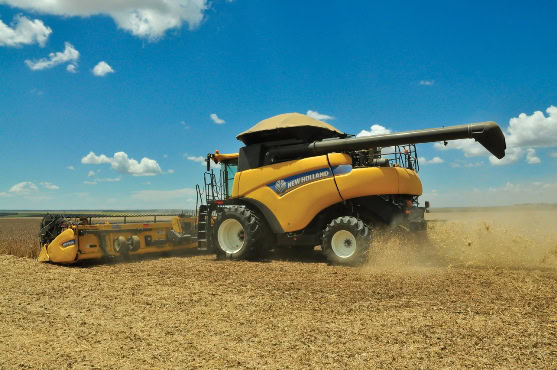
The New Holland CR7.90 is the second-smallest combine in New Holland’s traditional North American CR Series, but “small” is relative here.
With 420 gross horsepower and up to 460 maximum horsepower, the CR7.90 still has the power and crop-processing capacity for serious grain acreage. It uses the same basic Twin Rotor harvesting concept that defines the larger CR machines, but in a package that can make more sense for farms that do not need the output of a CR8.90, CR9.90 or CR10.90.
That is really where the CR7.90 fits.
It is not trying to be the highest-capacity combine in the lineup. Instead, it gives farms access to New Holland’s Twin Rotor system, automation and precision technology without forcing them into one of the largest machines in the series.
For a Western Canadian grain farm, especially one where field size, grain-cart capacity or annual acres do not justify a 500 to 700 hp combine, that can be a much better match.
New Holland CR7.90 Key Specifications
| Specification | New Holland CR7.90 |
|---|---|
| Combine type | Twin Rotor rotary combine |
| Engine | FPT Cursor 9 |
| Engine displacement | 8.7 L (531 cu. in.) |
| Gross engine power | 420 hp (313 kW) |
| Maximum engine power | 460 hp (343 kW) |
| Threshing and separation | Twin Rotor |
| Combine automation | IntelliSense available |
| Guidance | IntelliSteer available |
| Display | IntelliView |
| Cab | Harvest Suite Ultra |
| Track option | SmartTrax available |
| Emissions | Tier 4 compliant |
| Manufacturer | New Holland Agriculture |
The CR7.90 sits below the New Holland CR8.90 in the traditional CR lineup.
Its lower horsepower does not mean it uses a completely different harvesting idea. It is still built around New Holland’s two-rotor threshing and separation system.
Engine and Power
The CR7.90 uses an FPT Cursor 9 diesel engine with 8.7 litres of displacement.
New Holland rates it at 420 gross horsepower and 460 maximum horsepower.
That is substantially less than the 571 maximum horsepower available in the CR8.90, but judging combines purely by peak horsepower can be misleading.
More power matters when the machine can actually use it.
If a farm runs moderate header widths, has average crop yields or regularly waits for grain carts and trucks, putting another 100 hp in front of the same harvest logistics may accomplish very little.
The CR7.90 has enough power for significant crop flow while avoiding some of the size and cost that come with moving farther up the CR lineup.
For many operations, the better question is not “How much horsepower can I get?”
It is “How much combine can I keep busy?”
Twin Rotor Threshing and Separation
The main reason to choose a CR7.90 over a conventional combine is New Holland’s Twin Rotor system.
Crop enters through the feeder and is divided between two longitudinal rotors. Threshing and separation happen as material moves rearward through the machine.
The crop path stays relatively straight.
That matters because every major change in crop direction requires energy and can affect material flow. New Holland’s Twin Rotor layout is built around moving crop through the combine smoothly while providing enough rotor contact to release grain.
The two-rotor design has been part of New Holland combines for decades.
For the operator, the practical benefit is flexibility across different crop conditions.
A Saskatchewan farm might move from dry wheat into canola, then into barley or pulses. Even within one crop, conditions can change dramatically between a dry afternoon and a damp evening.
The CR7.90 gives the operator a wide range of adjustment without moving into the physical size and horsepower of the larger CR machines.
What the CR7.90 Does Well
It Brings Twin Rotor Capacity to a More Manageable Size
The biggest strength of the CR7.90 is probably its position in the lineup.
A farm does not always need the largest combine it can afford.
The larger New Holland CR9.90 reaches 600 maximum horsepower. The CR10.90 goes all the way to 700 hp.
Those machines make sense when there are enough acres, enough crop and enough grain-handling capacity to keep them working.
The CR7.90 gives farms another option.
It still offers 460 maximum horsepower and Twin Rotor threshing, but without pushing as far into high-capacity territory.
That can be particularly useful for farms running one combine where machine utilization matters more than owning the biggest model available.
Grain Quality
New Holland puts a lot of emphasis on grain quality with the CR Series.
The Twin Rotor system releases grain through repeated crop movement along the rotors rather than relying on one aggressive threshing point.
New Holland reports broken-grain levels as low as 0.2 percent in its comparative testing of the CR system.
That number should be treated as a manufacturer test result, not something every farm will automatically reproduce.
Actual grain damage depends on crop moisture, rotor speed, concave clearance, variety and operator settings.
Still, the basic design gives the CR7.90 a good starting point for crops where grain quality matters.
That can be especially relevant with peas and other pulse crops where cracked grain can quickly affect grade.
Smooth Crop Flow
A combine works best when material enters the threshing system consistently.
Sudden changes in crop volume can create losses even when the machine technically has enough horsepower.
New Holland uses a four-chain feeding system on the CR Series to move crop toward the Twin Rotors.
The goal is simple: keep the rotors fed evenly instead of sending large slugs of crop into the machine.
That consistency matters in variable Prairie fields where crop density can change considerably across one pass.
IntelliSense Combine Automation
IntelliSense combine automation is available on the CR Series.
The system monitors harvesting conditions and can adjust machine settings every 20 seconds.
The operator chooses what matters most, such as:
- higher throughput
- lower grain loss
- better grain quality
- a balance between several priorities
Automation becomes especially useful when crop conditions change throughout the day.
A combine may be set perfectly at 2 p.m. and need different settings several hours later when straw gets tougher and moisture increases.
An experienced operator can make those adjustments manually.
The challenge is doing it consistently while also watching the header, grain-loss monitor, yield information and grain-cart traffic.
IntelliSense reduces some of that workload.
It does not make operator knowledge unnecessary. It simply helps the machine stay closer to the selected target as conditions move around.
Grain and Straw Quality
One interesting part of the CR Series is that New Holland does not position Twin Rotor solely around throughput.
Straw quality is also part of the design.
Rotary combines are often assumed to destroy straw, but the reality depends heavily on machine design and settings.
The CR7.90 uses an in-line crop path and two relatively narrow rotors. Straw condition still depends on moisture, rotor speed, concave settings and how aggressively the combine is being pushed.
If a farm occasionally bales cereal straw, the CR7.90 can still be a reasonable option.
However, farms where long straw is a major part of the operation should also look at the New Holland CX8.90.
The CX8.90 uses a conventional straw-walker design and is a more natural choice when preserving straw for baling is one of the highest priorities.
That does not make one design better than the other.
They simply prioritize the harvest process differently.
Cleaning and Grain Loss
Threshing grain is only part of what determines combine capacity.
Once grain is separated from the crop mat, the cleaning system still has to remove chaff and other light material.
A combine can have plenty of engine power left and still reach the limit of its cleaning system.
That is why watching grain loss matters more than simply watching engine load.
New Holland uses technologies such as Opti-Fan and its CR cleaning systems to manage material after threshing.
The operator still needs to pay attention to fan speed, sieve settings and crop conditions.
Pushing ground speed higher until the engine finally sounds loaded is not a good way to determine combine capacity.
The real limit may have arrived earlier at the cleaning shoe.
Harvest Suite Ultra Cab
The CR Series uses New Holland’s Harvest Suite Ultra cab.
New Holland lists the cab at 131 cubic feet and 73 dB.
Those specifications might not seem especially important beside horsepower and rotor technology, but harvest days can be long.
An operator may spend ten, twelve or more hours in the seat when conditions are good.
Visibility, noise, seat comfort and control layout begin to matter quickly.
The CommandGrip multifunction handle puts commonly used combine and header controls close to the operator, while the IntelliView display provides access to machine information and settings.
That becomes increasingly important as combines take on more automation and precision functions.
IntelliSteer Guidance
The CR7.90 can use New Holland IntelliSteer automatic guidance.
With appropriate DGPS or RTK correction, New Holland says IntelliSteer can achieve pass-to-pass accuracy of approximately one inch.
That accuracy is useful, but operator workload is just as important.
With auto guidance handling the steering, the operator can spend more time watching crop feeding, header performance, grain loss and the grain cart.
Guidance also helps make better use of header width.
Leaving even a small amount of unused cutting width on every pass adds up across hundreds or thousands of acres.
SmartTrax
SmartTrax is available for the CR Series, including the CR7.90.
New Holland says its track design can reduce ground pressure by up to 57 percent compared with the referenced tire setup.
That can matter during a wet Canadian harvest.
A combine with a full grain tank is heavy regardless of whether it runs tires or tracks. SmartTrax does not eliminate that weight.
What tracks do is spread it over a larger contact area.
That can improve flotation and help reduce deep rutting in softer fields.
There are also drawbacks.
Tracks add cost and additional components to maintain. A farm that normally harvests in dry, firm conditions may not get enough benefit to justify them.
A farm that regularly fights soft ground may look at the calculation very differently.
Residue Management
The job is not finished once grain reaches the tank.
The CR7.90 still has to manage the straw and chaff passing through the machine.
On farms using direct seeding or minimum tillage, even residue distribution matters because the next crop has to be seeded through whatever the combine leaves behind.
Heavy strips of straw can hold additional moisture and interfere with opener performance.
Areas with very little residue can dry differently.
That is why residue spread should be considered when matching a header to the combine.
A wider header means residue has to be distributed over a wider area behind the machine.
The combine’s ability to spread material evenly can have consequences long after harvest is finished.
CR7.90 vs CR8.90
The next step up is the New Holland CR8.90.
| Specification | CR7.90 | CR8.90 |
|---|---|---|
| Gross engine power | 420 hp | 496 hp |
| Maximum engine power | 460 hp | Up to 571 hp |
| Threshing system | Twin Rotor | Twin Rotor |
| IntelliSense available | Yes | Yes |
| IntelliSteer available | Yes | Yes |
| SmartTrax available | Yes | Yes |
The horsepower increase is significant.
The CR8.90 has 76 more gross horsepower and up to 111 more maximum horsepower.
But that does not automatically make the CR8.90 the better choice.
For a farm already pushing a CR7.90 hard in heavy crops, the larger machine provides considerably more reserve.
For a farm where the CR7.90 spends time waiting for trucks or grain carts, another 100 hp will not fix the real bottleneck.
The CR8.90 also moves the operation farther into the large-combine category, so header size, grain handling and annual acreage become even more important.
CR7.90 vs CR10.90
At the other end of the traditional lineup is the New Holland CR10.90.
The difference is substantial.
The CR7.90 reaches 460 maximum horsepower. The CR10.90 reaches 700 hp.
Both use New Holland’s Twin Rotor concept, but they are aimed at very different levels of harvest demand.
A large Prairie operation trying to cover a huge number of acres inside a short weather window may be able to justify the CR10.90.
A smaller operation could spend much of the season unable to use that extra capacity.
This is why model selection should begin with farm requirements rather than the top of the specification sheet.
Where the CR7.90 Fits in the CR Lineup
The traditional North American CR lineup progresses from the CR7.80 through the CR7.90, CR8.90, CR9.90 and CR10.90.
The CR7.90 is therefore one of the more accessible machines in the family.
That gives it a useful role.
It is large enough to offer serious Twin Rotor capacity but far enough below the CR10.90 that farms can choose it without automatically building their entire harvest logistics around one enormous combine.
New Holland now also has the newer CR10 and CR11 generation, but those machines belong to a different, redesigned platform.
The CR7.90 remains part of the established CR architecture.
For farms considering used equipment, that mature design and the number of machines already working in North America may be just as important as having the newest technology.
Best Applications
The New Holland CR7.90 makes the most sense for:
- medium-to-large grain farms
- wheat, barley, canola and pulse operations
- farms wanting Twin Rotor threshing without moving to the largest CR models
- one-combine operations where utilization matters
- farms with moderate-to-large harvest acreage
- operations wanting IntelliSense automation
- farms where grain quality matters
- Prairie operations dealing with changing crop conditions during harvest
The CR7.90 can also be a logical step for a farm moving into a larger rotary combine for the first time.
It offers substantial capacity without immediately jumping to the upper end of New Holland’s CR range.
What to Check on a Used CR7.90
There are many used CR7.90 combines on the market, and condition matters more than the number on the side panel.
Check:
- engine hours
- separator hours
- rotor condition
- concaves
- feeder chains and slats
- bearings and belts
- elevator chains and sprockets
- cleaning system
- unloading auger and drives
- chopper and residue components
- SmartTrax condition if equipped
- IntelliSense and guidance operation
- service records
- previous crop history
Do not use engine hours alone to judge combine life.
Separator hours provide another useful part of the picture because they show how much time the harvesting systems have actually spent operating.
Maintenance history matters too.
A higher-hour combine that was inspected and serviced consistently can be a much better machine than a lower-hour unit that missed maintenance and ran worn components for several seasons.
New Holland CR7.90 Reviews & Ratings
A specification sheet can tell you that the CR7.90 has 460 maximum horsepower.
It cannot tell you how easy the machine is to set in canola when conditions get tough in the evening.
It also cannot tell you how the cleaning system behaves at higher throughput, what straw looks like behind the combine, how reliable the machine has been after several seasons, or which components owners find themselves replacing.
That is where owner reviews become useful.
If you operate a CR7.90, sharing your experience on Aglist can help other farms understand what the combine is actually like beyond the manufacturer specifications.
Is the New Holland CR7.90 Still Worth Considering?
Yes, especially in the used market.
The CR7.90 is no longer the newest idea in combine design, but 460 maximum horsepower is still serious harvesting power.
More importantly, it uses a mature Twin Rotor platform that New Holland has developed over many years.
For farms that do not need a CR9.90, CR10.90 or one of the new-generation CR machines, the CR7.90 can offer a more realistic balance between capacity and machinery cost.
Condition remains the deciding factor on a used machine.
A properly maintained CR7.90 with a good service history may be a much smarter choice than stretching the budget for a larger combine that the farm cannot keep fully utilized.
Final Thoughts
The New Holland CR7.90 is easy to overlook because there are much bigger CR combines above it.
That may actually be its biggest advantage.
Not every farm needs 600 or 700 horsepower.
The CR7.90 gives operators New Holland’s Twin Rotor system, up to 460 horsepower, available automation, guidance and track options in a machine that is easier to justify on a farm that does not need flagship-level capacity.
For Western Canadian grain operations, the right combine is the one that can get the crop off efficiently without creating unnecessary machinery cost.
For the right acreage, the CR7.90 may fit that job better than a larger machine.
You can compare more rotary and conventional machines in the Aglist combines section or browse more equipment on the New Holland brand page.
Frequently Asked Questions
How much horsepower does the New Holland CR7.90 have?
New Holland North America rates the CR7.90 at 420 gross horsepower and 460 maximum horsepower.
What engine is in the New Holland CR7.90?
The CR7.90 uses an FPT Cursor 9 diesel engine with 8.7 L (531 cu. in.) of displacement.
Is the CR7.90 a rotary combine?
Yes. It uses New Holland’s Twin Rotor system with two longitudinal rotors for threshing and separation.
What is the difference between the CR7.90 and CR8.90?
The main difference is capacity and engine power. The CR7.90 has 420 gross and 460 maximum horsepower, while the CR8.90 has 496 gross horsepower and up to 571 maximum horsepower.
Does the CR7.90 have IntelliSense?
IntelliSense combine automation is available on the CR Series. The system can monitor harvesting conditions and adjust combine settings every 20 seconds according to the operator’s selected strategy.
Can the New Holland CR7.90 have tracks?
Yes. SmartTrax is available on the CR Series, including the CR7.90.
Is the CR7.90 good for Canadian grain farms?
Yes. It can be a good fit for medium-to-large Prairie grain operations that need strong rotary-combine capacity but do not require the output of the larger CR8.90, CR9.90 or CR10.90.
Is the CR7.90 good for wheat and canola?
Yes. The Twin Rotor system is designed to work across different crops and conditions, including cereals, oilseeds and pulses. Correct rotor, concave and cleaning settings still matter for grain quality and losses.
CR7.90 or CX8.90: which is better?
The CR7.90 uses Twin Rotor threshing and is the more natural choice when rotary crop flow and capacity are priorities. The CX8.90 uses a conventional straw-walker design and deserves consideration when preserving long straw for baling is especially important.
Related
- New Holland CR8.90 – the next model up in the traditional CR Series.
- New Holland CR9.90 – a larger CR combine with up to 600 hp.
- New Holland CR10.90 – the largest traditional CR model, with up to 700 hp.
- New Holland CX8.90 – conventional straw-walker alternative.
- Combines – compare combine models and harvesting systems.
- New Holland – browse more New Holland equipment.
Note: Specifications and available equipment can vary by model year and configuration. Confirm critical specifications and installed options with New Holland, the operator’s manual, or your dealer.
Share your experience
Help other Canadian buyers — leave a quick review for the
New Holland CR7.90
There are no reviews yet. Be the first one to write one.