Overview & Specs
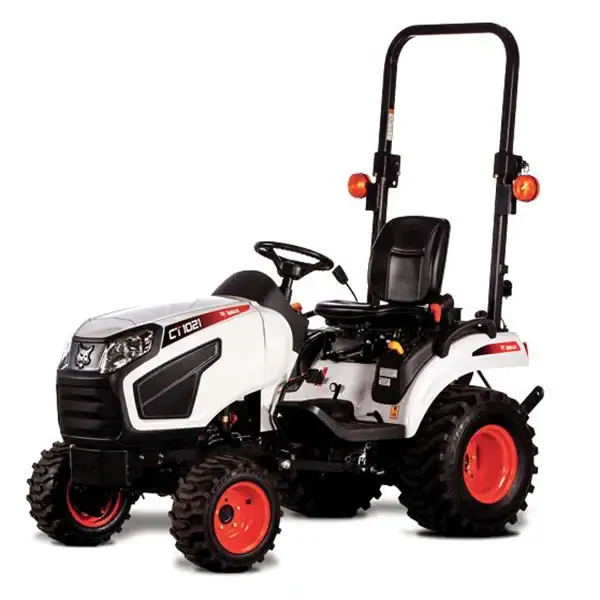
The Bobcat CT1021 is a useful starting point for a Canadian property owner who wants more than a mower but still needs a small machine around the house, garden and outbuildings. Its appeal is the combination of a sub-compact footprint, hydrostatic travel and front, rear and mid-mounted equipment possibilities. The right purchase is a complete set of compatible tools for recurring chores, rather than a tractor bought first and an attachment plan assembled afterwards.
It is particularly worth considering when mowing remains a large part of the workload and material handling is modest. If the essential job is unloading heavy deliveries, running a demanding rear implement or working on rough ground, establish those requirements before deciding that a small tractor is enough. The CT1021’s manageable size comes with real limits in clearance, implement geometry and power.
On This Page
ToggleCT1021 specifications with their measurement labels
| Item | North American model-page entry |
|---|---|
| Gross engine / PTO power | 21 / 16.3 hp |
| Transmission | Two-range hydrostatic |
| Rear / mid PTO speed | 540 / 2,200 rpm |
| Rear hitch | Limited Category 1 |
| Hitch lift, 24 inches behind lift point | 700 lb |
| Listed front-loader lift at maximum height | 608 lb |
| Loader bucket pivot height | 72 inches |
| Tractor width / ground clearance | 45.7 / 6.3 inches |
| Operating weight | 1,521 lb |
Source: Bobcat’s CT1021 model page, checked October 3, 2026. Some family summaries show different power entries; this guide consistently uses the detailed model table. Check serial-specific documentation for a particular used machine. Loader summary figures are not a universal allowance for material carried on forks.
Decide whether mowing is the main job or just one job
A tractor can mow a lawn and perform other work, but that does not mean it is the most convenient mowing machine for every property. Draw the lawn separately from the garden, lane and material-storage areas. Include trees, narrow passages and places where the machine must reverse. Then consider the complete mowing package, not the tractor width alone.
A mid-mounted deck changes the clearance envelope. Its discharge arrangement and outer edges may govern passage between obstacles even when the tyres fit. A rear mower presents a different turning and backing problem. These differences are visible during a route demonstration and cannot be settled from engine horsepower.
Also count changes of equipment. If mowing occurs every week but loader work is occasional, the process of parking and reconnecting the loader deserves attention. Identify a suitable storage surface, the required parking hardware and the approved procedure. Avoid assuming that every advertised package includes everything needed for easy removal.
For a mainly lawn-care purchase, compare the complete tractor arrangement with a separate mowing machine. Aglist’s tractor-versus-zero-turn guide helps frame that decision. The CT1021 becomes more compelling when its additional chores are frequent enough to justify the attachments and changeover routine.
Limited Category 1 is a useful boundary
The word “limited” should remain on the implement worksheet. A compatible pin category alone does not prove that a rear tool has the appropriate geometry, transport clearance or weight distribution for a sub-compact tractor. A long implement can present a different problem from a compact one of equal mass.
Begin with the exact implement model and its tractor requirements. Record hitch compatibility, mass, required power and any ballast instructions. Have the complete combination checked through its approved operating and transport positions. If a quick hitch is included, evaluate that configuration rather than assuming the extra connection changes nothing.
This is especially relevant to second-hand implements. A tool previously used on a larger tractor may connect to the arms yet remain unsuitable for the smaller machine. A low asking price does not remove a clearance or driveline problem. Inspect the actual implement, including its stands and connection hardware.
Keep the rear lift measurement separate from front-loader capability. The two systems perform different jobs. A rear hitch number cannot be used to approve a pallet on front forks, and neither figure establishes towing capacity.
What 16.3 PTO horsepower means for tool selection
For a shaft-driven mower, tiller or other implement, the published PTO output is the relevant tractor entry when the tool specifies PTO horsepower. The engine rating describes a different measurement point. An advertisement calling the CT1021 a “21-horsepower tractor” is therefore not a sufficient compatibility answer.
Consider a hypothetical implement requiring at least 18 PTO hp. The published model entry does not meet that threshold. This is an invented screening example, not a recommendation for a particular implement. A slower travel speed is not permission to ignore a stated minimum.
Once the power requirement is satisfied, working conditions still matter. A maintained garden and an unprepared site ask different things of a tiller. Regularly cut grass and neglected vegetation are not the same mowing workload. Select an implement for the intended duty as well as the tractor.
The rear and mid PTO entries also describe different shaft locations and speeds. A front-mounted implement needs its specified mounting and drive arrangement; the presence of a mid PTO does not prove that an arbitrary front snowblower fits. Bobcat’s PTO feature information identifies the CT1021’s mid-PTO provision, while exact attachment fit remains a separate check.
Hydrostatic travel around buildings and garden beds
The transmission is worth trying in the sort of short movements the property actually requires. Positioning near a material pile, withdrawing from a receiving point and lining up with an implement can involve many direction changes. Evaluate the pedal reach, seat adjustment and view of the work with the regular operator.
Two ranges do not mean two fixed working speeds. Travel varies within the selected range, while changing range follows the machine’s operating procedure. During PTO work, the required shaft speed and suitable ground speed are separate settings to manage. Treating the travel pedal exactly like a car accelerator can obscure that distinction.
Aglist’s transmission comparison explains the broader choices. For the CT1021, the useful evidence is whether its controls support a smooth, repeatable work sequence. A short drive through an open sales yard does not assess repeated manoeuvring around a garden.
Loader chores: small loads and the right receiving point
A sub-compact loader can make routine material movement much less manual, but its usefulness depends on the load and destination. Describe whether the work involves mulch, soil, aggregate or packaged goods. Similar-looking bucket volumes can represent very different masses.
Measure the receiving container. Bucket-pivot height is not clearance under a tipped bucket, and clearing the edge is not the same as reaching far enough to place material usefully. A trailer with tall sides may govern the purchase even if most other loader chores are straightforward.
For forks, document attachment mass, complete load weight, dimensions, load centre and placement height. Obtain the applicable loader information and required ballast configuration. Do not convert the summary lift entry directly into a goods allowance or test capacity by seeing when the hydraulics stop lifting.
The loader-capacity guide explains these measurements. If one occasional delivery exceeds the approved package, supplier unloading may be more sensible than buying every weekly mowing task a larger tractor.
Plan winter work as a separate attachment package
A Canadian property can change the purchase priorities quickly once snow clearing becomes essential. Start with the snow destination and the time available. A blade needs somewhere to push; a blower needs a suitable discharge plan and a compatible drive system; a bucket adds carrying cycles.
Assess the open operator environment for the actual exposure and work duration. A weather enclosure should not be assumed to be a manufacturer-approved heated cab or a substitute for protective structures. Verify any proposed accessory’s compatibility, visibility and function before valuing it in the quotation.
Include the route later in the season, when banks occupy space beside buildings. A summer access test may miss a winter restriction. Use the tractor snowblower fitment guide to organise the mounting and drive questions, then establish the exact Bobcat combination.
Ground clearance, tyres and the finished surface
The CT1021 belongs in a different access discussion from a larger compact. Low obstacles, ruts and the fitted mower’s clearance deserve attention before rough-property work is included in its job description. The published tractor clearance is not necessarily the lowest point of a complete attachment package.
Choose tyres around the regular surfaces and permitted equipment combinations. Lawn preservation, loose-ground work and winter use can pull the decision in different directions. No tyre label guarantees that loaded passes on wet turf leave no marks. Evaluate the route and surface condition rather than treating tyre choice as a universal fix.
For storage, measure the full ready-to-park package and the actual opening. Follow the protective-structure instructions; do not modify a structure to make the tractor fit. Space for implements, servicing and changeover should be planned alongside the parking space.
Alternatives and used-machine inspection
The John Deere 1025R and Kubota BX2680 provide other sub-compact arrangements to investigate. Compare the complete mowing and loader packages, controls and local support using current manufacturer specifications. Existing model guides are starting points, not proof that attachments transfer between brands.
A larger compact such as the Kubota L2502 belongs in the discussion if rear tools or material handling dominate. That change also brings different space and mowing considerations. More tractor is useful when it resolves a documented requirement, rather than merely offering a larger number.
On a used CT1021, verify serial identity and each installed attachment. Have a qualified inspection cover drive response, PTO operation, hitch, loader mounts, axle, hydraulics and repair evidence. Review service records against the correct manual. These are general inspection priorities, not claims of recurring CT1021 defects.
Request an itemised Canadian quotation for the tractor, loader, mower, rear tools, necessary connections, setup and delivery. Add storage and transport where needed. A US advertised starting price is not a Canadian ready-to-work price, and a tractor-only weight is not a complete trailer manifest.
Before delivery, agree on a handover using the actual purchased tools. Record which connections, parking supports and adjustments are included. A practical demonstration of the complete package is more useful than receiving several separate manuals without seeing how the chosen equipment works together.
CT1021 buying questions
Is it a replacement for a lawn tractor?
It can add useful implement and loader functions, but compare the actual mowing route, finish and equipment changes before deciding.
Will any Category 1 tool fit?
No. Preserve the Limited Category 1 designation and verify geometry, mass, power and the complete attachment arrangement.
Does four-wheel drive increase its lifting rating?
It does not change the manufacturer’s approved loader or hitch conditions. Traction and lifting capacity are separate questions.
What most often justifies a larger platform?
An essential implement, clearance or handling requirement that the documented CT1021 package cannot meet.
What is the best reason to choose it?
A recurring mix of lawn care and appropriately sized property chores that benefits from a small tractor and a well-planned attachment set.
Share your experience
Help other Canadian buyers — leave a quick review for the
Bobcat CT1021
There are no reviews yet. Be the first one to write one.