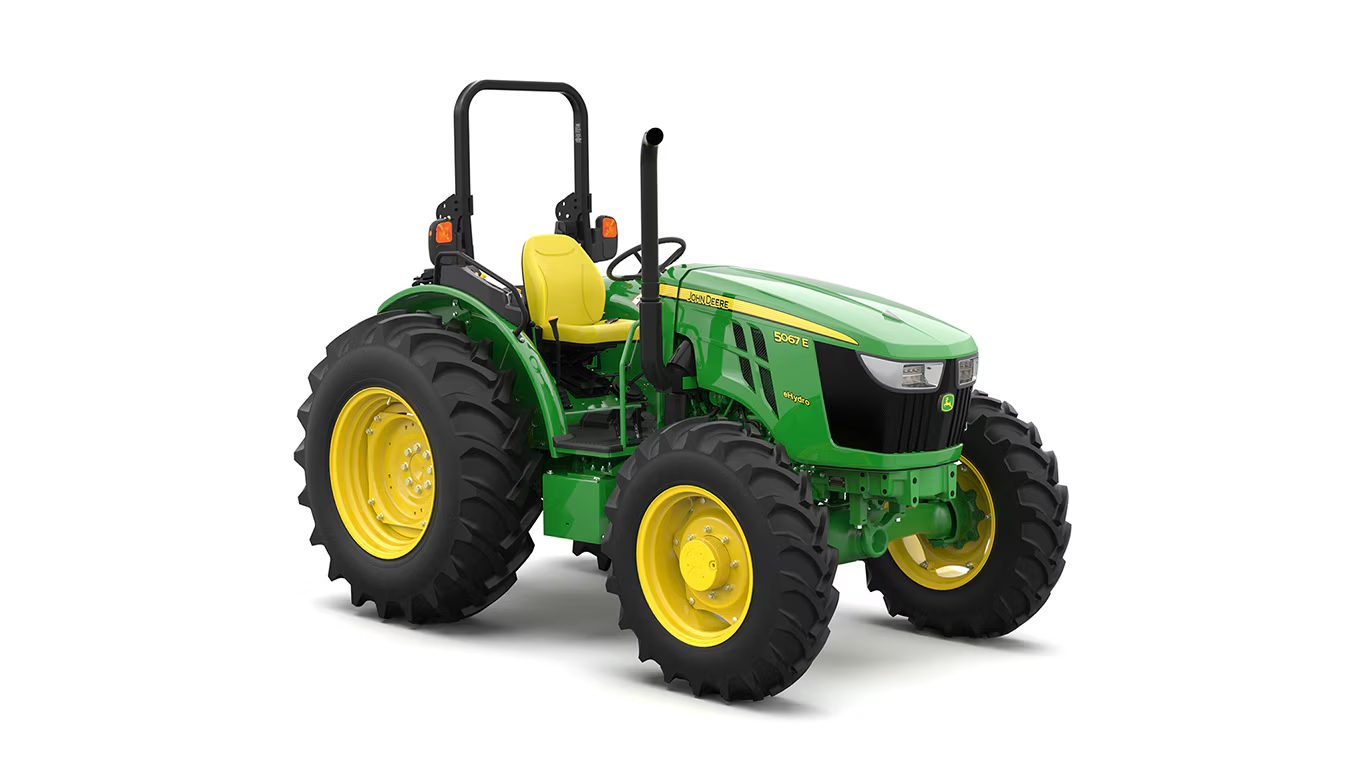
Overview & Specs
The John Deere 5067E deserves attention when a property owner or small farm needs to finish recurring implement work within a limited window, but does not want to choose a tractor solely by horsepower. The useful purchase starts with the mower, cutter or other tool, its required operating conditions, and the time available to complete the job. More engine output is useful only when the complete combination can turn it into acceptable work.
This guide covers the current Canadian model-page offering checked in October 2026. The page includes model-year-2027 eHydro material alongside geared alternatives. Older tractors carrying the 5067E name need their own serial-specific documents; current controls and ratings should not be assigned to them automatically.
On This Page
ToggleConfiguration-specific numbers to keep on the worksheet
The Canadian 5067E page lists these references.
| Item | Published value |
|---|---|
| Engine output | 67.5 hp at 2,100 rpm |
| Engine configuration | 2.9 L, three-cylinder diesel |
| Rated PTO, open station PR/TSS | 55.3 hp |
| Rated PTO, cab PR/TSS | 53.3 hp |
| Rated PTO, HST | 44.5 hp |
| Available flow at one rear SCV | 43.1 L/min |
| Rear hitch | Category 2, convertible to Category 1 |
The transmission choices shown are SyncShuttle, PowrReverser and eHydro. PR/TSS is the table’s grouping for the first two geared arrangements; HST is its hydrostatic entry. These are rated values, not promises of performance in every material or an invitation to substitute a maximum-power row.
Start with the work window
A farm may have plenty of total annual hours available yet only a short window for a particular job. Write down the area or quantity, required finish and realistic available time. Then identify the interruptions: gates, travel, refilling, obstacles, tool changes and maintenance checks.
This separates a genuine production requirement from a preference for a wider attachment. A larger cutter can reduce straight-line passes while becoming less convenient around trees and irregular boundaries. A narrower suitable tool may finish some properties sooner if it reduces backing, overlap or cleanup.
For illustration, an effective width of 2 m at 5 km/h gives a theoretical 1 hectare per hour: 2 multiplied by 5,000 equals 10,000 square metres. A 2.5 m effective width at 4 km/h gives the same theoretical coverage. These are invented inputs, not measured 5067E output or recommendations for a particular cutter.
Now add interruptions. A four-hectare job does not necessarily take four hours even when the straight-pass calculation says one hectare per hour. Count the time spent reaching the site and turning, and check whether the desired finish requires another pass. The demonstration should resolve those assumptions.
Power screening comes before width comparison
Obtain the exact implement’s requirements, including its mounting version. If a hypothetical tool requires at least 50 PTO hp, the two cited PR/TSS rated entries clear that numerical screen, while the HST entry does not. The engine figure cannot be used to erase the difference.
Passing that screen still does not guarantee a work rate. Crop density, soil conditions, implement adjustment and wear can influence the result. Choose a tool designed for the material, then evaluate a compatible tractor-and-tool combination in representative conditions.
Do not treat a gearbox rating as the minimum tractor requirement. Likewise, retain any maximum input or carrier limits. More tractor power is not permission to exceed an attachment’s intended duty or to ignore a protective device.
The PTO power guide explains the terminology. For this purchase, attach the implement evidence to the quotation so a change of transmission or tool model prompts a new check.
Choose travel control for changing material
A uniform demonstration strip can make almost any suitable transmission appear convenient. The harder question is what happens when the work changes within a pass. The operator may need a different ground speed while preserving the implement’s specified shaft speed.
With a geared arrangement, examine the available ratios and permitted shifts. Determine whether the normal working gear and the lower alternatives fit the task. Count range changes separately from ordinary gear changes; the total number of advertised speeds does not describe the whole control routine.
With the current eHydro option, evaluate pedal control and the fitted electronic assistance in the same task. Variable travel can be useful, but range choice, available PTO output and the implement’s requirements still apply. A convenient pedal does not turn an underspecified tool match into an approved one.
Include the regular operator and normal working footwear. Compare controlled approaches, headland manoeuvres and backing to an implement, not only straight travel. The transmission guide provides a framework for documenting those observations.
Economy PTO is a mode choice, not extra horsepower
The model table distinguishes PTO equipment by transmission and gives a 540E reference for the applicable package. That deserves verification when specifying the tractor, particularly if economical light-duty work is important. Do not assume that every 5067E, including an older used example, has the same PTO modes.
An economy mode is intended to maintain the required shaft speed at a lower engine speed where the available power suits the task. It is not permission simply to throttle down in the standard mode or to assume full rated power at every setting. Use the exact operating instructions and implement requirements.
For buying purposes, ask which recurring jobs could use the installed mode and how many hours they actually occupy. A feature used for occasional light work should not be assigned an annual saving based on all tractor hours. No fixed fuel-saving percentage is assumed here.
Hydraulics for a complete implement package
A PTO-driven machine can still need hydraulics for positioning, adjustment or another function. Write down each independent operation and identify whether it needs a brief cylinder movement or continuous flow. Electrical controls may introduce another connection requirement.
The single-valve flow entry is distinct from the combined pump output. The latter can include flow serving other tractor systems. A large total should not be presented as a hydraulic-motor supply rating.
Inspect the actual valve installation on a used machine. Count working functions and establish the controls and return provisions, rather than inferring capability from coupler count alone. Confirm simultaneous demands where the implement needs them.
The rear-remotes and third-function guide helps turn an attachment wish list into an equipment specification. A complete quotation should identify every required control and installation component.
Carrying the tool is a different assessment
A tool may pass the power screen yet remain unsuitable as a mounted load. Its mass, centre of gravity and distance behind the hitch matter. Keep the applicable lift measurement location and required tractor setup with the comparison.
The convertible hitch category helps define the interface, but pin sizes are not the entire fit. Check the full geometry and permitted movement, including any quick hitch. A longer mounting arrangement can change the driveline and carrying assessment.
Transport position also matters on a property with gateways or uneven approaches. A tool that works well in the field must still be moved and stored appropriately. Include folded or raised dimensions where applicable and identify how it will be parked securely for changeover.
For trailed equipment, use the drawbar requirements and actual attachment position. Do not convert the rear-hitch lift figure into a towing allowance. The two interfaces have different purposes and documentation.
Loader chores between field jobs
A 5067E may be selected primarily for rear tools and then expected to handle material around the yard. Treat that second job as a separate equipment brief. Identify the load, attachment, height and reach rather than assuming the engine class establishes loader suitability.
Account for the attachment’s own mass and the load centre. A pallet extending forward on forks differs from loose material close to a bucket’s reference position. The prescribed ballast and tyre arrangement belong in the delivered package.
Observe how much time is spent changing from field equipment to loading. If an awkward changeover consumes a substantial part of each session, a different storage arrangement or tool set may be more valuable than additional engine output. Record those delays in the demonstration.
The loader capacity explanation helps keep the numbers straight. It does not replace the actual loader and attachment ratings.
Canadian seasons and operator station
Open station, standard cab and premium cab alternatives should be assessed against the actual calendar. A sheltered seasonal property and a farm requiring winter work create different demands. Estimate the duration of exposure and the consequences if a job cannot wait for better conditions.
In a cab, evaluate sightlines to the work, visibility when reversing and the functioning climate equipment. Door clearance, seat adjustment and control reach deserve attention during the same demonstration. A feature list does not reveal whether the regular operator can use the package comfortably.
During thaw or wet periods, assess the route and ground support independently of drive configuration. More traction does not establish that the surface can carry the machine. Tyres and ballast should follow the documented setup and work, not an assumption that one tread suits everything.
Prepare for cold conditions using the applicable manual and approved equipment. This guide makes no claim about a universal starting temperature, annual fuel use or Canadian parts availability. Those need evidence for the actual machine and location.
Used-machine review and matched quotations
Identify the serial range, transmission, enclosure, PTO modes and installed hydraulics. Keep the current model-page snapshot separate from the documentation for the used unit. An abbreviated advertisement can conceal a configuration difference that matters to a required tool.
Have the engine, drive controls, PTO, brakes, steering and hydraulics inspected appropriately. Review service history, guards, tyres and structural repair evidence. Assess attachments separately rather than allowing a good tractor demonstration to establish their condition by association.
Compare ready-to-work cost: agreed repairs, correct attachment installation, ballast, delivery and any transport changes. If hauling is needed, obtain an equipped mass and a suitable loading plan for the complete combination.
The New Holland PowerStar 65 and KIOTI RX7320 guides offer alternative utility reference points. They help organise questions; their similar positioning does not establish equivalent controls, lift or PTO capability.
Frequently asked questions
Will a wider mower necessarily finish sooner?
No. Effective width, suitable travel speed, turns and finish all contribute. Compare completed work with compatible equipment.
Can the engine rating approve a 50-PTO-hp implement?
No. Use the rated PTO entry for the exact transmission and station, then check every other requirement.
Does eHydro remove all setup decisions?
No. Range, operating conditions, attachment matching and the fitted control features still need to be understood.
Is economy PTO a guaranteed fuel saving?
Its value depends on suitable loads and actual use. Measure equivalent completed work rather than assigning a universal percentage.
What should the demonstration settle?
Whether the identified tool and tractor can complete the recurring job to the required finish within the available window, including the interruptions that occur on your property.
Share your experience
Help other Canadian buyers — leave a quick review for the
John Deere 5067E
There are no reviews yet. Be the first one to write one.