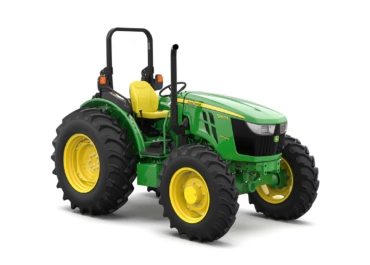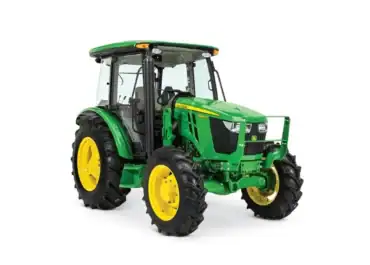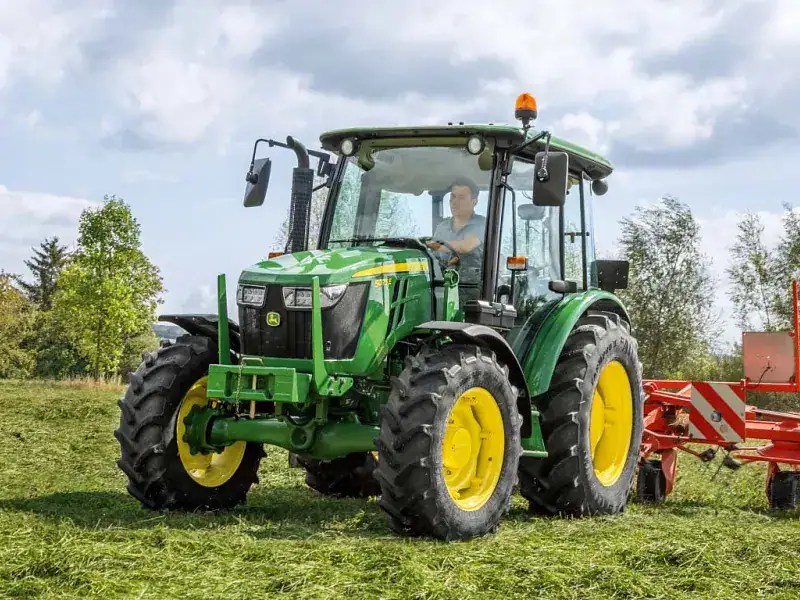
Overview & Specs
The John Deere 5075E is a useful candidate for a mixed chore tractor, but it should be bought around the loads and implements used every week rather than the number in its name. A Canadian farm may need the same machine to move feed, clear a yard and run a rear tool. Those jobs impose different requirements, and sufficient power for one does not approve the others.
The current Canadian page lists 71.3 rated engine hp, not an assumed 75 hp derived from the model designation. It also includes eHydro information referring to model year 2027. This guide uses that current documented offering while keeping earlier tractors and their equipment separate. A used 5075E needs documentation matching its own serial range and configuration.
On This Page
ToggleThe current model-table references
These figures come from the Canadian 5075E page.
| Reference | Published value |
|---|---|
| Engine | 2.9 L, three-cylinder diesel; 71.3 hp at 2,100 rpm |
| Rated PTO, open station PR/TSS | 57.0 hp |
| Rated PTO, cab PR/TSS | 55.0 hp |
| Rated PTO, HST | 51.4 hp |
| Base mass, MFWD open station | 2,685 kg |
| Base mass, MFWD cab | 3,040 kg |
| Rear hitch | Category 2, convertible to Category 1 |
The page offers SyncShuttle, PowrReverser and eHydro arrangements and open, standard-cab and premium-cab choices. PR/TSS identifies the geared grouping in the power table. Base weights are not equipped hauling weights, and maximum-power entries at other conditions should not replace the rated PTO values above.
Build a daily chore map
List the jobs in the order they happen on a normal working day. Include where tools are stored, how often the tractor changes attachments, what has to pass through a doorway and where material is placed. The sequence often reveals constraints hidden by a list of separate tractor capabilities.
For example, feeding may require picking up material outside, passing through a restricted approach and placing it at a particular height. Yard clearing may then require another attachment. A tractor can be suitable for each isolated task yet inconvenient if changeover space or storage makes the sequence cumbersome.
Measure the complete package through the route, including the front attachment and any rear ballast equipment. Consider the space needed to turn after the load is placed. A successful empty pass through a doorway does not establish that the working movement fits.
Record the longest recurring session and the most awkward repeated movement. Those observations help decide whether cab equipment, travel controls or a different attachment would improve the day more than another increment of horsepower.
Bale handling must have its own load assessment
Do not use the model name to decide that a bale is suitable. Establish actual bale mass, attachment type, load position and placement height. Material and condition can change mass, so an estimate based on one familiar bale is not enough for every handling task.
A front attachment and a rear-mounted carrier create different load arrangements. The front loader must be assessed with its own documented limits, the attachment’s mass and the actual load centre. A three-point lift figure cannot answer a loader question.
Include the route and final placement. Reaching over an obstacle or stacking at height can change the requirement compared with picking up the same load close to the machine. Select an approved complete package and operating method; do not use an improvised overload demonstration to discover its limits.
The prescribed ballast and tyre setup should appear in the quotation. The loader capacity guide explains why pivot-pin figures and fork or bale loads are not interchangeable. If the essential task falls outside the documented package, another loader arrangement or machine class may be necessary.
Transmission choice follows the number of reversals
Daily loading can place a high value on convenient approach and direction control. The current eHydro option therefore deserves a representative demonstration, as does a suitable PowrReverser package. Compare the actual movements and the regular operator’s response rather than treating one label as an automatic winner.
For a mostly field-oriented schedule, useful ratios at the required engine speed may matter more than fine yard positioning. Include the rear implement in the comparison. A tractor that feels convenient while empty may provide a different experience when maintaining prescribed PTO conditions.
SyncShuttle, PowrReverser and eHydro are distinct arrangements. Have direction changes, gears, ranges and any electronic features explained using the correct operating instructions. Convenient reversing is not permission to make every shift without following its procedure.
Deere’s current eHydro marketing uses model-specific internal comparisons. Those do not establish a universal time saving on your farm. The transmission guide helps structure an observation of the whole job instead.
PTO equipment: an implement minimum can separate versions
Suppose a hypothetical implement requires at least 55 PTO hp. The cited cab PR/TSS entry is at that numerical threshold, the open-station entry is above it, and the HST entry is below it. This is an illustrative screening exercise, not an approval for any implement or a recommendation to buy without appropriate working margin.
The tool’s complete requirements still govern: shaft speed, mounting, driveline, hydraulic functions and intended duty. A matched minimum does not promise the desired output in dense material or difficult conditions. Obtain the exact tool model and mounting version before finalising the tractor.
Do not turn a maximum PTO figure at a different engine speed into a substitute for rated output at the required conditions. Also avoid using the old assumption that a 5075 designation always means the same engine or PTO rating across years.
The power-rating explanation provides a useful foundation. Keep the configuration-specific numbers beside the equipment list so a transmission or cab change does not go unnoticed.
Hydraulics and attachment changes between chores
A loader, grapple and rear tool can require several different control functions. Describe each action rather than asking only for more outlets. A valve needed for continuous tool operation may have different requirements from one used for occasional cylinder movement.
Separate available circuit flow from a combined pump total. The current page lists different totals across transmission arrangements; that does not establish that the entire amount is available at a single connection. Match the tool’s pressure, flow, return and control requirements to the installed circuit.
Plan where attachments are parked and how they will be connected under the prescribed procedure. Poor storage can consume more time than a faster transmission saves. A tool set should be convenient to inspect, identify and change without improvising its support or access.
The hydraulic-control guide helps distinguish the functions that belong in a complete quotation. Do not assume a loader package includes every control needed for a future grapple.
The cab decision is about exposure and visibility
A daily winter chore tractor can justify weather protection differently from a seasonal field machine. Consider the duration of work, wind exposure and whether the task can be postponed. A cab’s value is tied to the real routine rather than the annual hour total alone.
Evaluate visibility with the actual loader attachment and at the positions where work is performed. Check rearward sightlines for the chosen implement. Heating, demisting, doors, glazing and the condition of seals all deserve inspection on a used cab.
Do not assume premium equipment is automatically necessary or that a standard cab is automatically adequate. Itemise the differences and try the controls. The operator should be able to reach and identify the required functions while maintaining a sensible working posture.
The cab versus open-station guide helps organise those trade-offs. Measure the storage and working route for the offered configuration before assigning a comfort preference final priority.
Snow work is a separate attachment brief
Decide whether snow will be pushed, carried or blown and where it will end up. A route that is easy early in winter can become restricted as banks accumulate. The tractor and attachment need room for the complete movement, not just the initial clearing width.
A rear blower brings PTO, reverse travel, chute-control and visibility questions. A front blade or pusher brings different hydraulic and handling requirements. Avoid selecting one solely because it appears in a package advertisement.
Plan cold-weather preparation from the tractor and implement manuals. Approved fluids, starting equipment and maintenance matter; no particular minimum starting temperature is promised here. Ground conditions and traction must be assessed separately from engine readiness.
Weight affects access, hauling and the cost comparison
The two listed MFWD base masses differ by 355 kg. That arithmetic describes the published configurations, not the complete difference between any two quotations. Loader, ballast, tyres and attachments can further change the package.
For transport, establish the actual equipped mass and deck arrangement. Spare tools may need substantial space as well as load allowance. Check the complete trailer, ramps, securement provisions and towing arrangement against the actual combination and applicable requirements.
If the tractor remains on one farm, contracted delivery may be more practical than maintaining dedicated hauling equipment. If it moves frequently, loading and travel time deserve a place in the ownership calculation. The same tractor can be economical in one pattern and inconvenient in another.
Compare ready-to-work quotations rather than base prices. Add agreed repairs, missing controls, attachments, ballast and commissioning. Use real local quotations for those costs instead of assuming that an incomplete machine can be finished cheaply.
Used 5075E: inspect the history behind the familiar name
Record serial identity, transmission, cab or open station, PTO modes and hydraulic equipment. Obtain the correct manuals and service history. Current model-page features do not establish what is fitted to an earlier tractor.
Have the engine, drive controls, brakes, steering, PTO and hydraulic operation assessed under appropriate conditions. Inspect the loader separately for wear, damage, locks and undocumented repairs. Check included implements independently. These are general inspection priorities rather than claims of recurring 5075E problems.
For a tractor needed daily, identify service arrangements and a practical backup plan. Avoid assuming a particular parts lead time or resale premium without evidence. Availability of support in your location can matter more than a small difference in headline output.
The New Holland Workmaster 70 and KIOTI RX7320 provide alternative utility references. Compare their exact packages against the same chore map, especially transmission, PTO and loader requirements.
Frequently asked questions
Does 5075E mean 75 rated engine horsepower?
Do not infer the rating from the name. The current Canadian page used here lists 71.3 hp; older units require their own documentation.
Can PTO power establish bale-handling capacity?
No. Loader, attachment, load centre, height and prescribed setup need a separate assessment.
Is the HST version equivalent for every rear tool?
The published rated PTO entries differ. Match the exact configuration to the implement requirements.
Is base weight sufficient for trailer selection?
No. Establish the complete equipped load, carried tools and hauling arrangement.
What makes the 5075E worth choosing?
A verified fit across the daily chore sequence, with a suitable loading package and rear implements, usable controls and an operator station appropriate to the season.
Share your experience
Help other Canadian buyers — leave a quick review for the
John Deere 5075E
There are no reviews yet. Be the first one to write one.