Overview & Specs
John Deere 1025R Reviews, Specs & Ratings
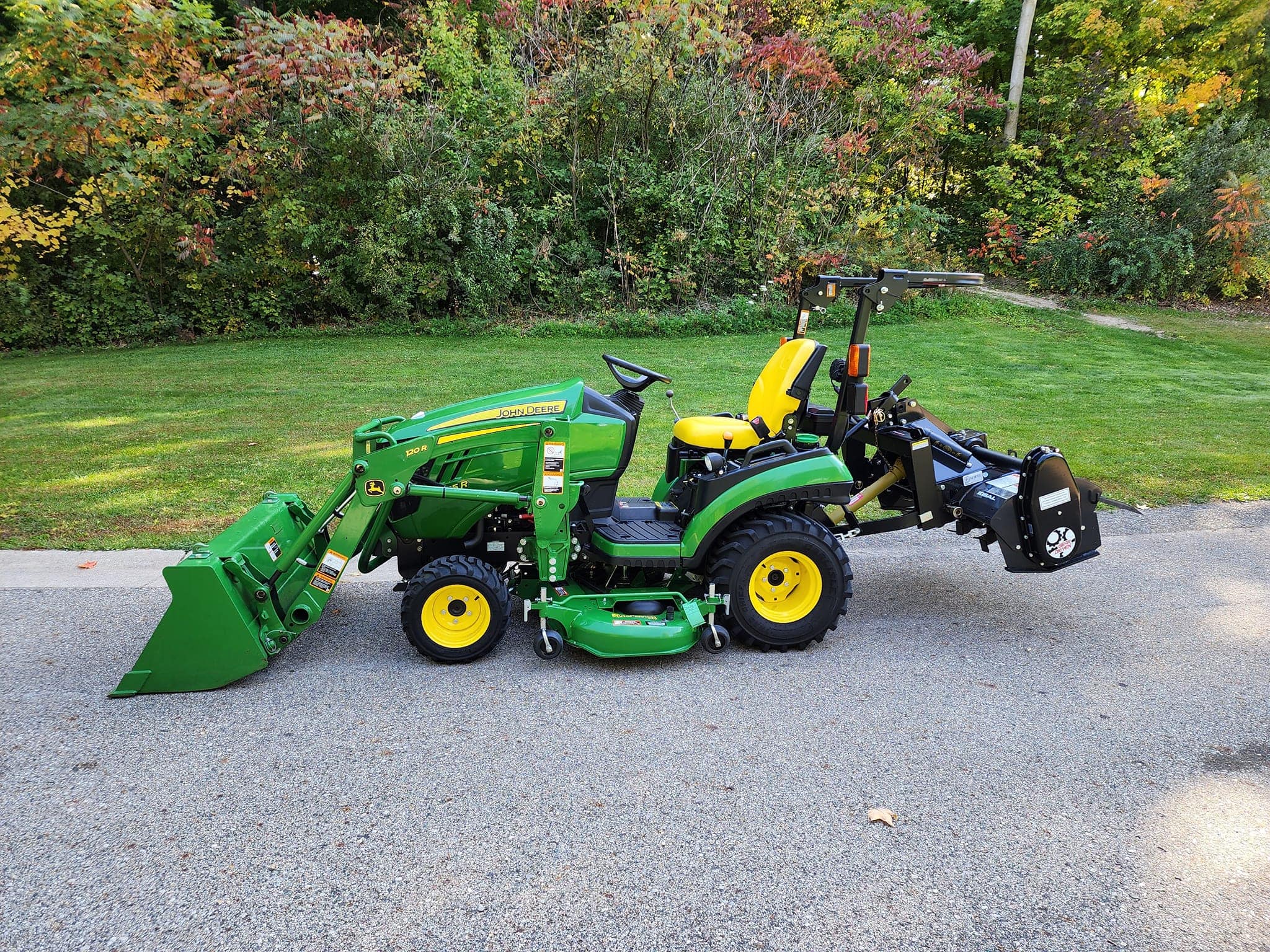
The John Deere 1025R is the flagship model in John Deere’s bestselling 1 Family sub-compact tractor lineup — and one of the most-popular sub-compact tractors in the Canadian market. With 23.9 gross horsepower from its Yanmar-built 3-cylinder diesel engine, the 120R Quik-Park loader for tool-less attachment changes, AutoConnect mid-mount mower deck compatibility, and the iconic John Deere green-and-yellow ecosystem of attachments and dealer support, the 1025R is engineered specifically for acreage owners, hobby farmers, large-property homeowners, and operators with 1-5 acres who want serious sub-compact capability in a John Deere platform.
The 1025R competes directly with the Kubota BX2680 — and for many Canadian buyers, the choice between these two flagship sub-compacts is the single most-debated equipment decision they’ll make. Both deliver real tractor capability in a sub-compact footprint. Both come from manufacturers with strong Canadian dealer networks and parts availability. Both retain value extremely well on the used market. The differences are real but more nuanced than the marketing on either side suggests.
The 1025R’s signature advantages include the AutoConnect drive-over mower deck system (connect a 54″ or 60″ mower deck in under 60 seconds without leaving the seat), the standard Twin Touch hydrostatic foot pedals(forward/reverse on separate pedals for reduced ankle fatigue), the Quik-Park Loader system (tool-less front loader removal in about a minute), and the iMatch Quick-Hitch Category 1 implement system. For operators who prioritize ease of attachment changes and intuitive controls, the 1025R often wins the cross-shop against the BX2680.
On Aglist, this page goes beyond John Deere’s brochure to help Canadian buyers understand exactly when the 1025R is the right choice over the smaller 1023E, when stepping up to the 2025R makes more sense, and how the 1025R genuinely compares to the Kubota BX in real Canadian acreage operation.
Aglist advantage: Use the 1025R Reviews & Ratings section below to compare real Canadian owner feedback on loader performance, mowing quality with the AutoConnect deck, cold-weather operation, and the long-debated 1025R vs Kubota BX2680 decision.
On This Page
ToggleQuick Specs
- Equipment type: Sub-compact utility tractor
- Family: John Deere 1 Family
- Model: 1025R
- Engine: Yanmar 3-cylinder liquid-cooled diesel (TNV Series)
- Engine displacement: 77.5 cu. in. (1,267 cc)
- Engine gross horsepower: 23.9 HP
- Engine PTO horsepower: 18.3 HP
- Rated engine speed: 3,200 RPM
- Fuel system: Mechanical injection — no DPF, no DEF
- Transmission: Hydrostatic (Twin Touch pedals) with 2-range high-low
- Drive system: 4WD standard (MFWD)
- Brakes: Wet disc
- PTO type: Fully independent PTO
- Rear PTO speed: 540 RPM
- Mid PTO speed: 2,100 RPM
- 3-point hitch category: Category 1 (limited)
- 3-point lift capacity (24″ behind pin): 681 lb
- Hydraulic flow (total): 6.3 GPM
- Compatible front loader: John Deere 120R Quik-Park
- 120R lift capacity (at pin, full height): 758 lb
- 120R maximum lift height: 71 in
- Compatible mid-mount mowers: 54″ AutoConnect or 60″ AutoConnect drive-over decks
- Compatible backhoe: 260B
- Travel speed (forward): 0-8.6 mph
- Travel speed (reverse): 0-7.6 mph
- Wheelbase: 57.5 in
- Overall length: 87 in (tractor only)
- Overall width: 41 in (min. tread)
- Overall height (with ROPS): 76.5 in
- Ground clearance: 8.6 in
- Operating weight: 1,444 lb (tractor only)
- Fuel tank capacity: 5.4 gal
- ROPS: Folding 2-post (under 84″ for garage clearance)
Reviews & Ratings on Aglist
Factory specifications tell you what the John Deere 1025R is engineered to do. Real owner reviews tell you whether it actually delivers on the John Deere reputation — and whether buyers would choose green over orange (Kubota BX) again.
What 1025R buyers consistently want to know:
- How does the AutoConnect mower deck actually compare to Kubota’s Easy-Over system in daily use?
- Is the Yanmar engine really as reliable as John Deere’s marketing suggests?
- How does the 1025R cold-start in –25°C prairie winters?
- Is the 120R loader genuinely capable for typical acreage work?
- Does the Twin Touch pedal system really reduce operator fatigue vs Kubota’s single rocker pedal?
- For a property of 1-5 acres, is the 1025R sufficient long-term?
- 1025R vs Kubota BX2680 — would owners choose John Deere again, or switch?
- How does dealer service experience compare to Kubota in your specific Canadian region?
This is where real Canadian owner experience matters most. The 1025R has been one of John Deere’s volume bestsellers since its 2013 introduction, with multiple generations of refinement. Owner reviews on this page particularly help future buyers understand the 1025R vs Kubota BX2680 decision — the most cross-shopped sub-compact tractor comparison in Canada.
What Makes the 1025R Different
Three engineering decisions define the 1025R within the John Deere lineup.
The AutoConnect Mid-Mount Mower System
The 1025R’s AutoConnect mower system is one of its strongest competitive advantages. While Kubota’s Easy-Over deck system uses ramps and a drive-over approach with manual rear locking, John Deere’s AutoConnect goes further: the mower deck attaches in under 60 seconds with the operator simply driving over the deck and engaging the locking system from the seat. The only off-seat step is locking the gauge wheels.
For owners who remove the deck seasonally (or to use the tractor for non-mowing work without ground clearance compromise), this is a meaningful daily productivity advantage. Many 1025R owners cite the AutoConnect system as a primary reason they chose the 1025R over the Kubota BX.
Twin Touch Hydrostatic Pedals
The 1025R uses side-by-side forward and reverse foot pedals (Twin Touch) — push the right pedal to go forward, push the left to reverse. This is fundamentally different from Kubota’s single rocker treadle pedal (rock forward to go forward, rock backward to reverse).
The practical implication: after a full day of mowing or loader work, the Twin Touch system requires meaningfully less ankle rotation. Owners doing 4-6 hours of continuous tractor work report less fatigue. For occasional users, this difference is minor; for daily users, it’s real.
This is one of the longest-debated comparison points between the 1025R and Kubota BX2680. Owner preferences split roughly evenly — some buyers strongly prefer Twin Touch, others find Kubota’s single-pedal approach more intuitive.
Sub-25 HP Engine = No DPF/DEF
Like the Kubota BX2680, the 1025R is deliberately rated under 25 HP (specifically at 23.9 HP) to avoid EPA Tier 4 Final emissions requirements. This means no diesel particulate filter (DPF) and no diesel exhaust fluid (DEF) — a significant long-term ownership advantage that John Deere shares with the Kubota BX class.
The Yanmar engine in the 1025R uses mechanical fuel injection without the electronic complexity of larger compact tractors. For Canadian buyers, this means:
- No regeneration cycles to manage
- No DEF tank to refill
- No emissions-related derate codes
- Simpler diagnostics when something does go wrong
- Lower long-term maintenance complexity
This is one of the 1025R’s strongest practical advantages over John Deere’s larger 2 Family compact tractors (which use DPF) and well-aligned with the Kubota BX class for emissions simplicity.
Engine & Performance
The 1025R is powered by a Yanmar 3-cylinder liquid-cooled diesel engine (TNV Series) — a long-standing John Deere/Yanmar partnership that delivers proven reliability.
Key engine specifications:
- Type: 3-cylinder, vertical, liquid-cooled, 4-stroke diesel
- Manufacturer: Yanmar (built for John Deere)
- Displacement: 77.5 cu. in. (1,267 cc)
- Bore × Stroke: Suited to compact size class
- Rated speed: 3,200 RPM
- Gross horsepower: 23.9 HP @ 3,200 RPM
- PTO horsepower: 18.3 HP
- Fuel system: Mechanical injection
- Cold-start: Glow-plug preheat
- Emissions: EPA Tier 4 Final compliant without aftertreatment (under 25 HP threshold)
The Yanmar engine is among the most-respected in the sub-compact tractor category. Notable features:
- Larger displacement than the Kubota BX class — the 1025R’s 1,267 cc is meaningfully larger than the Kubota BX2680’s 1,005 cc, delivering more torque per HP rating
- Industry-standard Yanmar reliability — same engine family used in countless industrial and equipment applications globally
- Strong cold-start characteristics even at the higher 3,200 RPM design speed
- Well-proven through 10+ years in the 1025R platform
Fuel consumption typical range: 0.6-1.0 gallons per hour during mixed sub-compact use (mowing, light loader, tillage). The 5.4-gallon fuel tank typically delivers 5-9 hours of continuous work between fillings — slightly less runtime than the Kubota BX class (which has 6.6-gallon tanks).
Quik-Park Loader (120R)
The 1025R is most commonly purchased with the John Deere 120R Quik-Park front loader — one of the most-praised aspects of the 1025R package.
Quik-Park refers to John Deere’s tool-less loader removal system. Removing the loader from the 1025R takes approximately one minute with no tools. This matters for two practical reasons:
- Mowing without the loader. Removing the loader before mowing meaningfully improves turning radius, reduces front-end weight on lawn surfaces, and improves visibility. Sub-compact owners doing significant mowing benefit substantially from the easy removal.
- 3-point and PTO work. Heavy 3-point implements work better without the front loader weight. Tool-less removal makes seasonal transitions practical.
120R Quik-Park loader specifications:
- Maximum lift height (pivot pin): 71 inches
- Lift capacity at pivot pin (full height): 758 lb
- Real-world bucket capacity: Approximately 500-550 lb of material accounting for bucket weight and forward reach
- Bucket breakout force: Strong for size class
- Tool-less removal: Approximately 1 minute, no tools required
- Compatible with John Deere implement attachments
The 758 lb pin-pivot lift capacity is higher than the Kubota BX2680’s 699 lb specification at 1500mm — a real but modest advantage for 1025R buyers handling heavier pallet loads or larger material volumes. For typical acreage work (garden materials, light gravel, mulch, small pallet loads, snow scooping), both the 120R and Kubota’s LA344 perform comfortably.
The optional 3rd Function Valve adds hydraulic capability for grapples and similar attachments — useful for brush work, material handling, and any attachment requiring hydraulic actuation beyond the standard bucket controls.
AutoConnect Mid-Mount Mower System
The 1025R’s AutoConnect mower system is genuinely innovative and one of the strongest competitive advantages over the Kubota BX class.
Compatible mid-mount decks:
- 54″ AutoConnect (54D) drive-over deck
- 60″ AutoConnect (60D) drive-over deck
The AutoConnect system process:
- Drive the tractor over the deck (the deck stays on its rolling base)
- Lower the deck-engagement mechanism via in-cab control
- Lock the gauge wheels (the only off-seat step)
- Resume operation
Total time: under 60 seconds. Compare to Kubota’s Easy-Over system, which is also drive-over but requires manual rear locking and ramp deployment — typically 2-3 minutes once familiar.
The Load-N-Go attachment system further extends the AutoConnect concept: with optional Load-N-Go ramps, the operator can use the front loader to move the disconnected mower deck around the property (to or from storage) — eliminating the need to drag or lift the deck manually.
Mid-PTO speed: 2,100 RPM (slightly different from Kubota’s 2,500 RPM standard) — optimized for the AutoConnect deck design.
Real-world mowing capability:
- 1-4 acres of residential turf: Excellent in 1-2.5 hours with the 60″ deck
- 4-7 acres of mixed turf: Capable but at the upper end of comfortable use
- Heavy/wet grass conditions: Manageable with slower ground speed; the Yanmar engine’s torque helps
- Manicured lawn quality: Strong with proper deck setup and sharp blades
For properties under 5 acres where mowing is significant (but not dominant), the 1025R with the 60″ AutoConnect deck delivers comfortable, productive mowing. For properties over 5 acres or operations where mowing dominates use, consider the larger 2025R (with 30 HP) or a dedicated John Deere ZTrak zero-turn mower.
Backhoe Capability (260B)
The 1025R is compatible with the John Deere 260B backhoe — though backhoe integration is less common on the 1025R than on competing TLB-class machines like the Kubota BX23S.
260B backhoe key specifications:
- Digging depth: Approximately 6 feet
- Subframe-mounted (not factory-integrated like BX23S)
- Hydraulic thumb available as option
- Reversible operator seating for backhoe operation
- Tool-less attachment with proper subframe pre-installation
Important consideration: the 1025R’s R1 cab is NOT compatible with the 260B backhoe — cab-equipped 1025R tractors cannot accept the 260B without removing the cab. Open-station 1025R tractors accept the backhoe without modification.
For buyers specifically seeking factory TLB capability, the Kubota BX23S delivers more integrated TLB performance than the 1025R + 260B combination. The 1025R is fundamentally a tractor that can accept a backhoe, not a factory TLB. For occasional backhoe use, however, the 1025R + 260B combination is fully functional.
Transmission & Drive
The 1025R uses hydrostatic transmission with Twin Touch foot pedals and 2-range high-low gear selection.
Key transmission features:
- Twin Touch pedals: Side-by-side forward/reverse pedals (the major control-style difference vs Kubota BX class)
- High/low range: Mechanical selector lever; must stop to shift between ranges
- 4WD standard (MFWD): No 2WD option
- Fully independent PTO: Engages and disengages without affecting transmission
Range usage typical pattern:
- Low range: Loader work, slow PTO, precise positioning, snow blowing
- High range: Mowing, transport, normal work
Hydrostatic Power Steering is standard, delivering smooth steering effort even with the loader installed.
The Twin Touch vs single rocker pedal debate: This is the most-discussed control difference between the 1025R and Kubota BX2680. Owner preferences split:
- Twin Touch favorites cite reduced ankle fatigue, more intuitive operation, easier precise speed control
- Single rocker favorites cite simpler operation, faster direction changes, less foot positioning complexity
Neither approach is objectively better. Most operators adapt to whichever they have within 10-20 hours of use. For buyers cross-shopping, test driving both is the only meaningful way to identify your preference.
3-Point Hitch & PTO
The 1025R features a Category 1 (limited) 3-point hitch:
- Lift capacity at 24″ behind pin: 681 lb
- Position control: Standard
- iMatch Quick-Hitch compatible: Yes (significant productivity advantage)
- Fully independent PTO with electro-hydraulic engagement
The iMatch Quick-Hitch system is a notable John Deere advantage. It allows hookup of Category 1 implements in seconds using three fixed points — the operator backs up to the implement, the iMatch automatically engages the pins, and the implement is ready to use. No leaving the seat required for most implement changes.
Practical PTO capability with 18.3 PTO HP:
- 54″ or 60″ mid-mount mower (AutoConnect): Strong continuous use
- 4-foot rotary cutter (rear): Excellent in all conditions
- 5-foot rotary cutter (rear): Capable in light-to-moderate grass; struggles in heavy conditions
- 48-inch tiller (rear): Strong in light-to-moderate soil
- Snow blower (front-mounted via Quik-Tatch): Capable in moderate snow conditions
- Post hole digger (9-inch auger): Strong performance
The 18.3 PTO HP slightly exceeds the Kubota BX2680’s 19.5 PTO HP for sustained PTO operation — within the noise of normal variability, the two tractors deliver similar PTO performance.
Operator Comfort & Storage
The 1025R operator station is well-regarded for its size class:
- Step-through flat platform with fender-mounted handrails (easy mounting from either side)
- Color-coded controls for quick identification
- Tilt steering wheel
- Deluxe suspension seat with movable armrests
- Easy-access toolbox
- Standard 12-V outlet on right-hand fender for accessories
- Easy-lift hood with dual gas-charged lift struts
- Foldable ROPS for garage storage compatibility
- Optional R1 cab (dealer-installed) — full enclosure with heat and optional A/C
The R1 cab is a meaningful capability differentiator for cold-climate Canadian buyers. Key R1 cab features:
- Sound damping system for quieter operation
- Removable doors and front/rear windows that open nearly 90 degrees (comfortable in warmer months)
- Full glass doors for excellent visibility
- Compatible with all 1025R tractor implements except the 260B backhoe
- Heated cab with optional A/C
R1 cab adds approximately $8,000-12,000 CAD over the open-station price — comparable to Kubota BX cab pricing.
Storage compatibility: With ROPS folded, the 1025R stands at 76.5 inches — fits comfortably through standard residential garage doors (7-foot clearance). Width of 41 inches (min. tread) and overall length of 87 inches (tractor only, more with implements) mean the 1025R parks within most single-car garage stalls.
Best Applications for the 1025R
The John Deere 1025R fits a specific operational profile across Canadian properties.
Best fit for the 1025R:
- Residential acreages (1-5 acres) with comprehensive maintenance needs
- First-time tractor buyers specifically wanting John Deere build quality and dealer support
- Properties requiring 60-inch mowing capability with AutoConnect convenience
- Operators who do significant daily tractor work and value the Twin Touch pedal system
- Garden and landscape operations with regular material handling
- Small-property snow removal including front-mounted snow blowers
- Year-round operators in cold climates (with R1 cab option)
- Buyers who value John Deere’s nationwide dealer network and parts availability
Best fit with R1 cab option:
- Year-round small property maintenance in cold provinces
- Snow removal as a primary winter use
- Operators valuing all-season comfort
- Operations where weather-independent productivity matters
Less suitable for:
- Properties over 7-10 acres with regular heavy work — consider 2025R or step up to compact utility tractors
- Operations focused on dedicated mowing of 5+ acres weekly — consider John Deere ZTrak zero-turn
- Heavy loader work or pallet handling beyond 700 lb — fundamentally underpowered
- Operations needing 5-foot or larger rear PTO implements consistently — at upper limit
- Buyers seeking factory TLB capability — Kubota BX23S is more capable for that specific use
- Buyers prioritizing absolute lowest price — Kubota BX2380 is often $2,000-3,000 CAD less
1025R vs 1023E vs 2025R
The 1025R’s most-common cross-shop is within the John Deere lineup itself.
| Feature | 1023E | 1025R | 2025R |
|---|---|---|---|
| Family | 1 Family | 1 Family | 2 Family |
| Engine | Yanmar 3-cyl | Yanmar 3-cyl | Yanmar 3-cyl |
| Gross HP | 22.4 | 23.9 | 24.7 |
| PTO HP | 17.4 | 18.3 | 18.6 |
| DPF/DEF | No / No | No / No | DPF required |
| Loader | 120R Quik-Park | 120R Quik-Park | 220R Quik-Park |
| Loader Lift (at pin) | ~530 lb | 758 lb | Higher than 120R |
| Independent PTO | Yes | Yes | Yes |
| iMatch Quick-Hitch | Yes | Yes | Yes |
| Cab Option | Yes | Yes (R1) | Yes |
| Approx CAD price (with loader) | $20,000–$24,000 | $24,000–$29,000 | $30,000–$36,000 |
Choose the 1023E if: You want the most economical John Deere sub-compact, your work fits within the smaller loader capacity, you’re prioritizing budget over capability.
Choose the 1025R if: You want the flagship 1 Family experience, you need the 120R loader’s stronger lift capacity, you want the full AutoConnect mower compatibility, you want premium operator amenities. The most-popular John Deere sub-compact choice.
Choose the 2025R if: You specifically need 24.7 HP and the larger 220R loader, you accept DPF requirements, properties at 5-10 acres or larger require sustained power. Note that the 2025R steps over the 25 HP emissions threshold and requires DPF management — significant practical change versus the 1025R’s emissions-free design.
The 1025R vs 1023E decision turns mostly on budget. The 1023E saves $4,000-5,000 CAD but delivers meaningfully less loader capability. For most buyers, the 1025R represents better long-term value.
The 1025R vs 2025R decision turns on emissions tolerance. The 2025R adds DPF complexity in exchange for slightly more capability. Many John Deere buyers specifically prefer the 1025R because of the no-DPF advantage — even though they could afford the 2025R.
1025R vs Kubota BX2680: The Honest Comparison
This is the most-cross-shopped sub-compact tractor decision in Canada. The honest comparison:
| Feature | John Deere 1025R | Kubota BX2680 |
|---|---|---|
| Engine | Yanmar 3-cyl, 1,267 cc | Kubota D1005, 1,005 cc |
| Gross HP | 23.9 | 24.8 |
| PTO HP | 18.3 | 19.5 |
| Loader Lift (at pin) | 758 lb | 699 lb @1500mm |
| Mower Connection | AutoConnect (~60 sec) | Easy-Over (~2-3 min) |
| Pedal Style | Twin Touch (side-by-side) | Single rocker treadle |
| Front Attachment System | Quik-Tatch | Multiple attach options |
| PTO Engagement | Independent | Independent |
| DPF/DEF | No / No | No / No |
| Operating Weight | 1,444 lb | 1,520 lb |
| Ground Clearance | 8.6 in | 8.4 in (min) |
| Fuel Tank | 5.4 gal | 6.6 gal |
| Wheelbase | 57.5 in | 55.1 in |
| Approx CAD Price (with loader) | $24,000–$29,000 | $25,000–$30,000 |
| Cab Compatible With Backhoe? | No (R1 cab incompatible with 260B) | Yes (BX23S cab compatible) |
Where the 1025R wins:
- AutoConnect mower system (faster mower attachment)
- Larger displacement engine for more torque per HP
- Higher loader pin lift capacity (758 vs 699 lb)
- Twin Touch pedals reduce ankle fatigue for sustained operators
- Slightly better ground clearance
- John Deere green-tractor brand recognition and resale tradition
Where the Kubota BX2680 wins:
- Slightly higher horsepower (24.8 vs 23.9)
- Slightly higher PTO HP (19.5 vs 18.3)
- Larger fuel tank (6.6 vs 5.4 gal) for longer runtime
- Heavier operating weight provides more stability in some situations
- Often $1,000-2,000 CAD less than comparably-equipped 1025R
- Cab compatible with the BX23S backhoe (1025R cab not compatible with 260B)
- Kubota dealer density is higher in some Canadian rural regions
Where they’re effectively equivalent:
- Real-world acreage capability for 1-5 acre properties
- 60-inch mower deck mowing quality
- Long-term reliability with proper maintenance
- Dealer parts availability across Canada
- Resale value retention
- No DPF/DEF emissions advantage
The honest verdict: for most Canadian buyers, the 1025R vs BX2680 decision should come down to:
- Test drive both — pedal preference is genuinely individual
- Brand/dealer preference — if you have strong John Deere or Kubota dealer relationships locally
- AutoConnect vs Easy-Over — if you swap the mower deck frequently, the AutoConnect advantage is real
- Specific feature priorities — fuel capacity, loader capacity, ground clearance
Both tractors deliver excellent value. Choose based on test drive impressions and dealer relationships, not on marketing claims. Owners of both tractors typically report high satisfaction.
Cold Weather Operation in Canada
The 1025R performs well in Canadian winter conditions with proper preparation.
Reliable cold-start temperature range: Down to approximately –25°C with proper preparation. The Yanmar engine’s mechanical injection and glow-plug system are well-tuned for cold-start performance. Below –25°C, a block heater becomes essentially required.
Cold-weather considerations for the 1025R:
- Mechanical injection simplifies cold operation (no DPF, no electronic injection complexity)
- No DEF system — no freezing concerns
- Block heater available as dealer-installed option (recommended for prairie use)
- R1 cab models strongly recommended for serious year-round work in cold provinces
- Yanmar engine is well-proven in cold-climate operation globally
Recommended cold-weather setup for prairie operation:
- 5W-40 full synthetic engine oil (October-April)
- Winter-blend diesel with anti-gel additive
- Block heater plugged in 3-4 hours before start at –15°C and below
- Battery load-tested in fall, replaced if 3+ years old
- R1 cab model if year-round operation is the goal
The honest assessment: the 1025R is well-suited to Ontario, BC, Quebec, and the Maritimes for year-round operation. For Saskatchewan, Alberta, and Manitoba prairie operation, the 2025R or larger John Deere compact tractors may be more appropriate for buyers prioritizing serious year-round cold-climate operation — though many prairie buyers successfully run 1025R tractors year-round with the R1 cab and proper preparation.
For complete prairie winter operation guidance, see our prairie winter equipment operation guide.
Maintenance & Long-Term Ownership
The 1025R has a simple maintenance profile due to its mechanical-injection Yanmar engine and lack of emissions aftertreatment.
Routine maintenance intervals:
- Engine oil and filter: Every 200 hours or annually
- Hydraulic/transmission filter: Every 400 hours
- Air filter: Every 200 hours (more frequently in dusty conditions)
- Fuel filter: Every 400 hours
- Coolant: Every 2 years
- Greasing of pivot points: Every 50 hours
Typical annual maintenance cost: $200-400 for owner-performed service; $500-900 for dealer service. Comparable to the Kubota BX2680 maintenance economics.
Long-term reliability:
- The Yanmar engine is among the most-respected in the sub-compact tractor category
- 5,000-8,000+ hour service lives are common with regular maintenance
- For typical residential use (150-250 hours per year), this represents 20-50+ years of service
- The mechanical injection design avoids electronic failure modes
- Resale value is exceptional — 1025R tractors typically hold value better than most competing sub-compacts
- Standard powertrain warranty: 6 years / 2,000 hours (verify current terms with your dealer)
Frequently Asked Questions
Where can I read John Deere 1025R reviews and ratings?
On Aglist, the Reviews & Ratings section helps Canadian buyers compare owner feedback, real operating experience, and long-term ownership impressions before choosing the 1025R.
How much horsepower does the John Deere 1025R have?
John Deere lists the 1025R at 23.9 gross HP with 18.3 PTO HP at 3,200 RPM. The horsepower is deliberately rated under 25 HP to avoid EPA Tier 4 Final emissions requirements.
Does the John Deere 1025R have a DPF or DEF?
No. The 1025R’s Yanmar mechanical-injection diesel engine does not require diesel particulate filter (DPF) or diesel exhaust fluid (DEF). This is one of the 1025R’s significant long-term ownership advantages and is shared with the Kubota BX class.
Who makes the 1025R engine?
Yanmar manufactures the 3-cylinder diesel engine in the 1025R for John Deere. Yanmar is among the most-respected industrial diesel engine manufacturers globally, and John Deere/Yanmar have partnered on sub-compact tractor engines for multiple generations.
What’s the difference between the 1025R and 1023E?
The 1025R is the flagship of the 1 Family, with the larger 120R Quik-Park loader (758 lb lift vs ~530 lb on the 1023E’s smaller loader), slightly more horsepower (23.9 vs 22.4), premium operator amenities, and the full AutoConnect mower system. The 1023E is the budget-oriented sub-compact at $4,000-5,000 CAD less. For most buyers, the 1025R represents better long-term value.
What’s the difference between the 1025R and 2025R?
The 2025R is a 2 Family compact tractor (not 1 Family sub-compact) with the larger 220R Quik-Park loader, 24.7 HP, and step-up capability. However, the 2025R requires DPF (because it crosses the 25 HP emissions threshold), while the 1025R is emissions-free. Many buyers specifically choose the 1025R over the 2025R because of the no-DPF advantage, even if they could afford the 2025R.
What loader does the 1025R use?
The John Deere 120R Quik-Park loader — 758 lb lift capacity at the pivot pin at full height (71 inches), with tool-less removal in approximately one minute.
Can I add a backhoe to the 1025R?
Yes — the John Deere 260B backhoe is compatible with the 1025R. Important caveat: the R1 cab is NOT compatible with the 260B backhoe. If you want both a cab and a backhoe, you must operate the cab open during backhoe work or remove the cab. For dedicated TLB use, the Kubota BX23S is a more integrated factory TLB platform.
What’s the AutoConnect mower system?
AutoConnect is John Deere’s drive-over mid-mount mower deck attachment system. The operator drives over the deck, engages the locking mechanism from the seat (only locking the gauge wheels requires leaving the seat), and starts mowing. Total time: under 60 seconds. The 1025R is compatible with 54″ or 60″ AutoConnect decks.
How does the Twin Touch pedal system work?
Twin Touch uses side-by-side forward and reverse foot pedals. Push the right pedal to go forward, push the left pedal to reverse. This contrasts with Kubota’s single rocker treadle pedal (which rocks forward for forward, backward for reverse). Owner preferences split roughly evenly between the two approaches — neither is objectively better.
Will the 1025R fit in my garage?
Yes, in most cases. With ROPS folded, the 1025R stands at 76.5 inches (less than 7 feet) — fits through standard residential garage doors. Width is 41 inches (min. tread), and overall length is 87 inches (tractor only). This fits comfortably in standard single-car garage stalls.
Is the 1025R a good first tractor?
Yes — it’s one of the most-recommended first tractors in the John Deere lineup. The intuitive Twin Touch pedal system, AutoConnect mower convenience, Quik-Park loader simplicity, and iMatch Quick-Hitch implement system combine to make daily operation accessible for new operators. John Deere’s nationwide dealer network across Canada provides strong support.
Can the 1025R handle snow removal?
Yes — for typical residential snow removal, the 1025R is well-equipped. Compatible front attachments include snow blowers, rotary brooms, and front blades (via Quik-Tatch). The 4WD chassis and front loader options handle typical residential snow events on driveways, walkways, and small parking areas. For commercial-scale snow contracting, the 1025R is undersized — consider larger compact utility tractors.
What’s the typical price of a 1025R in Canada?
As of 2026, a John Deere 1025R with the 120R Quik-Park loader typically lists in the $24,000–$29,000 CAD range from Canadian John Deere dealers, depending on configuration, attachments, and dealer financing programs. Adding the R1 cab adds $8,000–$12,000 CAD. Adding a 60D AutoConnect mower deck adds approximately $3,500–$5,000 CAD. Adding the 260B backhoe adds approximately $7,000–$9,500 CAD. Confirm current pricing directly with your local John Deere Canada dealer.
How long does a John Deere 1025R last?
With proper maintenance, the 1025R’s Yanmar engine and chassis are designed for 5,000-8,000+ hour service lives. For typical residential use (150-250 hours per year), this represents 20-50+ years of service. The Yanmar engine is among the most-proven in the sub-compact tractor category.
1025R or Kubota BX2680 — which should I buy?
Both are excellent flagship sub-compact tractors with strong Canadian dealer networks. The 1025R wins for AutoConnect mower convenience, larger displacement Yanmar engine, higher loader pin lift, and Twin Touch pedal preference for some operators. The BX2680 wins for slightly higher PTO HP, larger fuel capacity, lower typical price, and cab-with-backhoe compatibility. Test drive both before deciding — pedal preference and dealer relationships often determine the final choice. Owner satisfaction is high with both tractors.
Reviews & Ratings on Aglist
Share your experience
Similar Equipment
- John Deere 1023E — budget-oriented 1 Family sub-compact
- Kubota BX2680 — primary competitor in sub-compact category
- Kubota BX23S — factory TLB alternative
- Kubota L2502 — step up to compact tractor
Note: We try our best to keep specs and information accurate, but some details can be missing or different depending on the source. Before you buy, service, or repair equipment, please double-check key specs with the manufacturer, the owner’s manual, or your dealer.
About reviews: Reviews on Aglist are written by real users. We moderate them for spam and abuse, but opinions and claims are still personal—so use them as guidance, not as a guarantee.
Share your experience
Help other Canadian buyers — leave a quick review for the
John Deere 1025R
There are no reviews yet. Be the first one to write one.