Overview & Specs
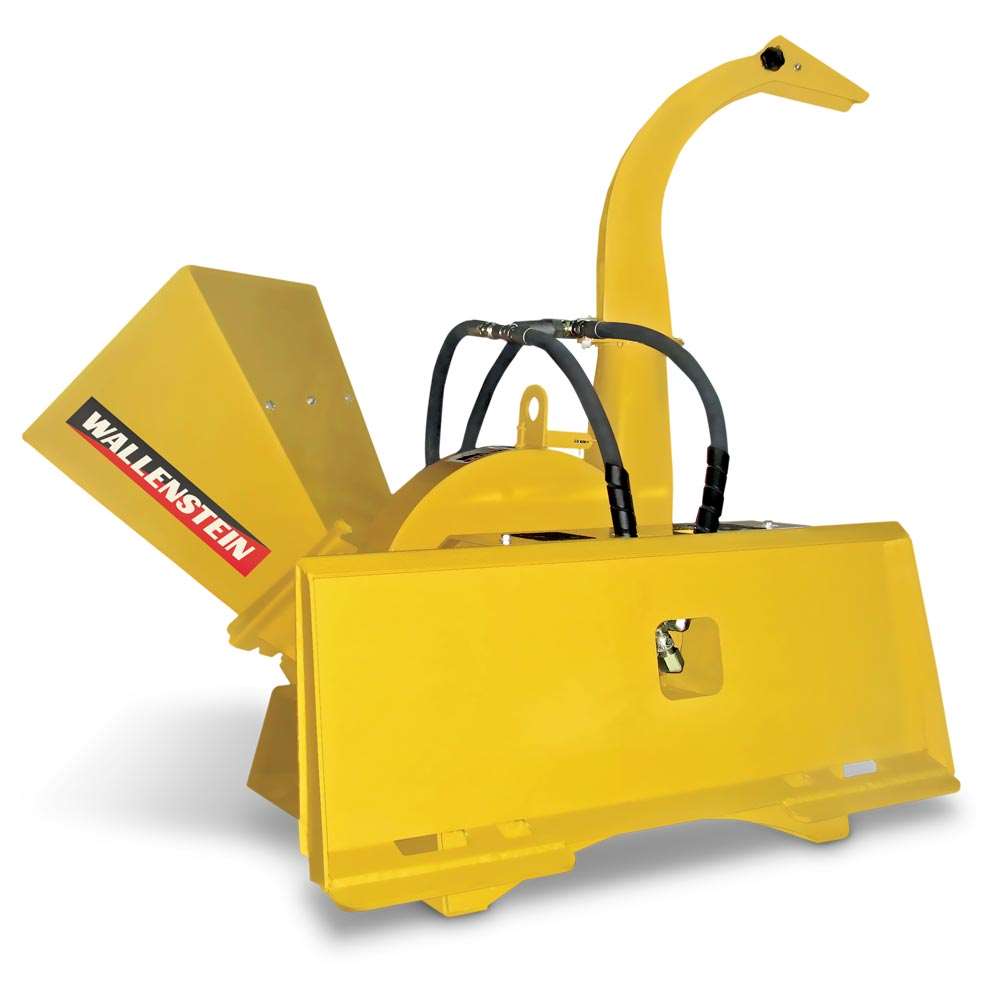
The Wallenstein BXH42 is a skid-steer-mounted wood chipper whose hydraulic motor drives the cutting rotor while branches enter through a gravity-feed hopper. That distinction is the starting point for a correct buying decision. “Hydraulic chipper” does not mean hydraulic feed rollers, automatic branch advance or electronic feed management on this model.
Its strongest case is a property or landscaping operation that already has a suitable skid steer and needs to move a chipping attachment between appropriate work positions. The carrier must provide the correct hydraulic supply and approved stationary attachment operation, as well as carry and secure the attachment. The presence of auxiliary couplers alone does not prove that fit.
This guide uses the Canadian BXH42 product page and September 2021 manual for serial number A0881030 upward, checked in October 2026. The page’s heading identifies BXH42, although one descriptive sentence reverses the letters to BX42H. Confirm the model plate and documentation rather than treating those spellings as different machines without evidence.
On This Page
ToggleRotor power and branch feeding are separate systems
On the BXH42, hydraulic oil from the carrier powers the rotor drive. The feeding arrangement remains gravity/manual feed as described in the manual. This differs from a tractor chipper where PTO power drives the rotor and hydraulic rollers control branch advance.
The BX52R illustrates that second arrangement. Its feed system should not be inferred from the BXH42’s hydraulic drive description, or vice versa. A buyer searching for powered rollers needs to check the feed specification explicitly.
The broader gravity versus hydraulic feed comparison explains the work implications. For the BXH42, branch shape and preparation remain central to the feeding routine. A hydraulic rotor does not make awkward forks disappear.
The specifications that determine carrier fit
| Published item | BXH42 | Practical meaning |
|---|---|---|
| Nominal chipping capacity | 4 inches | Assess the actual branch, including forks and shape. |
| Rotor opening | 4 by 10 inches | Different from the larger receiving hopper. |
| Hopper opening | 20 by 20 inches | Not a twenty-inch branch-capacity rating. |
| Recommended hydraulic flow | 25 US gpm | Check the actual auxiliary circuit and approved operating range. |
| Attachment weight | 740 lb | Part of the carrier’s attachment and stability assessment. |
| Rated rotor speed | 1,000 rpm | Not a tractor PTO setting or permission to increase flow arbitrarily. |
The manual and page identify a twenty-five-inch disc with two knives and a seventy-four-pound rotor. Those describe the cutting assembly; they do not establish a universal hourly chip output. Material, edge condition and the complete handling routine still affect the work.
The listed overall dimensions are eighty by fifty-seven by seventy-two inches. A carrier may fit through an opening while the installed chipper does not. Measure the assembled transport arrangement and the approved operating position, not just the skid steer’s tire width.
Twenty-five gallons per minute is not a generic “high-flow” label
Carrier manufacturers use different standard- and high-flow packages. Identify the available circuit on the exact machine and compare its documented flow, pressure and operating requirements with the attachment’s requirements. Do not decide compatibility solely because a seller calls one machine high flow.
The standard versus high-flow guide is useful background when the carrier’s options are unclear. The BXH42’s published flow figure must still be checked against the real configuration, including the required return arrangement and couplers.
More flow is not automatically better. It should not be used to chase extra rotor speed or a larger branch capacity. Establish the approved combination with the correct technical information rather than treating the hydraulic motor as tolerant of any supply above a minimum.
Also confirm how the skid steer is permitted to operate a stationary attachment while the chipper is fed. Follow the carrier’s documented procedure and interlocks. Never assume that an attachment’s need for continuous hydraulic power authorizes bypassing an operator-presence system.
Resolve what is actually included in the connection package
The Canadian page says hydraulic hoses and couplers are included. The September 2021 manual’s connection section says whip hoses are not supplied. Its specification table also contains a note that the mounting bracket is not supplied, while its attachment section describes a universal mounting plate. Those details require a specific quotation and inspection.
Do not turn either document into a blanket claim that every offered BXH42 arrives ready to attach. Identify the actual mounting assembly, hoses, couplers and any carrier-side components supplied. The written package should name what remains to be fitted.
This is especially relevant to used equipment. A previous owner may have configured hoses for a different carrier or retained part of the mounting arrangement. A chipper that was ready for that owner’s machine can still be incomplete for yours.
The correct hose specification and routing must follow the manufacturer’s instructions. Avoid improvised connections that happen to join but expose hoses to pinching or contact through the permitted attachment movement. Complete hydraulic fit is more than matching the shape of a quick coupler.
Use a representative branch sample
Collect a normal sample from the work the chipper is meant to do. Separate straight stems, forks and fine material. Record how much preparation is required before the pieces are appropriate for the hopper and cutting opening. The largest straight branch is rarely a complete description of a cleanup job.
A four-inch nominal rating does not mean all four-inch material will behave identically. Shape, condition and the prescribed feeding method matter. Do not use excessive force or an improvised tool to make a poor material match appear successful in a demonstration.
For a property with a large share of suitable small branches, mobility may be the attractive feature: the carrier can position the attachment near planned work areas. For one large clearing project with unsuitable material, a different processing service may be a more sensible comparison.
Carrier mobility can help, but the carrier is occupied
While it powers and carries the chipper, the skid steer cannot simultaneously use a bucket or grapple to gather branches. That matters if the same machine is expected to supply the pile and remove chips. Plan the sequence and the attachment changes rather than assuming mobility makes every stage faster.
Suppose an illustrative cleanup requires thirty minutes gathering material, twenty minutes preparing branches, forty minutes chipping and twenty minutes moving the output. The complete job is 110 minutes. Saving ten minutes by positioning the chipper closer to the material helps, but an extra fifteen-minute attachment change elsewhere would more than offset that saving.
These times are invented for planning, not measured BXH42 performance. They show why the comparison should start and finish with the same material in the same final location. If independence is more valuable than carrier mobility, an engine-powered towable chipper may deserve consideration.
Place the discharge before feeding begins
The published discharge height is seventy-two inches, with a rotating chute. Establish a suitable receiving area and keep it clear according to the manual. The useful site footprint includes the feed area, carrier, discharge zone and access for the next batch.
A rotating chute does not mean every direction is appropriate at a particular site. Consider buildings, vehicles, paths and other people. Plan the desired chip destination so the output does not block the next movement or create an avoidable second handling stage.
When chips are intended for later use elsewhere, include that transport in the ownership comparison. The chipper reduces branch material; it does not automatically place every chip in its final useful location. That distinction can change the value of carrying the attachment close to the source.
Compare with PTO equipment on complete-system terms
The BX52S provides a tractor-PTO gravity-feed alternative with a different nominal capacity and mounting arrangement. It should be compared as a tractor-and-attachment system, not just as a larger opening at a quoted price.
If a suitable tractor is already available and the skid steer is needed for other chores, the tractor arrangement may fit the workflow better. If the skid steer is the available machine and its hydraulics and stationary operation are appropriate, the BXH42 may avoid introducing another power source.
Neither choice is automatically cheaper. Include connection components, setup, transport, maintenance and the opportunity cost of occupying the host machine. An attachment-only quote can conceal the work required to make the complete package usable.
Used inspection should include the hydraulic drive
Begin with model and serial identification, then match the manual. Inspect the hopper, housing, discharge components, guards and mounting points with the machine safely isolated. Look for distortion, missing hardware and repairs needing qualified assessment.
Have the knives, ledger and rotor condition assessed using the correct procedures. Cutting quality and feeding behaviour can be affected by service condition. A poor result from a worn cutting system does not tell you how a properly maintained example should perform, but it does identify work the buyer must price.
The hydraulic motor, coupling, hoses and connections add another inspection area. Use proper leak-detection procedures and never search with a hand. A brief empty run is not a complete assessment of the system under suitable working conditions.
A demonstration should use a compatible carrier, the approved stationary operating procedure and representative suitable material. It should also show the safe shutdown and attachment connection. A demonstration that requires defeated interlocks is evidence of an unacceptable setup, not an advantage of the chipper.
Frequently asked questions
Does the BXH42 have hydraulic feed rollers?
No rollers are described in the cited gravity-feed configuration. Hydraulic power drives the rotor. Buyers wanting powered branch advance should evaluate a model explicitly equipped for that function.
Will any high-flow skid steer run it?
No universal approval follows from that label. Verify the exact auxiliary hydraulic configuration and the attachment’s requirements, along with mounting and stationary operation.
Are hoses and the mounting hardware included?
The current page and September 2021 manual contain differing statements. Confirm the actual supplied package in writing and inspect a used unit rather than assuming completeness.
Is the twenty-inch hopper its branch capacity?
No. The hopper is the receiving opening. The nominal chipping capacity is four inches and the rotor opening is separately specified.
Who should shortlist the BXH42?
An owner with a verified compatible skid steer, recurring suitable branch cleanup and a workflow that benefits from carrying the chipper between planned work positions. Hydraulic rotor power is useful only when the rest of that system fits.
Record the carrier configuration for future changes
Keep a written record of the carrier model, auxiliary hydraulic option, approved operating arrangement and fitted connection components. If the chipper later moves to another skid steer, repeat the compatibility assessment. A setup proven on one machine does not automatically transfer to another with similar engine power.
This is particularly useful for a farm sharing equipment between machines. Label and retain the correct components with the attachment so a later operator does not mistake a familiar-looking hose or mounting part for proof that the complete combination has already been checked.
Sources
Share your experience
Help other Canadian buyers — leave a quick review for the
Wallenstein BXH42
There are no reviews yet. Be the first one to write one.