Overview & Specs
The Wallenstein BX52S belongs on the shortlist when recurring branch cleanup justifies a tractor-mounted chipper, but the work does not require a powered hydraulic feeding system. Its five-inch rating is useful only when the material, tractor and handling routine fit together. For a Canadian acreage with regular pruning, shelterbelt maintenance or woodlot cleanup, the buying decision should start with the branches normally produced, not the largest piece shown in a demonstration.
This guide covers the Canadian BX52S specification checked in October 2026 and the January 2025 BX-S operator manual. It does not assign a model year to every used machine. Match the serial number and fitted driveline before applying the information to a particular unit.
On This Page
ToggleWhat defines the BX52S package?
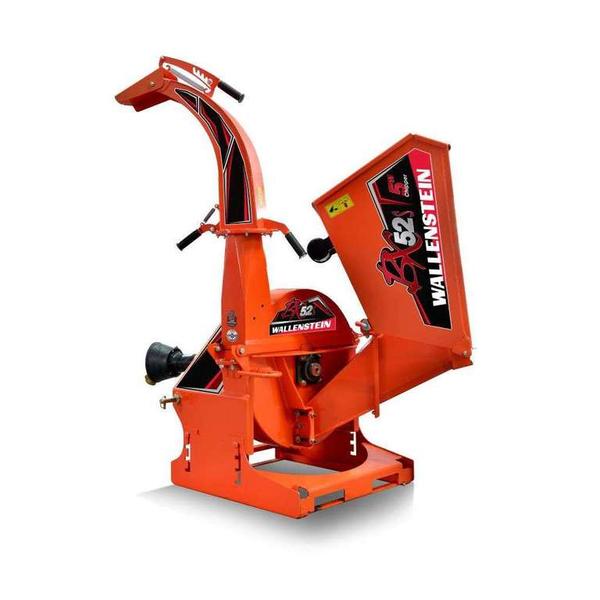
The Canadian product specification identifies a gravity-fed, direct-PTO disc chipper with a five-inch capacity, a 5-by-10-inch cutting inlet, four knives and a 25-inch rotor weighing 125 lb. Listed machine weight is 505 lb, and the mounting arrangement is Category 1 with quick-hitch compatibility. The advertised tractor engine range is 22–55 hp. Those figures describe a starting point for matching, not an assurance of equal output across the entire tractor range.
Its strongest distinction is straightforward: it puts a dedicated chipping mechanism behind an existing tractor. That avoids maintaining a separate chipper engine, while also committing the tractor to the chipping session. If that same tractor normally gathers branches or moves the finished chips, its availability becomes part of the equipment decision.
Measure branches, not just the brush pile
A pile occupies space partly because of the air between branches. Two piles with the same outside dimensions can represent very different cutting and handling work. One may contain mostly straight limbs; another may be a tangled collection of short forks, foliage and awkward bends. A diameter rating alone cannot describe that difference.
Make a simple material inventory before arranging a demonstration. Note the recurring diameter range, how much material branches off sharply, and what portion belongs in a different disposal or processing stream. Include the preparation already needed to make material suitable under the operating instructions. The relevant question is how much of your ordinary work reaches the chipper in a usable form.
The larger hopper mouth should not be mistaken for a larger cutting capacity. It receives and guides material toward a narrower working opening. A fork can obstruct feeding even when each separate limb seems modest. Do not plan on force, extra tractor speed or removing protective components to make an unsuitable piece fit.
For an acreage that produces only a small amount of oversized material, separate that exceptional work from the normal season. A contractor handling the large pieces may be more practical than sizing every future cleanup session around a rare event. Conversely, if substantial preparation is required for most branches, a different chipper architecture deserves consideration.
Gravity feed changes what the operator is buying
Gravity feed is not the same equipment as a hydraulically powered feed roller with its own control system. Treat the feeding method as a major selection criterion. A buyer accustomed to a commercial powered-feed chipper should not assume that the BX52S provides the same operating sequence in a smaller package.
Observe a competent demonstration using representative permitted material. Watch preparation and presentation as well as cutting. A machine can process an ideal straight branch convincingly while leaving unanswered questions about the irregular pieces that dominate your property. Record those questions rather than extrapolating a daily production figure from one successful pass.
Worksite layout also affects whether the feeding arrangement feels manageable. Material needs to arrive without blocking the prescribed operating position, and discharged chips need somewhere to go. The operator should not have to repeatedly reorganise the entire work area because the incoming and outgoing streams overlap.
Match the tractor’s actual configuration
An engine horsepower range is not a measured chip-throughput guarantee. Preserve the manufacturer’s rating language and check the tractor’s documented output rather than assuming that a number on its hood is PTO horsepower. Aglist’s engine versus PTO horsepower guide explains why the two ratings answer different questions.
Also assess carrying capability, ballast, hitch movement and permitted driveline geometry. The implement sits behind the tractor, and a rear-mounted weight must be evaluated in that actual position. Being able to raise it once does not establish an acceptable transport and working arrangement.
A quick hitch can make repeated connection more convenient, but only after the assembled fit is verified. Added hardware changes the relationship between tractor and implement. Use the Category 1 quick-hitch guide to organise the fitment questions, then complete the model-specific checks with the hitch included.
Shared ownership deserves special attention here. A shaft and setup approved for one tractor are not automatically correct for another tractor with apparently similar connections. Keep a separate configuration record for each host machine and include the cost of any required equipment in the sharing arrangement.
PTO speed and dimensional differences need explicit checks
The January 2025 operator manual lists 540–1000 rpm operation and a shear-bolt driveline. The product page separately lists a 1000-rpm shaft accessory. Verify the complete approved shaft and speed combination; the range is not an invitation to experiment with tractor speed. Keep the specified overload protection rather than substituting an arbitrary stronger fastener.
There is also a dimensional distinction worth resolving before ordering. The product page separates open and folded dimensions, while the manual presents a single envelope that differs. Measure the actual machine in the storage and working configurations you intend to use. Do not design a close-fitting storage bay from whichever number happens to be smallest.
This is especially relevant in a crowded farm shed. The space occupied by the stored chipper differs from the space required to connect it, inspect it and move past it. Include tractor approach and attachment access in the storage sketch. A theoretical fit that makes every changeover awkward can discourage using the machine for smaller jobs.
Plan the chip destination before buying
Decide whether chips will be deposited at the worksite, moved afterward or collected in a suitable receiving arrangement. These are different workflows. A chipper purchase does not by itself answer whether the property can use or store the material produced.
Check the actual discharge path and receiving geometry through the manufacturer’s procedure. Chute height by itself cannot prove that a particular trailer or container is suitable. The permitted positioning, distance, opening and clearance all matter. Keep the required exclusion area clear rather than arranging the work around the smallest possible footprint.
If the plan is a ground pile, determine how it will be cleared when it grows. A tractor committed to the chipper may need to stop and change tasks before moving chips. That interruption may be minor for occasional pruning and significant for a concentrated cleanup weekend. The answer depends on the layout, not just chipper size.
A useful whole-session calculation
Consider an illustrative session, not a BX52S performance claim: 35 minutes gathering suitable branches, 20 minutes preparing the work area and equipment, 40 minutes processing, and 25 minutes moving chips and cleaning up. Total elapsed work is 120 minutes.
If another machine hypothetically reduces processing from 40 to 30 minutes, the whole job falls to 110 minutes. That is an 8.3% reduction, not a 25% reduction in the entire job. The larger percentage applies only to the processing segment. This distinction helps keep equipment demonstrations in perspective.
Alternatively, a better collection point might remove 15 minutes of gathering without changing the chipper. Record a real session in similar segments before deciding where an equipment premium will help. Include any additional person involved: elapsed time and combined labour hours are different measures.
For a Canadian property with a short seasonal cleanup window, convenience may matter even when annual hours are modest. State that benefit directly. Being able to process suitable material when the property is ready is a legitimate ownership preference; it does not need an invented high annual throughput to justify it.
Compare the BX52S with the right alternatives
| Recurring need | Comparison worth making |
|---|---|
| Suitable branches with an available tractor | Dedicated tractor chipper with a verified feeding routine |
| Mixed small garden material and branches | A chipper/shredder with separately documented material limits |
| Frequent awkward material or intensive processing | An appropriately sized powered-feed machine or service |
| One exceptional clearing project | A complete contractor quotation against ownership after the project |
The Land Pride WC1504 guide provides a useful comparison for another tractor chipper. Compare the documented capacity, tractor requirements, driveline and complete routine independently. A one-inch difference in stated capacity is not a measured percentage improvement in completed property work.
Do not overlook the cost of material gathering. If that is the bottleneck, an appropriate handling attachment may be more relevant than a larger cutting mechanism. Conversely, buying a grapple does not remove the need to prepare and feed material correctly at the chipper.
Used inspection should cover the complete cutting system
Identify the serial number, manual and fitted components first. Have a competent person assess knives, their mountings, the rotor, housing, guards, driveline and support structure under the prescribed secured inspection procedure. A brief demonstration that produces chips is useful evidence, but not a complete condition report.
Reversible knives are a service feature, not proof that a worn set has a free second life. Ask what work is required to return the entire cutting system to specification, including parts and labour. A single attractive replacement-part price does not describe the total repair.
Check evidence of undocumented alterations and verify the correct protection components. Keep uncertainty separate from negotiated price: a discount does not make an unassessed modification acceptable. Resolve the configuration and repair scope before committing to a machine intended for regular seasonal use.
For budgeting, compare purchase, setup, immediate repairs, storage and expected maintenance with the scope of a service quotation. Avoid treating tractor fuel or owner labour as zero simply because the tractor is already owned. Also avoid assigning a speculative resale value that makes the calculation look favourable.
Questions buyers often leave until too late
Does a five-inch chipper eliminate all branch preparation?
No. Shape, permitted material and the inlet geometry still matter. Evaluate the recurring material stream and the complete preparation routine before treating the capacity label as a productivity measure.
Can I select the fastest PTO setting for every job?
No. The approved machine, shaft and tractor combination determines the permitted setup. Verify that configuration from the applicable documentation rather than choosing a speed by trial.
Is gravity feed a disadvantage?
It is a design choice to evaluate against the work. A manageable recurring branch stream may suit it well; a requirement for different feed controls or intensive processing calls for a different comparison.
What should a purchase demonstration prove?
That representative suitable material can be handled through the intended workflow, with a correctly matched tractor, an appropriate chip destination and a realistic operator routine. A single maximum-size branch does not answer those questions.
Who has the strongest ownership case?
An owner with recurring compatible material, a tractor available for the session and a useful destination for chips. Where the main workload is temporary, unsuitable or mostly preparation and handling, compare another process before buying additional cutting capacity.
Share your experience
Help other Canadian buyers — leave a quick review for the
Wallenstein BX52S
There are no reviews yet. Be the first one to write one.