Overview & Specs
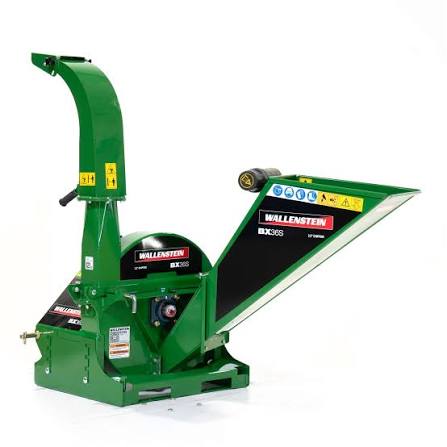
The Wallenstein BX36S is worth considering when a small tractor already handles acreage chores and the recurring cleanup is mostly manageable branches rather than large timber. Its attraction is a relatively compact, mechanically simple chipping package: a three-point attachment, PTO-driven cutting disc and gravity-fed hopper. The purchasing question is whether that arrangement fits the material and the tractor together. A nominal branch diameter alone cannot answer it.
This guide uses Wallenstein’s Canadian product information and January 2025 BX-S operator manual, checked in October 2026. It treats the BX36S as its own machine, not a smaller version to which every BX52S feature can be transferred. Serial-specific documentation remains important when inspecting an older example.
On This Page
ToggleStart with the branch pile you actually produce
A chipper earns its place through repeated work. Walk a representative pruning pile and separate straight branches, forked pieces, fine leafy material and timber better retained for another use. Measure the awkward junctions as well as the straight stems. The time spent cutting a fork to fit can matter more than a small difference in advertised capacity.
For a shelterbelt, orchard or maintained trail, the BX36S may suit frequent, limited batches that can be processed close to where they accumulate. For a one-time clearing project dominated by substantial trunks, ownership may make less sense than arranging a different processing service and keeping a smaller tool for later maintenance. Those are different jobs with different economics.
Do not assume a chipper is a general-purpose shredder for everything from a garden. Material suitability and the feeding method must follow the manual. If a property regularly generates both woody branches and material intended for a dedicated shredder, compare the separate processing functions described in the Wallenstein BXM32 guide. Buying one machine to perform two incompatible tasks usually creates more sorting later.
The specifications that shape the decision
| Item | Published BX36S figure | Buying implication |
|---|---|---|
| Nominal branch capacity | 3.5 inches | Assess the real branch shape, not just the diameter of a straight section. |
| Chipping chamber opening | 3.5 by 9 inches | The wider dimension helps explain why capacity is not the same as hopper width. |
| Published power range | 12–30 hp | Check the exact tractor and available PTO output; the range is not a productivity guarantee. |
| Attachment weight | 395 lb | Check rear lift geometry, transport stability and ballast requirements. |
| Overall dimensions | 55 by 45 by 60 inches | Measure storage, access and the operating area separately. |
| Mount | Category I three-point | Pin category alone does not prove driveline clearance. |
The manufacturer also identifies a 25-inch rotor weighing 96 lb, with four reversible cutting knives. These describe the cutting assembly; they do not establish a universal output in cubic yards per hour. Blade condition, material and how consistently suitable branches arrive all affect the useful result.
The current product page lists a 13-by-20-inch hopper opening. That is the receiving opening, not permission to feed a piece with that cross-section. A buyer comparing advertisements should write down which opening each number describes. This simple distinction prevents an apparently larger hopper from being mistaken for a larger cutting capacity.
Matching a small tractor involves more than horsepower
Engine power and PTO power are different measures. The product page labels its range as engine horsepower, while the manual lists a horsepower range. Do not use the lower number to promise that any tractor carrying a similar decal will process all permitted material at the same rate. The PTO versus engine horsepower guide explains why implement matching needs the correct figure.
The BX36S is carried behind the tractor. Its weight acts at a distance from the hitch, so a lift figure quoted at the hitch ends is not automatically the available capacity at the attachment’s centre of gravity. Confirm the tractor’s instructions for a rear implement of this weight and geometry, including steering control and ballast. A machine that lifts in a yard can still be an unsuitable transport combination.
Wallenstein describes Category I, iMatch and quick-hitch compatibility. That does not remove the need to check the assembled combination. A quick hitch changes the distance between tractor and implement. PTO shaft length, overlap, operating angle and clearance must be checked across the relevant hitch travel using the supplied instructions. The Category I quick-hitch guide is useful for planning those checks.
The published speed range is 540–1000 rpm, but this is not permission to select either tractor setting with an unidentified shaft or setup. Establish the approved driveline and operating configuration for the actual machine before use. Avoid an improvised adapter solution simply because the tractor and attachment can be physically connected.
What gravity feeding changes in everyday work
Gravity feeding removes hydraulic feed rollers from the purchasing package. There is no separate roller-feed circuit to match to the tractor. The practical tradeoff is that branch preparation and the prescribed manual feeding routine become central to how the job proceeds. The operator still needs to follow the full safety and shutdown instructions; simplicity does not make a running cutting mechanism forgiving.
A branch that enters cleanly is a different workload from one that catches at a fork. Before paying for a larger machine, identify whether the main delay is gathering material, preparing it, feeding it or moving chips afterwards. A larger capacity can help one stage while leaving the others unchanged.
For example, suppose a representative cleanup takes 35 minutes to collect branches, 20 to prepare them, 30 to chip and 15 to clear the area. That is 100 minutes. Even if a different arrangement reduced the chipping segment to 20 minutes, the total would be 90 minutes, a ten-percent reduction. These are illustrative times, not measured BX36S production figures. Record your own complete sequence before assigning a value to extra capacity.
Place the machine around the destination for the chips
Think through where the chips are supposed to finish. A convenient feeding position that deposits chips across the next access route creates another handling task. Plan a suitable, clear operating site and the discharge direction before starting. Keep the receiving area within the manufacturer’s operating restrictions and keep people away from the discharge zone.
The page and specification table describe a rotating discharge chute. The manual’s feature wording is not completely consistent about rotation travel, so physically check the actual chute’s permitted movement and locking positions rather than building a site layout around an assumed full circle. That detail is more useful than repeating a rotation number without qualification.
The BX36S product page does not list folded dimensions. Do not assume it has the same folding hopper arrangement as larger BX-S models. Measure the actual machine in its approved storage condition, including the PTO shaft and any protruding parts. A narrow shed doorway and the space needed to manoeuvre the tractor are separate constraints.
Canadian seasonal use: plan the work window
Acreage cleanup can arrive in bursts after pruning or weather damage. That makes readiness important. A chipper stored with worn knives, a damaged guard or a missing driveline component is not ready simply because the tractor starts. Before the expected season, check the condition and obtain the correct service parts for the serial number.
Wet or frozen footing can change whether the tractor can reach a chosen work position and whether people can move around it safely. The right response is to reconsider the site and timing, not to assume the attachment’s relatively low weight makes every route acceptable. Where access is poor, consolidating suitable branches at a better location may be the more practical plan.
Keeping some larger sound wood for another use can also change the chipper requirement. If material beyond the normal pruning size is infrequent and already has a useful destination, a larger chipper may not provide much additional benefit. Conversely, routinely cutting nearly every branch into multiple sections to fit is evidence that the normal workload deserves another look.
BX36S versus stepping up to a BX52S
The BX52S offers a larger nominal cutting capacity, but it also changes the tractor and handling discussion. Compare complete approved packages rather than treating the extra diameter as a free upgrade. The smaller machine’s case is strongest when it suits the existing tractor and most normal material without excessive preparation.
Do not choose the BX36S solely because it is the smaller option. If the tractor must be changed, the chipper moved frequently between sites, or the material routinely challenges the feeding arrangement, total ownership may favour a different solution. Equally, buying unused capacity can tie up money and storage without shortening the real job.
Inspecting a used BX36S
Start with the identification plate and matching operator and parts information. The January 2025 manual identifies several BX36S serial ranges. A seller’s approximate year is less reliable than the machine’s actual identity when ordering components or checking the correct construction.
With the machine safely isolated according to the manual, inspect the hopper, housing, guards, hitch points and discharge locking arrangement. Look for distortion, missing fasteners and evidence of inappropriate repair. These are general inspection priorities, not claims that the model commonly fails in those areas.
The knives and ledger are part of the cutting system, not optional finishing details. Have their condition and specified setup assessed correctly. A poor demonstration with dull or incorrectly set cutting components does not establish the performance of a properly maintained machine, but it does establish work and expense that a buyer must account for.
Inspect the complete driveline rather than accepting a shaft lying beside the machine as proof of compatibility. Check that guards, identification and the correct protection arrangement are present. A safe demonstration on an appropriate tractor should include the normal operating sequence and shutdown. Never bypass a missing guard to complete a sale demonstration.
Questions worth settling before purchase
Will a 3.5-inch rating cover all branches on my property?
No. It describes nominal capacity, not every fork, knot or material condition. Sample the normal pile and identify what must be prepared or routed elsewhere. The proportion of awkward material is often more informative than the single largest stem.
Does it require tractor hydraulic remotes?
The BX36S uses gravity feeding and PTO cutting drive, rather than a hydraulic feed-roller circuit. That simplifies this particular requirement, but the tractor still needs an appropriate hitch, driveline, power supply and safe transport arrangement.
Is it a good choice for occasional work?
Possibly, if convenience has value and storage and maintenance are practical. Compare annual ownership with the actual number of cleanup sessions. One unusually large pile should not determine a purchase intended for years of smaller routine jobs.
What should the written quote include?
Identify the exact machine, included driveline, required setup, delivery and any necessary tractor changes. Separate those from optional accessories. Avoid comparing a bare attachment quote with another supplier’s ready-to-use package.
The BX36S is most persuasive when its smaller package solves a repeatable branch-management problem with the tractor already available. Confirm the complete fit, evaluate the normal material and price the whole working arrangement before deciding that more capacity would be useful.
Sources
Share your experience
Help other Canadian buyers — leave a quick review for the
Wallenstein BX36S
There are no reviews yet. Be the first one to write one.