Overview & Specs
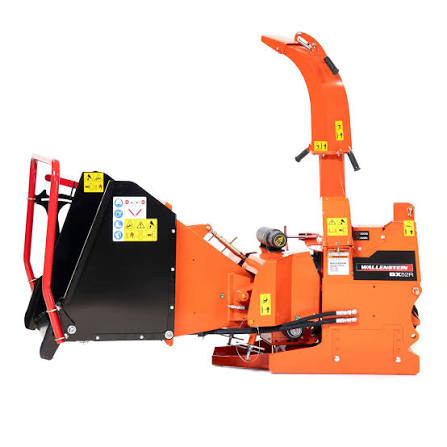
The Wallenstein BX52R is a five-inch tractor wood chipper whose main buying distinction is controlled hydraulic roller feeding. It deserves consideration when the recurring cleanup job calls for a different feeding routine from a gravity-fed chipper, while a compatible tractor can supply both the cutting drive and the feed system. Buying it merely because hydraulic sounds more powerful misses the actual decision.
The base BX52R should also be distinguished from electronically controlled configurations in the same family. This guide uses the Canadian product page checked in October 2026 and the applicable BXR manual. It does not assume that every feature shown in a family brochure is standard on the quoted machine.
On This Page
ToggleOne chipper, two power requirements
The Canadian specification lists direct PTO drive for the disc and two hydraulically driven feed rollers. It gives a 40–55 engine-hp range, a 3–6-gpm hydraulic requirement, five-inch chipping capacity and a 5-by-10-inch cutting inlet. The listed weight is 845 lb, with Category 1 quick-hitch-compatible mounting.
Those requirements belong on separate lines of the tractor assessment. Adequate PTO capability does not establish suitable hydraulic supply, and hydraulic couplers do not establish an acceptable shaft arrangement. Both systems must work correctly in the assembled package.
The page identifies onboard intelligence as unavailable on this base configuration. Do not infer automatic load management from the presence of powered rollers. Confirm the actual control equipment when comparing a BX52R with a differently designated machine.
What hydraulic feeding changes
The rollers provide a controlled means of advancing appropriate material toward the cutting mechanism. That changes the operator’s interaction with the feed system. It does not remove the need to prepare and present suitable material, observe the prescribed operating position or keep protective equipment intact.
A demonstration should show the supplied feed controls and how the authorised operating sequence works with ordinary branches. The useful question is whether that routine fits the property and operator. Watching one straight branch disappear quickly does not establish how much time will be saved on tangled pruning material.
Separate the effort involved before the rollers engage from the cutting process itself. Bringing material to the machine, identifying unsuitable pieces and preparing awkward shapes can remain substantial tasks. If those dominate the day, powered feeding may improve only a limited part of the overall job.
The safety control bar is part of the documented machine. Have its functions explained during handover using the applicable instructions. It should never be treated as an obstacle to production or modified to accommodate a preferred feeding technique.
Five-inch capacity is still five-inch capacity
Powered feeding does not turn the capacity label into a larger permitted material size. The actual inlet and cutting system still govern what belongs in the machine. A wide receiving hopper is useful for presentation but should not be confused with the narrower cutting opening.
Inventory normal material before selecting the chipper. Record typical diameters, bends, forks and the proportion needing another process. This produces a better purchasing basis than estimating only the apparent volume of a brush pile, much of which may be empty space.
A recurring supply of suitable branches presents a different ownership case from one exceptional clearing project. If most annual work is modest but a single storm creates oversized or complicated material, compare a service for that event rather than assuming every future purchase must handle it.
Do not count rejected or separately processed material as chipper throughput. A useful work record states what entered the machine and what remained for other handling. That prevents a demonstration from making the entire cleanup appear faster than it actually was.
Hydraulic compatibility is more than matching connectors
Identify the supply arrangement required by the exact machine and verify it against the tractor. The relevant flow is the flow available at that connection under the applicable conditions, not necessarily a brochure total that includes other tractor services.
Aglist’s hydraulic-control guide explains why a remote valve and a supply for an attachment’s own controls are different concepts. Use that distinction to ask precise questions, then follow the actual manufacturer installation requirements.
The product page offers self-contained PTO power packs as accessories. They are possible alternative arrangements, not equipment to assume is included. An itemised quotation should state the fitted supply, associated components and commissioning requirements.
If the tractor already carries additional hydraulic equipment, include it in the assessment. A proposed connection needs to work with the complete system. A successful installation on another tractor of the same brand is not a substitute for checking the buyer’s exact configuration.
Match the shaft and carrying arrangement
The October 2022 BXR manual covers BX52R serial numbers 152R1437 and up. Its specification lists a shear-bolt PTO drive and 540–1000-rpm operation. Verify the complete approved shaft, speed and power-pack combination rather than treating that range as permission to choose any convenient setting.
The manual confirms an 845-lb operating weight and separates open from closed feed-table dimensions. The Canadian page lists 80 by 67 by 74 inches open and 62 by 61 by 74 inches folded. Consider both working space and storage access when comparing the package.
Carrying the attachment is a separate question from powering it. Use the tractor’s applicable hitch, ballast and transport guidance for the actual rear-mounted position. A tractor within the engine range may still require a different assessment of the equipped implement.
If a quick hitch is planned, include it during verification. The quick-hitch compatibility guide explains why secure hook engagement does not settle shaft length and geometry. A used shaft fitted to the seller’s tractor must be checked again for the buyer’s combination.
Do not confuse family options with supplied automation
The family manual describes optional equipment, including electronic control arrangements. That does not contradict a base product page that excludes onboard intelligence; it means the family contains different configurations. Keep the exact designation and equipment list with the purchase documents.
An automated feature can change the control experience, but it does not remove material limits or operator responsibilities. If that feature is important to the purchase, demonstrate the actual offered machine rather than relying on a video of a related model.
For a used purchase, inspect the fitted controls and records for alterations. Do not assume an older box, switch or wiring arrangement is the same system described by a current promotional name. Service support depends on accurate identification.
Compare the BX52R with a gravity-fed alternative
The published BX52S guide provides a relevant comparison at the same nominal chipping capacity. The question is not which model number is larger. It is whether hydraulic feeding improves the recurring task enough to justify the different tractor requirements, weight and ownership cost.
Compare both machines using the same suitable material and the same starting condition. If one demonstration begins with neatly prepared branches and the other begins with a tangled pile, the resulting time difference does not isolate the feeding system.
Use the same end point too. Depositing chips at the machine is not equivalent to leaving them in their final destination. Include subsequent handling when that forms part of the real property job.
| Question | Useful evidence |
|---|---|
| Does powered feeding help? | A representative approved feeding routine |
| Can the tractor support it? | Verified shaft, hydraulic and carrying configuration |
| Does it save meaningful time? | A complete session with preparation and cleanup included |
| Are extra controls included? | The exact supplied equipment list and demonstration |
Measure where the day actually goes
As an invented planning example, suppose gathering and preparation require 50 minutes, processing requires 45 minutes and final chip handling takes 25 minutes. The complete job is 120 minutes. If an alternative feeding arrangement reduces processing to 30 minutes, total time becomes 105 minutes.
The assumed processing saving is one-third, but the whole-job saving is 12.5%. That difference matters when deciding how much to pay for a feature. It also identifies the other tasks that still need to be done efficiently.
Record combined labour where more than one person participates. A shorter elapsed session achieved by adding another worker is not automatically a labour saving. Likewise, a more comfortable authorised routine can be valuable even when the clock shows only a modest improvement.
Keep these benefits separate: time, effort, scheduling flexibility and desired control behaviour. They are all legitimate purchase considerations. None requires inventing an hourly production rate for the BX52R.
Plan for incoming branches and outgoing chips
The work area must accommodate the documented operating positions, branch staging and discharge zone. Avoid a layout where incoming material blocks access to controls or where chips build up along the route used to bring the next batch.
Decide whether the tractor and chipper will remain at one suitable location or be repositioned between work areas. The first arrangement can simplify setup; the second may reduce material travel. Property layout determines which trade-off matters more.
If the tractor also moves chips or gathers branches, schedule that work explicitly. Hydraulic feeding does not free the tractor for another task. A larger chip pile may require an interruption even when the chipper itself is working well.
Evaluate the actual discharge destination. Height alone does not prove that a trailer or container can be filled appropriately. Use the permitted positioning and clearances rather than building the job around an assumption from a photograph.
Used inspection adds a feed system to the checklist
Have a competent inspection assess the cutting assembly, roller system, hydraulic components, controls, guards, shaft, hitch and structure. Follow the complete isolation and stopped-motion procedure before access. The fact that a machine makes chips does not establish the condition of every system.
Ask for a complete repair estimate where necessary. Worn knives, uncertain roller behaviour and missing protective components are different issues. Pricing only the visible cutting edges can understate the work needed to make the package ready.
Confirm the correct overload-protection components. An arbitrary stronger replacement fastener is not a productivity upgrade. Undocumented modifications should be resolved against manufacturer requirements before the machine is put to work.
Store the serial number, manual revision, shaft information and hydraulic setup together. Those records make later parts purchases and changes of tractor less dependent on assumptions.
Frequently asked questions
Does hydraulic feeding mean automatic feed management?
Not on the base specification cited here. The Canadian page distinguishes this model from configurations with onboard intelligence. Verify the supplied controls.
Does it chip larger branches than every five-inch gravity machine?
The documented capacity remains five inches. Feeding architecture and permitted material size are separate comparisons.
Is tractor horsepower enough to confirm compatibility?
No. Hydraulic supply, PTO setup and carrying requirements must all be verified for the complete combination.
What should a demonstration include?
Representative permitted branches, the actual controls, the intended tractor setup and the complete material-handling routine. A single ideal branch is insufficient evidence.
Who should shortlist the BX52R?
An owner whose recurring branch work benefits from controlled roller feeding and whose tractor can support the complete package. If preparation or chip handling dominates the job, assess those stages before assuming a more elaborate feed system will transform productivity.
Share your experience
Help other Canadian buyers — leave a quick review for the
Wallenstein BX52R
There are no reviews yet. Be the first one to write one.