Overview & Specs
The Land Pride STH1590 is a spike-tooth harrow for a buyer who needs a broad, relatively light surface-working attachment after the main preparation question has been settled. Its job should be defined as a finishing or redistribution stage. It is not a substitute for every tiller, grading tool or lawn-treatment machine simply because all of them disturb the surface.
The useful buying question is what remains to be done when this harrow enters the field or yard. If the area still needs major reshaping, substantial material relocation or a diagnosis of poor growth, the STH1590 may be addressing the wrong stage. This guide uses Land Pride manual 322-314M dated May 9, 2019, without claiming that the document establishes present Canadian stock or a new production year.
On This Page
ToggleUnderstand the tooth arrangement first
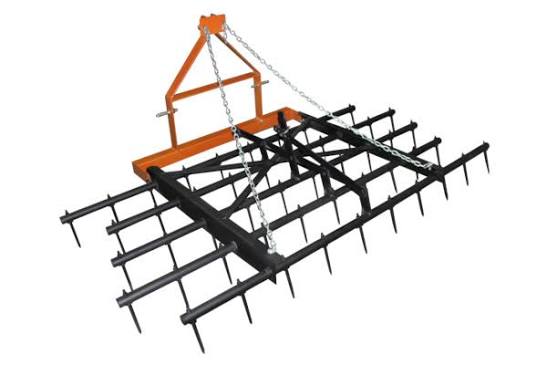
The manual specifies 50 teeth across five adjustment bars, ten tooth-angle settings and chain suspension at the rear frame. Working width is 88⅝ inches, overall width 90⅞ inches and listed machine weight 224 lb. The Category 1 hitch is quick-hitch adaptable. These details describe an adjustable tooth system rather than a solid blade or rolling drum.
That architecture suggests a useful way to evaluate the tool: inspect how consistently the teeth contact and treat the intended surface, and whether the chosen setting produces the required result without excessive unwanted displacement. The objective is not to make the most visible marks. It is to leave the area ready for the next operation in the plan.
Different jobs can require different outcomes. Breaking up and redistributing suitable surface material is not the same as creating a specified planting depth or correcting deep compaction. Keep those requirements separate so a successful harrowing demonstration is not credited with solving a problem that was never measured.
Retain the manual’s unusual horsepower label
The specification table labels its recommendation “Tractor Power Take-Off Horsepower” and gives a 20-hp minimum. The harrow itself is not described as a shaft-driven rotary implement. Preserve the manufacturer’s stated screening label rather than silently replacing it with engine horsepower or inventing a PTO-drive connection.
For the buyer, the next checks are the actual tractor’s approved implement arrangement, carrying ability, clearances and working suitability. A minimum number does not establish that every tractor meeting it can complete every proposed harrowing task. Soil condition and the intended disturbance also influence what the combination can achieve.
If a seller describes suitability using a different power measure, ask for the basis in the applicable documentation. This is a narrow clarification about the identified machine, not a reason to assume that all small tractors or all Category 1 connections are interchangeable.
Put the harrow into a written work sequence
For a bare-area establishment project, write down the stages: assess the site, establish the required shape, prepare the soil as needed, distribute seed by the chosen method and complete any specified finishing or firming. The harrow belongs only where its action helps meet the requirement of that stage.
Suppose an area has already been shaped and appropriately loosened but needs a more even surface treatment before the next step. That is a different question from a rough site with substantial depressions and missing material. In the latter case, purchasing a wide tooth harrow first does not resolve the earlier work.
Aglist’s BB3584 guide provides context for retained material movement, while the FSP500 guide addresses broadcast delivery. Neither operation should be assumed to happen correctly merely because the finished surface looks tidy after harrowing.
Seed incorporation needs a planting plan
If harrowing is being considered after broadcasting, determine the required placement for the actual species and establishment method first. A machine capable of disturbing the surface does not supply the agronomic target. Do not use tooth marks or the disappearance of visible seed as proof that the intended depth has been achieved.
Evaluate a small suitable trial using the established planting criteria. Check more than one location, including overlaps and transitions. A visually uniform pass can still conceal uneven seed distribution from an earlier operation, so retain the application record as well as the harrow setup.
The STH1590 should not receive credit or blame for every later stand result. Seed quality, rate, placement, moisture, weather and subsequent care can all be relevant. Keeping the stages separate makes a later assessment more useful than a general statement that the harrow “worked” or “did not work.”
Tooth angle is a setting, not a universal recipe
The ten documented settings give adjustment choice, but the catalogue does not identify one setting as correct for every material and condition. Establish a permitted starting configuration from the manual, inspect a representative result and change the relevant variable deliberately.
A useful trial record includes the starting surface, tooth setting, tractor setup, travel conditions and observed outcome. If several settings change at once, the operator may get a better result without learning which change mattered. A short repeatable trial can be more informative than a full field completed with uncertain settings.
Also define a stopping condition. If the tool gathers excessive unwanted material, leaves an unacceptable pattern or does not achieve the required stage of preparation, pause and reassess the method. Repeated passes should have a reason; they are not automatically an improvement because the attachment is already connected.
Chain suspension changes the inspection focus
The rear-frame suspension is part of the documented assembly. Inspect the correct chains, connection points and associated hardware on the actual machine. Do not replace intended movement with an improvised rigid arrangement merely because it appears easier to align or transport.
For a used purchase, examine whether the bars and teeth remain in the intended relationship across the working width. A missing or distorted component can leave an uneven treatment pattern. The fact that the implement has no powered gearbox does not mean condition is irrelevant to the result.
Follow the manual’s support and shutdown instructions before approaching adjustment or wear components. This guide discusses purchase evidence; it is not a substitute for the detailed procedure used to assemble, adjust or safely support the harrow.
Wide coverage can be awkward on a small property
The difference between working and overall width is a useful reminder to measure the complete attachment. An opening sized around an approximate seven-and-a-half-foot description may not provide a suitable margin. Include the tractor’s approach, uneven ground and the turn immediately beyond the opening.
Map narrow passages, trees and isolated patches before calculating area per hour. A broad harrow can reduce straight passes on open ground, yet require more repositioning on a divided site. The purchase should fit the route from storage through every work area, not only the largest rectangle.
Storage deserves attention too. Identify a firm, accessible place where the implement can be supported as prescribed and approached for the next connection. A tool left in a convenient corner after one project may become difficult to retrieve once other equipment or seasonal conditions change access.
Coverage arithmetic with honest assumptions
Consider a hypothetical 8,000-square-metre project. Assume an effective working width of 2.10 metres after overlap, a suitable 4 km/h pace and 60% field efficiency. The calculated rate is 2.10 × 4,000 × 0.60, or 5,040 square metres per hour. One pass would take about 95 minutes.
These are invented planning inputs, not an STH1590 performance test or operating-speed instruction. If the work requires two passes, the calculated working time doubles before separate setup and cleanup. If the second pass is unnecessary, including it solely to justify ownership would overstate the workload.
At 40% efficiency, the same single-pass area takes about 143 minutes. That difference illustrates the cost of a fragmented route or substantial interruptions. Measure the relevant routine during a demonstration instead of assuming that the maximum physical width becomes continuously productive coverage.
Canadian seasonal timing follows the surface
A spring date does not establish that the area is ready for tractor traffic or the intended treatment. Observe the actual condition and the requirements of the project. A rental deadline or a newly purchased implement is not evidence that working immediately will produce an acceptable result.
For a property with repeated establishment work, record which areas need the harrow and when the preceding stages will be complete. That can reveal whether ownership solves a recurring timing problem or whether the machine would sit unused after one project. Availability is a valid consideration, but it should describe real work.
Do not carry a result from prepared bare soil into a recommendation for an established lawn without a separate assessment. Harrowing, core aeration and dethatching are different treatments. The appearance of surface disturbance alone does not prove that the underlying lawn problem has been addressed.
Alternatives should be compared by stage
| Unfinished requirement | Comparison to investigate |
|---|---|
| Substantial reshaping or nearby material relocation | Appropriate grading equipment and a defined profile |
| Further soil cultivation | A suitable cultivation method for the site |
| Broadcast application | A calibrated delivery system |
| Firming after placement | The establishment plan’s specified contact operation |
| Tooth-based surface finishing | A representative STH1590 trial |
This is a sequence comparison, not a ranking in which the heaviest or most complex attachment wins. A separate tool can be useful for one stage while adding nothing to another. Some projects may be better served by an integrated machine or a contracted sequence, particularly where the owner lacks the other required equipment.
Used condition and complete purchase cost
Confirm model identity and the applicable manual. Inspect the hitch frame, bars, tooth condition, adjustment mechanisms, chains and retainers. Look for distortion, missing parts and repairs requiring competent assessment. These are individual condition checks, not claims of a model-wide defect.
Compare wear across the width rather than examining only the easiest tooth to reach. An uneven assembly may need more work than the seller’s simple “replace a few teeth” estimate suggests. Obtain actual parts and labour information for identified findings instead of applying a generic repair allowance.
Add delivery, necessary connection equipment and storage preparation to the offer. For occasional use, compare rental or service options on the same complete project scope. A low purchase price does not remove the cost of the tractor, operator and earlier preparation stages.
Frequently asked questions
Is the STH1590 a rotary tiller?
No. It uses an adjustable spike-tooth arrangement. Select it for the action needed at a defined stage rather than treating all soil-working attachments as substitutes.
Why does the table mention PTO horsepower?
That is the manufacturer’s stated minimum-power label. It should be retained accurately without implying that this harrow has a powered rotary driveline.
Does the widest tooth setting establish planting depth?
No. Placement requirements come from the planting plan and must be checked in the actual result. A setting count is not an agronomic prescription.
Can it solve an uneven established lawn?
First identify the cause and appropriate treatment. A finishing harrow should not be assumed to correct every turf or soil problem.
Who should shortlist it?
An owner with a compatible tractor, accessible working areas and repeated projects that need the specific tooth-based finishing stage demonstrated by the machine.
Source
Land Pride manual 322-314M, May 9, 2019, checked November 13, 2026. Coverage calculations are hypothetical; no Canadian price, availability or field-test result is asserted.
Share your experience
Help other Canadian buyers — leave a quick review for the
Land Pride STH1590
There are no reviews yet. Be the first one to write one.