
Overview & Specs
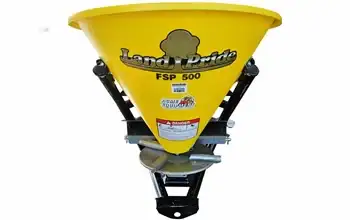
The Land Pride FSP500 is a small tractor-mounted broadcast spreader whose usefulness depends more on calibration and refill logistics than on its maximum advertised swath. It is a candidate for owners who need to distribute a suitable material over a measured area and can maintain the required pattern, travel pace and application rate.
The first purchasing question is what product will be spread and why. Seed and fertilizer are not interchangeable materials, and a machine’s ability to distribute something does not establish the appropriate application rate. Use the product’s directions and the relevant agronomic plan; the spreader is the delivery tool.
On This Page
ToggleUse the current manual’s FSP500 column
The downloaded Land Pride manual dated October 1, 2026 lists a 350-lb maximum hopper load, 5.83 cubic feet of capacity, 119-lb empty weight, Category 1 mounting and a 15-hp minimum tractor requirement for the FSP500. It gives a 36-inch loading height. Its spread-width entries vary by material class rather than defining one universal working width.
This revision differs from older search summaries in some spread-width figures. Use the applicable current manual and actual calibration rather than combining numbers from several editions. In particular, do not transfer the FSP300’s quick-hitch designation to the FSP500 merely because both appear in the same table.
Keep the exact model and revision with the purchase documents. An older unit or altered configuration may require its own applicable instructions. A shared family name does not mean every adjustment or accessory is identical.
Hopper volume and hopper weight are separate limits
A hopper can reach its weight limit before it is physically full, depending on the material’s bulk density. Conversely, a light material can occupy the available volume before reaching the maximum mass. Neither limit should be ignored because the other appears to have spare room.
The tractor also carries the spreader itself. Using the listed figures, 350 lb of material plus 119 lb of empty machine gives 469 lb before any additional fitted equipment. That is a simple inventory total, not an approval that every 15-hp tractor can carry the loaded combination.
Check the tractor’s relevant hitch, ballast and transport requirements for the actual configuration. Include the load position behind the tractor. A minimum power statement is not a substitute for assessing the loaded rear implement.
For example, seven hypothetical 50-lb bags equal the stated maximum hopper mass. That arithmetic does not mean seven bags of every product will fit the hopper volume or that loading them all is appropriate for the tractor and task. It simply helps make the mass limit visible during planning.
The widest throw is not the correct pass spacing
A broadcast pattern does not normally have identical density across its entire visible width. Material can reach the outer edge while much less lands there than nearer the centre. Effective overlap therefore matters to uniform application.
The buying implication is that maximum reach should not be multiplied by travel speed and advertised as accurately completed area. The useful width is the spacing that produces the required distribution with the particular material and settings.
Different particle sizes, shapes and conditions can change that pattern. A setting that worked for one product should not be assumed correct for another bag with a different formulation or physical character.
Before choosing the FSP500 by its apparent coverage, ask how the intended product will be calibrated and how the operator will maintain the chosen pass spacing. On a small irregular property, boundaries and turns may matter more than the largest possible swath.
Application rate is a mass-per-area calculation
Separate three numbers: the desired application rate, the amount loaded and the area treated. A full hopper is not a unit of area unless the rate and delivered mass have been verified.
As an arithmetic example only, suppose an approved product plan calls for 100 kg/ha on a measured 0.25-hectare area. The required product mass is 25 kg. This is not a fertilizer or seed recommendation; it demonstrates how a prescribed rate becomes a loading quantity.
If 30 kg is actually distributed over that same area, the average rate is 120 kg/ha. If 25 kg is spread over only 0.20 hectares, the average becomes 125 kg/ha. Errors in either mass or area can change the result even when the gate setting remains unchanged.
Average rate also does not prove uniformity. The correct total mass could be concentrated in strips with too little between them. Calibration must address both quantity and distribution, not merely whether the hopper empties.
Calibrate before treating the whole property
The manufacturer’s operating guidance distinguishes an initial setting from a final check using a measured area and known quantity. Its charts provide a starting point for the relevant material and operating conditions; they do not remove the need to verify the actual result.
Prepare a record containing product identification, target rate, measured area, mass used, travel setting and spreader adjustments. Follow the manual and product instructions for the permitted calibration method. Keep people clear of the rotating mechanism and shut down before making adjustments as prescribed.
If the measured amount does not agree with the intended area, investigate before continuing. A gate setting copied from another owner may differ because of product, travel, machine condition or pattern setup. Repeating the same error over a larger area only makes the correction more difficult.
Retain the record as a starting point for the next comparable job, but recheck when the product or conditions change. A calibration note is useful evidence, not permanent approval for every future application.
Travel consistency and PTO operation work together
The spreading process depends on both material delivery and the ground area covered. Changing travel speed while leaving the delivery setting unchanged can change the amount applied per unit area. Changing the drive conditions can also affect the distribution.
Use the exact operating requirements in the manual. Do not assume that reducing engine throttle to slow the tractor preserves the same spread pattern. Select the appropriate transmission control and operating mode for the actual machine.
The Aglist transmission guide helps frame travel-control choices, while the PTO explanation distinguishes shaft speed from engine output. Neither replaces the FSP500’s own setup requirements.
On an irregular site, anticipate where the tractor must slow, stop or turn. Plan the application sequence and gate control according to the instructions rather than hoping that the average across the entire property will conceal local overapplication.
Refill logistics can outweigh hopper size
The FSP500’s smaller hopper may be practical when the treated area and prescribed product quantity are modest. A larger spreader is not automatically more efficient if the owner must handle heavier loads or has limited storage and tractor capacity.
Suppose a hypothetical job requires 120 kg of product. If the complete approved setup and material permit a 60-kg working load, two fills are needed. A larger hopper only saves time if the larger permitted load eliminates a refill and the loading method remains practical.
Count the distance back to the supply, time to load and time to rejoin the application route. If the supply point can be placed more conveniently, that may improve the job without changing the spreader. If loading is physically awkward, more hopper capacity may make the problem worse rather than better.
Include the actual loading height and bag-handling method in a demonstration. A machine can be easy to operate from the tractor and inconvenient to refill. The complete routine determines whether ownership is pleasant over repeated sessions.
Boundaries and small areas need their own plan
A broad broadcast pattern can be useful in open areas but awkward beside gardens, water, buildings or neighbouring property. Product directions and site constraints should determine where application is permitted and how the edges are handled.
Do not assume that a pattern adjustment guarantees zero material beyond a boundary. Evaluate the actual distribution and use an appropriate method for sensitive edges. The most suitable equipment for a large open section may not be the best tool for every narrow strip.
For a mixed acreage, divide the work into zones rather than forcing one operating pattern everywhere. This can also improve area measurement and record keeping. A clear application map is more useful than treating the property’s total acreage as the amount to cover.
Canadian seasonal use and product condition
Schedule the work around the product’s permitted application conditions and the site’s trafficability. Owning a spreader does not justify applying on an unsuitable day simply because the tractor is available.
Inspect stored product before use and follow its storage directions. Material that has changed condition should not be assumed to flow and spread like the product used for the previous calibration. Do not compensate for unexplained bridging or irregular flow by reaching into an operating mechanism.
Plan cleaning and storage as part of the job. Residue left in the machine can create service problems and complicate the next application. Use the manufacturer’s cleaning instructions and manage remaining product appropriately rather than treating cleanup as optional because the hopper appears empty.
Buying used: inspect the metering system
A sound hopper is only part of a serviceable spreader. Inspect the gates, adjustment mechanisms, spinner components, drive, guards and frame. Look for corrosion, binding, wear and missing parts that could affect consistent delivery.
Check whether settings can be selected and retained accurately with the machine safely stopped. A worn scale or sticking mechanism can make repeatable application difficult even if the unit still throws material.
Inspect the hopper for damage and the hitch for deformation or repairs. Obtain the correct manual and identify modifications. These are general used-equipment checks, not claims of a recurring FSP500 defect.
Price restoration and setup for the actual tractor before comparing the offer with a complete alternative. A cheap spreader that cannot meter consistently is not good value merely because its hopper capacity is adequate.
Ownership versus a larger machine or service
Choose capacity from the actual product quantity, permitted loaded weight and refill route. If applications are infrequent, compare rental or a suitably equipped service with purchase, storage and maintenance.
For a hypothetical CAD 1,200 complete purchase used four times annually for five years, simple capital cost is CAD 60 per session before maintenance, financing, resale and tractor costs. At one session annually, it is CAD 240. These invented figures illustrate frequency; they are not a Canadian FSP500 price estimate.
Accuracy and timing may be more valuable than the lowest cost per session. State those benefits honestly. A machine that allows a well-planned, correctly calibrated application can be useful without a claim that it automatically improves yields or saves a fixed percentage of product.
Frequently asked questions
Can I fill the hopper to the rim?
Only if every applicable mass, volume and tractor limit is respected. A full-looking hopper is not a reliable weight measurement.
Does maximum spread width determine pass spacing?
No. Use the calibrated pattern and required overlap for the actual product and conditions.
Is the FSP500 automatically quick-hitch compatible?
Do not transfer the FSP300’s table entry to it. Verify the exact mounting arrangement and manual for the proposed package.
Can I reuse a setting for a different product?
Treat it as unverified until the new material is calibrated according to the applicable instructions.
What makes the FSP500 a sensible choice?
A measured recurring application task, a compatible loaded tractor arrangement, manageable refills and an operator prepared to verify rate and pattern. Hopper size alone does not establish that fit.
Share your experience
Help other Canadian buyers — leave a quick review for the
Land Pride FSP500
There are no reviews yet. Be the first one to write one.