Overview & Specs
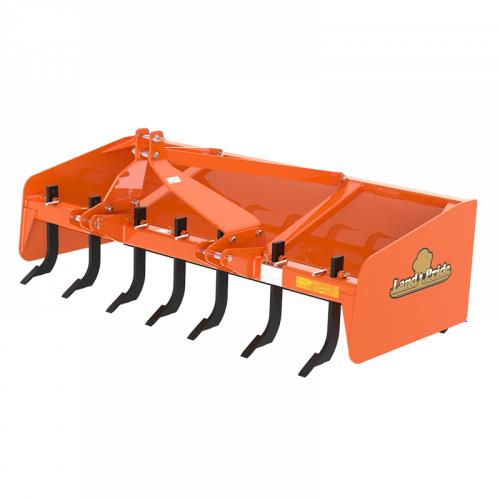
The Land Pride BB3584 is a seven-foot fixed-bar box scraper for a suitable tractor doing substantial grading, local material relocation and backfilling work. Its appeal is the combination of a large box, manually positioned scarifiers and two cutting edges. It should be selected because the work requires those functions, not simply because a heavy attachment appears likely to produce a better driveway.
This guide uses the North American BB3584 in operator manual 303-398M dated November 8, 2023. The manual and a separate manufacturer brochure contain slightly different weight figures. The distinction is retained below rather than blended into a supposedly exact universal specification.
On This Page
ToggleStart with where the material must go
A box scraper can retain material while it is moved to a nearby location, then distribute it as part of grading. That makes it relevant when the job includes changing the distribution of material rather than merely dressing an already serviceable surface. Sketch the source, destination and travel path before selecting width.
If material must be brought from a distant stockpile or supplied from outside the property, the complete operation may also need a loader, delivery truck or other equipment. A box scraper is not a substitute for every hauling task. Its purchase should be evaluated within that larger sequence.
Separate initial correction from recurring maintenance. A property requiring one major reshaping project followed by light dressing may not need to own the same tool that performs the initial repair. Conversely, frequent local material movement can make a substantial box useful beyond driveway maintenance.
Specifications with their source conditions
| BB3584 manual reference | Practical meaning |
|---|---|
| 84-inch working width | A seven-foot grading pass, subject to actual setup and overlap. |
| 32 cubic feet listed capacity | A volume reference, not a rated material payload. |
| 853 lb listed weight | The November 2023 manual figure; the separate brochure lists 855 lb. |
| Seven scarifier shanks | Each has a manual retaining-pin arrangement. |
| 45–120 hp requirement | Compare the stated tractor range with the complete carrying and working match. |
| Category I and II hitch | Check actual connections, quick-hitch arrangement and tractor guidance. |
The two-pound weight difference is not a reason to invent a production change. It is evidence that the documents should not be treated as one interchangeable table. This guide uses the manual’s 853-lb figure for its defined reference and leaves actual delivered or used-machine weight to the identified configuration.
The horsepower label also needs care. The scraper is a ground-engaging tool; its stated range should not be relabelled as a PTO-power requirement. Traction, setup, material and the tractor’s permitted implement arrangement remain separate considerations.
Volume does not tell you how much the tractor can carry
The 32-cubic-foot capacity describes the box’s nominal volume. Material mass depends on density and how much is retained, while the force needed to work the surface depends on additional conditions. Treating that figure as a payload rating would answer a question the specification does not establish.
A useful comparison starts with the expected movement distance and material. If the job is mostly shallow redistribution between nearby high and low areas, the box’s retaining action can be relevant. If it requires repeated transport of large quantities, compare the entire process with other equipment.
Do not assign a fixed number of trips from nominal volume alone. Actual filling, spillage, the required finished profile and suitable operation can change the useful amount moved. A representative demonstration is better evidence than multiplying capacity by an assumed number of passes.
Fixed-bar means a particular adjustment routine
The seven shanks are positioned manually using the documented pins and retainers. The manual lists four vertical positions relative to the end plates: above, even and two below-grade positions. This is not a hydraulically retractable scarifier bar.
That distinction matters most when the job changes repeatedly between loosening and finishing. An operator who sets the shanks once for a session has a different convenience requirement from someone alternating functions many times. Count the likely adjustment events before deciding whether fixed-bar simplicity suits the workload.
Any adjustment must follow the prescribed shutdown and support procedure. The buying point is the routine and effort involved, not a reason to change shank positions while the equipment is unsafe to approach. Include correct pins and retainers in a used-machine inventory.
Loosening, collecting and finishing are separate stages
Scarifiers can prepare suitable hard-packed material for the blade’s action. The cutting edge then engages and distributes material according to setup. A successful job may require distinct stages rather than one aggressive pass that attempts everything at once.
Define the desired final surface before selecting the most aggressive setting. More disturbance is not automatically better: it can create additional material to manage and more finishing work. If the task only requires light dressing, the full loosening capability may add little value.
Where a defect repeatedly returns after weather, reassess the cause. A scraper can alter the surface but does not independently establish a drainage or base-repair solution. Buying a heavier implement should follow the diagnosis, not replace it.
Two cutting edges and the backfilling role
The manual specifies two reversible, replaceable half-inch-by-six-inch high-carbon heat-treated cutting edges, with the rear-facing backfill blade standard. These are working components that deserve explicit inspection and maintenance planning.
The presence of a rear blade adds a documented backfilling role, but it does not turn the tractor linkage into a general bulldozer arrangement. Use the actual operating instructions and suitable task conditions. Do not judge capability from how substantial the side panels appear.
On a used unit, inspect both edges and their mounting, not only the forward edge visible in an advertisement. Remaining usable material, fastener condition and the underlying structure affect whether reversing or replacing an edge is a straightforward service task.
Construction matters through condition and fit
The manual documents a reinforced frame and substantial side panels for the BB35 family. The practical purchase question is whether the actual implement retains its intended shape and sound connections. Steel thickness alone cannot establish the condition of a machine with unknown repairs or severe wear.
Inspect the box, hitch and shank beam for deformation, cracks, repairs or missing components requiring competent assessment. A repaint may improve appearance while hiding useful history. Ask what work has been done and identify the parts fitted.
These are inspection priorities, not claims of recurring BB3584 faults. The aim is to price the specific machine as a complete working tool, including any necessary restoration, rather than discounting or praising it by appearance alone.
Seven feet needs a suitable tractor and route
Compare the tractor’s attachment and ballast instructions with the complete scraper package. Carrying the implement between work locations is a different condition from dragging it on the surface. The tractor must remain appropriately controlled throughout the intended use.
The manual drawing gives an overall width of 84¾ inches, slightly beyond the nominal working width. Measure constrained access and allow appropriate manoeuvring clearance. A tool that fits a straight opening may still be awkward when the tractor must turn immediately beyond it.
Include any quick hitch in the assessment. A category match and a manufacturer compatibility statement are useful starting points, but the actual engagement and mounted configuration still need checking. A heavier-rated accessory does not increase the tractor’s own capacity.
Three Canadian ownership cases
A working yard with recurring material redistribution
Here the box can serve a repeated practical task rather than a one-time ambition. Identify where material accumulates and where it needs to go. A demonstration should include collecting, moving and distributing under suitable conditions, not just a pass across an already smooth patch.
A long lane needing mainly periodic dressing
A grading scraper may deserve comparison if transporting retained material is rarely needed. The BB3584 can perform grading, but the most useful purchase is the system that fits the recurring task with an understandable operating routine.
A property with a major failed section
Obtain a repair scope before deciding that the box scraper is the solution. Drainage, missing material or deeper weakness can require work beyond surface manipulation. Ownership of a maintenance implement can be considered separately once that repair is defined.
Compare tools by what they do with material
The Land Pride RB1672 is useful context for a blade that directs material laterally and changes working position. It is a different configuration from a box retaining material between side plates.
The LR1672 illustrates a tine-based finishing approach. A rake can suit a different surface-handling task; it should not be treated as a cheaper equivalent merely because both tools work behind a tractor.
Aglist’s grading-tool comparison explains the broader choices. Use those distinctions to state the job, then compare the BB3584 with exact alternatives that meet the same requirement.
What a used quotation should contain
Record model identity, supplied shanks and hardware, both cutting edges, hitch components and documentation. List findings from the structural and wear inspection. Obtain actual repair and replacement quotations instead of assuming a missing pin or worn tip is insignificant.
Add delivery and tractor-specific setup to the purchase price. If a seller’s demonstration uses a different tractor, it can provide condition evidence without settling fit on yours. Treat those as separate acceptance questions.
Compare complete ready-to-work costs. A low asking price for an uncertain box can be less attractive than a sound alternative once repair, transport and missing equipment are included. No current Canadian retail price or standard restoration allowance is invented here.
Ownership frequency and working conditions
Count the jobs that genuinely recur. If the scraper is needed for only one substantial project, rental or contracted work should be priced alongside ownership. If it serves repeated yard and lane tasks, immediate availability may be valuable even without a dramatic time-saving claim.
Choose appropriate conditions for the actual material and equipment. A fixed calendar does not make wet or otherwise unsuitable ground ready for grading. Plan storage, inspection and changeover so that the tool is available when conditions are useful rather than forcing the work to fit a purchase date.
Keep a record of settings and results for recurring jobs, while following the manual. That can make future sessions more consistent and help distinguish a setup issue from a surface problem requiring another approach.
Frequently asked questions
Is the correct weight 853 or 855 pounds?
The November 2023 manual lists 853 lb; the separate manufacturer brochure lists 855 lb. This guide identifies the manual reference rather than inferring an undocumented change.
Are the scarifiers hydraulically retractable?
The referenced BB3584 is a fixed-bar design with manual positioning at each shank. Do not confuse it with another model’s hydraulic arrangement.
Is 32 cubic feet a payload rating?
No. It is a volume specification and does not establish allowable material mass or tractor capacity.
Will more weight permanently fix a rough driveway?
Not necessarily. The required repair depends on why the defect exists and returns.
Who should shortlist this model?
An owner with a compatible tractor and recurring work that benefits from a substantial seven-foot box, manual scarification and local material relocation.
Primary references
Specifications use Land Pride manual 303-398M, November 8, 2023. The weight discrepancy is retained from the separate BB35 brochure. No performance test, current price or universal repair outcome is claimed.
Share your experience
Help other Canadian buyers — leave a quick review for the
Land Pride BB3584
There are no reviews yet. Be the first one to write one.