
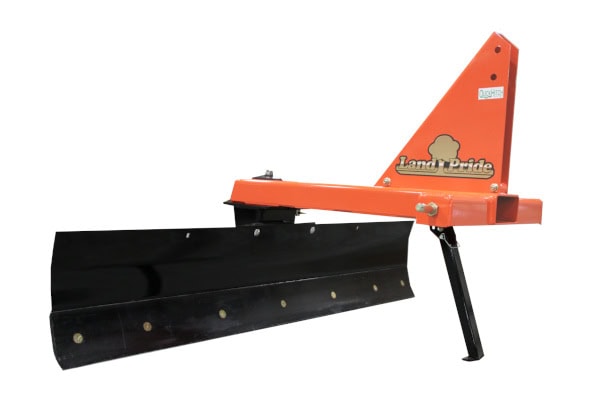
Overview & Specs
The Land Pride RB1672 is a six-foot rear blade whose value comes from adjustable working position, not merely from having a long cutting edge. It belongs on a shortlist when the property task calls for directing material and using angle, tilt or offset with a suitable tractor. A buyer mainly seeking uncomplicated repeated smoothing should also consider whether a grading scraper better matches the recurring job.
For Canadian acreage owners, the RB1672 can create a combined summer-and-winter equipment discussion, but each use needs its own assessment. The tractor range, actual adjustment equipment, working coverage and operator’s viewing routine all matter. This guide explains those decisions without turning a general application list into a promise for every site.
On This Page
ToggleIdentify the RB1672 specification and options
| Item | Manufacturer information |
|---|---|
| Nominal blade width | 72 inches, approximately 1.83 m |
| Approximate weight | 297 lb, approximately 135 kg |
| Tractor horsepower range | 20–40 hp |
| Hitch | Category 1 |
| Working-position adjustments | Angle, tilt and offset |
Source: the RB16/RB26 specification sheet, dated September 28, 2018 and checked October 20, 2026. The manufacturer’s RB16 listing also shows the 20–40-hp range and describes an optional hydraulic angling kit. Verify the equipment fitted to the actual implement, particularly when buying used.
Start with the direction material needs to move
A useful rear-blade assessment begins with a simple sketch. Mark where the tractor can travel, where the material starts and where the intended result requires it to end up. This makes it easier to identify whether lateral placement or an offset working position is genuinely part of the task.
Do not begin with the assumption that all uneven surfaces require the same tool. Nearby contained material transfer, shaping a defined profile and recurring dressing of a sound surface create different requirements. The RB1672 should be selected because its adjustable blade arrangement suits the assignment, not because a rear blade is familiar or appears inexpensive.
Where defects return repeatedly, establish the underlying repair requirement before buying. A tool capable of changing the surface does not provide a drainage design or correct an unidentified base problem. Record what happens after weather events and obtain an appropriate assessment when the intended work goes beyond ordinary maintenance.
Angle, tilt and offset are three separate choices
Angle changes the blade’s orientation in plan view. Tilt changes the relative height of its ends. Offset changes its lateral position relative to the tractor. These adjustments should remain separate on the buying checklist because a task can need one without needing frequent changes to the others.
The cited detailed sheet lists up to 45 degrees of forward angling, offset of 12 inches either way and tilt up to 15 degrees. These are configuration limits from the dated document, not recommended settings for a particular driveway. Follow the applicable manual and assess the actual implement’s arrangement.
Write down the setting changes expected during the routine. If the blade is positioned once before an occasional session, manual adjustment may be practical. If the route repeatedly changes the required angle, hydraulic control can deserve closer investigation. Its value should come from that work pattern rather than from the assumption that every optional feature is necessary.
Why six feet is not always six feet of projected coverage
For a simple straight blade rotated in plan view, projected width across the travel direction equals blade length multiplied by the cosine of its angle. This geometric illustration helps explain why a nominal width cannot be used uncritically when deciding whether the intended working setup covers a desired strip.
Using a nominal 72-inch length, the simple projection at 30 degrees is about 62.4 inches; at 45 degrees it is about 50.9 inches. These calculations are not measured RB1672 finished swaths. Actual geometry, offset, setup and material behaviour still need to be assessed.
The buying implication is to evaluate the configuration that will actually be used. A blade can appear comfortably wider than the tractor when square and present a different coverage question when angled. Do not solve that question by automatically buying a wider implement without checking tractor compatibility and access.
Measure the complete working envelope at gates, buildings and turning areas. Rear-mounted equipment also changes the route needed to manoeuvre. A wide nominal blade that is inconvenient to position can lose much of its apparent advantage on a divided property.
Respect both ends of the tractor range
The manufacturer’s 20–40-hp range is not simply a suggestion to bring as much power as possible. Preserve the upper limit when screening a host tractor. A Category 1 connection does not approve a tractor outside the stated requirements, and using a different power figure to make it appear to qualify is not a sound matching method.
Within the range, complete the carrying, clearance and setup assessment. Include any quick hitch or fitted options. The implement’s approximate mass is useful information, but it does not answer every question about the tractor’s rear carrying arrangement or the geometry in transport.
Compare the actual tractor configuration with the applicable documentation. A model family can contain machines with different equipment, and an older used tractor may have modifications. The useful purchase record identifies the combination being approved rather than simply stating that the blade is for compact tractors.
Hydraulic angling: specify the whole system
The optional kit deserves a complete quotation. Identify the approved kit, mounting components, hoses, connections and the tractor function that will operate it. A cylinder shown in a product image is not evidence that every item is included in a particular offer.
Assess control reach and the required operating sequence from the regular driver’s position. A rear remote, diverter and another auxiliary arrangement should not be treated as interchangeable labels without checking what the actual system provides. The connection needs to support the required function in the prescribed way.
Keep hydraulic angle distinct from hydraulic tilt or offset. The presence of one powered adjustment does not establish that the others are powered. List each function separately on the quotation so the delivered implement matches the routine demonstrated.
Quick-hitch compatibility can depend on identity
The current RB16 listing includes a serial-number qualification for QH05 compatibility: serial 872034 and later. That detail is especially relevant to a used purchase. Do not apply a current family compatibility claim to an unidentified older blade.
Identify the exact quick hitch, tractor and implement, then verify their combination. Pin category alone is not enough. Check the permitted raised position, connection geometry and practical parking arrangement with all components included.
The Aglist quick-hitch guide explains the broader process. Convenience is useful when the complete arrangement fits; it should not become a reason to improvise around a mismatch discovered after delivery.
Summer grading and winter clearing need separate plans
The manufacturer lists grading-related work and snow removal among RB16 applications. That supports investigating both uses, but it does not establish the correct settings, tractor setup or route for every property. Define the intended result for each season.
For winter, mark where snow can go as banks accumulate and how the operator will view the task. A rear-mounted tool can create a different posture from a front attachment. Evaluate the actual routine rather than assuming that an enclosed tractor automatically makes every clearing arrangement comfortable.
For summer, identify the intended material placement and the finished surface. Avoid carrying a successful snow-clearing impression into a conclusion about gravel grading without a relevant assessment. The same blade can serve different jobs while requiring different evidence of suitability.
The operator-station guide and transmission comparison help evaluate the tractor-side routine. Neither substitutes for the blade’s own compatibility and operating instructions.
Evaluate adjustment convenience over a whole season
Consider an invented example in which a session requires six permitted angle changes. Suppose a particular complete control arrangement is assumed to save one minute per change compared with another suitable arrangement. The assumed saving is six minutes per session, or two hours over 20 sessions.
Those values are not measured RB1672 results or a promise associated with hydraulic equipment. They show why the number of adjustments and frequency of use matter. If the owner makes only one change during a few annual sessions, the time argument becomes much smaller.
Convenience or reduced interruption can still justify an option without an hourly payback. State that preference directly and compare the complete cost. Avoid claiming that hydraulic adjustment automatically pays for itself without evidence about the actual workload.
A useful demonstration includes the awkward section
Choose a representative permitted task and define the desired result beforehand. Record the tractor, blade options and conditions. Include the route or manoeuvre expected to constrain the purchase, not only a long easy pass on an open surface.
Observe the operator’s view, required adjustments and time spent repositioning. Compare the achieved result with the stated objective. An implement can feel easy to control yet leave a result that does not meet the property’s need, or require more setup than the owner expects.
Allow appropriate familiarisation and distinguish observed performance from assumptions. A brief demonstration cannot establish every seasonal condition or predict years of cutting-edge life. Record unanswered questions explicitly rather than filling the gaps with an optimistic estimate.
Used RB1672 inspection and ownership cost
Confirm model and serial identity, installed options and the correct manual. Have the structure, hitch points, adjustment mechanism, locking components and cutting edge assessed. Inspect any hydraulic kit and repairs as actual equipment rather than assuming that added components increase value.
The specified edge is reversible and replaceable, but identified wear still needs a realistic parts and labour estimate. Missing hardware or damaged adjustment components can undermine the feature that makes the blade useful. These are inspection priorities, not claims of a model-wide defect pattern.
Compare ready-to-work costs. Include required controls, connection equipment, delivery, initial repair and storage. For infrequent tasks, obtain local rental or service quotations and consider availability when the work must occur. Do not assume a resale premium or a fixed operating life to make ownership appear cheaper.
Keep the configuration and serial information with the purchase records. That makes future parts, hitch and option questions easier to resolve and reduces the risk of ordering equipment for a neighbouring model that looks similar.
Frequently asked questions
Is the RB1672 suitable for every Category 1 tractor?
No. The cited range is 20–40 hp, and the complete tractor, hitch, clearance and setup requirements still apply.
Does hydraulic angling mean every adjustment is hydraulic?
No. Identify angle, tilt and offset equipment separately. The advertised angling option does not establish powered control of the others.
Will it cover a six-foot strip at maximum angle?
Do not infer that from nominal length. Projected coverage changes with angle, and the actual working arrangement needs evaluation.
Can an older used blade be assumed to fit a QH05?
No. The current listing gives a serial qualification. Verify the exact implement and hitch combination.
What is its clearest buying case?
A compatible tractor and recurring task that benefits from adjustable blade position, with an understood control routine and an acceptable complete cost.
Share your experience
Help other Canadian buyers — leave a quick review for the
Land Pride RB1672
There are no reviews yet. Be the first one to write one.