
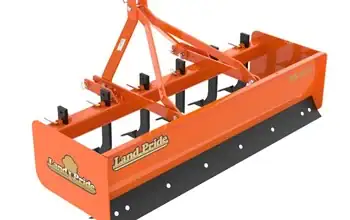
Overview & Specs
The Land Pride BB1572 is a six-foot box scraper for owners who need to loosen a surface, collect material and redistribute it over a nearby area. Its strongest buying argument is controlled material movement on a compatible compact tractor. It deserves a closer look when a lighter or narrower scraper leaves too much work unfinished, but a wider blade alone will not solve weak traction, a saturated driveway base or an unsuitable tractor match.
For a Canadian acreage, start by naming the job: moving a gravel ridge back into the travelled area, redistributing a delivered pile, or preparing a disturbed patch around a building. Those jobs require different quantities and distances of movement. The BB1572 becomes easier to evaluate once you can point to both the material source and its intended destination.
On This Page
ToggleThe BB1572 specification that matters most is the limit
Land Pride’s BB15 specification sheet dated August 29, 2022 lists the following figures. They describe that documented configuration, not an assurance that every modified used example is identical.
| Item | BB1572 specification |
|---|---|
| Working width | 72 inches / 1.83 m |
| Listed weight | 504 lb / 228.6 kg |
| Box capacity | 14.7 cubic feet / 0.42 m³ |
| Shanks | Six; four vertical positions |
| Maximum horsepower rating | 40 hp |
| Hitch | Category 1; Land Pride quick-hitch fit identified |
| Outside width in drawing | 72⅝ inches / approximately 1.84 m |
The 40-hp entry is a maximum, not a minimum to shop above. Do not choose a larger tractor on the assumption that the extra power can only help. Equally, a tractor below the maximum still needs adequate carrying capacity, the correct hitch arrangement and suitable traction. This is a ground-engaging implement: a power figure does not tell you how much material the tractor can pull on your actual surface.
What the box changes about grading
A straight blade can move material, but the side plates of a box scraper create a contained working area. That gives the operator a way to collect material while shaving a high area and release it where the surface is low. Think of the task as a sequence of collection, movement and distribution rather than simply driving until the driveway looks smooth.
Land Pride’s operator manual describes nearby transfer and redistribution, with ripping used when the surface needs loosening first. It also describes backfilling with the rear-facing edge. Follow its setup and shutdown procedures; the choice of pitch and shank position changes how the tool engages the surface.
A practical example is a short accumulation of loose gravel beside a shed apron. Before buying, estimate where that material needs to end up and whether the tractor can approach and leave the area without tight turns against the building. A tool can have enough width and still be awkward when there is no room to position the full tractor-and-implement combination.
For a large pile that must travel a substantial distance, compare the entire handling method. Loading and transporting material may be a separate job from finishing it. The scraper’s volume figure should not be interpreted as a promise that each pass moves a full measured load over any distance.
Six feet of cut needs six feet of useful space
The distinction between working width and outside width is small here, but neither measurement describes the full turning envelope. A gate opening must accommodate the actual implement, alignment errors and a workable approach. A nominal six-foot opening is not automatically sufficient for a nominal six-foot tool.
Compare the scraper with the tractor’s actual outside tyre width. If the tractor is wider than the working cut, the travel pattern may leave areas requiring another pass. If the scraper extends beyond the tyres, its corners need attention beside posts and walls. Neither arrangement is automatically wrong; the consequence should be visible before purchase.
On a hypothetical 3.6-metre-wide lane, two perfectly adjacent 1.83-metre cuts total 3.66 metres. That arithmetic leaves almost no allowance for overlap, steering variation or a separate finishing pass. It illustrates why dividing driveway width by catalogue width understates the real working pattern. It is not a claimed two-pass completion rate.
A wider tool can also encounter more material at once. On a site with isolated firm patches, choose a workable bite and permitted operating technique rather than using the width calculation as an instruction to remove the entire high area in one pass.
Use the shanks for a defined first stage
The six shanks are useful when the cutting edge needs help entering a consolidated surface. They are not a reason to rip every area every time. Decide which patches actually require loosening and which only need redistribution. Separating those jobs can avoid disturbing material that was already in a satisfactory condition.
The manual confirms individual pin-and-cotter adjustment. Changing between ripping and finishing therefore involves a stopped, properly secured adjustment routine, not a hydraulic shank function controlled from the seat. If a property repeatedly alternates between small hard patches and smooth finishing areas, include those transitions in a demonstration.
Inspect the intended working area for buried services and obstructions before ground engagement. The relevant working depth is a property constraint as well as an implement setting. A photographed smooth surface does not reveal what is immediately below it.
Judge a test by the material condition after loosening. Does it become workable for the next stage, or does the tractor simply lose traction while little useful preparation occurs? That distinction can identify an unsuitable surface condition or task without blaming the implement’s width.
Capacity is volume, not a guaranteed payload
The listed box capacity is a geometric volume. The force required to move the contents depends on material, moisture, engagement and the surface beneath it. A shallow layer of loose aggregate and a deep bite into consolidated soil are different loads even when the implement is unchanged.
For scale only, a hypothetical rectangular patch measuring 10 metres by 2 metres with an average 20-millimetre layer contains 0.4 cubic metres: 10 × 2 × 0.02. That is close to the listed box volume, but it does not mean one pass can collect, carry and place all of it. Real material is uneven, the box need not fill completely, and the finished profile may require several stages.
This calculation is most useful for planning whether the job is small redistribution or a larger earthmoving task. If the material quantity grows dramatically when you measure it, reconsider the handling equipment before selecting a scraper by appearance.
BB1572 versus a smaller scraper or a different tool
The BB1260 guide covers a smaller five-foot option. Compare complete tractor suitability and access rather than treating the BB1572 as an automatic upgrade. A tool that fits a confined work area can be more useful than additional width that repeatedly forces repositioning.
A GS1572 grading scraper belongs in the comparison when recurring surface maintenance is the main task. A box scraper is more attractive when deliberately retaining and moving material is part of the work. The distinction is the required result, not which attachment appears more substantial on a sales lot.
Within Land Pride’s families, do not substitute a BB25-series specification just because the working width matches. Model family and configuration remain part of the purchase identity. If the tractor or intended duty falls outside the BB15 documentation, investigate an appropriate alternative rather than treating a shared width as permission.
For lateral movement and adjustable blade positioning, consider the separate box blade, rear blade and land-plane comparison. Buying several overlapping attachments before defining the recurring work can consume storage and money without improving the result.
A Canadian driveway scenario: repair and maintenance are separate
Imagine an acreage lane that looks acceptable after grading but develops the same depression after wet weather. Photograph the location before work and after traffic returns. Record whether water remains there, whether the material is being displaced, and whether the surface is yielding under vehicles.
The scraper can redistribute material; it cannot by itself establish why that location repeatedly fails. If the underlying problem requires drainage or base correction, repeated cosmetic passes are not the complete repair. Resolve the site design before making an aggressive grading plan.
Seasonal timing also belongs in the ownership decision. A flexible maintenance task can wait for suitable ground conditions. An access route that must remain usable every day may require another contingency. Do not justify buying the BB1572 with an assumption that every spring condition is workable or that it automatically replaces winter equipment.
What to inspect on a used BB1572
Begin with the identification plate, the complete shank set and the hitch. Count the parts and inspect the adjustment positions, retaining hardware and areas where loads enter the frame. Missing shanks change the supplied package; a bent mounting area is a different problem from ordinary wear at a replaceable tip.
Look along the cutting edges and side plates for uneven wear or deformation. Land Pride documents reversible, replaceable edges, but reversibility is not proof that a particular edge has useful material remaining. Establish whether it has already been reversed and whether the mounting surface is sound.
Assess repairs with a competent person, especially around the hitch and shank beam. These are inspection priorities, not claims of a recurring BB1572 defect. Obtain parts and labour estimates for the actual findings instead of assuming that all visible wear can be corrected cheaply.
Arrange the inspection with the implement safely supported and the tractor shut down according to its instructions. A buyer should not crawl beneath a hydraulically held attachment to improve the view of a bargain.
Make the demonstration answer a purchase question
Choose a short representative section with a clear starting condition and desired finish. Record where material begins, where it ends, how many adjustments are needed and whether the tractor remains controllable. Test a suitable package under competent operation; do not use excessive loading as a strength test.
Include the approach, turns and final cleanup. If most of the session is spent repositioning, a different working route or attachment size may matter more than greater capacity. If most time is spent collecting material from too far away, the handling method may need to change.
Compare purchase quotations with the same shanks, edges, hitch equipment, delivery and identified repair work included. A simple ownership comparison should also include storage and the realistic number of jobs each year. There is no need to invent fuel savings or resale value when the real benefit is being able to maintain the property at a convenient time.
Questions buyers ask
Can I use it as ballast whenever the loader is fitted?
Do not infer an approved ballast arrangement from implement weight alone. Use the tractor and loader documentation for the exact configuration; distance behind the hitch and required ballast type matter.
Does a quick hitch remove every connection check?
No. Confirm the exact hitch and implement fit, clearance and carrying arrangement. Aglist’s Category 1 quick-hitch guide explains the distinction between a category label and a verified combination.
Should all work begin with the deepest shank position?
No. Choose the permitted setup for the actual need. Unnecessary deep disturbance can create more finishing work and does not demonstrate that the tool is being used efficiently.
Is it a useful purchase for one major project?
Possibly, but compare rental or contracted work against ownership after the project. A recurring need for nearby redistribution is a stronger ownership case than a single task followed by years of storage.
What would rule it out?
An incompatible tractor, inadequate access, a job dominated by long-distance hauling, or a site problem requiring a different repair. Those are reasons to change the equipment plan rather than expect the six-foot box to compensate.
Share your experience
Help other Canadian buyers — leave a quick review for the
Land Pride BB1572
There are no reviews yet. Be the first one to write one.
