
Overview & Specs
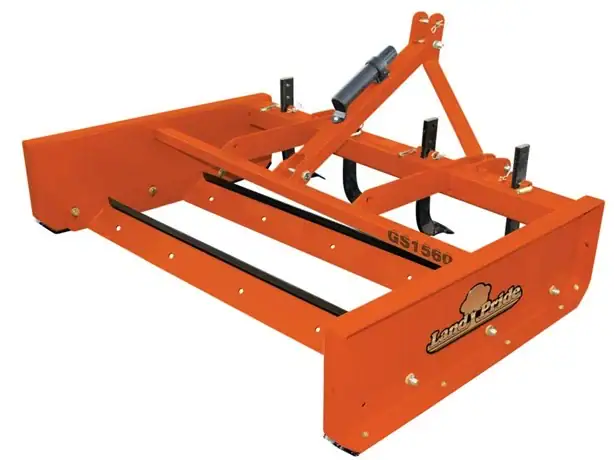
The Land Pride GS1572 is a six-foot grading scraper to investigate for recurring maintenance of an established gravel surface with a suitable tractor. Its buying case is different from that of a box scraper chosen to collect and transfer material nearby. The GS1572 should be assessed around the finish required, the actual driveway condition and the complete tractor-and-implement combination.
For a Canadian acreage owner, the appealing question is whether this tool makes routine upkeep practical enough to perform when needed. That is not the same as promising that a land plane will fix every road problem. A recurring defect, missing material or an unresolved drainage issue may require a separate repair plan before a maintenance attachment delivers lasting value.
On This Page
ToggleGS1572 specifications: distinguish working width and equipped weight
| Item | Manufacturer information |
|---|---|
| Working width | 72 inches, approximately 1.83 m |
| Overall width | 78.25 inches, approximately 1.99 m |
| Tractor horsepower requirement | 25–50 hp |
| Base weight | 539 lb, approximately 245 kg |
| Weight with shanks | 594 lb, approximately 269 kg |
| Hitch | Category 1 and Category 1 quick hitch |
Source: Land Pride’s GS15 specification sheet, dated March 28, 2022 and checked October 20, 2026. The sheet identifies five optional scarifier shanks for the GS1572. Match the applicable documentation and actual equipment when purchasing a newer, older or modified unit.
Buy it for the maintenance task it actually addresses
Land Pride’s GS15 description distinguishes the grading scraper from a box scraper by noting that it is not designed to transfer large volumes of dirt between locations. That distinction should stay visible when the owner describes the intended work.
If the recurring objective is to maintain a suitable gravel surface, the GS1572 deserves investigation. If material must be moved from a separate stockpile, if substantial reshaping is needed or if the road’s underlying problem has not been identified, define those tasks separately. A convenient maintenance tool is not automatically the complete repair system.
Describe the result before discussing the attachment. Which section needs attention? What finish is acceptable? How often does the problem return? What happens after rain or seasonal changes? Those observations help prevent the purchase from being based on a successful demonstration on an easier surface than the owner’s property.
The six-foot label does not describe the storage envelope
The difference between 72-inch working width and 78.25-inch overall width is 6.25 inches. That distinction matters when an owner compares the advertised size with a gate, trailer position or storage bay. Use the complete external envelope for access, not the width of the worked strip.
Check the approach and turning space as well as the narrowest opening. A rear-mounted tool changes the manoeuvre needed around buildings or parked equipment. Passing through a gate in a straight line does not establish that the combination can comfortably turn immediately beyond it.
Compare the GS1572 with narrower candidates using the actual route. A broader working width may reduce passes on an open lane, but it can also create inconvenience at a constrained entrance. The better tool is the one that fits the complete task, not necessarily the one with the largest nominal coverage.
Record the parking position before purchase. Enough room to store the tool is only part of the question; the tractor must also be able to approach and connect it using the prescribed procedure. A manageable storage routine supports regular maintenance more effectively than an implement tucked into an awkward corner.
Base weight and shank-equipped weight answer different questions
The manufacturer’s two mass entries should not be mixed. Use the figure appropriate to the actual configuration when making the initial tractor and transport assessment. A quotation with shanks should not be evaluated using the lighter base entry simply because that number appears first in the table.
The additional equipment also changes the inspection and ownership checklist. Confirm that the quoted shanks, tips and retention components are present and suitable. For a used unit, inventory them rather than assuming that every mounting location contains a complete assembly.
Weight alone does not approve the tractor match. Evaluate the implement’s rearward geometry, hitch arrangement, permitted carrying position, clearance and required tractor setup. Include a quick hitch or other approved connection equipment in the complete assessment.
For hauling, account for the full transported package, including the tractor and other equipment where applicable. A base implement mass is useful input, but it does not establish that an entire trailer load is suitable.
Respect the 25–50-hp requirement
Preserve both ends of the manufacturer’s range. A buyer should not treat 50 hp as merely a minimum or assume that a much larger tractor is acceptable because the hitch connects. The actual tractor and implement requirements must support the proposed combination.
Do not substitute a PTO rating for a tractor-power limit without a documented basis. This grading implement creates a different matching question from a shaft-driven mower. Use the terminology and conditions in the relevant documentation rather than selecting whichever number makes the pairing appear suitable.
A tractor within the power range still needs the rest of the compatibility review. The three-point connection, carrying arrangement, tyre configuration and applicable setup remain part of the package. There is no universal approval based solely on the tractor’s model number or its general compact classification.
Two grading blades and optional scarifiers: understand the configuration
The specification sheet describes two parallel grading blades and adjustable cutting-edge placement, with optional scarifiers. Those features identify equipment to inspect and understand; they are not a set of universal working settings for every driveway.
Use the actual operator’s manual to establish setup and operating procedures. A general buying guide should not prescribe one depth or speed for unknown material and conditions. Learn how the provided adjustments affect the permitted routine and determine whether that routine suits the operator.
When comparing offers, keep configuration differences explicit. A base unit and a shank-equipped unit may both be described simply as a GS1572. Compare the included components, condition and complete cost rather than treating the model name as a complete equipment list.
For occasional work, ask how much setup changes between sessions. For varied property tasks, consider whether adjustments or equipment changes become a recurring burden. The useful question is how the complete implement fits the owner’s schedule, not how many features can be listed in an advertisement.
Quick-hitch convenience needs a verified combination
The sheet identifies Category 1 and Category 1 quick-hitch compatibility. Still verify the actual tractor, hitch and implement configuration before purchase. A broad category statement does not remove the need to inspect geometry, connection hardware and the raised arrangement.
Include the storage-to-work sequence in a demonstration where practical. Can the tractor approach the parked implement appropriately? Is the connection routine manageable? Does the combination clear the route in its permitted transport position? These are useful ownership questions beyond whether the lower pins appear to align.
The Aglist quick-hitch guide explains why a complete fitment review matters. A convenient attachment system is valuable when it works correctly with the actual components, not when it relies on an improvised workaround.
Establish a driveway maintenance plan before buying
Divide the property work into initial correction and recurring upkeep. If a significant repair is needed first, define its scope independently. Then decide which implement makes sense to own for the maintenance that follows. The tool needed once and the tool used every season may not be the same.
Keep records of the surface before work and after subsequent weather or traffic. This helps distinguish an acceptable maintained result from a temporary cosmetic improvement. If the same defect returns quickly, investigate the cause rather than assuming that more passes or a different adjustment will necessarily solve it.
This guide does not prescribe a universal driveway crown or drainage alteration. The appropriate profile depends on the site and where water can properly go. Establish the required outcome before using an attachment’s capabilities as a substitute for a plan.
Calculate whole-session value
Suppose, as an invented example, a maintenance session takes ten minutes to connect and prepare, 40 minutes of work and ten minutes to park and finish. The total is one hour. If an alternative suitable arrangement takes 75 minutes overall, the assumed difference is 15 minutes per session.
At twelve sessions a year, that difference is three hours. At four sessions, it is one hour. These values are not measured GS1572 performance or a claim that it outperforms another implement by a fixed amount. They show how frequency affects the value of convenience.
Record actual times where a representative demonstration is possible. Include interruptions and turning rather than timing only a smooth straight pass. A tool that is pleasant to use may encourage timely maintenance, but that personal benefit should be stated honestly rather than converted into unsupported productivity statistics.
Canadian seasonal conditions and the limits of a demonstration
Identify when the maintenance normally occurs and whether the work can wait for suitable conditions. A single demonstration cannot establish results across every season or surface state. Retain the manufacturer’s operating guidance and record what the test actually showed.
Do not assume the grading scraper is the correct winter-clearing attachment merely because it is already connected to the tractor. Verify any intended application for the model and configuration. Separate winter access responsibilities from the gravel-maintenance purchase if they require a different system.
For the tractor-side routine, assess travel control and operator comfort over the complete session. The transmission guide helps frame control preferences, while the operator-station guide addresses seasonal work patterns. Neither replaces the implement’s requirements.
Used GS1572 inspection
Confirm model identity and obtain the correct manual. Inspect the frame, hitch points, cutting edges, skid surfaces, adjustment hardware and any shanks with competent help. Assess deformation, repairs and missing components rather than judging condition solely from paint or surface rust.
The documented cutting edges are reversible and replaceable, but that does not establish a fixed repair bill for every used example. Obtain estimates for the actual parts and work required. A worn adjustment or damaged mounting area can change the value of an otherwise attractive offer.
Compare the supplied configuration with the seller’s description. If the price assumes optional equipment, verify that it is complete. Keep any modifications visible in the assessment rather than treating them as automatic improvements.
Compare complete ownership cost with alternatives
Include delivery, required hitch equipment, initial repairs and storage in the purchase comparison. For occasional maintenance, obtain actual rental or service quotations and consider whether the equipment will be available when needed. A theoretical low rental cost is less useful if timing makes that arrangement impractical.
A hypothetical CAD 2,000 capital cost spread over 40 uses is CAD 50 per use before financing, maintenance, resale and tractor costs. Spread over ten uses, it is CAD 200. These are invented inputs, not Canadian GS1572 prices. They demonstrate why the owner’s realistic use pattern belongs in the decision.
Quality of result and independence can justify ownership without a promise of cash savings. State those benefits directly. Avoid inventing wear life, fuel economy or resale assumptions simply to make the preferred tool appear cheaper.
Frequently asked questions
Is the GS1572 only 72 inches wide for storage?
No. The cited working width is 72 inches, while overall width is 78.25 inches. Measure the complete route and configuration.
Which mass should be used for a shank-equipped unit?
The cited table gives 594 lb with shanks rather than the 539-lb base figure. Verify the actual equipment and complete carrying arrangement.
Can it replace a box scraper for every material-transfer job?
No. The manufacturer’s description distinguishes its maintenance role from transferring large volumes between locations.
Is a tractor within the horsepower range automatically approved?
No. Hitch, carrying geometry, clearance and required setup still need verification.
What makes it a strong purchase candidate?
A compatible tractor, an established surface needing recurring maintenance, practical access and storage, and a demonstrated result that meets the owner’s actual expectations.
Share your experience
Help other Canadian buyers — leave a quick review for the
Land Pride GS1572
There are no reviews yet. Be the first one to write one.