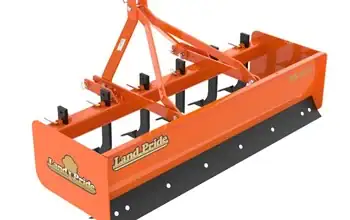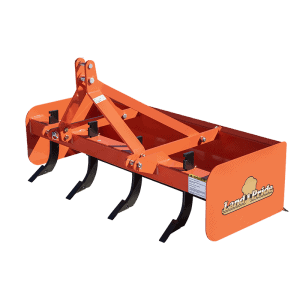
Overview & Specs
The Land Pride BB1260 is a five-foot fixed-bar box scraper for a suitable smaller tractor, with a clear upper power limit that deserves attention before the width or price. It is worth investigating for property work that involves collecting and redistributing material nearby, preparing a surface and maintaining a lane. It is not an attachment to select simply because any tractor with a Category 1 hitch can physically connect to it.
For Canadian acreage owners, the most useful purchase question is whether the BB1260 fits both the tractor and the recurring material-moving task. A modest implement can be a sensible ownership choice when it serves regular work, but buying beyond its stated tractor range or expecting it to solve an unidentified driveway problem creates a poor starting point.
On This Page
ToggleBB1260 specifications that affect the decision
| Item | Manufacturer specification |
|---|---|
| Working width | 60 inches, approximately 1.52 m |
| Weight | 346 lb, approximately 157 kg |
| Shanks | Four, manually adjusted |
| Maximum horsepower rating | 30 hp |
| Hitch | Category 1 |
Source: Land Pride’s BB12 specification sheet, dated September 25, 2018 and checked October 20, 2026. The manufacturer’s BB12 listing identifies the BB1260 within a 17–30-hp tractor range. Match the actual implement and its applicable manual before purchase; the dated sheet is not an inventory of modifications on a used unit.
The 30-hp figure is a ceiling, not a target to exceed
A common buying mistake is to read every horsepower figure as a minimum. Here, the detailed sheet explicitly states a maximum. More tractor power does not automatically create a suitable combination, and the owner should not treat careful driving as a substitute for the manufacturer’s equipment requirements.
Keep the tractor rating terminology consistent with the implement documentation. Do not replace a tractor-power limit with a lower PTO figure to make an oversized host appear to qualify. This implement is not selected by applying the same shaft-power matching method used for a driven mower.
The power range is also only one screening requirement. Confirm hitch compatibility, the tractor’s carrying arrangement, required setup and clearance. A tool can satisfy the stated power range while presenting another mismatch. Review the complete proposed combination rather than approving it from one specification row.
Choose it for a material task, not just a rough-looking driveway
Describe where the material is now and where it needs to be. A box scraper is worth considering when the work includes retaining scraped material and redistributing it over a nearby area. If the main need is transporting material over a substantial distance, include the equipment and time required for that separate part of the job.
For driveway work, distinguish a surface that needs maintenance from a recurring defect with an unresolved cause. Photograph the problem and note when it returns. Repeated smoothing without understanding the underlying issue can produce an attractive result briefly while leaving the owner dissatisfied with the purchase.
For landscaping or garden-area preparation, define the intended finish and the material being worked. Do not convert a general list of possible applications into a promise that the BB1260 will handle every site condition. The tractor, implement and actual assignment must all be suitable.
Five-foot working width and real property access
The 60-inch working width helps establish the scale of the tool, but it should not be used as the only access measurement. Check the complete attachment, tractor tyre arrangement and the route through gates or between stored equipment. Include the space needed to turn with a rear-mounted implement.
A useful comparison with a narrower or wider candidate starts with the property layout. Long open passes may make working width important. A route divided by tight entrances can make manoeuvring and storage more important. A wider tool does not automatically shorten the whole session.
Measure before delivery. Write down the smallest clear opening, the turning area and the attachment’s proposed parking position. A tool that can be stored somewhere but is awkward to connect may create a recurring inconvenience larger than the small saving expected from its width.
Manual shanks: assess the setup routine
The specified four-shank arrangement is manually adjusted. For a new purchase, confirm what is included; for a used one, inspect the actual shanks, retainers and tips. Missing parts should be priced before the implement is compared with a complete alternative.
The buying question is how often the required setup changes during the owner’s work. A setting made before an occasional session creates a different convenience requirement from repeated changes between different tasks. A fixed-bar manual arrangement should be evaluated on its own terms, not compared with the photograph of a more elaborate hydraulic model.
Follow the applicable manual for adjustment and operation. This guide does not prescribe a universal shank depth or a sequence for an unfamiliar tractor. Establish the correct procedure and decide whether that routine is practical for the regular operator.
If the work genuinely requires frequent adjustment that the proposed arrangement makes inconvenient, compare another suitable implement. Do not assume an improvised hydraulic conversion is available or appropriate. The complete documented alternative is the relevant comparison.
The hitch category does not finish the fitment check
Inspect the three-point connection and the tractor’s requirements for the configured implement. Include any quick hitch in the assessment rather than treating it as a neutral spacer. The geometry, carrying position and clearances need to remain appropriate with the exact components installed.
Land Pride’s sheet identifies compatibility with its quick-hitch arrangement, but that does not establish universal compatibility with every product described as Category 1. Verify the exact hitch and implement combination. The Aglist quick-hitch guide explains why the category label is only part of the answer.
Plan how the implement will be parked for connection. A practical storage location and an approved connection routine can make occasional ownership more convenient. Do not evaluate attachment changes only on a level showroom floor if the real storage location creates a different situation.
Compare the job with a rear blade or grading scraper
If the main requirement is lateral placement with a blade whose position can be adjusted, investigate a suitable rear blade. If it is recurring smoothing of an established gravel surface rather than contained transfer, investigate a grading scraper. These are candidate directions, not claims that one category universally outperforms the others.
The BB1260 deserves its place when the box-style work is actually needed and its tractor requirements fit. Avoid buying a tool mainly because a neighbour achieves a good result with it on another property. The starting surface, tractor and operator routine may be different.
Consider the initial repair separately from ongoing maintenance. Contracting a substantial one-time job and owning a smaller maintenance tool can be rational. So can owning a box scraper when nearby material redistribution is frequent. Write the recurring task list before choosing which capability to own.
Canadian seasonal use: plan around the surface
Record the conditions in which the property work normally takes place and whether the schedule is flexible. A demonstration on an easy dry section does not establish performance across every seasonal condition. Keep the actual task and the manufacturer’s permitted use in view.
Do not assume that every grading implement should become the winter-clearing tool. If winter use is part of the purchase rationale, verify that application for the actual model and configuration. The destination for moved material and the operator’s view remain important regardless of season.
Where work can wait, scheduling may be part of a better equipment plan. Where it cannot, identify the required result and an appropriate alternative if the chosen combination is unavailable or unsuitable. An attachment purchase should reduce uncertainty rather than depend on favourable conditions that rarely occur.
A demonstration with a measurable outcome
Agree on a representative permitted task and the desired finish before testing. Record the tractor, implement setup and conditions. Allow the operator to learn the correct procedure; comparing a familiar tool with an unfamiliar one can obscure the equipment decision.
Assess the complete session, including connection, working passes, repositioning and parking. Note where adjustment is required and whether the result meets the stated objective. A brief successful pass does not establish a universal work rate or long-term durability.
As a hypothetical planning example, suppose a session takes 15 minutes to prepare, 45 minutes to work and ten minutes to park and clean up. The total is 70 minutes. Saving ten minutes in the working portion reduces the total to 60 minutes, not to the 35-minute working figure alone. These are invented inputs, not measured BB1260 performance.
At six annual sessions, the assumed improvement saves one hour per year. That may be useful, but the purchase decision should compare the actual complete cost and the value of the result, not an exaggerated time-saving claim.
Inspect a used BB1260 as a complete tool
Confirm the model identification and inspect the structure, connection points, cutting edges, shanks and adjustment hardware with competent help. Look for deformation, repairs and missing components. These are inspection priorities rather than statements that the model has particular recurring defects.
The specification describes reversible and replaceable cutting edges. That does not mean a worn implement is automatically cheap to restore. Obtain the correct parts and labour estimates for the actual findings, including damaged mounting or adjustment components if present.
Ask for the applicable manual and identify any modifications. An undocumented alteration should not be assumed to improve suitability. Compare the completed condition and cost with a sound alternative before deciding that a low advertised price represents value.
Budget for ownership rather than the advertised implement alone
Include required connection equipment, delivery, identified service work and a practical storage arrangement. For occasional use, compare rental or contracted work using actual local quotations and availability. An implement that is inexpensive to purchase can still be inconvenient to own if there is no suitable place to keep or connect it.
A hypothetical CAD 1,500 purchase used ten times annually over five years represents CAD 30 per use before maintenance, financing, resale and tractor costs. At only two uses annually, the same simple capital calculation is CAD 150 per use. Those invented numbers demonstrate the effect of frequency; they are not Canadian BB1260 prices.
Capability can justify ownership even when use is infrequent, particularly if timing matters. State that reason directly. There is no need to invent fuel savings, resale premiums or guaranteed wear life to support a purchase that genuinely fits the task.
Frequently asked questions
Can a larger tractor use it because the hitch fits?
Do not approve that from physical connection alone. The cited maximum rating is 30 hp, and all applicable tractor and implement requirements must be met.
Are the shanks hydraulically adjusted?
The cited BB1260 specification describes manual adjustment. Verify the actual equipment rather than borrowing features from another series.
Does five-foot width guarantee fewer total hours?
No. Setup, access, turns and the desired finish can dominate the complete session.
Will it permanently fix every rough driveway?
No. Identify the cause and required repair where defects recur. A grading tool does not replace a suitable site plan.
Who should shortlist the BB1260?
An owner with a compatible tractor and recurring nearby material-redistribution or grading work who values a manageable, documented complete package.
Share your experience
Help other Canadian buyers — leave a quick review for the
Land Pride BB1260
There are no reviews yet. Be the first one to write one.