
Overview & Specs
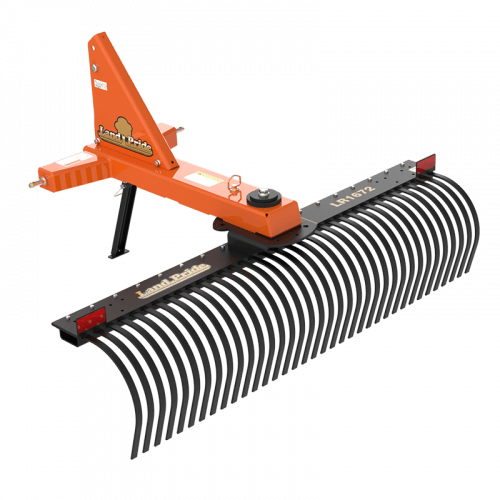
The Land Pride LR1672 is a six-foot landscape rake for sorting and reshaping loose surface material. It is worth considering when the job is to collect scattered debris, redistribute aggregate or prepare a surface for the next stage of landscaping. It is a different purchase from a box scraper: the teeth interact with material selectively, rather than enclosing a load between solid side plates.
That distinction matters on a Canadian acreage. Gathering material from a disturbed yard, recovering displaced gravel and finishing an already prepared area are plausible rake jobs. Cutting a new grade through hard ground or carrying a large quantity from a distant pile asks a different question. Decide which task dominates before adding optional equipment to make one attachment appear to cover everything.
On This Page
ToggleDocumented LR1672 specifications
The figures below come from Land Pride’s LR16/LR26 specification sheet dated July 18, 2025. They refer to the LR1672 column; accessories can change the delivered arrangement.
| Item | LR1672 |
|---|---|
| Rake width | 72 inches / 1.83 m |
| Approximate weight | 270 lb / 123 kg |
| Teeth | 36 individually replaceable teeth |
| Tooth spacing | 2-inch centres |
| Horsepower range | 20–40 hp |
| Hitch | Category 1 |
| Standard angle adjustment | Seven forward positions, up to 45° either side |
| Drawing width | 72½ inches / approximately 1.84 m |
Use the horsepower range as an initial screen. The rake’s mass, fitted accessories, tractor carrying requirements and clearance still need assessment. A tractor with much more power is not automatically an improved match, and a connection that physically fits is not a complete approval.
Why teeth behave differently from a solid blade
A landscape rake gives material opportunities to move between the teeth. What remains ahead of the rake depends on particle size, shape, moisture, depth of engagement and accumulated debris. The practical result is a sorting and redistribution action rather than the predictable capture of everything in its path.
The tooth spacing is a centre-to-centre measurement. It is not a certified screening aperture or a guarantee that every object above a particular diameter will be collected. Stones can turn, irregular material can bridge, and roots or vegetation can change how the rake loads. A buyer who needs a tightly specified screened product should evaluate actual screening equipment.
For property work, define the acceptable result in ordinary terms: fewer loose stones on a prepared strip, gravel gathered away from an edge, or a surface ready for another finishing operation. Then inspect both the material collected and what remains behind. A large windrow alone does not establish a good result.
The manufacturer’s LR16 page describes final surface preparation and profile reshaping, with optional gauge wheels and hydraulic angling. Those features make sense when tied to a particular problem; they are not reasons to treat the rake as a substitute for every earthmoving implement.
Angling reduces the width across the direction of travel
The LR1672’s six-foot dimension describes the rake across its full width. Once angled, its projected width perpendicular to travel becomes smaller. This matters when trying to cover the tractor’s tyre tracks or estimating how many passes will be needed across a yard.
For a simplified straight rake, projected width is width multiplied by the cosine of the angle. At 30°, 72 × cos 30° is approximately 62.4 inches. At 45°, it is approximately 50.9 inches. These are geometric calculations, not measured coverage claims; real overlap, the working ends and material flow also matter.
Suppose the tractor’s outside tyre width is a hypothetical 60 inches. The straight rake extends beyond that width, while the 45° projection does not. The operator might still have a workable sequence of passes, but the expectation of covering both tyre tracks in a single angled pass needs revision.
Measure the tractor as equipped, not from a generic model width. Wheel and tyre configurations can change the comparison. Also remember that a narrower projected cut does not eliminate the physical sweep of the rake as it turns behind the tractor.
Plan the windrow’s destination
Angling can help direct material toward one side, but the purchase question is where that material should ultimately go. A useful windrow can become an obstacle if it is left across an access route or against a feature that needs to remain clear.
Before work, sketch the travel direction, collection side and pickup or distribution area. On a small yard, the final handling of the collected material may take longer than the raking itself. Include that stage when comparing a rake with other tools or a contractor’s complete service.
Consider a hypothetical spring cleanup where gravel has moved beyond a maintained lane. The objective may be selective recovery while preserving the surrounding surface, not scraping every square metre aggressively. A short trial in suitable conditions can show whether the rake separates material acceptably or pulls too much unwanted material along with it.
If the mix cannot be separated satisfactorily, more passes may simply move the same mixed pile around. Recognising that limit early is more useful than interpreting every untidy result as a need for a larger tractor.
Gauge wheels and hydraulic angling solve different problems
Land Pride lists optional gauge wheels for depth control and a hydraulic kit for changing angle. The first concerns how the rake follows the surface; the second concerns adjustment convenience. Buying one does not deliver the function of the other.
Gauge wheels deserve consideration where maintaining a consistent working relationship to uneven terrain is the recurring difficulty. They also add components that need room, inspection and a suitable storage position. Compare the complete equipped machine rather than assuming the base drawing describes every accessory combination.
Hydraulic angling is more attractive when the required angle changes repeatedly within a job. If the rake remains at one setting for an entire session, manual adjustment may be entirely practical. The value comes from actual adjustment frequency, not simply from being able to list another hydraulic function.
Check the necessary tractor-side hydraulic equipment for the exact kit. The rear-remotes and hydraulic-control guide explains why an available hydraulic system is not the same thing as the right outlets and controls at the attachment.
For an invented example, six safe stopped adjustments taking two minutes each add twelve minutes to a session. Across ten sessions, that is two hours. This is a way to value convenience using your own observations, not a promised saving for the LR1672 or permission to skip the prescribed stopped adjustment procedure.
The flip-down grader is not the same as a separate rear blade
The manufacturer describes a flip-down grader accessory and a separate rear-blade attachment arrangement. Keep those descriptions distinct on a quotation. A photograph of one configuration should not be treated as evidence that every component shown is included.
If the aim is to own fewer implements, price the complete conversion or accessory arrangement, including any required hardware and the time involved in changing tasks. A versatile frame is valuable only if the changes are practical for the owner who will actually perform them.
Compare that plan with keeping dedicated tools ready. For occasional work, a slower changeover may be acceptable. For frequent alternating tasks, the storage cost of a separate implement might be justified. This is an ownership choice that cannot be settled from the base rake’s width alone.
Quick-hitch fit has a serial-specific detail
The LR16 product page identifies QH05 compatibility for serial number 872034 and later. Preserve that qualification when shopping used. A broad description such as “quick-hitch compatible” should not erase the specific condition attached to a particular hitch model.
Record the rake serial number, hitch model and actual mounting hardware. Check the complete configuration through its permitted movement and transport position. If the proposed purchase includes older or modified equipment, obtain the documentation that applies rather than borrowing approval from a newer machine.
Aglist’s Category 1 quick-hitch guide provides the broader fitment method. Here the important buying point is that identification is part of compatibility, not paperwork to collect after paying.
Where a box scraper or grading scraper may fit better
If the task requires retaining a quantity of material and dragging it to a nearby low area, examine a box scraper such as the BB1260. Its solid sides answer a different material-handling need from the LR1672’s open row of teeth.
For repeated smoothing of an established gravel surface, compare a GS1572 grading scraper. The right choice depends on whether the desired operation is sorting, contained transfer or surface maintenance. Several tools can improve the appearance of a driveway while doing materially different work.
Do not select the rake merely because it is lighter than another implement. Lower mass can be useful for a suitable tractor, but it does not establish that the tool can perform the heavier earthmoving job you had in mind. Match the mechanism first, then the tractor and equipped package.
Inspect the tooth row before judging the paint
On a used rake, sight along the tooth row with the machine safely parked. Look for missing teeth, inconsistent shapes, damaged retaining hardware and uneven wear. Individually replaceable teeth make local repairs possible, but a large number needing replacement changes the purchase calculation.
Inspect the frame, pivot, angle-locking arrangement and hitch points. Test adjustments only under the correct secured procedure. Excessive play, binding or visible deformation deserves investigation; this is a general inspection method, not a claim that the LR1672 suffers from a particular recurring fault.
If gauge wheels are included, assess their bearings, tyres, supports and adjustments. If hydraulic angling is included, identify the cylinder and kit, inspect hose condition and check the permitted movement with competent help. Missing accessory parts can make a cheap advertised package substantially less complete than it first appears.
Obtain the parts list for the actual serial number and price the identified work. Avoid adding a blanket repair allowance that ignores whether the damaged part is a simple wear item or part of the load-bearing structure.
A useful demonstration ends with an acceptable surface
Choose a representative patch and state the acceptance criteria before starting. Count unwanted larger pieces remaining, examine how much desirable material was displaced, and record whether another tool is required to finish. This is more informative than a demonstration that ends as soon as a neat windrow appears.
Include an angled pass if that is the intended routine. Observe overlap and tyre-track coverage. Include the route to the work area and the final handling of collected material. The attachment should fit the whole process, not just the most photogenic minute.
For Canadian seasonal work, compare conditions realistically. Ground that is firm enough for an acceptable cleanup one week may behave differently after prolonged wet weather. Schedule flexible finishing work around suitable conditions rather than assuming the rake will compensate for every surface state.
Frequently asked questions
Will it remove every stone larger than the tooth spacing?
No. Centre spacing is not a guaranteed screening size. Shape, orientation, engagement and mixed debris affect what is collected.
Is a 72-inch rake always wide enough for a 60-inch tractor?
Not across every angle. The simplified 45° projected width is about 50.9 inches, so examine the actual pass pattern rather than using straight width alone.
Are gauge wheels essential?
That depends on the required finish and terrain. Evaluate their benefit in the intended work and include their complete cost and storage envelope.
Can it replace all driveway attachments?
No. Sorting and redistribution are not the same as deep loosening, contained transfer or correcting an underlying drainage problem.
Who has the strongest ownership case?
An owner with a compatible tractor, recurring surface-finishing or material-sorting work, and a practical destination for what the rake collects. For a single landscaping project, compare the full rental or contracted solution before committing to permanent storage.
Share your experience
Help other Canadian buyers — leave a quick review for the
Land Pride LR1672
There are no reviews yet. Be the first one to write one.