Overview & Specs
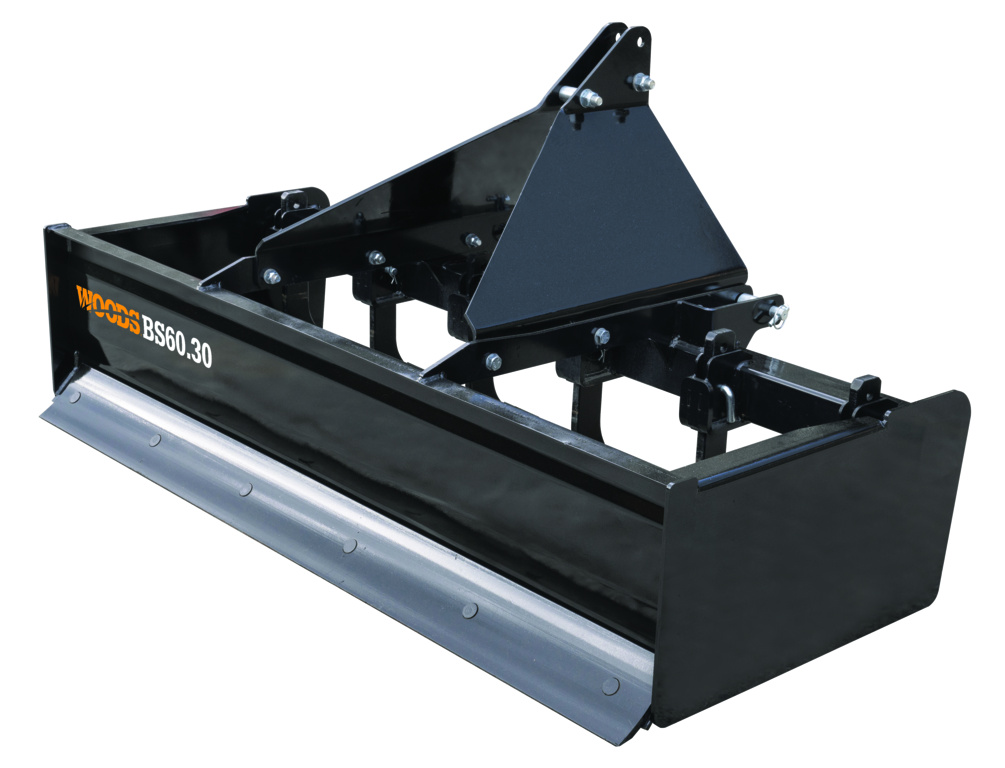
The Woods BS60.30 is a five-foot box scraper for a suitably matched tractor, intended for jobs involving scraping, loosening and redistributing material over a nearby area. It is worth considering when the recurring task genuinely calls for a box that retains material. It is a different purchase from a grading scraper chosen mainly to maintain an established gravel surface.
Its most useful buying details are the fixed tailgate, five saddle-mounted scarifiers and the distinction between heaped volume and a permissible load. There is also a small but real discrepancy between the weight on the current product page and the linked manual. A sound purchase assessment keeps that uncertainty visible instead of selecting whichever figure makes the tractor appear adequate.
On This Page
ToggleSixty-inch width, with a weight discrepancy to resolve
The Woods BS60.30 specification page, checked October 31, 2026, lists 60-inch working width, a 25–45 engine-hp tractor range, Category 1 hitch and approximately 510 lb. Its browser title says 54 inches, but the model specification table says 60. Do not use that inconsistent page-title wording as the working dimension.
The linked MAN1377 operator manual, May 10, 2024, also gives 60 inches and the 25–45-hp range for the BS60.30 column, but lists approximately 500 lb. The sources do not explain the ten-pound difference. Confirm the actual supplied configuration and weight rather than averaging the figures.
| Feature | Documented BS60.30 detail |
|---|---|
| Working width | 60 inches |
| Heaped capacity in the manual | 15.6 cubic feet |
| Scarifiers | Five, heavy-duty saddle mounting |
| Listed depth positions | 0, 1.5 and 3 inches |
| Tailgate | Fixed |
| Cutting edges | Two reversible edges |
Choose the box because material must go somewhere
Describe the material movement before choosing an attachment. Where does the material start, where should it finish and how far apart are those locations? The answers distinguish a nearby redistribution task from a hauling job or a surface-maintenance pass.
For example, a small area with excess loose material near a low section presents a different problem from a lane that lacks sufficient surface aggregate throughout. In the first case, redistribution may be part of the answer. In the second, no implement can create the missing material; delivery and placement must be included in the plan.
The box’s ability to retain material can be useful when that retention is intentional. It can also become an inconvenience when the owner only wants light maintenance over a long established surface. Decide what the implement should do during each part of the route rather than judging it from a short demonstration on an easy patch.
Separate initial correction from recurring upkeep. A property may need a contractor or different equipment for a substantial first repair, then a manageable attachment for subsequent maintenance. Owning the tool needed for the occasional largest job is not automatically the best way to manage the work that returns every season.
Heaped capacity is not a payload rating
The 15.6-cubic-foot figure describes volume. It does not authorize filling the box with any material and lifting it as a transport container. Different materials and conditions produce different masses, and tractor stability depends on more than the empty implement’s weight.
For a purely hypothetical arithmetic example, 15.6 cubic feet at an assumed bulk density of 80 lb per cubic foot would represent 1,248 lb of material. The assumed density is not a recommended load or a claim about your gravel. The calculation simply shows why a volume figure cannot substitute for a load assessment.
A buyer who compares only an empty attachment mass with a hitch-lift rating misses that distinction. The mounted geometry, retained material and prescribed operating method must remain part of the assessment. Do not use the example to establish a safe filled-box transport capacity.
Ask for the complete tractor-and-implement setup to be evaluated under the applicable instructions. MAN1377 specifically addresses stability and requires weighing rather than guessing in its front-weight assessment. This is a practical setup task for the actual combination, not something a generic horsepower chart resolves.
Five scarifiers add a separate loosening stage
The five-shank arrangement lets a buyer evaluate loosening capability separately from the finish obtained with the cutting edges. A quoted machine should include the correct shanks, tips and retention hardware; a used machine should be inventoried rather than assumed complete.
Think about how often the work changes between loosening and finishing. If adjustment is made once before an occasional session, a manual arrangement may fit the routine well. If the job constantly alternates between conditions, include the stopped adjustment time in the comparison with other suitable equipment.
The listed depth positions are equipment settings, not universal instructions for an unfamiliar surface. The right approach depends on the task, material and complete operating guidance. Buried services and unidentified obstacles must be addressed before ground-engaging work, rather than discovered by the implement.
Do not infer a hydraulic scarifier system from the tractor having rear remotes or from a generic manual checklist mentioning hydraulic hoses. The cited BS60.30 configuration describes the saddle-mounted shanks and their retained adjustment. An optional hydraulic feature must be documented for the actual product before it is included in a buying claim.
Fixed tailgate: compare the correct series
MAN1377 includes several box-scraper models, and its table distinguishes fixed tailgates from the floating arrangement shown for the larger .40 models. The BS60.30 belongs to the fixed group. Reading a family manual without following the model column can create an attractive but nonexistent specification package.
For the owner, this means judging the actual box’s response and adjustment routine rather than expecting another series’ behaviour. A demonstration should show the intended material movement and the final surface. Do not assume a feature is present because it appears somewhere in the same brochure or manual.
Inspect a used machine for undocumented changes around the rear edge and supporting structure. An alteration may change the equipment from the documented configuration. It needs evaluation on its own merits; an improvised modification is not automatically an upgrade.
Tractor matching extends beyond a Category 1 label
The product page labels the 25–45-hp range as engine horsepower. Preserve that label instead of replacing it with a lower PTO number to make a larger tractor appear to fit. This passive ground-engaging implement is not matched in the same way as a shaft-driven tiller.
Check the tractor’s hitch, permitted implement load, carrying position and required ballast. Assess side clearance and interference using the actual connection hardware. A tool that accepts the lower pins can still be an unsuitable complete combination.
Woods describes factory quick-hitch readiness. The manual nevertheless shows the required sleeve arrangement for connection, so confirm that the supplied equipment is complete. “Ready” should not become an assumption that missing used-machine parts do not matter.
Aglist’s Category 1 quick-hitch guide explains why geometry, clearance and complete engagement need checking together. Plan a level, suitable parking position that permits the prescribed connection routine without improvised supports.
Plan a driveway repair around its cause
A rough appearance does not identify the repair. Mark where defects occur, how quickly they return and what happens after rain or heavy traffic. A recurring low spot, missing surface material and a temporary loose ridge can look similarly untidy while requiring different responses.
The BS60.30 can be part of a suitable material-working plan, but it does not determine where drainage should go or whether the underlying structure is sound. Establish those outcomes before repeated scraping becomes the default response.
For Canadian seasonal work, distinguish a convenient calendar opening from suitable ground conditions. If working the surface creates rutting or mixes material you intended to keep separate, the operation may generate additional repair work. The finished condition is the objective, not simply completing a planned number of passes.
Compare the box blade, rear blade and land-plane approaches when the actual task remains unclear. The category choice should follow the required material movement and profile, rather than follow the attachment already available at an attractive price.
Measure useful work instead of counting passes
Before a demonstration, define the area and the result: material redistributed to the intended location, an acceptable transition and no unresolved issue concealed by a thin cosmetic layer. Use a representative permitted section, with the correct tractor and setup.
Record time for connecting, adjustments, working, repositioning and parking. If the result requires another tool or delivery of material, include that separate task in the plan. A fast scraper pass is not the complete repair when important work remains.
Suppose an illustrative session includes 12 minutes of preparation, 35 minutes of working passes, eight minutes of adjustments and ten minutes of cleanup and parking. That is 65 minutes. Saving five minutes of forward travel changes the total to 60, not to the 30-minute working portion alone.
These are invented inputs, not measured Woods performance. They help identify whether width, adjustment convenience or storage access is actually the constraint. A small improvement repeated frequently can matter, but its value should be calculated from your own work frequency.
Used inspection: pay attention to straightness and attachment points
Inspect the frame, mast, lower connections, side plates and edge mountings for deformation, cracking or repairs. Have uncertain structural findings evaluated by a competent person before assigning a repair budget. Paint condition is a poor substitute for this assessment.
Check the cutting edges and the metal supporting their fasteners. A reversible edge can be a useful service feature, but severely worn mounting areas are a different problem. Obtain correct parts identification and an estimate for the actual condition.
Inventory all five scarifiers and inspect their tips, saddles, pins and retention components. A complete set of worn parts may cost more to restore than the purchase-price difference between two candidates. Do not compare an incomplete machine with a ready-to-work offer as if they were equivalent.
These are general inspection priorities, not assertions of recurring BS60.30 defects. A low asking price can still be good value when the restoration is understood and practical. The mistake is treating unpriced uncertainty as free capability.
Alternatives and ownership value
The Land Pride BB1260 guide offers another five-foot box-scraper reference with different documented tractor limits. For recurring surface maintenance, the Land Pride GS1572 guide provides a grading-scraper comparison. Shared working width does not establish equal duty, weight or fit.
Build a complete quotation including delivery, connection equipment and initial service. For occasional work, compare actual local rental or contracting options and their availability. Independence and timing can justify ownership without inventing a fixed annual saving.
Frequently asked questions
Is the BS60.30 a 54-inch scraper?
The product table and manual both specify 60-inch working width. The inconsistent browser title should not override those model-specific specifications.
Which weight is correct?
The page lists approximately 510 lb and the cited manual approximately 500 lb. The reason is not established by those sources; verify the actual configuration instead of blending them.
Can the heaped volume be used as a safe carrying load?
No. Volume, material mass and permitted operation are different questions. A cubic-foot figure is not a payload approval.
Does it have the .40 series floating tailgate?
No. The cited BS60.30 configuration has a fixed tailgate. Keep the family-manual columns separate.
Who should shortlist it?
An owner with a compatible tractor and recurring nearby material-redistribution work, who can demonstrate the required finish and accommodate the complete connection, adjustment and storage routine.
Share your experience
Help other Canadian buyers — leave a quick review for the
Woods BS60.30
There are no reviews yet. Be the first one to write one.